

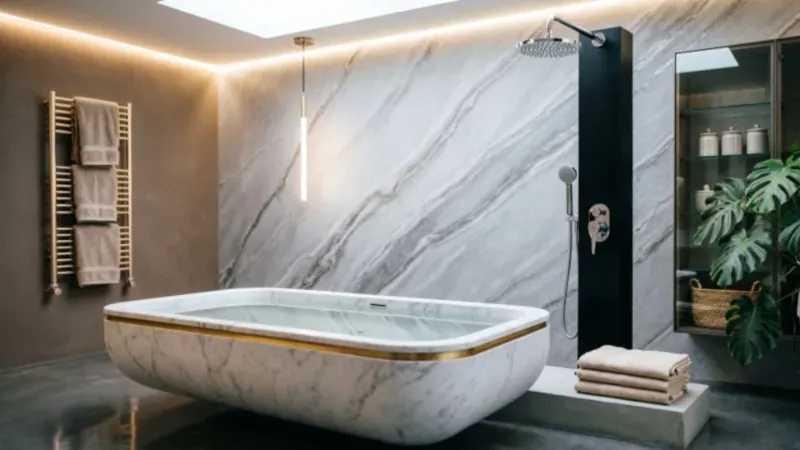
Most bathrooms are built for function, not feeling. You wash up, brush your teeth, and move on with your day, never once pausing to enjoy the room around you. That’s the gap between an ordinary bathroom and true luxury bathroom design: one is a chore, the other is an experience.
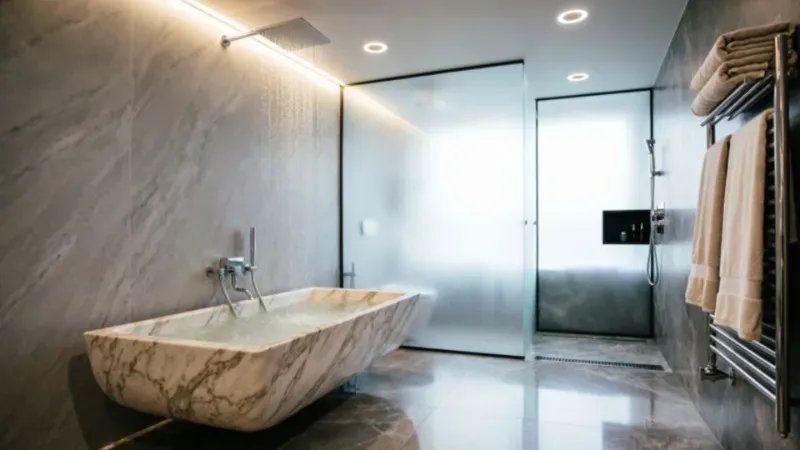
The good news is that luxury bathroom design ideas don’t require a mansion-sized floor plan or an unlimited budget. A freestanding tub, a warm lighting layer, or a well-placed slab of natural stone can shift the entire mood of the room. This guide walks through eight proven luxury bathroom concepts, backed by real design logic, so you can build a space that feels like a private spa every single morning.
Whether you’re planning a full remodel or a smaller refresh, you’ll find style notes and pro tips in every section, plus five advanced sections covering trends, expert strategy, sustainability, future innovation, and the mistakes homeowners make most often when chasing luxury bathroom design.
Freestanding Soaking Tubs as the Room’s Centerpiece
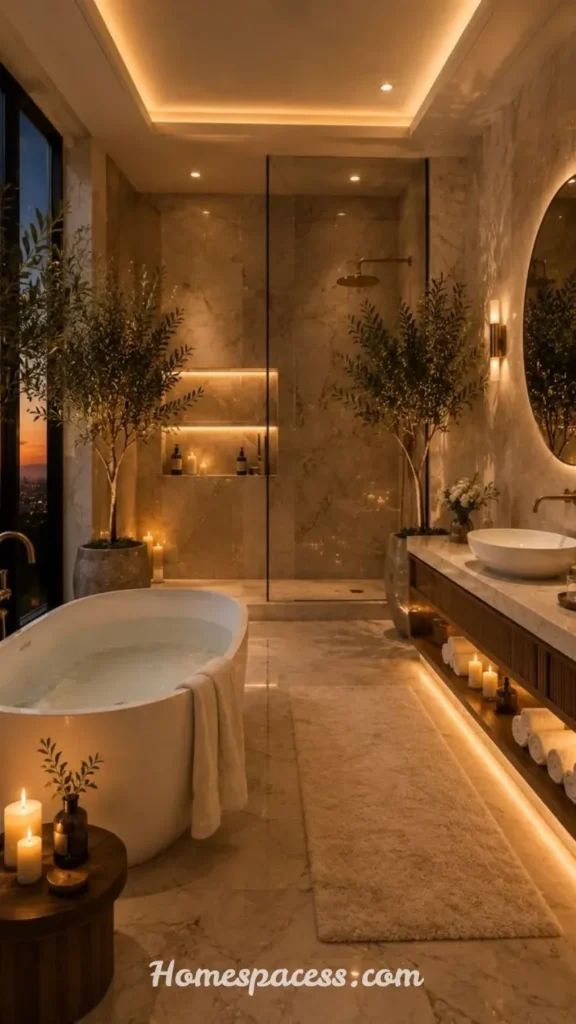
A freestanding tub is still the fastest way to signal luxury the moment someone walks in, making it one of the most timeless Luxury Bathroom Design Ideas. Unlike a built-in tub tucked against a wall, a freestanding piece reads as sculpture. It gives the eye a focal point and makes even a modestly sized room feel considered rather than crowded.
Consider a matte stone-resin tub centered beneath a window, paired with a floor-mounted filler. In a real renovation of a 1990s colonial, swapping a corner jacuzzi for a simple oval freestanding tub instantly modernized the whole bathroom without touching the tile or plumbing layout underneath. This simple upgrade proves that Luxury Bathroom Design Ideas do not always require a complete remodel.
Material matters as much as shape. Cast iron holds heat longest, acrylic is budget-friendly and light, while solid surface stone-resin blends give that heavy, high-end look for a fraction of natural stone’s cost and weight, making them a smart choice for Luxury Bathroom Design Ideas.
Style Note: Pair a freestanding tub with a low-profile floor-mounted faucet in brushed brass or matte black to keep sightlines open and the silhouette uninterrupted.
Pro Tip: Leave at least 24 inches of clearance around the tub on all accessible sides so it feels like a feature, not an obstacle.
See Related Articles: Bathroom Tile Ideas That Transform Any Space (2026 Guide)
Walk-In Rain Showers With Frameless Glass
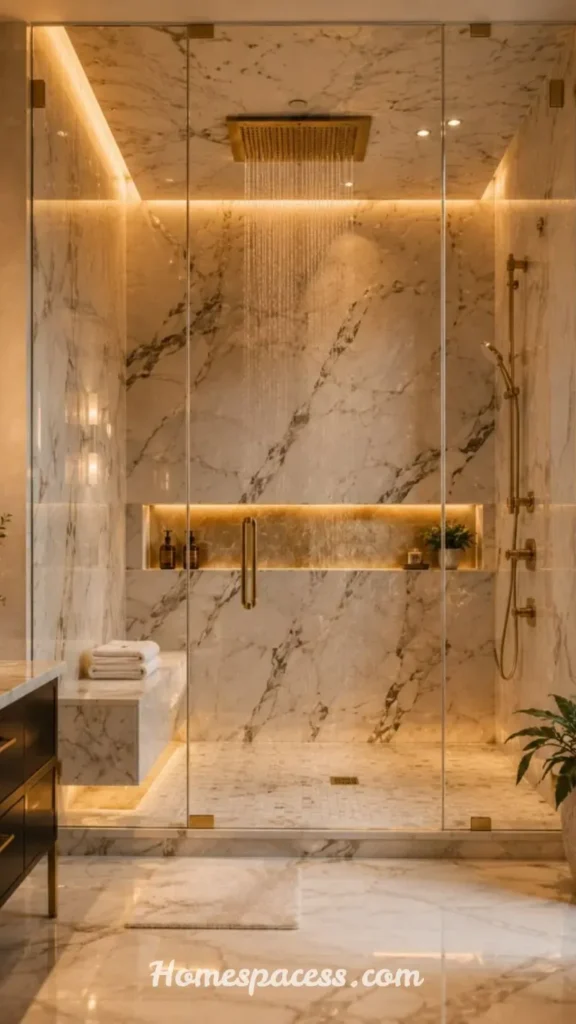
A walk-in shower with frameless glass removes visual clutter and lets natural stone or large-format tile speak for itself. Ditching the door frame and shower curtain track alone can make a small bathroom read 15 to 20 percent larger, simply because sightlines stay unbroken from floor to ceiling.
Rain shower heads, ideally ceiling-mounted, add the sensory payoff. Instead of a hard, directional spray, water falls evenly overhead, mimicking the feel of standing under warm rainfall. Combine this with a linear drain set flush into the floor tile for a seamless, curbless entry.
In wetter climates or households with kids, a secondary handheld wand on a slide bar keeps the rain head purely for relaxation while handling everyday washing separately.
Style Note: Run the same large-format tile from the shower floor onto the main bathroom floor to visually expand the room and reinforce a clean, luxury bathroom feel.
Pro Tip: Ask your installer for low-iron glass; standard glass carries a faint green tint that dulls the crispness of a frameless enclosure over time.
You May Also Like: 29 Bathroom Decor Ideas That Transform Any Space
Natural Stone and Marble-Look Surfaces
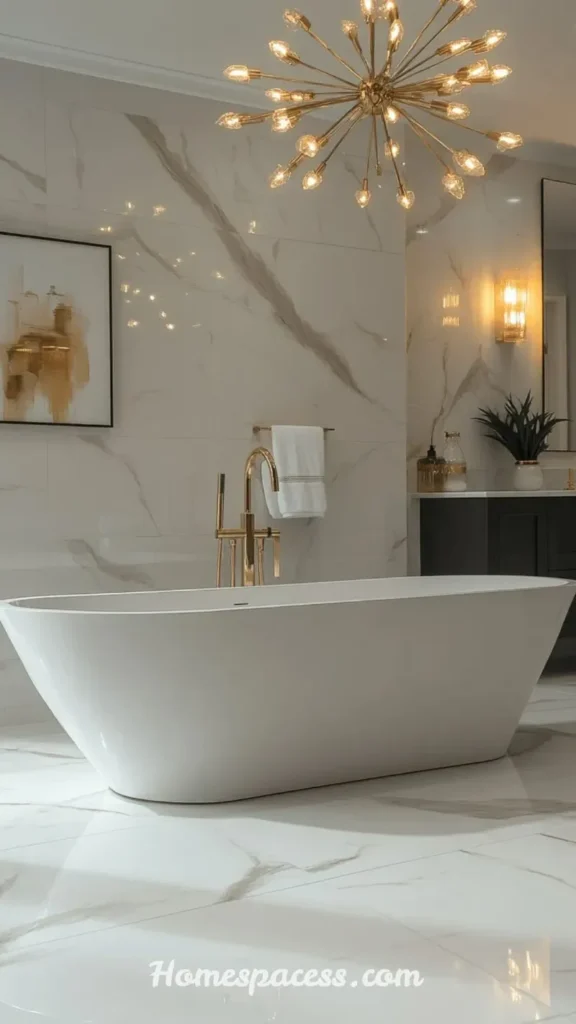
Nothing communicates luxury bathroom design faster than the visual weight of natural stone. Calacatta and Carrara marble remain the benchmark, prized for soft grey veining that photographs beautifully and ages gracefully under normal household use.
Real marble is porous and needs sealing every 12 to 18 months, which puts off some homeowners. Porcelain slabs that replicate marble veining through digital printing have closed that gap significantly, offering a near-identical look with zero sealing and far better stain resistance.
A practical middle ground many designers use: marble on a single feature wall or vanity top, with durable porcelain everywhere else. This keeps the tactile luxury of real stone in the areas people touch and see up close, while protecting the budget elsewhere.
Style Note: Book-matched marble slabs on a shower wall create a mirrored, symmetrical vein pattern that instantly elevates the entire room.
Pro Tip: Order 10 percent extra stone from the same batch and lot number; veining and tone can shift noticeably between quarry batches.
Recommended for You: Guest Half Bathroom Ideas: Stylish Designs to Wow Every Visitor
Layered, Spa-Grade Lighting Design
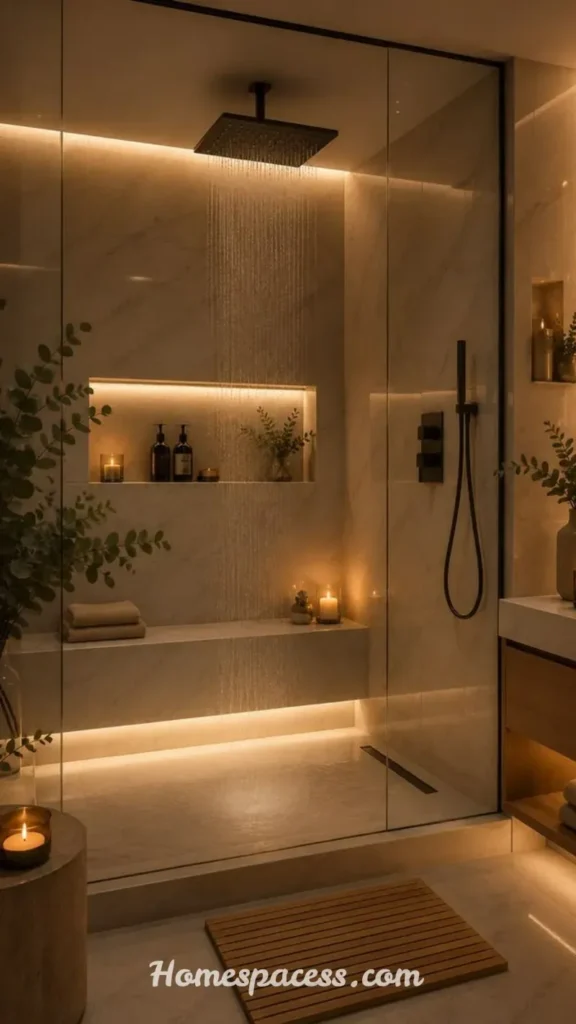
Overhead lighting alone flattens a room and casts harsh shadows across faces at the vanity mirror. Real luxury bathroom design uses three layers: ambient ceiling light, task lighting at the mirror, and low-level accent lighting near the floor or tub.
Vertical sconces flanking the mirror, set at eye level, eliminate the shadowing that downlights cause. Warm dimmable LEDs, in the 2700K to 3000K range, keep the room feeling like a hotel suite rather than a clinical exam room.
A small strip of accent lighting under a floating vanity or along a tub’s base does double duty: it’s a practical night-light and a subtle luxury cue that most competing guides skip entirely.
Style Note: Choose brushed brass or aged bronze fixtures to add warmth against cool stone and glass surfaces.
Pro Tip: Put every lighting layer on its own dimmer switch or smart control so morning routines and evening soaks can each have their own mood.
More on This Topic: Colorful Bathroom Ideas to Transform Your Space with Style in 2026
Heated Floors and Towel Warmers
Heated floors are one of the highest-satisfaction upgrades in any luxury bathroom remodel, and homeowners consistently rank them above flashier finishes in post-renovation surveys. Electric radiant mats sit under tile and warm the surface to a comfortable 80 to 85 degrees Fahrenheit within 30 minutes of a scheduled start time.
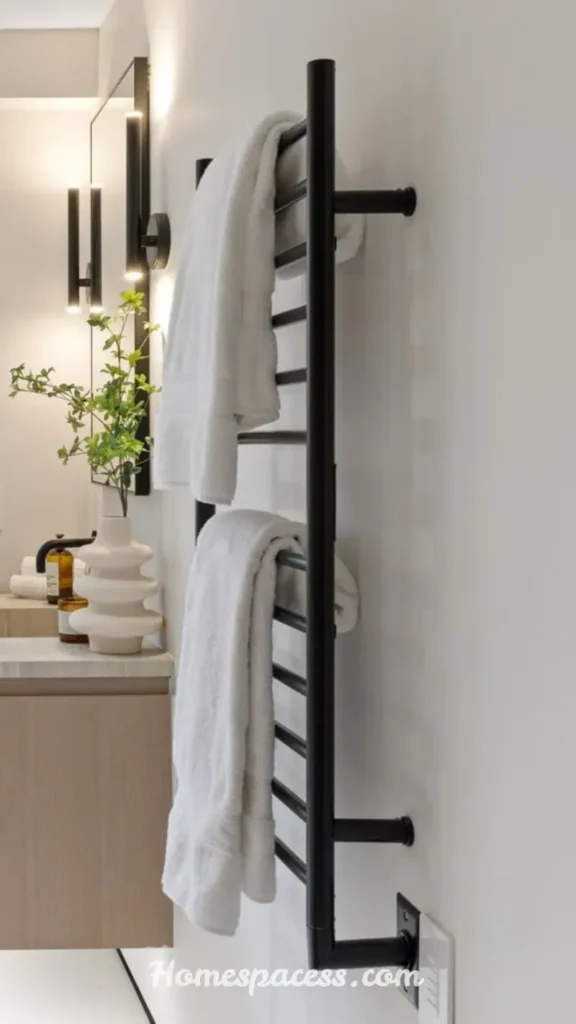
A heated towel bar, either hydronic or electric, complements the floor system and solves the age-old problem of cold, damp towels after a shower. In colder climates, this pairing alone can change how a bathroom feels for eight months of the year.
Programmable thermostats let you schedule warmth for exactly when it’s needed, morning and evening, without running the system all day, which keeps energy costs reasonable.
Style Note: Match the towel warmer’s finish to your faucet hardware so the metals read as an intentional set rather than mismatched pieces.
Pro Tip: Install a floor sensor thermostat, not just an air sensor, so the system reads actual tile temperature and avoids overheating.
Explore More: Bathroom Towel Hanging Ideas to Transform Your Space
Statement Vanities With Integrated Storage
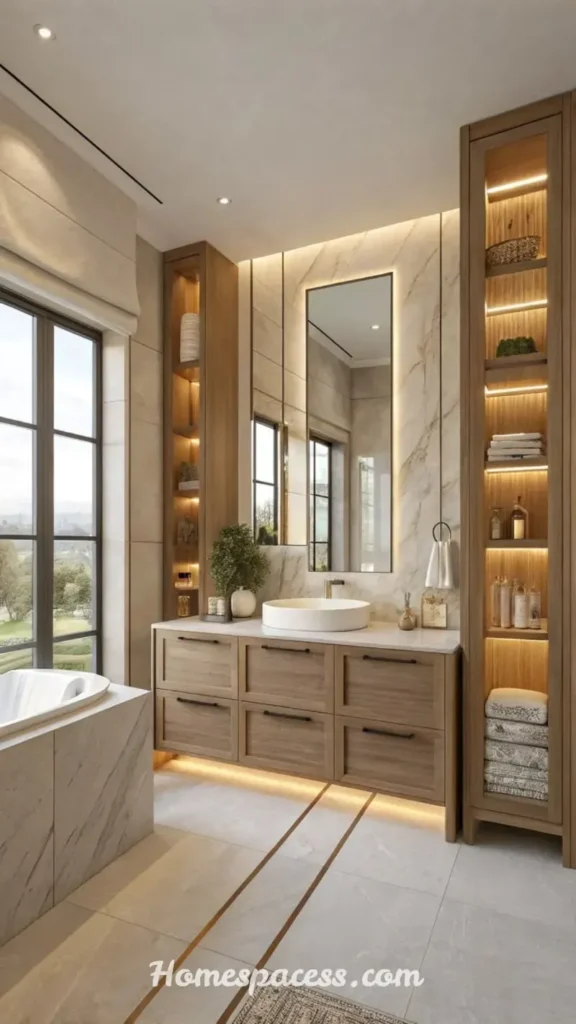
A luxury bathroom vanity balances two things people rarely get right at once: striking design and genuinely useful storage. Floating vanities with push-to-open drawers keep countertops clear and make cleaning the floor beneath far easier.
Double vanities with a shared knee-space in the middle create a furniture-like look, especially when finished in a rich walnut or dark green lacquer instead of standard white. Undermount sinks paired with a single-slab stone top keep the surface easy to wipe clean.
Inside the drawers, dedicated dividers for hair tools, skincare, and daily essentials matter more than square footage. These smart storage solutions are a key part of Luxury Bathroom Design Ideas, and a well-organized 60-inch vanity often outperforms a poorly planned 72-inch one for daily usability.
Style Note: Choose a furniture-style vanity with tapered legs to add visual lightness in bathrooms with lower ceilings.
Pro Tip: Add a built-in outlet inside one drawer for hair tools, so cords stay hidden and the countertop stays clutter-free.
Smart Technology Integration
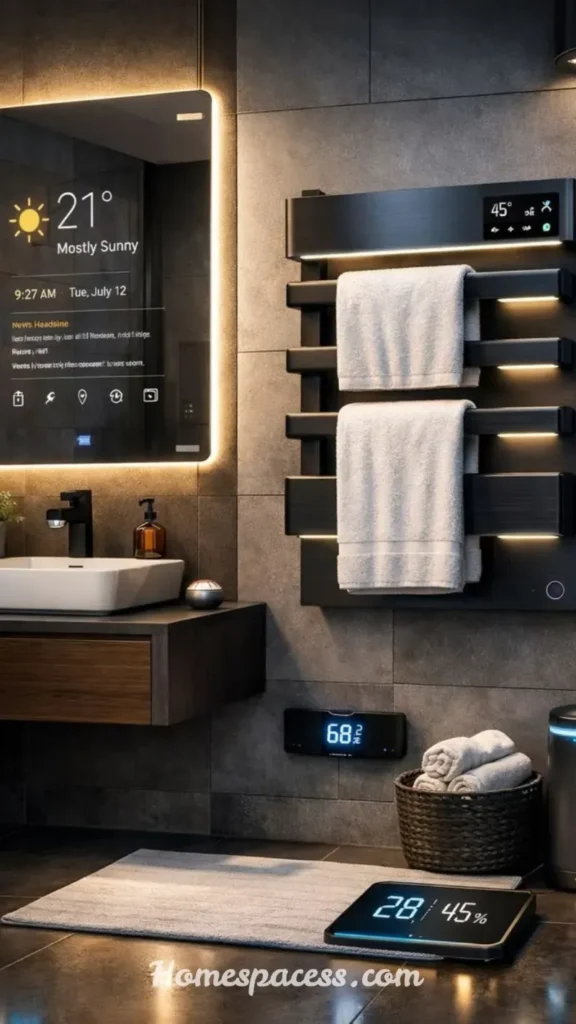
Smart bathroom technology has moved from novelty to expectation in high-end renovations. Digital shower valves let you save preset water temperatures and flow patterns for each household member, starting the water remotely before you even step in.
Smart mirrors with built-in anti-fog heating, adjustable lighting temperature, and voice-controlled displays are now common in premium primary suites. Some models sync with home assistants to show weather or the day’s schedule while you get ready.
Heated, self-cleaning smart toilets round out the category, using bidet functions and UV sanitizing cycles that reduce daily cleaning time. These upgrades cost more upfront but consistently rank among the features buyers mention first during home tours.
Style Note: Keep smart controls recessed or built into mirrors and panels rather than mounted as separate gadgets, so the tech disappears into the design.
Pro Tip: Confirm Wi-Fi signal strength in the bathroom before installing smart fixtures; thick tile and stone walls commonly weaken connectivity.
Biophilic Touches: Greenery, Wood, and Natural Light
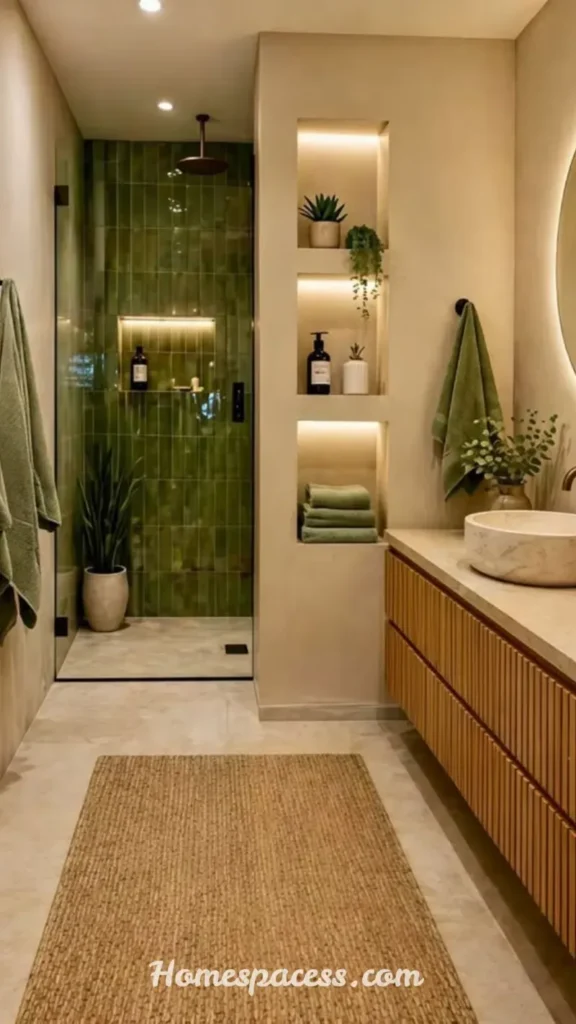
Biophilic design, bringing natural materials and plant life indoors, softens the hard surfaces that dominate most bathrooms. Teak shower mats, wood-look tile ceilings, and live plants like pothos or ferns thrive in the humidity and add texture that stone and glass alone can’t provide.
A skylight or an enlarged window above the tub changes the entire experience of soaking, especially in primary suites where privacy allows for more glazing. Natural light also makes accurate skincare and makeup application far easier than most artificial lighting setups.
In a recent case study from a coastal remodel, adding a single operable skylight over the shower cut the exhaust fan’s daily runtime nearly in half, since fresh air and daylight did much of the work moisture control usually requires.
Style Note: Group two or three plant varieties at different heights near a window to create depth without overwhelming a small footprint.
Pro Tip: Choose humidity-tolerant wood species like teak or thermally modified ash for any wood details near the shower or tub.
Conclusion
Great luxury bathroom design isn’t about one expensive feature. It’s the layering of a striking tub, warm lighting, natural materials, and smart, thoughtful storage that turns a functional room into a daily retreat.
Start with one or two ideas from this guide, a heated floor here, a statement vanity there, and build outward as budget allows. The most successful luxury bathrooms are the ones planned with both beauty and daily livability in mind.
Advanced Insights & Expert Perspective
Luxury Bathroom Design Trends for 2026 and Beyond
2026 bathroom trends are moving away from the stark, all-white spa look that dominated the last decade. Warmer palettes, think sage green, terracotta, and deep charcoal, are replacing cool greys as homeowners look for spaces that feel personal rather than clinical.
Curved edges are also gaining ground over sharp rectangular vanities and mirrors, softening the geometry of the room. Expect to see more oval mirrors, rounded tub shapes, and arched niches through 2026 and into 2027 as this shift continues.
Wellness-driven features, steam showers, chromotherapy lighting, and dedicated meditation corners, are no longer limited to five-star hotels. Designers increasingly treat this kind of space as a wellness room first and a utility space second, a shift that’s likely to define the category for years to come.
Expert Insights: Getting the Most From Your Renovation Budget
Experienced designers consistently point to one pattern: homeowners overspend on finishes and underspend on infrastructure. Before choosing tile or fixtures, confirm your plumbing rough-in and electrical capacity can support a rain shower, heated floors, and smart fixtures together, since retrofitting later costs far more than planning upfront.
A practical sequencing tip from contractors: lock in your tub and shower fixtures before finalizing tile layout. Fixture dimensions vary by a few inches between brands, and tile cut around the wrong measurements is one of the most common, and expensive, remodeling mistakes.
For a strong return without a full gut renovation, prioritize lighting layers and a statement vanity first. Both changes cost a fraction of a full remodel yet do more to shift the room’s feel toward genuine luxury bathroom design than almost any other single upgrade.
Sustainability and Long-Term Value in Luxury Bathrooms
Sustainable luxury is no longer a contradiction in bathroom design. WaterSense-certified rain shower heads now deliver the same immersive feel as older, water-heavy models while using up to 20 percent less water per minute, which lowers utility bills without sacrificing the experience.
Durable materials pay off over the long run. A well-sealed natural stone or porcelain surface installed correctly can outlast three or four cycles of trend-driven laminate finishes, meaning the true cost per year often favors the higher upfront investment.
From a resale perspective, a well-executed remodel of this kind consistently ranks among the top value-adding renovations in real estate reports, often recovering 60 to 70 percent of project cost at resale while making the home significantly more competitive on the market in the meantime.
Future Predictions: Where Luxury Bathroom Design Is Headed
Water recycling systems, once limited to commercial buildings, are beginning to appear in high-end residential bathrooms. Greywater capture from sinks and showers, filtered and reused for toilet flushing, is likely to move from niche to mainstream over the next several years as water costs rise.
Personalization through sensors is another emerging direction. Expect showers that automatically adjust temperature and pressure based on a recognized household member, and mirrors that track basic wellness metrics passively, without wearable devices, as this technology matures and becomes more affordable.
Modular, prefabricated luxury bathroom pods, built off-site with stone, tile, and fixtures pre-installed, are also gaining traction for faster renovation timelines. This approach could reshape how quickly homeowners can achieve luxury bathroom design without the months-long disruption of a traditional remodel.
Common Mistakes to Avoid in Luxury Bathroom Design
The most frequent mistake is chasing individual trendy pieces instead of a cohesive plan. A striking freestanding tub next to mismatched hardware finishes and inconsistent lighting temperatures reads as disjointed, not luxurious, no matter how much any single item cost.
Poor ventilation is another overlooked factor. Even the best natural stone and wood finishes will suffer without an exhaust fan rated correctly for the room’s square footage, leading to mold, warped wood, and dulled stone sealants within a year or two.
Finally, many homeowners underestimate storage needs in pursuit of an open, minimalist look. A beautiful bathroom that leaves toiletries cluttered on the counter within weeks fails its purpose. Planning enclosed storage before finalizing the aesthetic keeps the space both stunning and genuinely livable.

Team Home Spacess shares simple, practical design ideas that work for real families. The team focuses on cozy décor, soft colors, and natural textures that make a space feel truly lived-in. From everyday decorating tips to creative home projects, Team Home Spacess is dedicated to helping readers create warm, comfortable, and inviting spaces with a fresh and personal touch.