

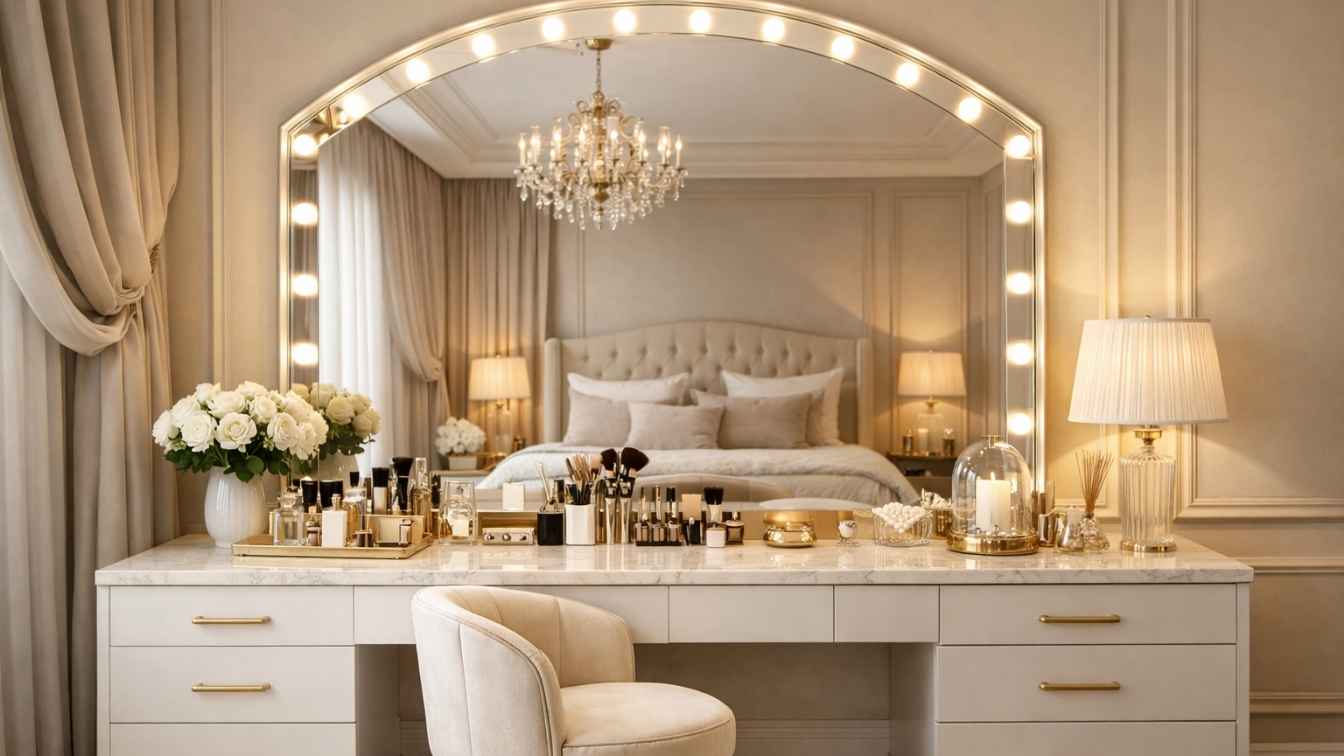
Your dressing table is more than just a piece of furniture it is the command center of your morning ritual and the quiet sanctuary where you prepare to face the world. Whether you have a sprawling bedroom suite or a compact studio apartment, the right dressing table idea can redefine how you feel every single day.
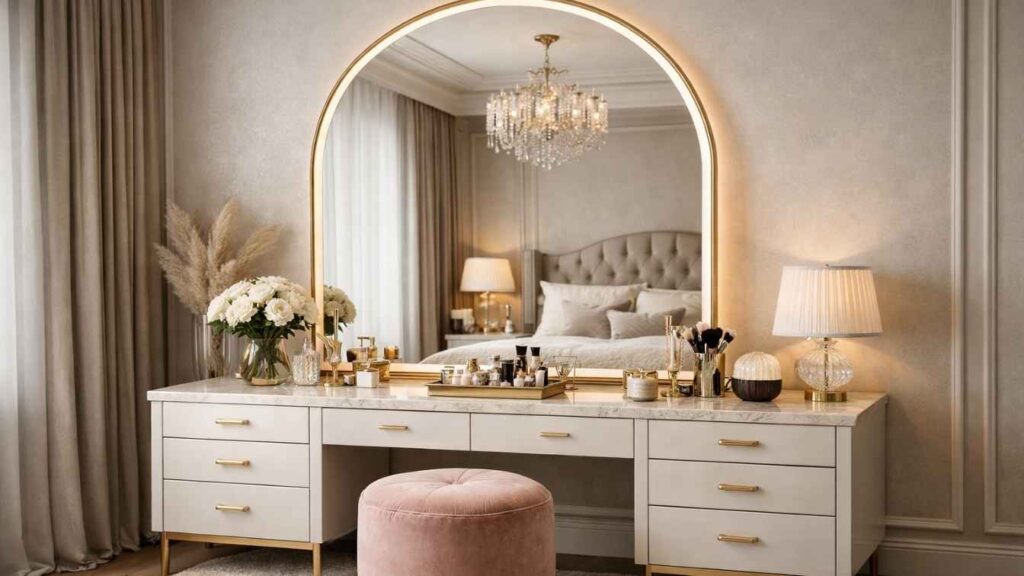
With the global home décor market projected to surpass $838 billion by 2027, the demand for personalized, beautiful vanity spaces has never been higher. Whether you are drawn to the stripped-back elegance of Japandi design, the theatrical glamour of a Hollywood vanity, or the resourceful creativity of a DIY upcycled build, this guide has something actionable for you. Each idea comes with practical insights, mini-scenarios, and pro-level design tips you can implement regardless of budget or skill level.
What separates a forgettable vanity from one you genuinely love comes down to three things: function, light, and personality. Most people default to whatever fits their budget and floor plan. But the most inspiring dressing table setups are those that are intentionally designed where every element, from the mirror’s frame to the drawer pulls, tells a story. In this guide, we go beyond generic advice to give you 25 deeply considered dressing table ideas drawn from real interior design practice, emerging trends, and sustainability thinking.
Space Saver
Minimalist Floating Vanity
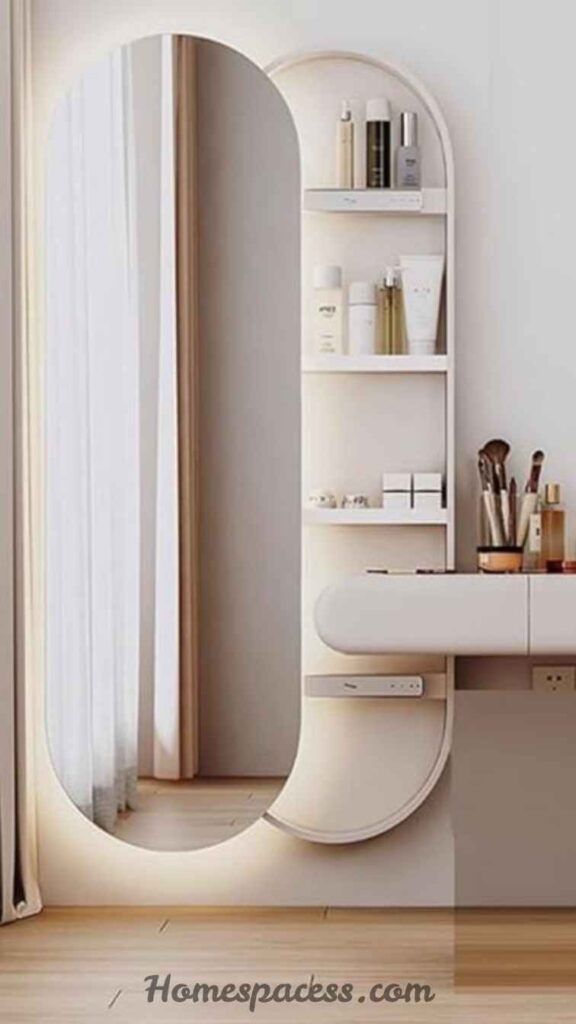
A wall-mounted floating dressing table is one of the smartest design moves you can make in a modern bedroom. By eliminating visible legs, you create an instant illusion of more floor space a critical advantage in bedrooms under 150 sq ft. The floating design also makes cleaning effortless and keeps the room looking airier than a freestanding table ever could.
The key to making a floating vanity feel luxurious rather than austere is in the material choice and hardware. Opt for a thick slab of white oak, walnut, or matte lacquer board mounted at seated height (typically 28–30 inches). Add a single deep drawer with soft-close runners for a tactile, premium feel. Pair with a round frameless mirror to soften the horizontal lines of the shelf.
✦ Pro Tip
Install a concealed LED strip behind or beneath the floating surface. The indirect warm glow creates a halo effect at night and delivers functional task lighting during the day without cluttering your mirror area.
MINI SCENARIO:
Imagine a 10×12 ft bedroom where a bulky traditional vanity eats into the walking space. Replace it with a 90cm floating walnut shelf, a round LED-backlit mirror, and a sleek stool that tucks underneath suddenly the room feels twice as open
Must Read: 27 Library Room Ideas to Transform Any Space Into a Dream Home Library
Statement Piece
Hollywood Glam Mirror Setup
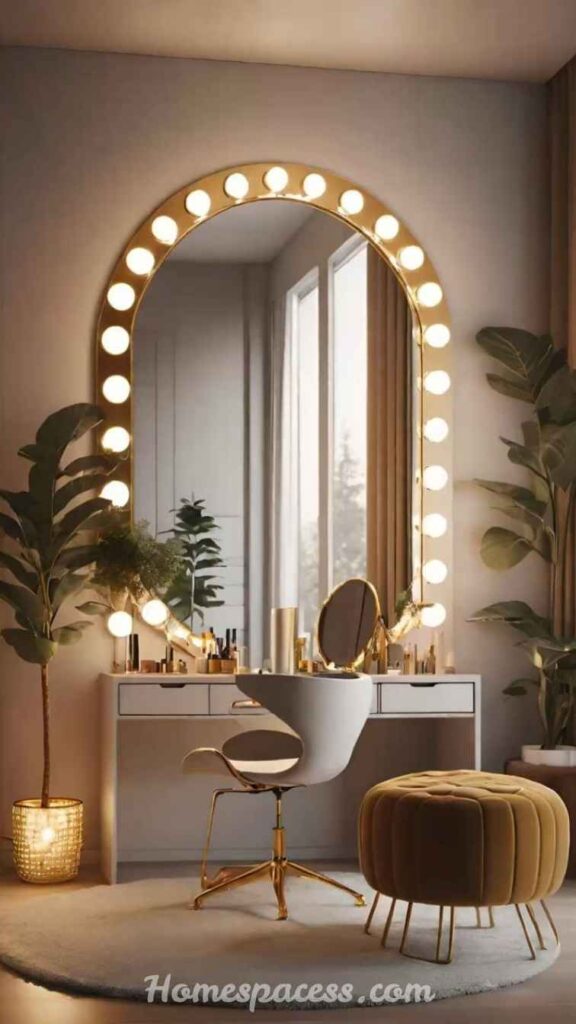
The Hollywood vanity a wide mirror ringed with exposed globe bulbs has migrated from movie star dressing rooms to mainstream bedrooms, and for good reason. It delivers the most flattering, even illumination of any vanity lighting setup. Unlike overhead lighting that casts downward shadows on your face, bulb-surround mirrors mimic natural studio light from multiple angles simultaneously.
When building a Hollywood-style dressing table setup, resist the urge to go bigger than your wall can handle. A mirror spanning 80–100% of your table width looks intentional; anything wider creates a theatrical imbalance. Choose warm-tone bulbs (2700–3000K) rather than cool-white, which makes skin tones appear grey. The table itself should be a simple neutral surface cream, white, or soft grey so the mirror remains the star of the show.
✦ Design Insight
The latest Hollywood mirror designs feature dimmable smart bulbs controlled via app or touch panel. This lets you simulate “morning light,” “evening light,” or “office light” to check your makeup under different conditions before leaving home a genuine functional upgrade, not just aesthetics
Don’t Miss: 20 Stunning Flower Garden Ideas to Transform Your Outdoor Space
Compact
Small Space Corner Dressing Table
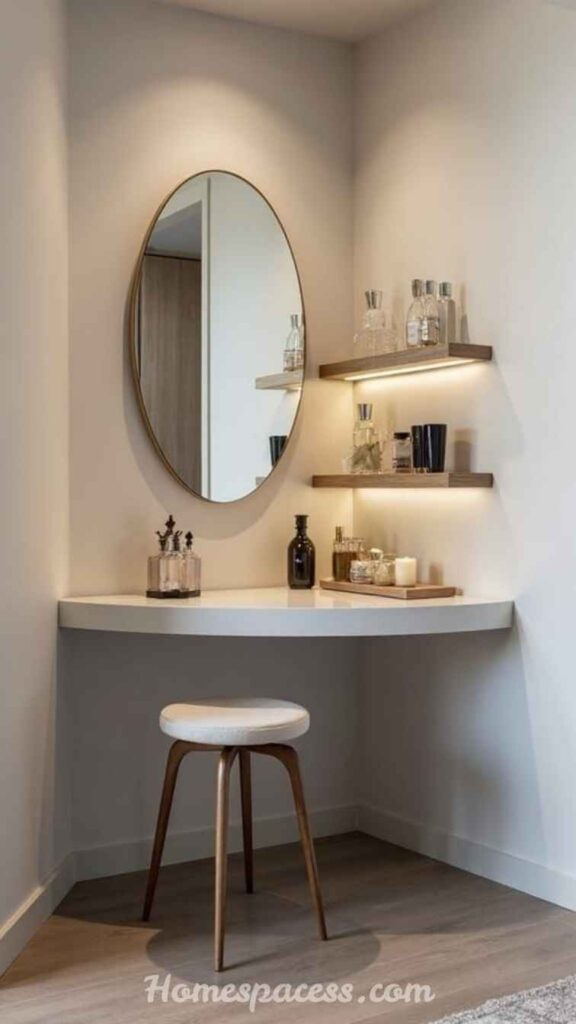
Corner dressing tables are one of the most underused solutions in bedroom design. The corner is typically dead space in most rooms a triangle that collects clutter or remains awkwardly empty. A purpose-built corner vanity table, usually triangular or L-shaped, reclaims this area entirely. You gain a functional beauty station without sacrificing a single inch of prime wall space.
The trick to a successful corner setup is angling the mirror correctly. A standard flat mirror placed flat against one wall will be hard to use from a centred seating position. Instead, consider a trifold mirror, a pivoting wall-mounted design, or two mirrors meeting at 90 degrees in the corner itself. For storage, use vertical space with a slender tower shelf or a pegboard on the adjacent wall rather than deep drawers.
✦ Pro Tip
Measure your corner carefully before purchasing. Standard corner desks often have a “dead zone” at the apex that is too deep to reach comfortably. Custom-cut surfaces at 70–80cm depth on each arm and a 45-degree cut at the centre are far more user-friendly.
Read More: BBQ Patio Ideas That Transform Your Outdoor Space
Timeless
Vintage Antique Vanity Revival
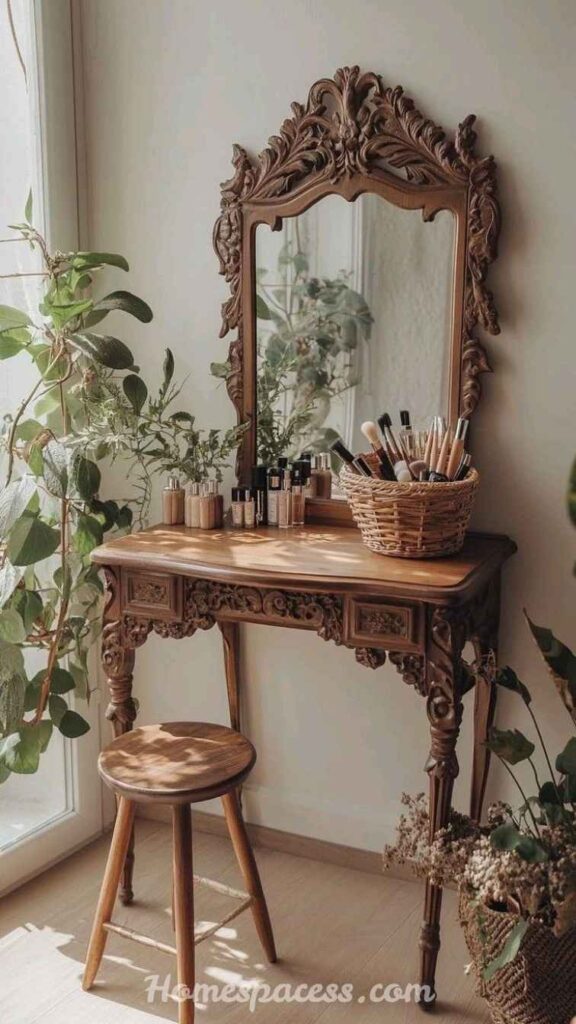
Few things in interior design carry the warmth and character of a genuinely antique dressing table. Victorian kidney-shaped vanities, 1950s mid-century low dressers, and early 20th-century French dressing tables with triple mirrors are among the most sought-after finds at estate sales and antique markets. The beauty of these pieces is their built-in patina the marks of time that no factory can replicate.
Reviving an antique dressing table does not mean leaving it untouched. The most successful vintage vanity setups blend the old frame with updated accessories: new drawer liners in a contrasting color, modern acrylic or glass organizers on top, and contemporary lighting that complements rather than fights the vintage aesthetic. A sleek contemporary bench or lucite stool paired with an ornate antique table creates a compelling tension that feels curated rather than nostalgic.
✦ Design Insight
When refinishing an antique vanity, preserve the original hardware if at all possible. Brass ring pulls, ceramic knobs, and Art Nouveau drawer handles are increasingly hard to source and add significant resale and aesthetic value to the piece.
Don’t Skip: 26 Media Wall Ideas That Transform Any Living Space in 2026
Hygge Living
Scandinavian Simplicity Design
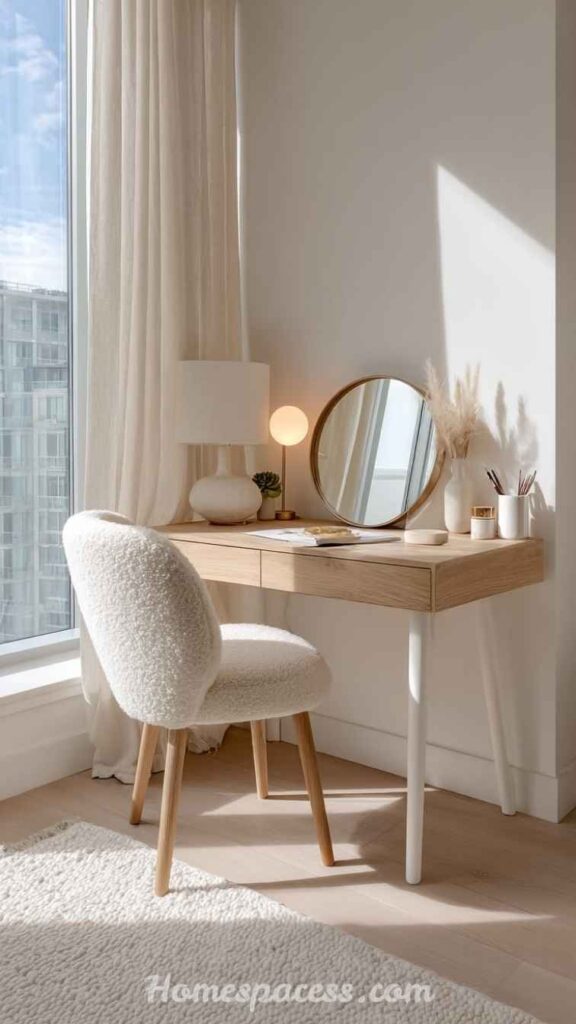
Scandinavian-inspired dressing tables are built around the principle that beauty lies in restraint. Think pale birch or ash wood, clean straight lines, minimal hardware, and a deliberate absence of clutter. The Scandi vanity is not sparse for the sake of being sparse it is intentionally edited so that every object in the space earns its place. This philosophy results in a vanity that is genuinely calming to sit at each morning.
Color in a Scandinavian vanity setup stays within a tightly controlled palette: whites, creams, warm greys, and natural wood tones. A single accent a sage green pottery dish for rings, a terracotta tray for perfumes is all the color you need. Lighting should replicate natural daylight as closely as possible; consider a mirror with integrated daylight-spectrum LEDs rather than warm globe bulbs, which is a distinctly non-Scandi aesthetic choice.
✦ Pro Tip
Introduce texture through materials rather than objects. A linen-covered stool, a wooden-handled brush set, and a boucle rug beneath the table add tactile richness without visual clutter the Scandinavian way of making a space feel warm.
Custom Built
Built-In Alcove Vanity
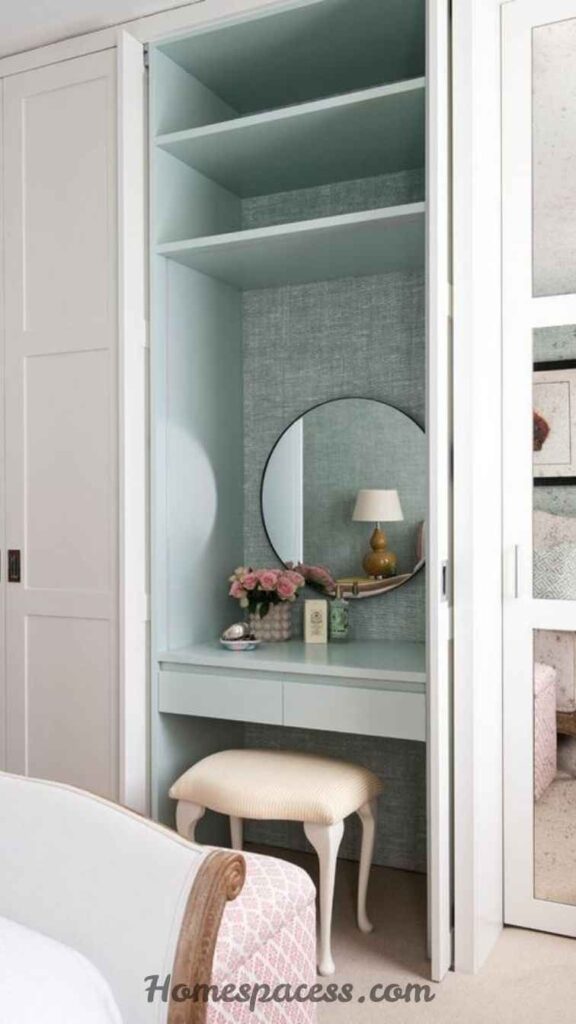
If your bedroom has an alcove, chimney breast recess, or structural niche, you are sitting on one of the most valuable custom vanity opportunities available. A built-in alcove dressing table uses every millimeter of that recessed space and, when done well, looks as though the room was designed with a vanity in mind from the start. It is the difference between furniture in a room and architecture of a room.
The practical advantage of built-in alcove vanities goes beyond looks. The walls of the alcove can carry shelving on either side, concealed lighting in a pelmet above, and deep storage below the surface all without occupying additional floor space. Joinery companies and skilled carpenters can build these bespoke units; alternatively, Ikea hack communities have developed detailed guides using Kallax or Alex units to achieve near-custom results at a fraction of the cost.
MINI SCENARIO:
Victorian terrace bedroom with a chimney breast alcove roughly 90cm wide. A carpenter fits a painted MDF surface at table height, two open shelves above styled with plants and perfumes, and two deep drawers below. Cost: a fraction of a bespoke fitted bedroom result: looks completely custom.
Earthy & Warm
Boho-Chic Rattan Dressing Table
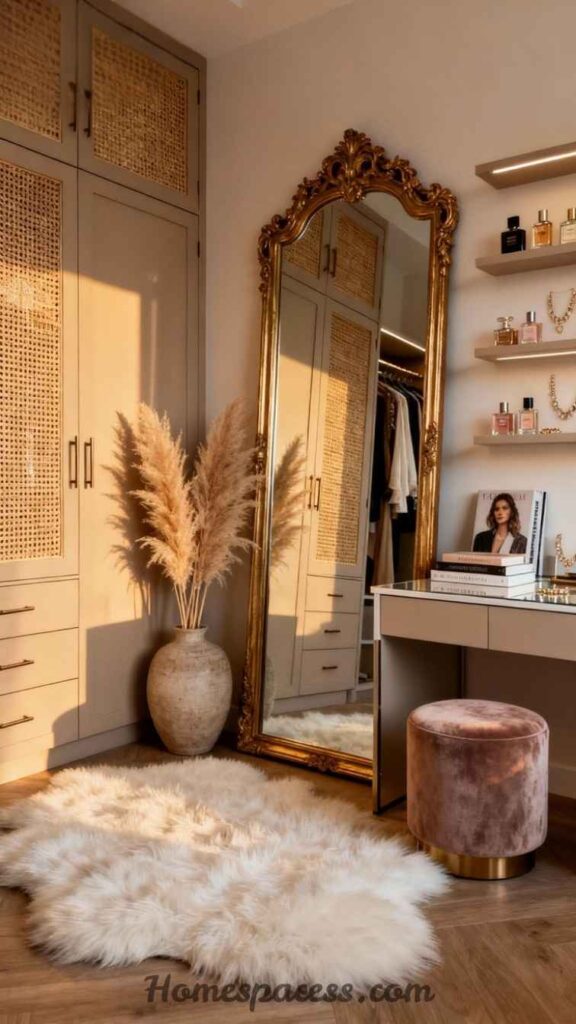
Bohemian dressing table ideas thrive on layering textures, mixing materials, and embracing organized maximalism. A rattan-fronted vanity either a vintage find or a contemporary piece from retailers like Anthropologie or H&M Home immediately introduces warmth and an organic quality that wood alone cannot achieve. Rattan’s open weave also provides subtle ventilation, which is actually useful for storing perfumes and skincare that should not overheat.
Styling a boho dressing table is where the real fun begins. Layer a woven tray with perfume bottles, add a crescent moon or sunburst mirror in natural wood or brass, hang air plants or trailing pothos from a small shelf above, and arrange crystals or vintage pottery alongside your everyday products. The boho aesthetic is the most forgiving of any vanity style because it celebrates imperfection and personal history.
✦ Design Insight
The key that separates styled boho from chaotic clutter is the presence of a unifying color thread. Pick two base colors warm terracotta and cream, or sage and blush and make sure every object on the table connects to at least one of them. This gives a “collected over time” look rather than “random pile.”
Urban Edge
Industrial Pipe & Wood Vanity
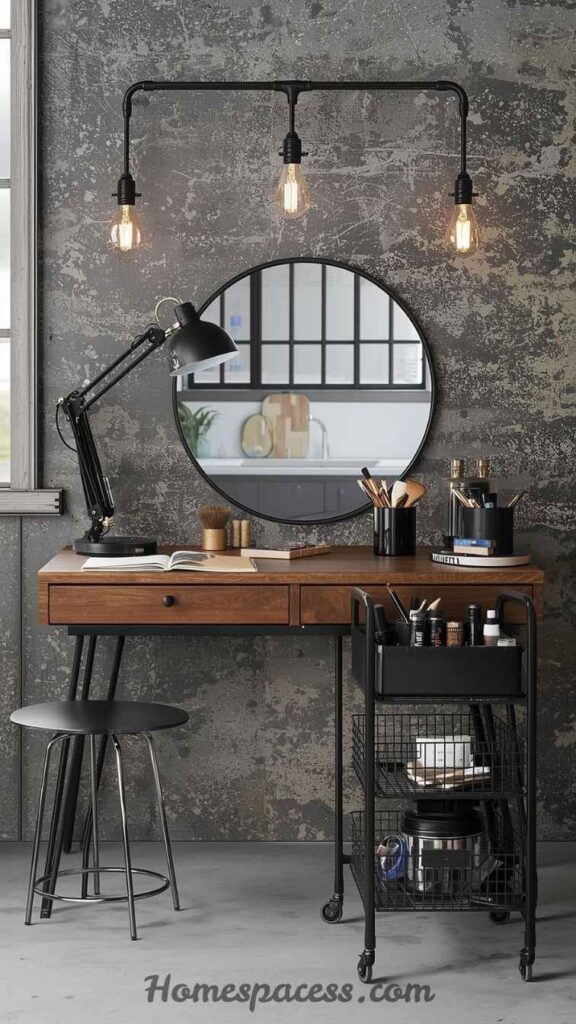
The industrial aesthetic exposed metal pipe frames, reclaimed wood surfaces, and raw concrete or brick backdrops translates surprisingly well into a dressing table context. Far from feeling masculine or cold, an industrial vanity done right feels genuinely artisanal. The raw materials carry visual interest that polished surfaces simply cannot, and the robust construction means these pieces last for decades.
Building an industrial pipe vanity is one of the most achievable DIY projects in this category. Standard plumbing pipe in black or copper, available from hardware stores, can be assembled into a table frame with a reclaimed scaffold board surface. The result is a completely custom piece for a modest investment. For a softer contrast, pair the industrial structure with a round vintage-style mirror with an ornate frame, or add leather drawer pulls and a velvet stool.
✦ Pro Tip
Seal reclaimed wood vanity surfaces with a food-safe or cosmetic-safe sealer (not standard wood varnish) to prevent skincare products and makeup residue from permanently staining the grain. A matte furniture wax also works beautifully and is easy to re-apply.
Walk-In Luxury
Closet-Integrated Dressing Table
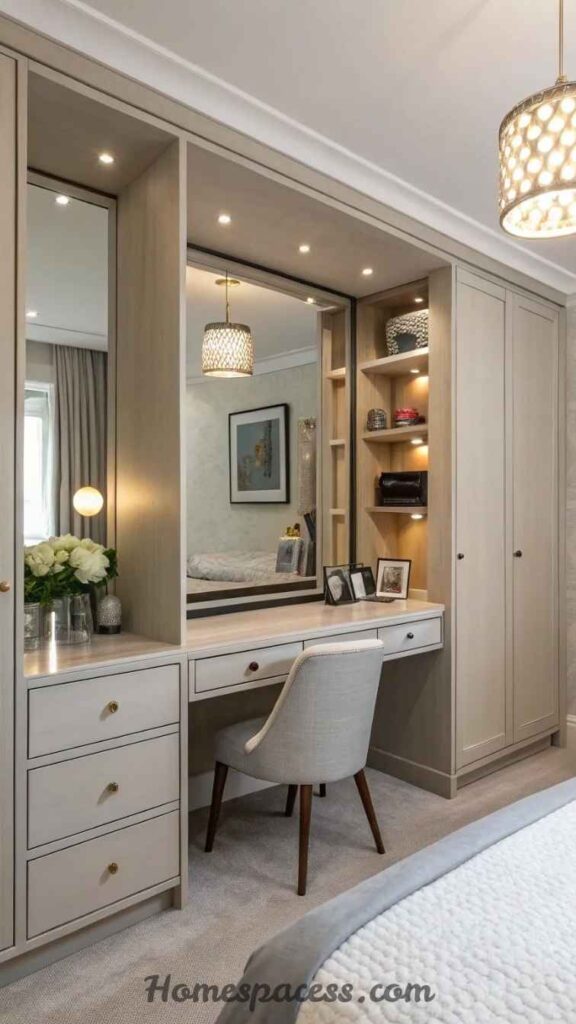
Integrating your dressing table directly into a walk-in wardrobe or fitted wardrobe run is the gold standard of bedroom organization. This design eliminates the bedroom clutter of a standalone vanity and keeps your entire getting-ready process in one dedicated zone. It is the approach used in nearly all high-end master bedroom suites and bespoke fitted bedroom designs, and for good reason: it is both supremely functional and visually seamless.
The most practical closet-integrated vanity sits at the end of a wardrobe run or in a dedicated peninsula section, with a lift-up or pull-out mirror that conceals when not in use. Storage is typically built into the surrounding wardrobe: drawer units for makeup, pull-out shelves for hairdryers and styling tools, and even a dedicated lighting circuit separate from the main bedroom. When you close the wardrobe doors, the entire vanity disappears.
✦ Design Insight
Brief your joiner to install the vanity section at a slightly lower height than the adjacent wardrobe worktop typically 720mm versus 760mm. This seated working height is often overlooked in fitted wardrobe specs and makes the difference between a vanity you love and one that strains your back.
Future Forward
Smart Tech-Integrated Vanity
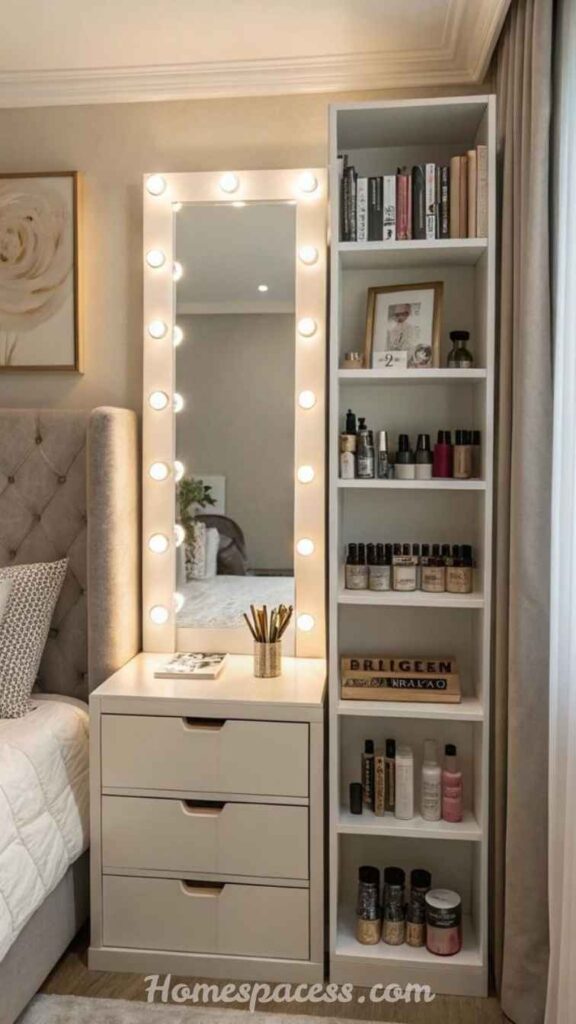
The smart vanity is no longer a concept it is a fully realized product category in 2026. From mirrors with built-in AI skin analysis to Bluetooth-connected speaker systems, voice-controlled lighting, and built-in USB-C and wireless charging pads, technology is being woven into the dressing table in ways that make the getting-ready experience measurably better. The HiMirror and Magnify Cosmetics smart mirrors are just two examples of consumer products now widely available.
A practical smart vanity setup does not require purchasing a purpose-built smart mirror. A standard quality mirror combined with a smart LED lighting strip (Philips Hue or similar), a wireless charging pad integrated into the tabletop, a tablet mount for tutorials or podcasts, and a small Bluetooth speaker achieves 90% of the functionality for a fraction of the cost. The key is to conceal cables from day one use cable management channels and recessed power outlets to maintain a clean surface.
✦ Pro Tip
Have an electrician install a USB-C power outlet flush into your dressing table surface or within the side panel during initial setup. Retrofitting cable management later is far more disruptive. Plan for at least three power points: one for lighting, one for styling tools, one for device charging.
Power User
Makeup Artist Professional Station
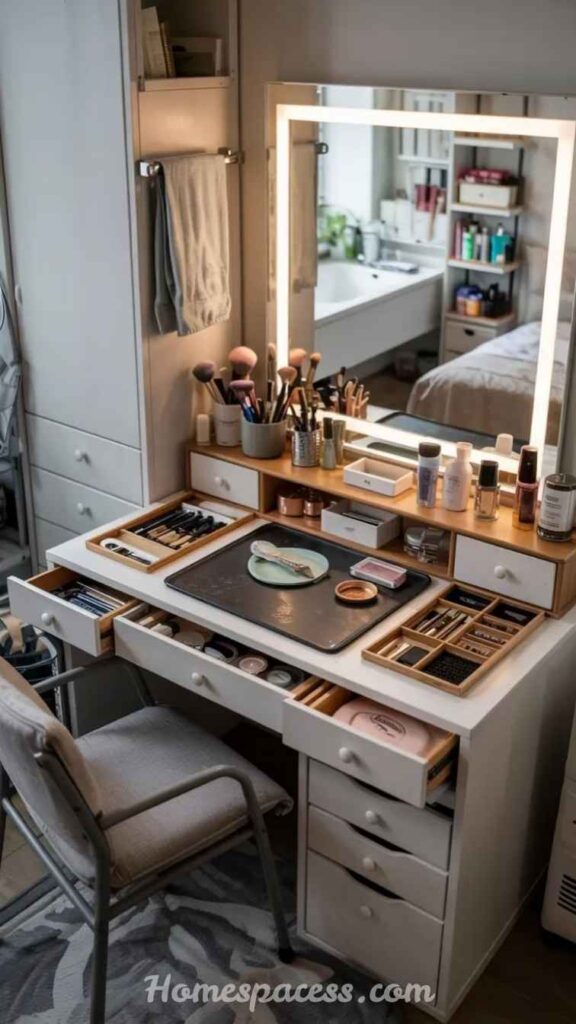
If makeup is a serious part of your life whether professionally or personally your dressing table deserves to reflect that. Professional makeup artist station setups prioritize function absolutely: large working surface, studio-quality lighting with no shadows, extensive storage that keeps all products visible and accessible, and a mirror large enough to see your full face without leaning in. This is not about luxury it is about performance.
The standard professional MUA station uses a Hollywood mirror at minimum 90cm wide, a surface depth of at least 60cm to accommodate product layout, a tiered rotating organizer or acrylic drawer system for categorized storage, and a director’s chair or adjustable-height stool. Many serious makeup artists now add a secondary smaller “detail mirror” with 5–10x magnification on a swing arm beside the main mirror, which is invaluable for liner, lash work, and brow shaping.
MINI SCENARIO:
A semi-professional makeup artist working from home converts a spare bedroom corner into a client-ready MUA station using an IKEA ALEX desk, a custom-built Hollywood mirror, professional strip lighting, and a fully organized acrylic product display. Total investment under £600 versus £3,000+ for a commercial professional unit.
Mindful Design
Japandi Zen Vanity Style
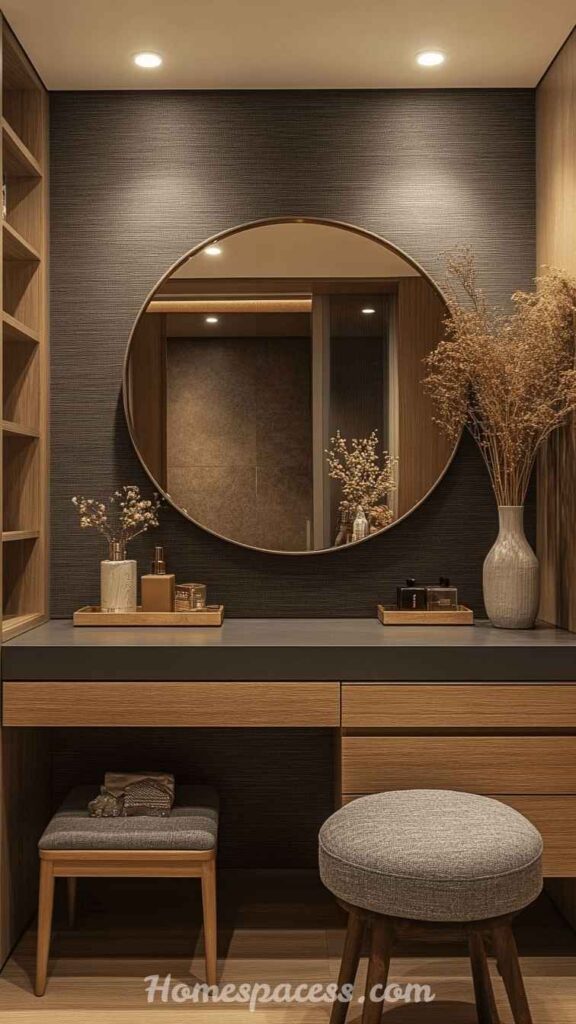
Japandi the design philosophy that merges Japanese wabi-sabi with Scandinavian functionality has become one of the most influential interior aesthetics of the 2020s. Applied to a dressing table, it produces a space of extraordinary calm: natural materials, a near-monochromatic palette, deliberate negative space, and objects chosen for both beauty and purpose. Sitting at a Japandi vanity in the morning can genuinely alter your mental state before the day begins.
A Japandi dressing table typically uses a low-profile table in dark walnut, blackened oak, or natural bamboo. The mirror is often arched, oval, or asymmetrically shaped a subtle acknowledgment of organic form. Decoration is minimal but deeply considered: a single ceramic dish for jewelry, one carefully chosen perfume bottle, a small bonsai or succulent. Every surface element is intentional, and there is no cosmetic product left visible that is not used daily.
✦ Design Insight
The Japandi principle of “ma” meaningful empty space is the hardest concept for Western design sensibilities to embrace. Try leaving 30% of your vanity surface completely empty. That negative space is not wasted; it is visually active and makes the objects around it feel more precious and intentional.
Invisible Luxury
All-Glass Acrylic Dressing Table
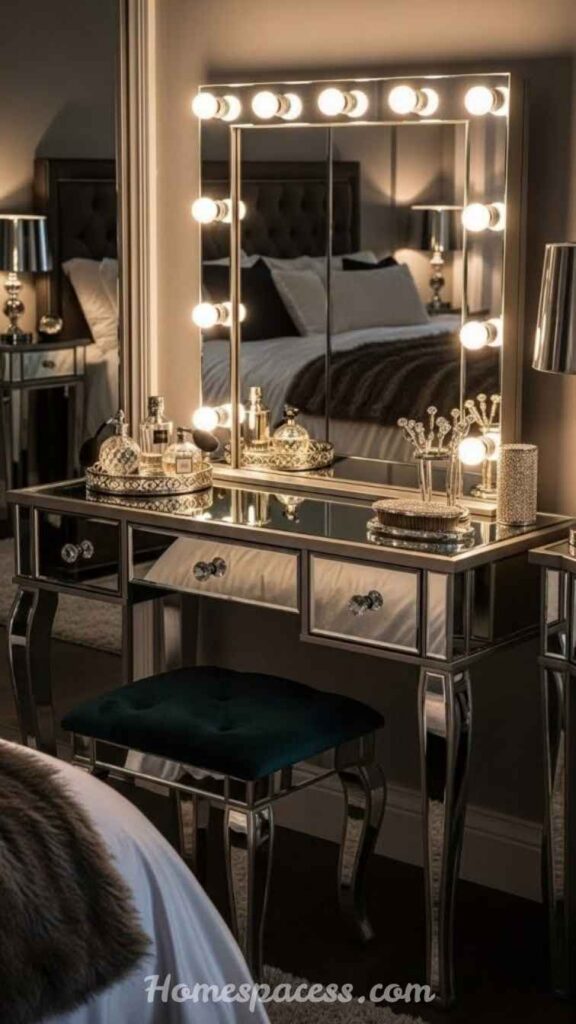
An acrylic or tempered glass dressing table is the definitive solution for small bedrooms that cannot afford to have any piece of furniture “read” visually. Because the structure is nearly transparent, the eye moves through it rather than stopping at it the room feels unbroken, and the vanity appears to float in space rather than occupy it. This is not a compromise design choice; it is a sophisticated one, frequently used in high-end interior photography and luxury hotel suite styling.
The most successful all-acrylic setups use thick cast acrylic (12–15mm) rather than thin injection-moulded pieces, which can crack or yellow over time. The mirror should also embrace the transparent aesthetic a frameless bevelled mirror or a simple acrylic-framed design keeps the lightness consistent. The only styling consideration worth noting: cleaning frequency increases significantly with acrylic and glass surfaces, which show fingerprints and product residue very readily.
✦ Pro Tip
Use a microfibre cloth with 70% isopropyl alcohol spray for daily acrylic cleaning it cuts through makeup residue without leaving streaks or clouding the surface. Never use abrasive cleaners or paper towels, which cause micro-scratches that accumulate into a dull haze over time.
Personal Expression
Eclectic Gallery Wall Vanity
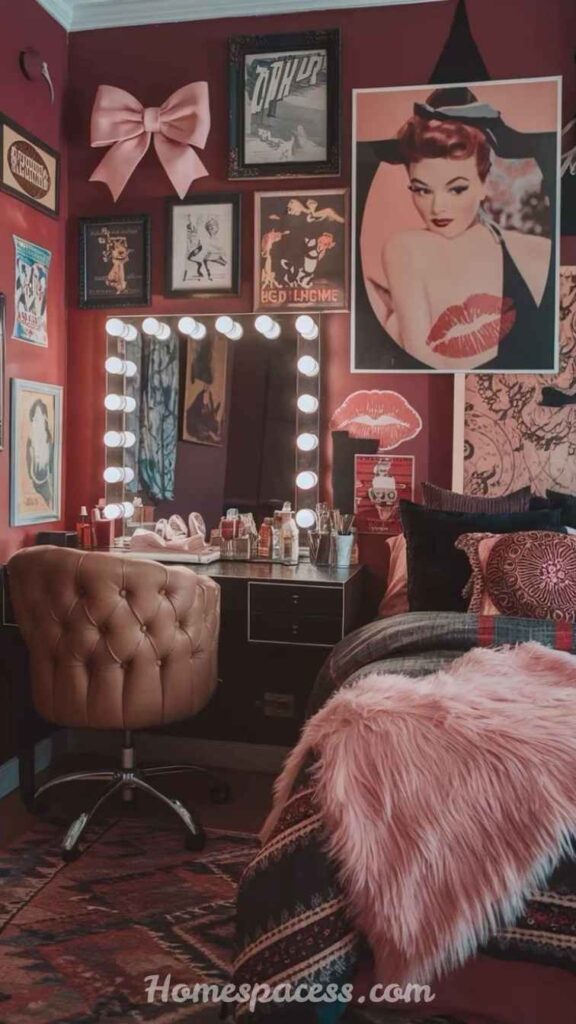
The gallery wall dressing table approach transforms the space around and above your vanity into a curated personal exhibition. Rather than a single mirror, you build a composition of different mirrors round, rectangular, sunburst, leaning interspersed with framed prints, pressed botanicals, vintage fashion photographs, or personal artworks. The effect is deeply personal, visually rich, and unlike any other vanity style.
Planning a gallery wall vanity requires more forethought than it appears. Start by laying all the pieces on the floor in front of the table and arranging them until the composition feels balanced. Take a photo, then transfer to the wall using paper templates before a single nail goes in. The central largest piece should sit at eye level when seated; everything else radiates outward. Ensure at least one reflective surface large enough to actually use for makeup application the gallery concept is stunning but functionality cannot be sacrificed entirely.
MINI SCENARIO:
A renter who cannot damage walls uses adhesive strips rated to 3kg each, arranging seven different vintage mirrors and four framed botanical prints above a simple white IKEA Hemnes table. The gallery creates a focal point so strong that visitors assume it was professionally designed.
Couple-Friendly
Double-Sided His & Hers Vanitya
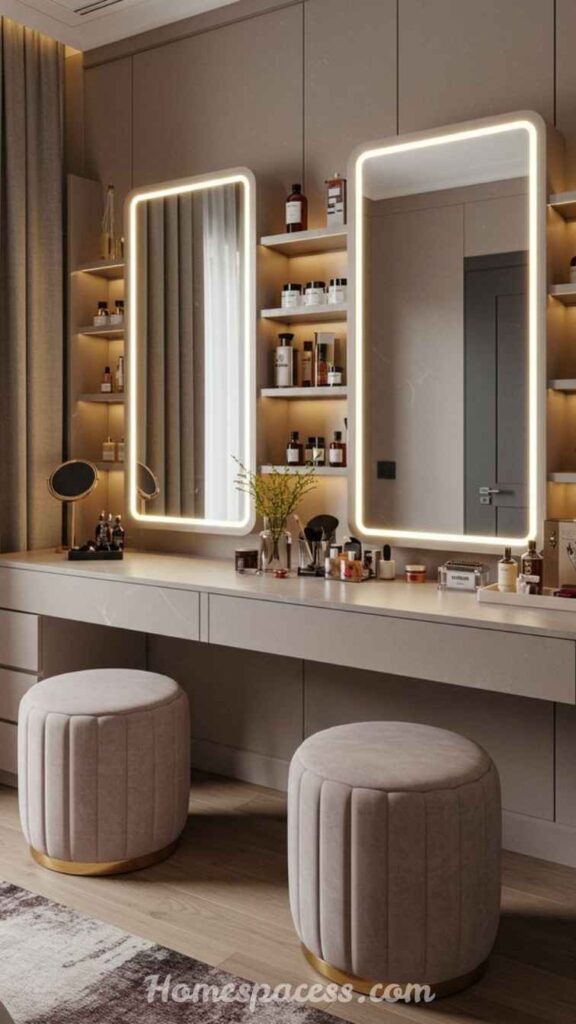
Shared master bedrooms rarely consider the dressing table as a shared resource, but a thoughtfully designed “his and hers” vanity configuration eliminates the morning bottleneck that plagues couples who share a single mirror. The double-sided approach whether a single wide table with designated zones, two tables flanking a central mirror, or two separate stations facing each other is the most sophisticated solution to a genuinely common household frustration.
The most elegant version uses a wide table (typically 160–180cm) with a mirrored back panel or a large wall-mounted mirror that both partners can use simultaneously. Each side has its own drawer allocation, its own power outlet, and its own lighting zone. The division can be subtle different trays, different drawer organizers or clearly delineated by a central divider shelf. The key is that each person’s side feels entirely personal within a cohesive overall design.
✦ Design Insight
In shared vanity design, the biggest mistake is treating both sides identically. One partner may need more surface space; another may need deeper drawers. A functional his and hers setup starts with a candid conversation about each person’s actual getting-ready process before any furniture is purchased.
Grow With Me
Kids & Teen Dressing Table Ideas
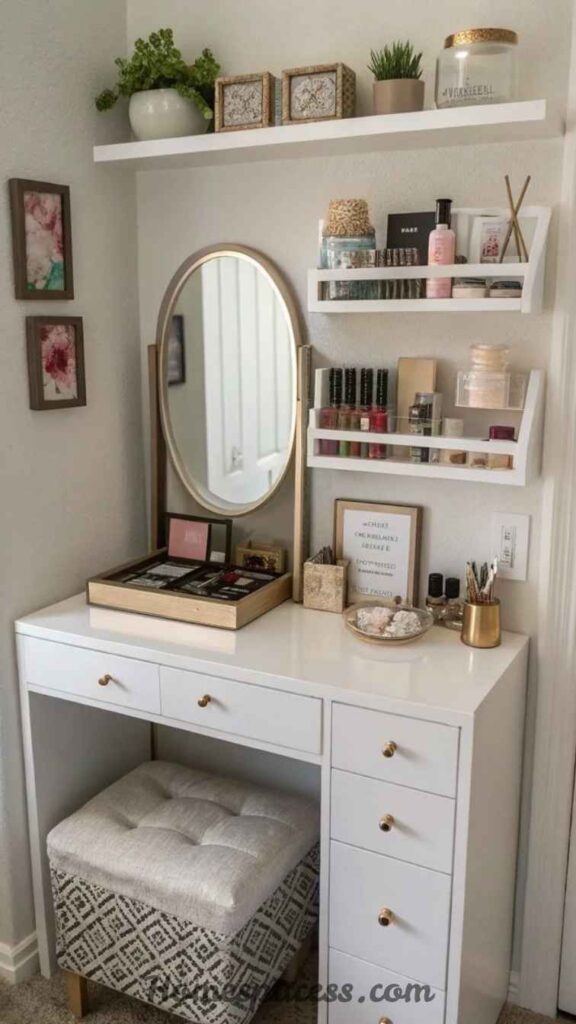
Children’s dressing tables are a category that deserves its own design language one that balances age-appropriate fun with a design that can evolve as the child grows. For younger children (ages 5–10), a low table with a child-height mirror, a fun shaped design, and wipeable surfaces is ideal. For tweens and teens, the priority shifts rapidly toward the kind of aesthetic agency that lets them express their own emerging identity and a vanity is often the first space in a room they feel is truly theirs.
The smartest investment is a height-adjustable or modular vanity that grows with the child. Several flat-pack furniture brands now offer table systems where legs can be extended and mirror mounts can be raised. For teens, the Hollywood-mirror aesthetic consistently ranks as the most desired, followed by the gallery wall approach. The golden rule for any child’s vanity: invest in storage that is genuinely easy for them to use and return to, or the surface will become permanently cluttered.
✦ Pro Tip
For a child’s vanity, use a pegboard or corkboard behind the table instead of a fixed mirror to start. This gives them a surface they can rearrange, pin to, and evolve seasonally and the mirror can be added later as the skincare and makeup stage arrives.
Opulent
Luxury Marble & Brass Vanity
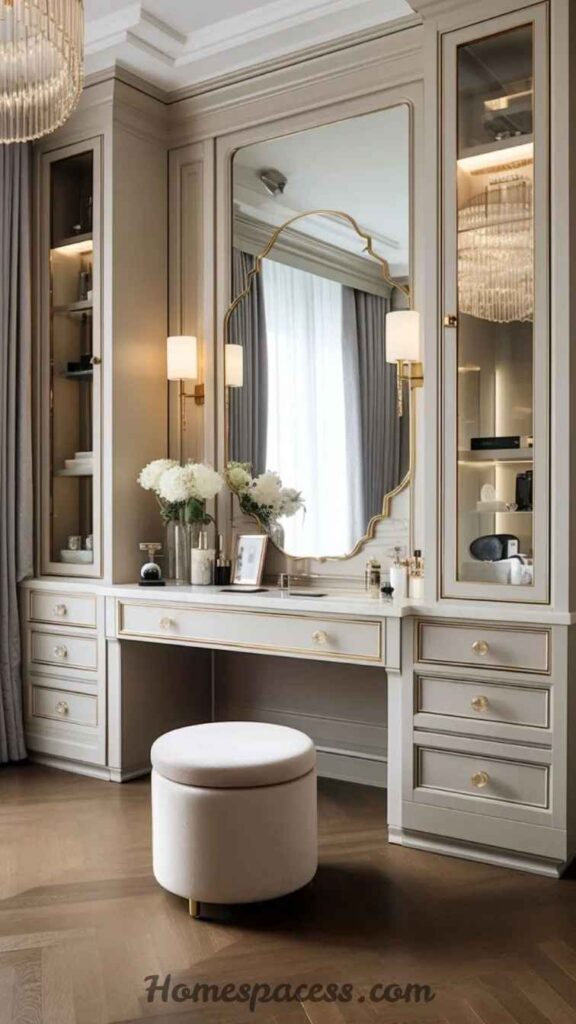
Nothing communicates investment and permanence in bedroom design quite like a marble vanity surface paired with solid brass hardware. This combination cool stone against warm metal is the material hallmark of genuine luxury. Hotels like The Connaught, Claridge’s, and Four Seasons all use variations of this material pairing in their suites for exactly this reason. In a home bedroom, even a smaller marble-topped dressing table reads as a definitive statement of quality and considered taste.
If a full marble slab is beyond budget, consider marble-effect porcelain tile adhered to a standard table surface a finish indistinguishable from natural stone in most practical lighting. Alternatively, a marble-effect vinyl wrap applied professionally to a plain table achieves a convincing result for under £200. Pair this with unlacquered brass or aged brass hardware (not polished chrome, which reads as hotel bathroom) and a classic shaped mirror with a brass frame for full coherence.
✦ Design Insight
Unlacquered brass the version that patinas naturally over time is increasingly preferred over polished or lacquered brass in high-end residential design. It develops a unique character as it ages, and each piece becomes genuinely one-of-a-kind. Seal with a thin layer of paste wax to slow, not stop, the natural patination process.
Creative & Affordable
DIY Repurposed Upcycled Vanity
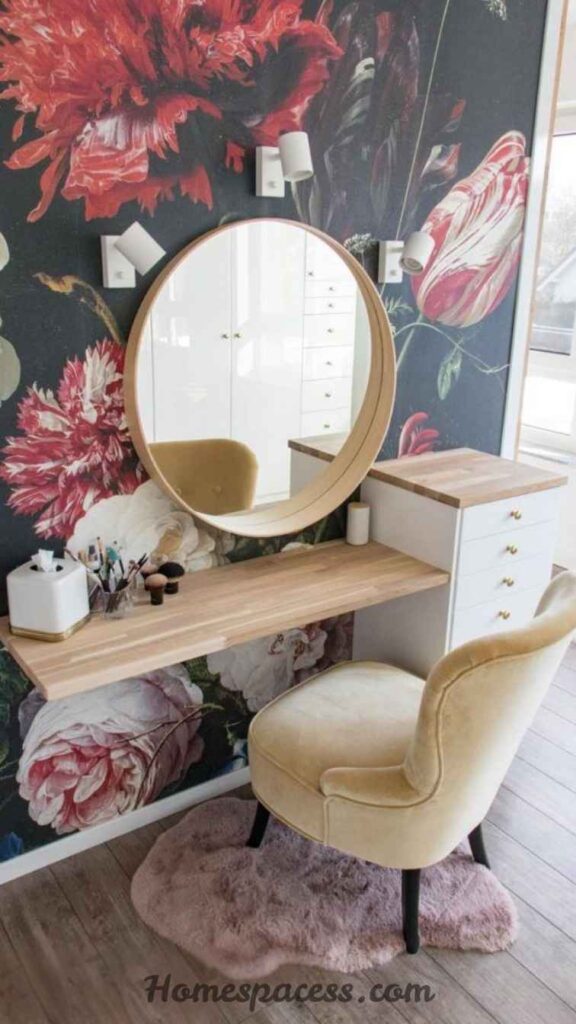
The upcycled dressing table is having a significant cultural moment, driven equally by sustainability consciousness and the rising cost of furniture. Old sewing machine tables, school writing desks, vintage sideboards, and console tables are all strong upcycling candidates each bringing character that no new piece can match. The conversion process typically involves sanding, painting or staining, adding a mirror, and fitting new hardware, none of which require professional skills.
The most successful upcycled vanity projects combine structural integrity with an unexpected aesthetic direction. A school desk painted in a rich forest green with new brass ring pulls reads as sophisticated rather than nostalgic. A vintage Singer sewing table with its ornate cast-iron base, given a marble-effect painted top, becomes a genuinely striking and unique piece. The goal is always to transform rather than to merely restore bring your personal vision to the material, not the other way around.
✦ Pro Tip
Chalk paint (Farrow & Ball or Annie Sloan) is the best medium for vanity upcycling. It adheres to most surfaces without sanding or priming, dries quickly, and can be distressed or sealed with wax for different finishes. It is also water-based and low-VOC important in a bedroom environment.
Light Architecture
Statement Lighting Vanity Setup
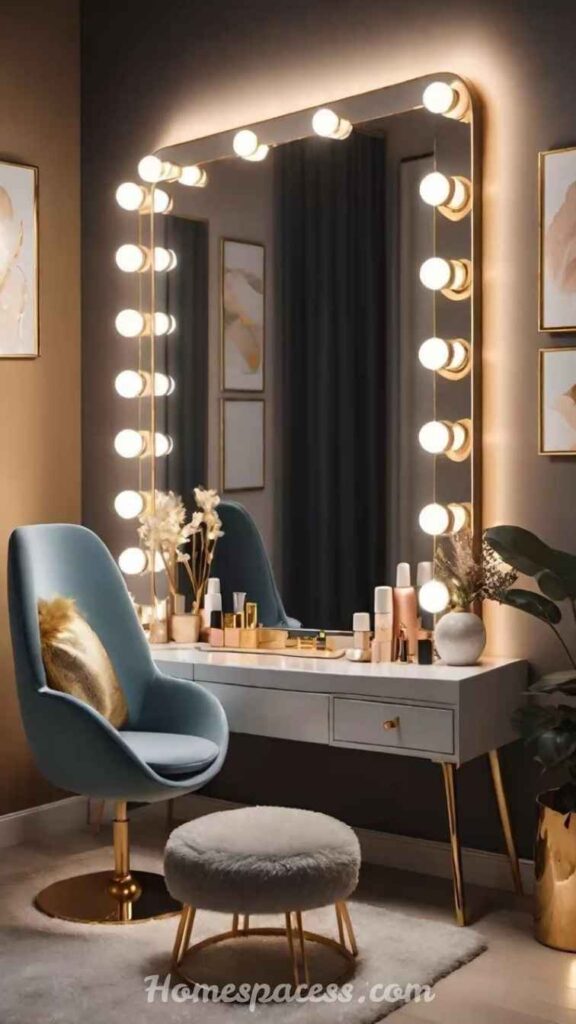
Lighting is the single most impactful upgrade you can make to any dressing table, yet it remains the most neglected element in most bedroom setups. The majority of people apply makeup under overhead ceiling lighting, which creates shadows under the eyes, nose, and chin that lead to poorly blended products and colors that look different the moment you step outside. Strategic vanity lighting positioned at eye level or surrounding the mirror eliminates these problems completely.
Beyond the functional, lighting can be used architecturally to make the dressing table area feel like a designed destination within the bedroom. A pair of wall-mounted sconces at head height on either side of the mirror, combined with a backlit mirror and an underlighting LED strip beneath the tabletop, creates a three-layer lighting setup of extraordinary beauty. Each layer can be controlled independently for different times of day and different moods.
MINI SCENARIO:
Without changing the furniture at all, someone replaces their bathroom overhead light experience with two plug-in sconces at mirror height, a backlit mirror, and a £25 LED strip under the table edge. Family members ask what new furniture was purchased the transformation is that dramatic.
Micro-Living
Studio Apartment Vanity Solutions
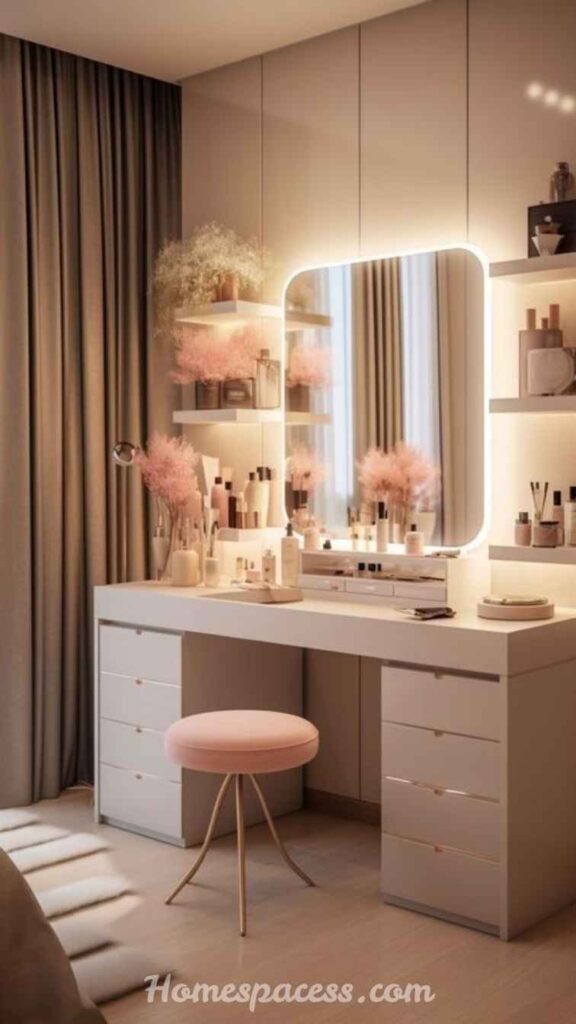
In a studio apartment, every piece of furniture must justify its square footage twice over. The best dressing table solutions for micro-living environments are those that either fold away completely when not in use, double as another functional surface (desk, bedside table, console), or are so visually lightweight that they do not add to the sense of density in the space. Murphy bed companies have recently entered the vanity market with fold-flat wall-mounted systems that store an entire dressing table in under 8 inches of wall depth genuinely ingenious solutions for micro-living.
For non-Murphy approaches, consider a folding wall-mounted shelf that drops down when needed and latches flat to the wall when not; a narrow console table used against the wall as both an entryway table and a seated vanity; or a glass and metal bedside table that moonlights as a compact vanity surface. In each case, a wall-mounted mirror keeps the table surface clear and eliminates the largest piece of a traditional vanity setup.
✦ Design Insight
The most space-efficient vanity organizer for micro-living is a hanging fabric caddy attached to the wall or the back of a door. It holds an enormous number of products vertically in a footprint of just a few centimeters transferring storage from horizontal surface space to vertical wall space, where micro-living has plenty of room to spare.
Unexpected
Outdoor or Sunroom Dressing Nook Unexpected
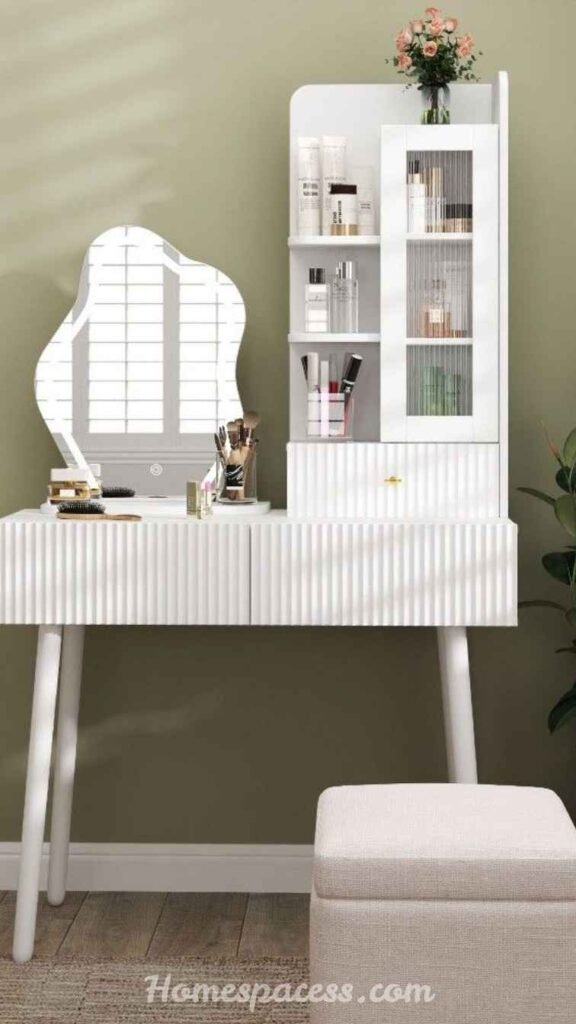
This is one of the most unconventional dressing table ideas on this list, and arguably the most joyful. In climates or homes where a sunroom, conservatory, or screened porch is available, creating a morning dressing nook in natural light offers something no indoor setup can match: the most accurate, flattering, and enjoyable light for applying makeup and grooming that exists. Natural daylight at the correct angle shows true color, texture, and skin tone with absolute honesty.
An outdoor or sunroom vanity requires weather-resistant materials: teak, powder-coated steel, or marine-grade treated wood for the table, and a high-quality weather-sealed mirror. Storage must be contained rather than open a lockable cabinet or waterproof basket keeps products protected and organized. The ambiance of a sunlit, plant-filled conservatory dressing routine is, simply put, incomparably pleasant and increasingly popular in lifestyle content for precisely this reason.
✦ Pro Tip
Direct sunlight is not the same as natural light harsh direct sun at the wrong angle is unflattering and makes products appear lighter than they are. Position a sunroom vanity to receive north light (in the northern hemisphere) or diffuse filtered light through sheer curtains for the most accurate and flattering result.
Hidden Gem
Concealed Cabinet Vanity
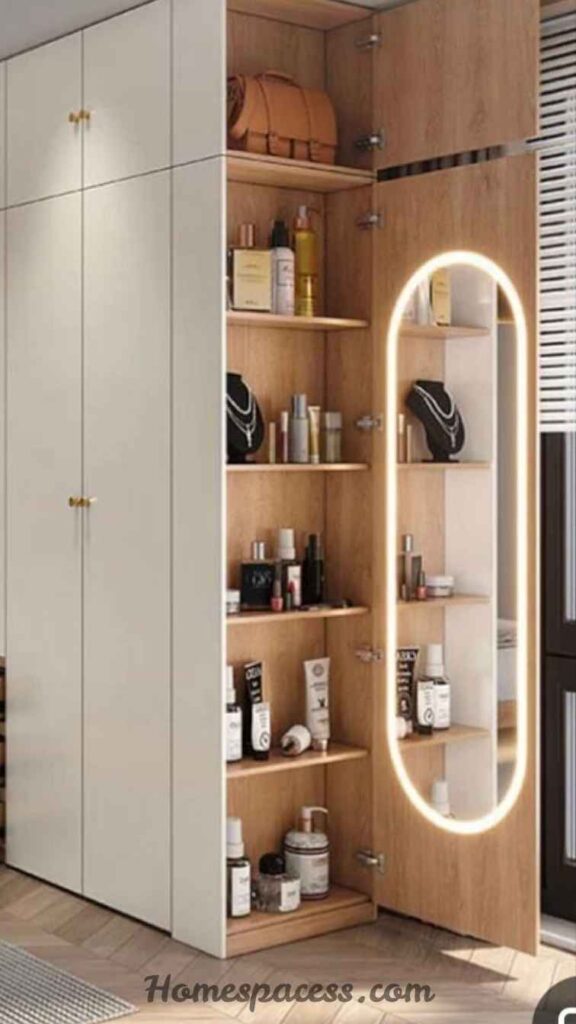
The concealed cabinet vanity where the entire setup lives inside what appears to be a standard wardrobe or cabinet door is the most space-efficient and visually tidy solution in the entire category of dressing table ideas. When the doors are closed, the room shows no sign of a vanity at all. When open, a fully equipped beauty station is revealed: a folding mirror mounted to the inside of the door, interior lighting, organized shelves, and a drop-down or fold-out surface for seated use.
This concept is being commercially developed by several European furniture brands, including Gautier and Novamobili, as a response to the growing demand for bedrooms that look like retreats rather than functional spaces. The DIY version converting a deep Ikea PAX wardrobe into a concealed vanity is one of the most-searched home improvement projects on Pinterest with hundreds of documented builds. The key is planning the interior layout meticulously before cutting a single shelf.
✦ Design Insight
Battery-powered LED interior cabinet lights have become sophisticated enough that they now rival wired lighting in quality and ease of installation. Rechargeable motion-sensing strips inside a concealed vanity cabinet mean you never reach for a light switch and never run wiring through furniture a genuinely elegant solution.
Period Drama
Art Deco Glamour Vanity
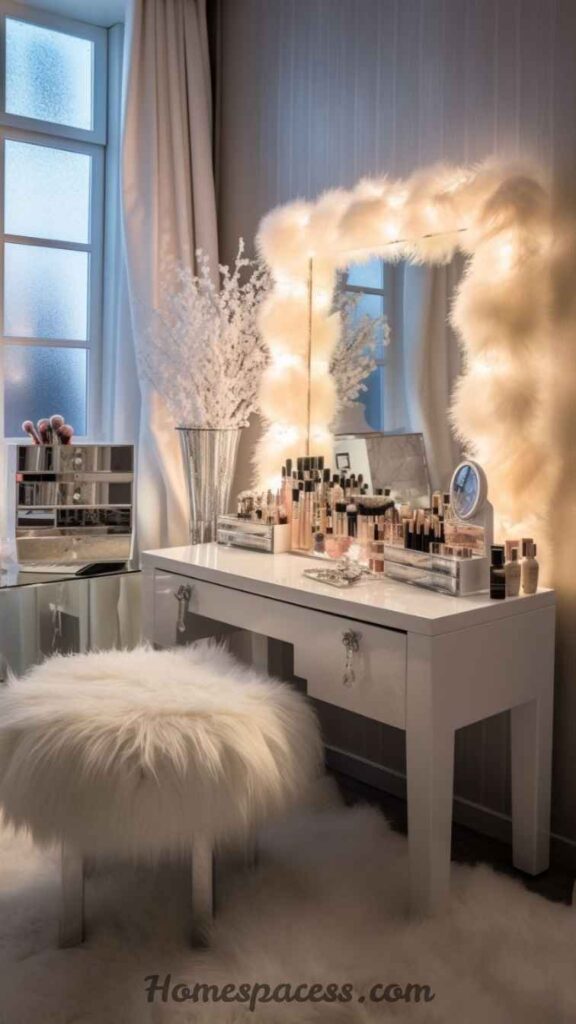
Art Deco design with its geometric precision, opulent materials, bold contrasts, and celebration of craftsmanship makes one of the most visually arresting dressing table aesthetics available. An Art Deco vanity setup typically features a fan-shaped or trapezoidal mirror with a lacquered black or gold frame, a black lacquered or deep walnut table surface, geometric drawer pulls in polished chrome or gold, and carefully placed table lamps with geometric shades.
Sourcing authentic Art Deco pieces requires patience and usually involves specialist antique dealers, estate sales, or auction platforms like Catawiki. However, the aesthetic is also well-served by contemporary pieces from brands like Graham & Green, Sweetpea & Willow, and Z Gallerie, which offer convincing Art Deco styling at accessible price points. The key signature materials are lacquered surfaces, geometric patterns, and a strict palette of black, gold, cream, and deep jewel tones.
✦ Pro Tip
Art Deco dressing tables almost always look better with a matching set of accessories than with eclectic mixing. Invest in a complete tray set matching brush holder, ring dish, perfume tray, and powder box in the same material and finish as your hardware. Coherence within the style is everything.
Planet-Conscious
Eco-Friendly Sustainable Vanity
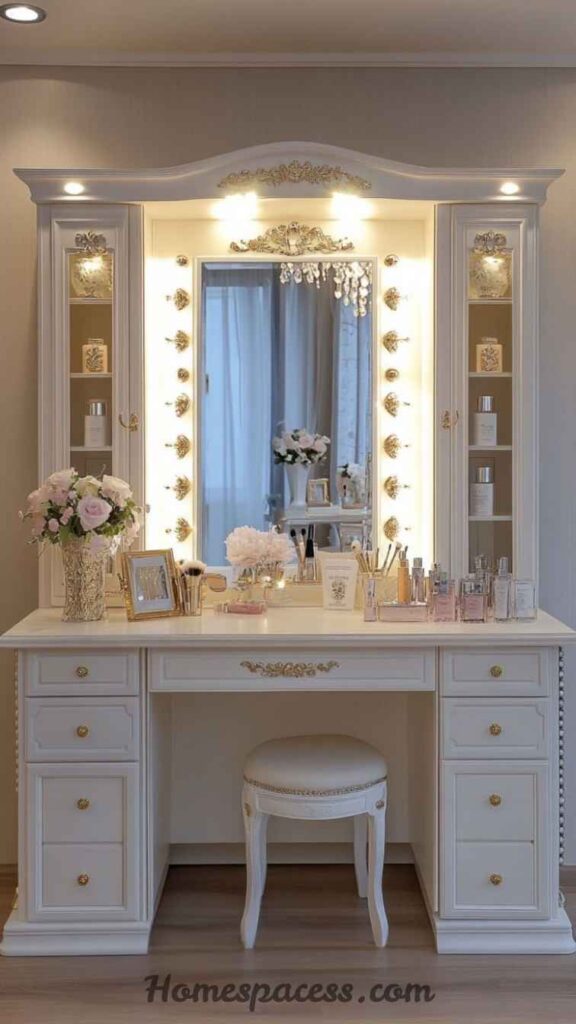
A sustainable dressing table is not about sacrifice it is about choosing materials and sources that have both aesthetic integrity and environmental responsibility. In 2026, this is more achievable than at any previous point. FSC-certified timber, reclaimed wood, recycled metal, natural rattan, bamboo, and bio-based finishes are all commercially available and visually beautiful. The sustainable vanity movement is also driving design innovation some of the most striking contemporary vanity designs are made from salvaged materials with intentional imperfections.
Sustainability in a dressing table context extends beyond the furniture itself to the products stored on it. Organizing your vanity around minimal, refillable, and zero-waste beauty products displayed in consistent glass or ceramic vessels rather than their original plastic packaging creates a vanity that looks curated, reduces environmental impact, and saves money over time. This “decant and display” approach is one of the fastest-growing trends in the vanity styling community.
✦ Design Insight
Bamboo is one of the most underrated vanity materials. It grows without pesticides, sequesters carbon rapidly, and can be manufactured into surfaces, organizers, and mirror frames that are both beautiful and significantly more environmentally sound than hardwood or MDF alternatives. It is also naturally antibacterial a genuine bonus in a cosmetics environment.
WFH Ready
Multi-Functional Desk-Vanity Hybrid
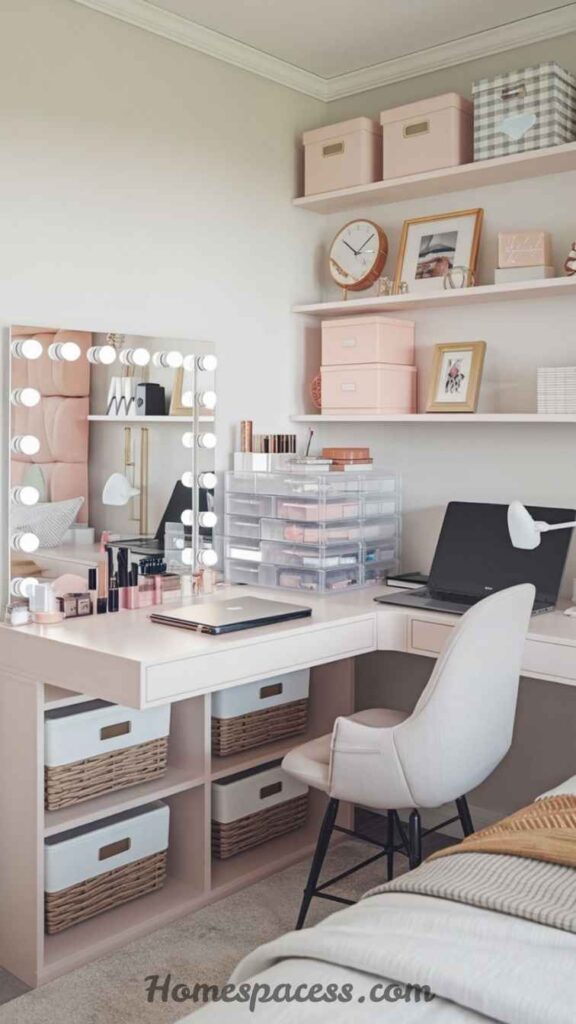
The post-pandemic home workspace revolution has made the desk-vanity hybrid one of the most practically important dressing table ideas of our era. When home office space is limited, combining a vanity and a work desk into one multi-functional piece eliminates duplicate furniture and makes the room work considerably harder. When executed well, neither function is obviously compromised the surface works as a desk during working hours and transitions to a beauty station when the laptop closes.
The transition between modes is the critical design challenge. A large monitor arm that swings to the side for vanity use, a sliding tray that emerges when in vanity mode and hides underneath when working, cable management integrated from the start, and a mirror that is stored flat against the wall or in a drawer when the desk is active these are the functional solutions that make the hybrid work. Aesthetically, a neutral palette in natural wood or white makes the transition between contexts feel seamless rather than schizophrenic.
✦ Pro Tip
For a true desk-vanity hybrid, invest in a monitor arm (VESA-compatible) that can fully retract against the wall when not in use. This single addition costing around £40–£80 liberates the entire desk surface for vanity use without the compromise of working around a fixed screen.
Conclusion:
The perfect dressing table idea is ultimately the one that aligns with how you actually live, the space you have, and the daily experience you want to create. The 25 ideas in this guide span every aesthetic, budget, and spatial constraint from a £40 DIY upcycle to a bespoke built-in wardrobe vanity. The through-line connecting all of them is intentionality: choosing deliberately rather than defaulting to whatever fits.
Before you purchase anything, spend one week observing your current getting-ready process. Where do you reach most often? What frustrates you? What do you love? The answers will point directly toward which of these dressing table ideas is genuinely yours not just the most beautiful one, but the one built for the life you actually have. Now, let’s look at the advanced insights that will keep your vanity setup ahead of the curve for years to come.
Trend Analysis
2026–2028 Dressing Table Trend Analysis: What’s Hot, Rising, and Coming Next
+34%
Growth in “vanity room” searches on Pinterest since 2022
67%
Of Gen Z homeowners prioritize vanity space in bedroom planning
£2.1B
Global vanity furniture market value projected by 2026
| Trend | Status | Key Driver | Longevity |
| Japandi Vanity | Hot 🔥 | Wellness & mindfulness culture | 5+ years |
| Smart Mirror Integration | Hot 🔥 | Tech adoption in beauty routines | Transformational |
| Sustainable Materials | Hot 🔥 | Climate consciousness & Gen Z values | Permanent shift |
| Concealed/Hidden Vanity | Rising ↑ | Micro-living & minimalism | 3–5 years |
| Desk-Vanity Hybrid | Rising ↑ | Permanent remote work culture | 5+ years |
| AI Skin-Analysis Mirrors | Future → | AI personalization in beauty tech | 2026–2028 peak |
| Biophilic Vanity Design | Future → | Indoor nature integration | Emerging |
The Trend Driving the Most Change:
The Vanity as Wellness Anchor
The most significant shift in how people think about their dressing table in 2026 is not aesthetic it is philosophical. The vanity is increasingly understood as a wellness ritual space rather than simply a functional grooming station. This is influencing material choices (natural over synthetic), lighting design (circadian-supportive spectrums), and even the category of products stored on the surface (skincare curated for ritual rather than convenience, aromatherapy diffusers, crystals, plants). This wellness-anchor framing is likely to be the dominant design language of dressing tables through 2030.
Brands entering this space including premium beauty brands launching their own furniture partnerships and wellness companies creating “ritual stations” are reinforcing this positioning in their marketing and product design. Expect the boundary between beauty furniture and wellness furniture to become increasingly blurry over the next three years, with dressing table design absorbing influences from meditation room design, spa architecture, and biophilic interior principles.
Expert Insights & Practical Tips:
What Interior Designers Know That Shoppers Don’t
The 3-Zone Rule for Vanity Organization
Professional interior stylists and organizers use a consistent framework when designing vanity setups: Zone 1 is the immediate surface (daily-use items only the products touched every single day); Zone 2 is accessible storage within arm’s reach (weekly-use items in the top drawer or closest shelf); Zone 3 is deep storage (seasonal, backup stock, or rarely used products). Violating this zone structure which most people do by placing everything equally accessible is the primary reason vanities become cluttered within days of being organized.
The practical implementation of the three-zone rule requires ruthless honesty about what you actually use daily versus what you hope to use daily. Perfumes worn twice a year do not belong in Zone 1 alongside your daily moisturizer. When Zone 1 contains only daily items, your morning routine accelerates measurably professional organizers typically report a 30–40% reduction in getting-ready time after implementing this structure. That time saving, compounded over a year, represents significant recovered life.
Mirror Placement Geometry The Factor Designers Optimize First
The single most important technical decision in any dressing table setup is the mirror’s relationship to the light source, not the wall it sits on. The optimal configuration positions the light source and the mirror on the same plane meaning the light faces you directly as you look into the mirror, rather than coming from above or behind. This is why Hollywood mirrors (light surrounding the mirror) are so effective: the light and the reflective surface are physically unified, eliminating shadows by definition.
Interior designers also optimize for the distance between the user and the mirror a factor most people ignore. The ideal distance for makeup application is 30–45cm (closer than most standard vanity setups allow). If your vanity table is very deep (60cm+), a wall-mounted mirror placed further back may be too distant for detail work. Consider a swing-arm magnifying mirror positioned at the correct distance as a supplementary tool, or choose a table shallow enough to bring the wall mirror within functional range when seated.
✦ Expert Pro Tip: The “Morning Light Test”
Before finalizing your vanity position in a room, sit at the planned spot at the same time you typically get ready and observe the natural light quality. Where is it coming from? Does it hit your face? Does it create harsh shadows? Relocating a vanity 90 degrees to better utilize a window’s natural light is often more impactful than any furniture change.
The Hardware Psychology Principle
Interior designers are well aware that the tactile quality of a vanity’s hardware has a disproportionate impact on how luxurious or cheap the entire piece feels. A solid oak table with thin, hollow, rattling drawer pulls feels lower quality than a flat-pack table with heavy solid brass hardware. This is the most cost-effective upgrade available to any existing dressing table: replacing original hardware with quality alternatives (solid brass, ceramic, or forged iron) typically costs £20–£60 and transforms the feel of the piece entirely. It is an upgrade that competitors’ articles almost never mention.
Sustainability, Long-Term Value:
Strategic Thinking in Dressing Table Investment
The True Cost of Cheap Vanity Furniture
The furniture industry’s “fast furniture” problem cheap, disposable flat-pack pieces replaced every 3–5 years has a measurable environmental and financial cost that is increasingly understood. A dressing table purchased for £89 that is replaced twice in a decade costs £267 and contributes three units of manufacturing carbon, transportation, and disposal. A solid wood or metal vanity purchased for £400–£600 that lasts 20+ years costs significantly less over its lifetime and generates a fraction of the material waste. The sustainable and the economically rational choice are, in this category, the same choice.
The resale market for quality dressing tables is also significantly stronger than most furniture categories. Antique and vintage vanities regularly sell at or above their original purchase price on platforms like eBay, Vinterior, and 1stDibs. A marble-topped or solid hardwood contemporary vanity retains 40–60% of its value after 10 years in good condition. These are not just furniture purchases they are furnishing investments with real long-term value, which changes the calculation significantly when deciding how much to spend.
Material Sustainability Ranking for Dressing Tables
Not all “natural” or “sustainable” materials are equal in their actual environmental impact. Solid hardwood from FSC-certified forests is excellent but the certification matters enormously, as uncertified tropical hardwood is one of the most environmentally destructive furniture materials available. Bamboo and rattan are among the most sustainable structural materials in furniture, growing rapidly without pesticides and sequestering carbon efficiently. Reclaimed and upcycled materials score highest of all zero new extraction, zero manufacturing energy, and the preservation of embodied history in the material.
MDF (medium-density fibreboard), which forms the core of most flat-pack vanity furniture, is a more complex case. Modern low-formaldehyde MDF with water-based finishes is significantly less harmful than older formulations, but still represents a non-recyclable composite material with a defined end-of-life at landfill. As a consumer, choosing solid wood, rattan, bamboo, or reclaimed material over MDF even when more expensive initially represents both a sustainability and a durability upgrade that pays back over the life of the piece.
✦ Sustainability Pro Tip
Before buying new, search “dressing table” on your local Facebook Marketplace, Gumtree, or Freecycle. The quality of second-hand vanity furniture available often barely used, since people frequently redecorate before the furniture wears out is consistently underestimated. You will frequently find solid wood pieces for 10–20% of their original retail price, fully ready to use or requiring minimal restoration.
Future Predictions:
Upcoming Innovations in Dressing Table Design (2026–2030)
AI-Powered Skin Analysis at Your Vanity Mirror
Within 18–24 months, AI skin analysis integrated into dressing table mirrors will transition from niche luxury product to mainstream consumer item. Current offerings from companies like HiMirror and Perfect Corp already analyze skin texture, hydration levels, and hyperpigmentation in real time, making product recommendations based on AI-interpreted data. The next generation of these products will be integrated directly into furniture mirror designs rather than being standalone devices expect major furniture brands to announce partnerships with beauty-tech companies by 2026. This will fundamentally change the relationship between the dressing table and the skincare routine it supports.
The longer-term innovation predicted for 2028–2030 is personalized AR (augmented reality) makeup try-on integrated into the vanity mirror itself, allowing users to “try on” lipstick, eyeshadow, or blush in real time before applying any physical product. Combined with direct e-commerce integration, this transforms the dressing table into a point of sale as well as a point of preparation a convergence of beauty routine and beauty retail that several major beauty conglomerates are already quietly developing.
Circadian Lighting Systems Built Into Vanity Design
Circadian rhythm lighting light systems that shift color temperature throughout the day to support the body’s natural wake-sleep cycle is transitioning from a wellness industry concept to a mainstream interior feature. By 2027, most premium vanity mirror products and many furniture-integrated lighting systems will offer automatic circadian mode as standard: cool energizing light (5000–6500K) in the morning, neutral balanced light (4000K) through the day, and warm amber light (2700K) in the evening. This is not merely a comfort feature research consistently demonstrates that circadian lighting has measurable positive effects on mood, alertness, and sleep quality.
The implication for dressing table design is significant. Future setups will be specified not just by lumen output or CRI (color rendering index) but by their circadian effectiveness their ability to support the body’s biological clock rather than simply illuminate the face. This will drive demand for more sophisticated integrated lighting systems and gradually make single-spectrum LED strips seem as outdated as incandescent bulbs appear today.
Modular and Reconfigurable Vanity Furniture Systems
The furniture industry’s most significant structural trend is the shift toward modular systems furniture that can be reconfigured, added to, or reduced as life circumstances change. This trend, currently most visible in shelving (Vitsœ 606, Muuto Stacked) and kitchen cabinetry, will fully arrive in the dressing table category by 2026–2027. Vanity systems where the mirror module, surface module, storage module, and lighting module are specified and purchased separately then combined and recombined as needs evolve will offer genuine long-term flexibility that current vanity furniture cannot match.
Common Dressing Table Mistakes:
Overlooked Factors That Sabotage Beautiful Setups
- Buying the Mirror and Table Separately Without Coordinating Heights→ The Fix The most common dressing table setup error is purchasing a wall mirror without checking the eye-level relationship with the seated user. The center of the mirror should be at face height when seated typically 130–140cm from the floor for an average adult. Test with a temporary mirror taped at various heights before committing.
- Choosing a Chair Over a Purpose-Made Stool→ The Fix A standard dining chair seat height (45cm) is typically 3–5cm too high for a dressing table surface (set at 68–72cm), forcing an uncomfortable posture. Vanity stools are specifically designed at 38–42cm seat height to align correctly with vanity table heights. Always verify seat height when purchasing, not just aesthetics.
- Ignoring the Electrical Planning Stage→ The Fix Most dressing table setups are positioned without any power outlet within practical reach, leading to extension cables trailing across the floor a safety hazard and an aesthetic disaster. If a new vanity position is being planned, involve an electrician to install an appropriately located outlet before furniture arrives, not after.
- Over-Organising at the Outset→ The Fix Purchasing an elaborate organizer system before understanding how you actually use the vanity leads to a system that fights your habits rather than supporting them. Live with a new dressing table setup for 2–4 weeks before buying organizers the patterns of use will show you exactly what the system needs to accommodate.
- Neglecting Ventilation and Product Storage Temperature→ The Fix Most natural and high-quality skincare products degrade faster when stored in warm environments and a bedroom near a radiator or in direct sun can easily exceed the 15–25°C recommended storage temperature for many cosmetics. Position your vanity away from direct heat sources and consider a small beauty fridge (a rapidly growing product category) for temperature-sensitive serums, vitamin C products, and natural formulations.
- Underestimating the Power of the Stool→ The Fix The stool or chair is the most physically experienced element of the entire vanity setup you sit on it for extended periods daily yet it consistently receives the least design attention and budget. A beautiful dressing table with an uncomfortable, cheap, or poorly proportioned stool will be used less, enjoyed less, and ultimately the routine will suffer. Invest proportionally in seating: budget at least 25–30% of total vanity spend on the stool.

Team Home Spacess shares simple, practical design ideas that work for real families. The team focuses on cozy décor, soft colors, and natural textures that make a space feel truly lived-in. From everyday decorating tips to creative home projects, Team Home Spacess is dedicated to helping readers create warm, comfortable, and inviting spaces with a fresh and personal touch.