

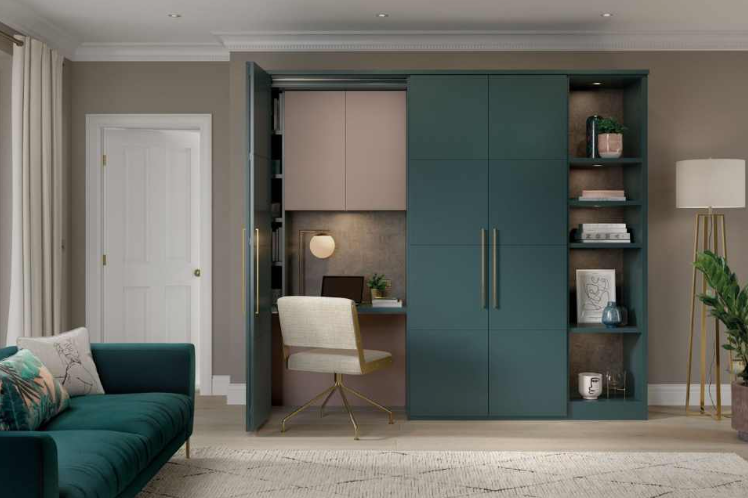
A home office rarely gets a room of its own. More often it shares space with a guest bed, a dining table or a corner of the living room. That works well enough during the day. In the evening, though, the printer, file folders, cables and half-finished paperwork stay in view. The room never fully stops being an office.
Good storage fixes that. When work materials have a dedicated place out of sight, a shared room can switch from workspace to living space in a few minutes. The right furniture also makes the workday easier, because the things you need are organized and close at hand.
Why Open Shelving Falls Short
Open bookshelves are a popular choice for home offices. They look nice in photos and make everything easy to grab. In practice, they tend to collect clutter. Binders lean at odd angles, cords dangle and stacks of mail pile up on the edges. What looks curated on day one often looks messy by month three.
Open storage also leaves work visible all the time. For people who want a clear line between their job and their home life, seeing tax forms and project files from the couch can make it hard to switch off. Closed storage gives you that separation.
The Case For A Credenza
A credenza is a long, low cabinet that combines a usable top surface with storage hidden behind doors or drawers. In traditional offices it sat behind or beside the desk. In a home, it fits along a wall, under a window or behind a sofa that faces into the room.
Its biggest advantage is balance. The top works as a second surface for a printer, a lamp, a plant or a tray for incoming mail. Below, cabinets and drawers hide files, supplies and equipment. That mix of surface space and concealed compartments keeps documents and tools within reach while keeping the room looking tidy.
Because credenzas sit low, they also don’t dominate a room the way a tall bookcase or filing cabinet can. They can look just as natural in a living room as in a study, which matters when the office shares space with daily life.
Choosing A Material That Belongs At Home
Office furniture often looks like office furniture: metal, laminate and gray tones built for cubicles. In a home, those finishes can feel cold and out of place.
A wood credenza brings warmth and durability to the space while still keeping a clean, professional look. Wood pairs easily with other furniture in the house, such as dining tables, side tables and bookshelves, so the piece reads as part of the home rather than equipment brought in from a corporate office. Well-made wood furniture also holds up to years of daily use, with drawers that keep opening smoothly long after cheaper materials have started to sag.
When choosing a finish, look at the floors and the larger furniture in the room. A tone that complements them helps the credenza blend in. A contrasting finish can work too, as long as it feels intentional.
Other Pieces Worth Considering
Credenzas aren’t the only option for closed storage. Depending on how much paper you keep and how the room is laid out, other pieces may work better or pair well with one.
Lateral files have wide drawers that run side to side and hold folders in hanging rows. They work well for people who still keep a lot of paper records, and their tops add more surface space.
File chests are more compact, with deep drawers in a smaller footprint. They suit small rooms or tuck neatly beside a desk.
Two- and three-drawer pieces let you choose the right amount of storage. A two-drawer unit may be enough for a light paper load, while three drawers give more room for supplies and records.
Some households use a credenza for supplies and electronics alongside a lateral file for documents. Pieces from the same collection keep the look consistent.
Planning What Goes Inside
Storage only helps if it’s organized. Before buying, sort what you actually need to keep near your desk.
Daily items, such as notebooks, chargers and pens, should sit in the most accessible drawer.
Active files for current projects belong in hanging folders that are easy to flip through.
Archive records, like old tax documents, can go in lower or deeper drawers since they’re rarely used.
Equipment, such as a printer, router or paper shredder, may need a cabinet with space for cords and airflow.
Bulk supplies, like paper and ink, can fill whatever space is left.
Measure your largest items, especially a printer, before you shop. Check whether cabinets have an opening in the back for cables. If they don’t, plan for a small power strip and cord clips so wires stay tidy.
Placement In A Shared Room
Where the storage goes affects both function and appearance. In a guest room, a credenza along the wall can hold work materials on weekdays and double as a dresser top for visitors. In a living room, a low piece behind a sofa can mark off the work zone while still looking like regular furniture. In a dining area, placing storage near the table lets you set up and pack away quickly when the table is used for work.
Leave enough clearance in front so drawers and doors open fully, usually about three feet. Make sure the top is at a comfortable height if you plan to use it for a printer or as a standing surface for sorting mail.
A Nightly Reset Routine
Even with good storage, a small habit makes the biggest difference. At the end of each workday, take five minutes to put files back, close the laptop, and slide supplies into drawers. Clear the top of the credenza except for a lamp or a decorative piece.
That short routine signals the end of the workday and gives the room back to the rest of the household. Over time, it keeps paper from piling up and makes starting the next morning faster.
Work Space That Feels Like Home
Working from home doesn’t have to mean living in an office. Closed, well-made storage lets a room do two jobs without looking cluttered at either one. With a few thoughtful pieces and a simple routine, the work disappears at the end of the day, and the room feels like home again.

Team Home Spacess shares simple, practical design ideas that work for real families. The team focuses on cozy décor, soft colors, and natural textures that make a space feel truly lived-in. From everyday decorating tips to creative home projects, Team Home Spacess is dedicated to helping readers create warm, comfortable, and inviting spaces with a fresh and personal touch.