

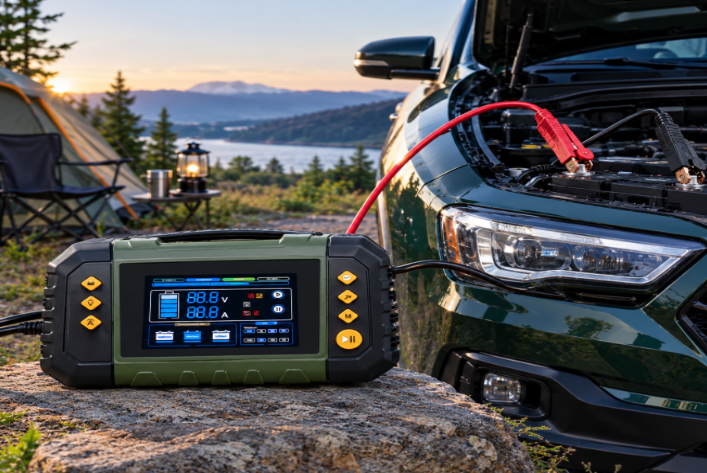
Every autumn, you park the classic car in the garage and connect the old charger to keep the battery topped up. In spring, the car refuses to start. The battery case feels warm, the electrolyte level has dropped, and a white crust has formed around the terminals. The charger did exactly what it was built to do. It kept pushing current into a battery that no longer needed it.
This scenario explains why more drivers, boat owners, and RV users are rethinking how they charge. A traditional battery charger for lead acid batteries delivers power in a simple, fixed way, while a smart charger monitors the battery and adjusts its output as conditions change. Understanding the difference between the two helps you choose the right tool for your battery type, your usage, and how long the charger will stay connected.
How a Traditional Battery Charger Works
A traditional charger uses a transformer and rectifier to convert household AC power into DC current. It delivers a fairly steady output regardless of the battery’s actual state of charge. Some models offer a manual switch between charging rates, but the charger itself does not decide when to slow down or stop.
The Overcharging Problem
Once a lead-acid battery reaches full charge, continued current causes gassing. Water in the electrolyte breaks down, plates become exposed, and heat builds inside the case. On flooded batteries, you can top up with distilled water. On sealed AGM or gel batteries, lost electrolyte cannot be replaced, so repeated overcharging permanently shortens their life.
Where Traditional Chargers Still Make Sense
Traditional chargers are not obsolete. They remain simple, durable, and easy to repair. For a flooded lead-acid battery that you charge under supervision and disconnect once it is full, a basic charger does the job. Many workshops still keep one for quick recovery charges on older equipment.
How a Smart Battery Charger Works
A smart charger contains a microprocessor that reads the battery’s voltage and, on many models, its temperature. It then moves through several charging stages instead of delivering one constant output.
The process usually starts with a bulk stage that delivers most of the charge at maximum current. An absorption stage follows, holding voltage steady while current gradually tapers. Once the battery is full, the charger switches to float or maintenance mode, supplying only enough current to offset natural self-discharge. This staged approach is what makes it safe to leave a smart charger connected for weeks or months.
Key Differences That Matter in Practice
The technical differences translate into real consequences for battery life and convenience. Several distinctions stand out when comparing the two types side by side.
- Supervision. A traditional charger needs you to monitor progress and disconnect it, while a smart charger manages the process on its own.
- Battery chemistry. Most traditional chargers suit flooded lead-acid batteries only, whereas smart chargers offer dedicated modes for AGM, gel, and lithium batteries.
- Long-term storage. A smart charger’s float mode maintains seasonal vehicles safely, a task a traditional charger cannot handle without risk.
- Protection features. Smart chargers typically include reverse polarity, short circuit, and overheating protection, which reduces the risk of damage from connection errors.
- Recovery functions. Many smart chargers include a desulfation mode that can help recover lead-acid batteries weakened by sulfate buildup after long periods of discharge.
Matching the Charger to Your Battery Type
Battery chemistry often decides the question for you. Modern vehicles increasingly use AGM batteries, especially those with start-stop systems, and these batteries need precise voltage control during absorption and float. A charger set for flooded batteries may undercharge or overcharge them.
Lithium and LiFePO4 batteries require even more care. They use different charging voltages, do not benefit from a traditional float stage in the same way, and can be damaged by desulfation pulses designed for lead-acid batteries. Always select the correct battery mode before charging, and confirm that the charger explicitly lists lithium support.
For drivers handling several battery types at home, a smart charger for car batteries with 6V, 12V, and 24V settings and separate modes for lead-acid, AGM, gel, and lithium covers cars, motorcycles, and boats with a single unit. An LCD display showing voltage and charge progress also removes the guesswork that comes with basic chargers.
Choosing the Right Charging Current
Charging current affects both speed and battery health. A higher amperage charges faster, but it is not always better. Small motorcycle or lawn tractor batteries charge more safely at a lower rate, while large truck, RV, or marine batteries need higher current to charge within a reasonable time.
Check the battery manufacturer’s recommended charging rate, usually printed on the label or in the documentation. A smart charger with selectable current lets you match the output to each battery rather than applying the same force to all of them.
Which Charger Should You Choose?
The right choice depends on how you use your batteries. A traditional charger works for occasional supervised charging of flooded lead-acid batteries, particularly when budget is the priority. A smart charger suits anyone storing a vehicle seasonally, owning AGM or lithium batteries, or wanting to connect the charger and walk away without worrying about damage.
For most modern vehicles, the added protection and battery-specific modes of a smart charger justify the difference. The cost of replacing a single prematurely failed battery often exceeds the price gap between the two types.
Conclusion
The core difference comes down to control. A traditional charger delivers current until you stop it, while a smart charger reads the battery and adapts each stage of the process. For heavy-duty applications such as trucks, RVs, and boats, a higher-output smart charger for car batterie rated at 30A charges large batteries faster while keeping the same maintenance and protection features.
The classic car in the garage would have started on the first turn of the key with a charger that switched to maintenance mode once the battery was full. Before buying, check your battery’s chemistry and voltage on its label. That single step tells you which charger modes you actually need.

Team Home Spacess shares simple, practical design ideas that work for real families. The team focuses on cozy décor, soft colors, and natural textures that make a space feel truly lived-in. From everyday decorating tips to creative home projects, Team Home Spacess is dedicated to helping readers create warm, comfortable, and inviting spaces with a fresh and personal touch.