

We understand that upgrading your home’s water heater can feel like a big investment. For many California homeowners, rising energy costs make finding efficient solutions more urgent than ever. Replacing an old, inefficient water heater with a modern heat pump water heater is a smart move for long-term savings and environmental benefits. However, the initial cost can be a barrier. Thankfully, California offers a wide array of energy incentives designed to make heat pump water heater replacement more affordable. This comprehensive guide will explore how to access these programs, focusing on opportunities across the state, including specific Southern California water heater energy incentives. We aim to help you transition to cleaner, more efficient homes, reducing both our utility bills and our carbon footprint by navigating the various rebates and programs available.
California is at the forefront of encouraging energy-efficient home improvements, and water heater replacements are a prime target. As of October 2026, numerous programs are in full swing, offering substantial financial incentives for homeowners who choose to upgrade to a heat pump water heater (HPWH). These incentives are designed to offset the initial cost, making the switch to more efficient technology an attractive option.
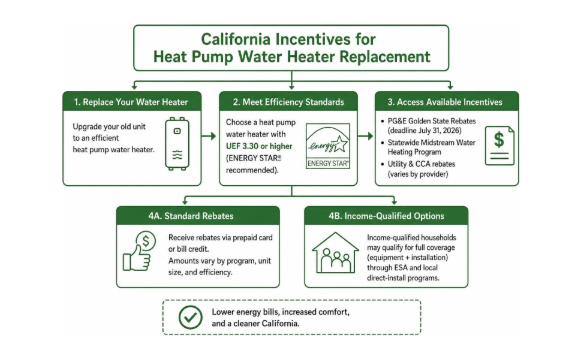
One of the most prominent programs for residential customers is PG&E’s Golden State Rebates. This program offers tiered incentives for replacing an existing gas water heater with a high-efficiency heat pump model. For instance, homeowners can receive up to $700 for larger units (40-50+ gallon) replacing gas heaters, or $600 for 45-55 gallon units replacing smaller 30-40 gallon gas heaters. There’s also a $400 rebate for replacing an electric storage water heater with a heat pump model. It’s important to note that this particular program has a hard deadline of July 31, 2026, so timing is crucial for eligible customers in PG&E’s service territory.
For commercial and multifamily properties across Southern California, the Statewide Midstream Water Heating Program provides significant incentives. This program, which includes counties like Los Angeles, Orange, Santa Barbara, Ventura, Riverside, and San Bernardino, offers rebates for electric heat pump water heaters. Depending on the equipment’s efficiency and capacity, rebates can range from hundreds to several thousands of dollars, with high-COP (Coefficient of Performance) units potentially qualifying for up to $7,000.
Regional Utility Rebates from SoCalGas and Electric Providers
Beyond PG&E, other major utilities and community choice aggregators (CCAs) across California, including those in Southern California like Southern California Edison (SCE), San Diego Gas & Electric (SDG&E), and various CCAs, also offer their own rebate programs. While the specific dollar amounts and eligibility criteria can vary, the goal remains consistent: to encourage the adoption of energy-efficient water heating solutions.
These utility programs typically provide incentives in the form of prepaid cards or billing credits. For example, the Statewide Midstream Water Heating Program, administered in partnership with utilities like SoCalGas, offers rebates that are often processed through participating distributors, simplifying the process for commercial and multifamily property owners. Residential customers should check directly with their electric and gas providers for the most current residential HPWH rebate offerings in their specific area. It is worth noting that some programs may also offer additional incentives for customers impacted by wildfires, providing increased rebate values to support recovery and rebuilding efforts with energy-efficient upgrades.
Heat Pump Water Heater Upgrades and Efficiency Standards
To qualify for most California energy incentives, the new heat pump water heater must meet specific efficiency standards. The Uniform Energy Factor (UEF) is a key metric used to determine eligibility, measuring the overall energy efficiency of a water heater. For many programs, including PG&E’s Golden State Rebates, a UEF of 3.30 or higher is required for heat pump water heaters.
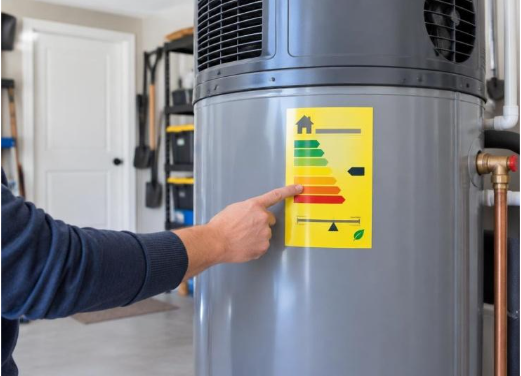
Choosing an ENERGY STAR certified heat pump water heater is an excellent way to ensure compliance with these efficiency requirements. ENERGY STAR products are independently certified to meet strict energy performance standards. Heat pump water heaters, often referred to as hybrid units, are significantly more efficient than traditional electric resistance or gas water heaters. They work by extracting heat from the surrounding air and transferring it to the water, rather than generating heat directly. This process allows them to achieve high Coefficients of Performance (COP), meaning they produce more heat energy than the electrical energy they consume. The storage capacity of the unit, typically measured in gallons, also plays a role in rebate tiers, with larger units often qualifying for higher incentives.
Income-Qualified and Direct-Install Programs Across California
California is committed to ensuring that energy efficiency upgrades are accessible to all residents, regardless of income level. For income-qualified households, there are robust programs that go beyond standard rebates, sometimes covering the entire cost of a heat pump water heater installation. These initiatives aim to reduce energy burdens and improve comfort for vulnerable communities.
Energy Savings Assistance and Full Coverage Options
The Energy Savings Assistance (ESA) program, offered by California’s major utilities like PG&E, SCE, and SoCalGas, is a cornerstone of this effort. For eligible income-qualified households, the ESA program can provide a fully covered heat pump water heater installation, meaning zero out-of-pocket expenses for both the equipment and the labor. In 2026, income thresholds for ESA are generous, reaching up to $82,500 for a family of four, for example. This program is designed to deliver whole-home efficiency improvements, which can also include other appliance upgrades and weatherization measures, significantly lowering utility bills for participating families.
Another avenue for full coverage is through local direct-install options, such as the EmPower My Home program. These programs often work with local contractors to provide and install energy-efficient appliances, including heat pump water heaters, at no cost to eligible residents. Eligibility for these programs typically depends on household income and other specific criteria, ensuring that those who need assistance most can benefit from these vital upgrades. Tenant eligibility is also often considered, allowing renters to benefit with landlord approval.
Qualifying for Low-Income Southern California Water Heater Energy Incentives
Beyond ESA, additional support is available for low-income households through programs like the California Alternate Rates for Energy (CARE) and Family Electric Rate Assistance (FERA). While CARE and FERA primarily offer discounts on monthly utility bills, qualifying for these programs can also unlock additional bonuses on top of standard rebates for energy-efficient appliances. For instance, some local programs, like Silicon Valley Clean Energy, offer an additional $1,000 for CARE/FERA customers on top of their standard heat pump water heater rebate, illustrating the potential for significant savings for income-qualified residents across the state.
Income verification is a standard part of the application process for these programs, often benchmarked against Area Median Income (AMI) thresholds. The federal Inflation Reduction Act (IRA) also plays a role, with its Home Efficiency and Home Electrification rebate tracks defining low-income households as those earning less than 80% of the AMI, and moderate-income households between 80-150% of the AMI. These federal funds are channeled through state programs, further enhancing the financial assistance available.
Statewide Rebate Layers: TECH Clean California, SGIP, and Local CCAs
Beyond utility-specific and income-qualified programs, California offers several statewide initiatives and local community choice aggregation (CCA) programs that can be stacked with other incentives, maximizing savings for homeowners. These programs are crucial for accelerating the state’s electrification goals and transitioning away from fossil fuels.
TECH Clean California is a significant statewide initiative designed to accelerate the adoption of heat pump water heaters and other clean heating and cooling technologies. This program offers substantial rebates that can often be combined with utility incentives, providing a powerful stacking opportunity. However, it’s important to be aware that TECH Clean California funding operates on cycles and can run low mid-cycle, so timely application is key.
The Self-Generation Incentive Program (SGIP) has also expanded its eligibility to include heat pump water heaters, recognizing their potential as thermal storage devices that can support grid stability. The SGIP HPWH program now allows customers of publicly-owned utilities to qualify and offers a $1,500 kicker incentive for HPWHs using low-Global Warming Potential (GWP) refrigerants. This expansion highlights a policy shift that integrates thermal storage into demand-response services, treating water heaters as valuable grid assets.
Many local Community Choice Aggregators (CCAs) across the state also offer their own rebates, which can often be combined with state and utility incentives. These CCAs, such as CleanPowerSF or Silicon Valley Clean Energy, provide additional financial motivation for their customers to switch to heat pump water heaters. For example, Silicon Valley Clean Energy offers a $2,000 rebate for HPWHs replacing gas units, with an extra $1,000 for CARE/FERA customers. Homeowners should check with their local CCA for specific offerings.
How to Stack Statewide Rebates with Southern California Water Heater Energy Incentives
Combining multiple incentives is where the real savings can add up. The strategy for stacking rebates often involves understanding the interplay between state, utility, and local programs. Many programs are designed to be complementary, allowing homeowners to claim incentives from different sources for the same upgrade.
For instance, a homeowner might first qualify for a utility rebate from their electric provider (like PG&E’s Golden State Rebates), then apply for additional funding through TECH Clean California. Some programs offer midstream discounts, where the rebate is applied at the point of sale by a participating distributor or contractor, simplifying the process. Working with an experienced energy-efficiency contractor is highly recommended, as they are often familiar with the various programs, their eligibility requirements, and the application process, helping to navigate funding caps and incentive sequencing. A real-world example demonstrates this: a homeowner in Hayward successfully combined a $700 PG&E rebate with additional TECH Clean funding, significantly reducing their net cost.
Demand Response and Grid-Connected Load Shifting Programs
Beyond upfront rebates, homeowners can also earn ongoing incentives by participating in demand response programs with their new heat pump water heaters. These programs leverage the “smart” capabilities of connected HPWHs to help balance the electricity grid.
PG&E’s WatterSaver program is a prime example. It offers a $50 enrollment bonus and an additional $5 per month for ongoing participation for connected heat pump water heaters. By allowing the utility to subtly adjust the water heater’s operation during periods of high grid demand, homeowners contribute to grid stability and earn rewards. This load-shifting capability is a key benefit of HPWHs, as they can store hot water like a “thermal battery,” heating water during off-peak hours when electricity is cheaper and cleaner, and then coasting during peak demand. Enrolling in such programs adds an extra layer of savings and environmental benefit.
Application Requirements, Documentation, and Contractor Guidelines
Navigating the application process for water heater rebates requires attention to detail and proper documentation. While the incentives are substantial, securing them often depends on submitting a complete and accurate application package. Working with a licensed and experienced contractor can significantly streamline this process.
An experienced energy-efficiency contractor will understand the specific requirements of each program, ensuring that the chosen equipment meets eligibility standards and that all necessary paperwork is completed correctly.
They can also advise on obtaining required permits and conducting pre- and post-installation inspections, which are often crucial for rebate approval and quality assurance.
Required Permits, Invoices, and Equipment Documentation
To successfully claim a PG&E heat pump water heater rebate, for example, homeowners will need to provide
several key documents:
- Recent PG&E bill: To verify account type and eligibility.
- Itemized contractor invoice: Clearly showing the cost of the equipment and installation.
- Plumbing (and possibly electrical) permits: Proper permitting ensures the installation meets local building codes and safety standards.
- Photos of the unit nameplate and installed unit: These photos verify the model, serial number, and proper installation of the new HPWH.
- Proof of purchase: Often includes the model number, serial number, and UEF rating of the new unit.
For income-qualified programs, additional documentation such as proof of income or participation in other assistance programs (like CARE/FERA) will be required for income verification.
Steps Before and After Water Heater Installation
To maximize your chances of securing rebates, follow these actionable steps:
Before Installation:
- Verify Eligibility: Check your utility’s website or contact them directly to confirm your eligibility for specific programs, including income-qualified options like ESA.
- Choose Qualified Equipment: Ensure the heat pump water heater model you plan to purchase is on the utility’s qualified products list and meets the required UEF ratings.
- Get Bids from Licensed Contractors: Obtain quotes from several licensed contractors experienced in HPWH installations and rebate processes. An experienced contractor can guide you through the incentive landscape.
- Obtain Permits: Ensure your contractor pulls all necessary plumbing and electrical permits before work begins. Some programs require permits for rebate approval.
- Pre-Approval (if applicable): Some programs may require pre-approval or a reservation request before installation.
After Installation:
- Final Inspection: Ensure the installation is completed to code and passes any required inspections.
- Gather Documentation: Collect all required documents, including the final itemized invoice, permits, photos, and your utility bill.
- Submit Application: Complete and submit the rebate application form, either online or by mail, according to the program’s instructions. Pay close attention to deadlines.
- Track Your Claim: Keep copies of all submitted documents and track the status of your rebate application. Processing timelines can vary.
Frequently Asked Questions About California Water Heater Rebates
We understand that energy incentives can be complex. Here are answers to some of the most common questions we encounter regarding California water heater rebates.
Can You Stack Utility Rebates with TECH Clean California?
Yes, in many cases, you can stack utility rebates with TECH Clean California incentives. This is one of the most effective strategies for maximizing your savings. TECH Clean California is designed to complement existing utility programs, offering additional funding for heat pump water heater installations. However, it’s crucial to verify the specific program rules, as funding limitations and eligibility criteria can vary. Working with a contractor who is familiar with both utility and TECH Clean California processes can help ensure proper filing and maximize your combined savings. It’s important to apply for these rebates in the correct sequence and within the specified budget cycles, as TECH Clean funding can be allocated on a first-come, first-served basis.
What UEF Efficiency Ratings Are Required for Rebate Approval?
The Uniform Energy Factor (UEF) is the primary metric used to determine the energy efficiency of a water heater and is a key eligibility requirement for most rebate programs. While specific UEF thresholds can vary by program and utility, a common requirement for heat pump water heaters is a UEF of 3.30 or higher. Many programs align with ENERGY STAR certification, which sets minimum efficiency standards. Always check the technical guidelines of the specific rebate program you are applying for to ensure your chosen equipment meets the required UEF or other efficiency metrics (like Coefficient of Performance, COP). Selecting a model with a higher UEF typically indicates greater energy savings and may qualify for higher rebate tiers.
How Do Income-Qualified Households Get Free Water Heater Installations?
Income-qualified households in California can often receive free heat pump water heater installations through programs like the Energy Savings Assistance (ESA) program. These programs are designed to provide direct installation services, covering the full cost of both the equipment and labor, resulting in zero out-of-pocket expenses for eligible families. To qualify, households must meet specific income thresholds, which are often generous (e.g., up to $82,500 for a family of four in 2026). The process typically involves applying through your utility provider, undergoing income verification, and allowing an approved contractor to perform the installation. These programs aim to alleviate energy burdens and improve home comfort for those who need it most.
Conclusion
California’s commitment to energy efficiency and building electrification presents an unparalleled opportunity for homeowners to upgrade their water heating systems. By understanding and leveraging the diverse range of incentives available—from utility rebates and income-qualified programs to statewide initiatives like TECH Clean California and local CCA offerings—you can significantly reduce the cost of installing a modern, energy-efficient heat pump water heater.
Making the switch to a heat pump water heater not only contributes to California’s ambitious electrification goals but also offers substantial long-term savings on your utility bills. The combination of upfront rebates, potential ongoing demand response incentives, and reduced operational costs means a significant return on investment. We encourage you to take action today: research the specific programs available in your area, verify your eligibility, and connect with a qualified energy-efficiency contractor. Don’t let these valuable incentives go unclaimed—start your journey towards a more efficient and comfortable home now.

Team Home Spacess shares simple, practical design ideas that work for real families. The team focuses on cozy décor, soft colors, and natural textures that make a space feel truly lived-in. From everyday decorating tips to creative home projects, Team Home Spacess is dedicated to helping readers create warm, comfortable, and inviting spaces with a fresh and personal touch.