

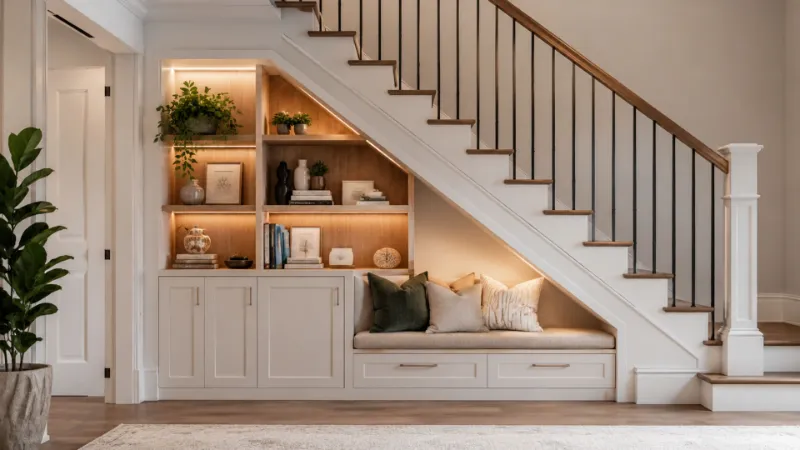
Most homes are hiding a secret storage goldmine and it’s sitting right beneath the staircase. That awkward triangular void under your stairs is one of the most underutilized spaces in any home, yet with the right design approach, it can become a functional, beautiful, and highly organized storage zone. Whether you’re dealing with a small apartment staircase or a grand hallway flight of steps, the potential is enormous.
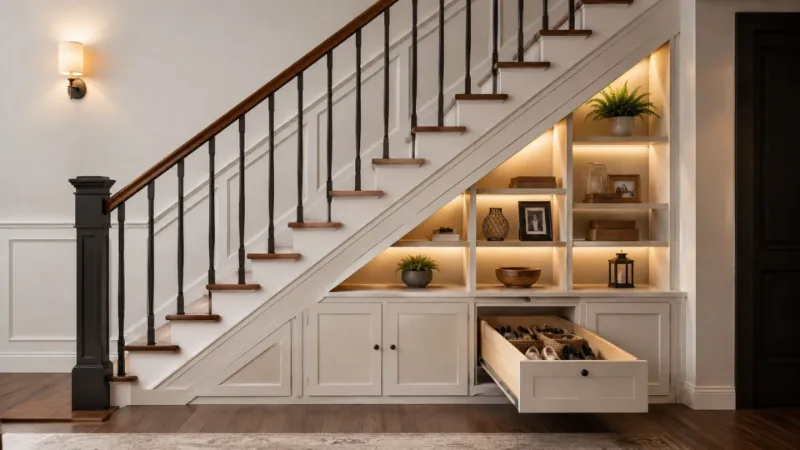
The challenge isn’t a lack of space it’s a lack of imagination. Homeowners often overlook under stairs storage solutions because the irregular shape feels limiting. In reality, that angled geometry is exactly what makes it so versatile. From built-in shelving to hidden home offices, from wine cellars to pet nooks, the space under your staircase can be designed to do virtually anything. This guide walks you through expert-level under stairs storage ideas that are practical, stylish, and surprisingly achievable even on a budget.
Built-In Pull-Out Drawers for Maximum Organization
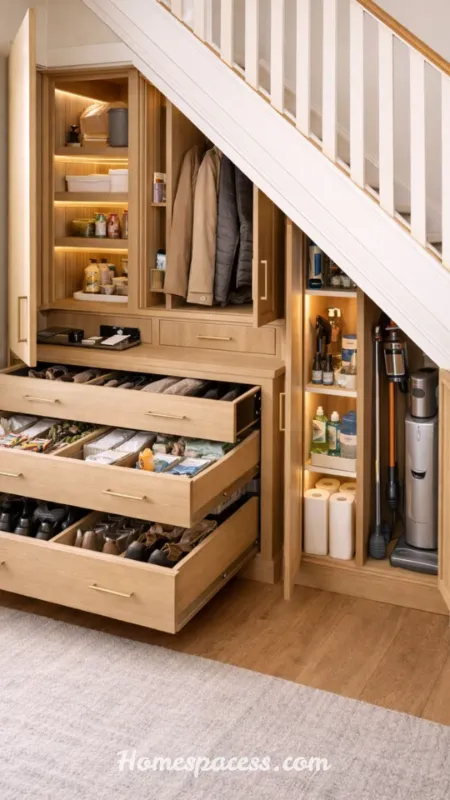
One of the most efficient under stair storage solutions is a custom set of pull-out drawers fitted directly into the risers of your staircase. Each step essentially becomes its own drawer unit, creating a seamless and completely hidden storage system. This approach is particularly popular in modern and minimalist interior design because the drawers disappear entirely when closed, maintaining a clean visual line in the hallway or living room.
The key advantage of stair drawers is their high storage density you’re utilizing every cubic inch of that triangular space. A standard staircase with 12 steps can yield as many as 8–10 functional drawers, each capable of holding shoes, children’s toys, seasonal accessories, or household tools. Families with young children especially benefit since low-level drawers are perfectly accessible for kids to self-organize their belongings.
For a real-world example, consider a semi-detached home in a busy urban area where hallway clutter was a constant problem. The homeowners replaced their plain staircase with a carpeted flight featuring built-in oak veneer pull-out drawers on alternating steps. The result? A completely clutter-free entrance hall with storage for 22 pairs of shoes, sports gear, and seasonal items all invisible from the living area.
Style Note:
Pair natural wood drawer fronts with brushed brass handles for a warm, contemporary feel. For a sleeker look, choose flat-front panels with push-to-open mechanisms no handles needed.
Pro Tip:
Install soft-close drawer runners to prevent slamming and ensure longevity. Label drawer fronts with small engraved plaques or chalk labels to keep family members organized.
See Related Articles: Modern Family Room Ideas for Relaxing and Entertaining Guests
Open Shelving Display Style Meets Storage
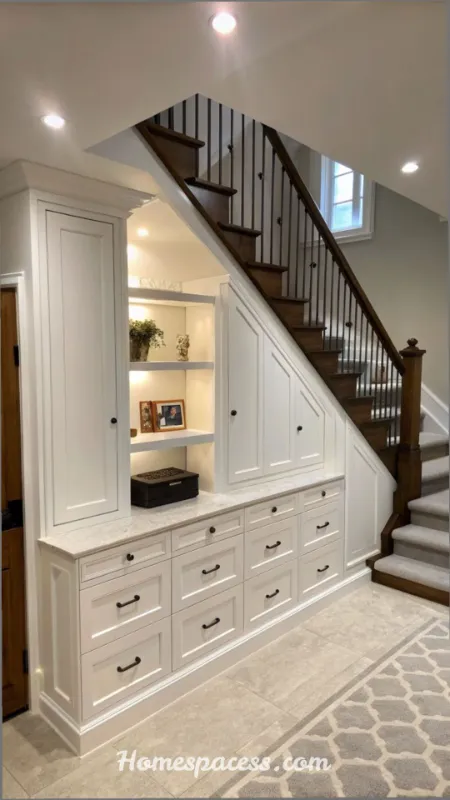
Open shelving under the stairs transforms a structural necessity into a design feature. By installing floating shelves or custom-built shelving units in the open alcove beneath a staircase, you create a gallery-like display that’s both functional and visually striking. This approach works exceptionally well in open-plan living spaces where the understairs area is visible from the main living zone.
The beauty of open shelving is its flexibility. You can organize books, display curated decorative objects, store baskets of household items, or even create a mini indoor plant display that adds life and color to a neutral hallway. Mixing display items with practical storage such as wicker baskets at lower levels and curated decorative pieces at eye level strikes a perfect balance between aesthetics and utility.
Interior designers frequently use open understairs shelving as a focal point in contemporary homes. A homeowner in a Victorian terraced property used open oak shelving under a large staircase to house a rotating art display alongside books and plants. The shelving became the most photographed element of the home, demonstrating that under stair shelving ideas can function as genuine architectural features rather than mere storage afterthoughts.
Style Note:
Paint the back wall of the shelving alcove in a deep, moody color like navy, forest green, or charcoal to create a dramatic backdrop that makes displayed objects pop.
Pro Tip:
Use adjustable shelf brackets so you can reconfigure heights as your storage needs change over time. This future-proofs your investment without any additional structural work.
You May Also Like: Trending Basement Family Room Ideas for Comfortable Home Living
A Compact Home Office Tucked Under the Stairs
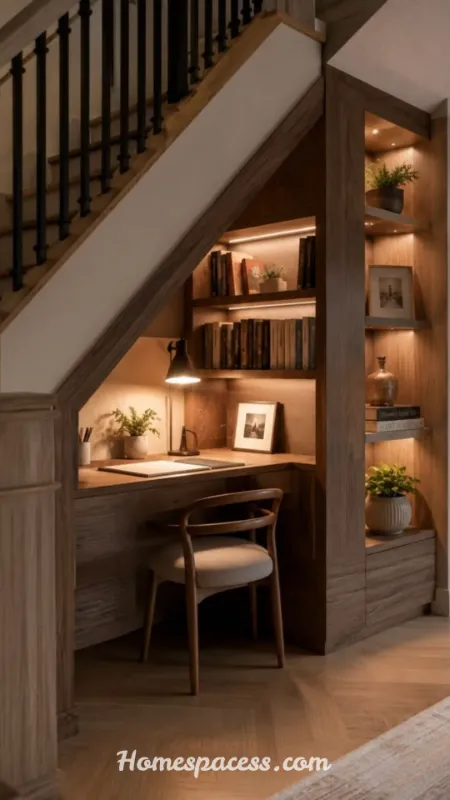
The rise of remote work has driven a surge of interest in compact, cleverly disguised home office spaces. The triangular void beneath a staircase often between 1.5m and 2.5m in depth is perfectly sized to accommodate a desk, monitor, and basic office essentials. When fitted with good lighting, electrical sockets, and a ergonomic chair, it becomes a fully functional work-from-home nook that can be hidden behind bi-fold doors when the workday ends.
This is especially valuable in smaller homes or apartments where dedicating an entire room to a home office isn’t possible. A well-designed understairs office can include a built-in desk at the correct height, open shelving above for reference materials, cable management channels to keep wires tidy, and even acoustic paneling to reduce noise from foot traffic overhead. The stepped ceiling adds a cozy, cave-like quality that many remote workers find surprisingly conducive to focus.
A graphic designer working from a London flat converted her understairs void into a fully operational studio with dual monitors, a drawing tablet, and custom-built storage for art supplies. With barn-style doors that slide closed completely, the entire workspace disappears after hours, restoring the hallway to its clean, domestic feel. This kind of multi-functional space design is a hallmark of modern urban living.
Style Note:
Warm, directional task lighting (2700K–3000K color temperature) makes the enclosed space feel inviting rather than claustrophobic. A small pendant or recessed downlight works beautifully here.
Pro Tip:
Install a USB charging hub and surge-protected power strip during the build phase retrofitting electrical access afterward is significantly more expensive and disruptive.
Recommended for You: Stunning Staircase Decor Ideas for Small Spaces and Narrow Halls
Under Stairs Wine Storage A Touch of Luxury
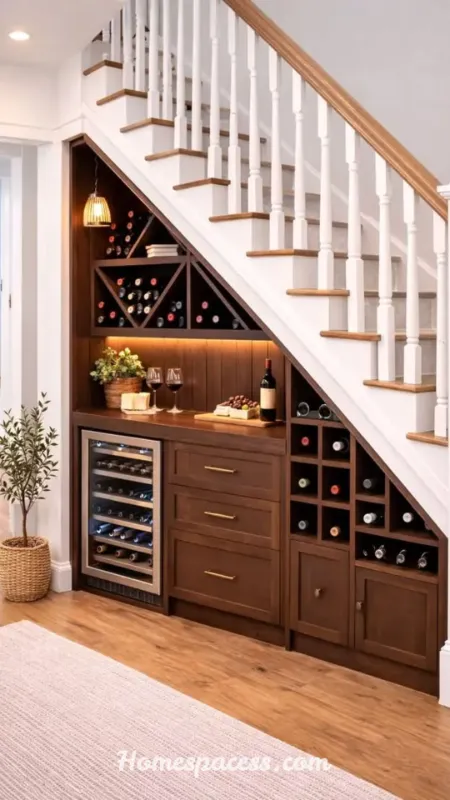
For wine enthusiasts, transforming the understairs space into a wine cellar or wine rack is both a practical and indulgent storage solution. The naturally cool, dark environment beneath a staircase mimics ideal wine storage conditions consistent temperature away from direct sunlight. With the addition of temperature control units and custom-built wine rack systems, this space can properly store hundreds of bottles.
Even without full temperature regulation, a simple under stair wine rack built from horizontal timber or steel tube frames provides excellent storage for everyday wines. You can combine lower-level wine storage with upper shelving for glassware, decanters, and bar accessories to create a full home bar area that’s sophisticated and space-efficient. This idea adds genuine resale value to the property and is a strong selling point for buyers with an interest in entertaining.
A homeowner in a large Victorian townhouse installed a climate-controlled under stair wine room with brick-effect wallpaper lining, iron wine racks, and LED strip lighting that gently illuminated each row of bottles. The space, originally just a cluttered cupboard, became the conversation centerpiece of every dinner party proving that wine cellar storage ideas don’t require a basement to make an impact.
Style Note:
Use exposed brick cladding panels or a textured stone effect on the back wall for an authentic cellar feel. Pair with vintage-style Edison bulbs on a dimmer for atmospheric lighting.
Pro Tip:
If budget permits, install a wireless temperature/humidity sensor and connect it to a smart home app. Maintaining 55–65°F and 50–70% humidity will protect your wine investment long-term.
See Also: Trending Home Decoration Ideas to Upgrade Your Home Instantly
Shoe Storage Solutions Taming the Hallway Chaos
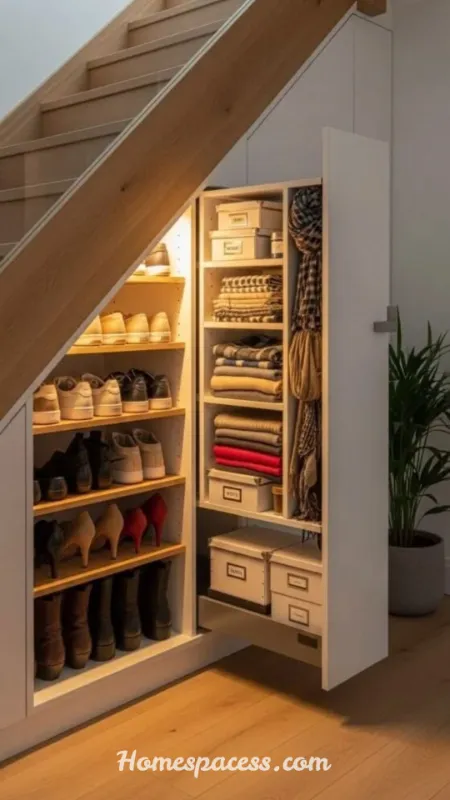
The hallway is the most common place for shoe clutter to accumulate, and the understairs area is the single best location to address it. Custom-built shoe storage under stairs can be designed to house everything from children’s wellies to adult dress shoes in a systematic, accessible way. Options range from simple open shelving with angled shoe slots to fully enclosed cabinet-style units with ventilation panels to prevent odors.
A smart approach is to layer different shoe storage systems based on frequency of use. Everyday shoes go in easily accessible pull-out trays at the front. Seasonal footwear winter boots, summer sandals gets stored further back in stacked boxes or on deeper shelves. This tiered approach maximizes depth utilization, which is often wasted in standard cupboard shoe storage.
A family of five converted their entire understairs void into a bespoke shoe storage wall with individual cubbies for each family member, color-coded with small label holders. A bench was added at the entrance to the cupboard, allowing people to sit while putting on shoes an ergonomic detail that made the system genuinely pleasant to use every day. Functional hallway storage doesn’t need to sacrifice style when it’s this well-considered.
Style Note:
Incorporate ventilation grilles or slatted panel doors to allow airflow, preventing the musty smell that plagues traditional shoe cupboards. Cedar wood inserts also naturally neutralize odors.
Pro Tip:
Use angled shelves (15–20 degrees) so shoes sit at a visible, organized angle rather than being piled flat. This makes retrieval faster and keeps the space looking neat automatically.
More on This Topic: 20 Home Office Ideas to Boost Productivity in 2026
Children’s Playroom A Magical Hideaway
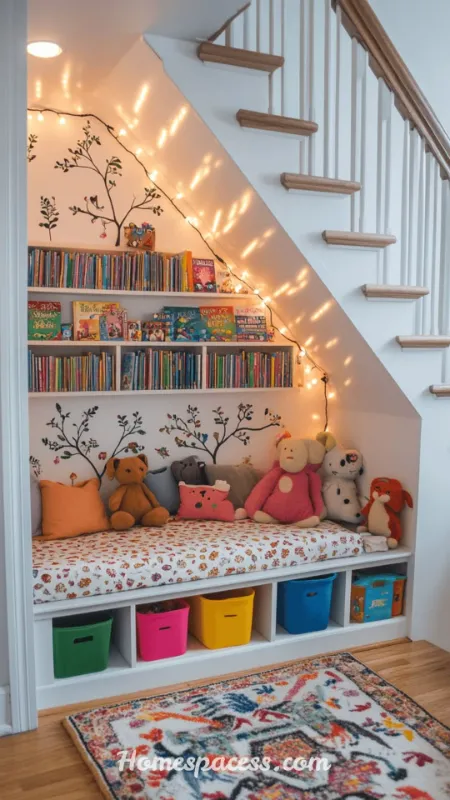
Children are instinctively drawn to small, enclosed spaces, making the understairs void an ideal location for a kids’ playroom or reading nook. With child-safe LED lighting, a soft carpet, and small bookshelves, this space becomes an irresistible children’s den that encourages independent play and creativity. Many parents report that children consistently prefer the cozy understairs nook over larger, dedicated playrooms.
The design can be as simple or as elaborate as the budget allows. At the minimal end, a painted arch, a cushion on the floor, and a battery-operated fairy light set creates an instantly magical space. At the premium end, custom-built tiered seating, integrated toy storage drawers, a small chalkboard wall, and a personalized nameplate transforms the alcove into something that feels genuinely special. It doubles as toy storage, keeping the rest of the home tidy.
A family redesigning their Edwardian semi converted the understairs space into a Harry Potter-themed den complete with a painted stone arch, lantern lighting, and a hidden latch door. The children’s engagement with the space was so high that it effectively organized their play habits, keeping toys contained and encouraging quieter, imaginative play. Themed kids’ storage solutions like this prove that good design can positively influence behavior.
Style Note:
Use washable, matte paint in a rich, warm tone deep plum, forest green, or midnight blue to create a cave-like atmosphere that feels adventurous without being overwhelming.
Pro Tip:
Install a small Dutch door (top half open, bottom half closed) to allow parents to see in and pass items through, while keeping the enclosed, magical feeling for the child.
Must Read This Post: Colorful Kids Room Ideas: Creative Ways to Design a Space Kids Will Love
A Cozy Reading Nook with Built-In Bookshelves
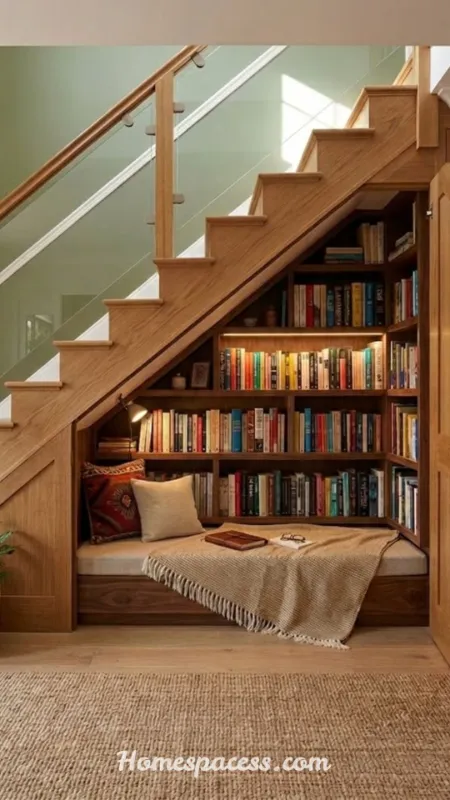
One of the most timeless under stair storage ideas is converting the alcove into a reading nook with built-in bookshelves. This elegant solution serves a dual purpose: it stores an extensive book collection while creating a private, cozy corner perfect for curling up with a novel. The sloped ceiling of the understairs space actually enhances the intimate quality of a reading nook, providing a natural sense of enclosure.
The design typically features low bookshelves on the sides and back of the space, with a built-in bench seat above which storage can be concealed with a lift-up lid. Cushions, a throw, and good task lighting complete the scene. Crucially, built-in bookshelves can extend beyond the immediate understairs area, running along the adjacent wall to dramatically increase book storage capacity while maintaining a cohesive visual appearance.
A book collector with a large terraced home built a wrap-around understairs library nook featuring floor-to-ceiling bookshelves that extended 2 meters beyond the staircase along the hallway wall. A custom curved bench with a lift-up storage compartment held additional items. The reading nook became so central to family life that the homeowner described it as “the most-used room in the house” despite being less than 3 square meters.
Style Note:
Arched shelving profiles following the slope of the staircase look architecturally intentional and beautifully integrated. Avoid sharp rectangular edges that create an awkward “off-cut” appearance.
Pro Tip:
A small, directional LED reading light on a flexible arm attached to the shelving provides ideal task lighting without requiring an electrician for a fixed ceiling installation.
Don’t Miss This Post: Stunning Canopy Bed Ideas to Create a Dreamy Bedroom Retreat
Under Stairs Bathroom Maximizing Space in Smaller Homes
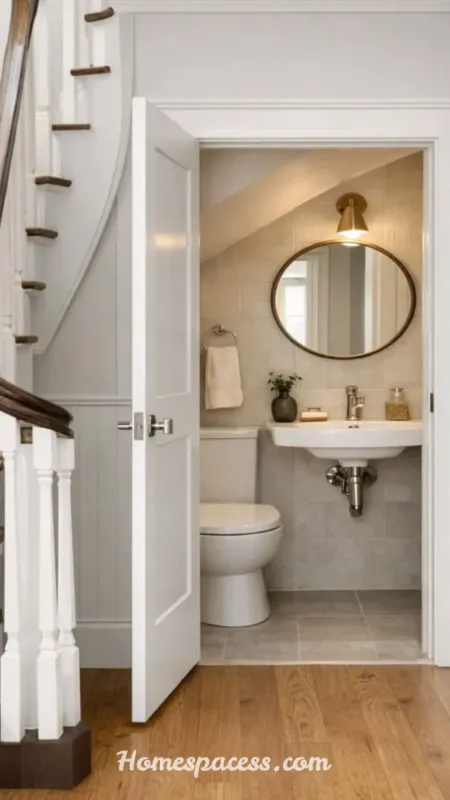
In smaller homes or multi-storey properties, adding a cloakroom or guest toilet under the stairs is one of the highest-value home improvements possible. A compact understairs WC with a small basin and toilet can be fitted into as little as 1.1m × 1.3m of floor space, making even tight staircases viable for this conversion. A downstairs cloakroom consistently ranks among the top features that add value to residential property.
The design challenge is maximizing hygiene and ventilation in a confined space. Wall-hung toilets and compact corner basins free up floor space and simplify cleaning. Clever understairs bathroom ideas include using the sloped wall for built-in shelf storage for toiletries, a mirror that creates the illusion of more space, and a strong extractor fan to manage ventilation effectively. Bold, dramatic design choices dark tiles, statement wallpaper, brass fixtures work particularly well in small spaces.
A Victorian end-of-terrace homeowner converted an unused understairs cupboard into a fully functional micro-cloakroom featuring a wall-hung cistern toilet, a tiny circular basin, and bold geometric encaustic tiles. The project added an estimated 5–7% to the property’s market value, representing a return on investment that far exceeded the construction cost. For homes without a ground-floor toilet, this is arguably the single best use of understairs space.
Style Note:
Dark, moody interiors work brilliantly in understairs bathrooms deep teal tiles, black fixtures, and a single statement pendant create a jewel-box effect that feels intentional and luxurious.
Pro Tip:
Install a mechanical extractor fan connected to the light switch to ensure automatic ventilation every time the room is used. This prevents damp and odor buildup in the enclosed space.
Laundry Station A Hidden Utility Area
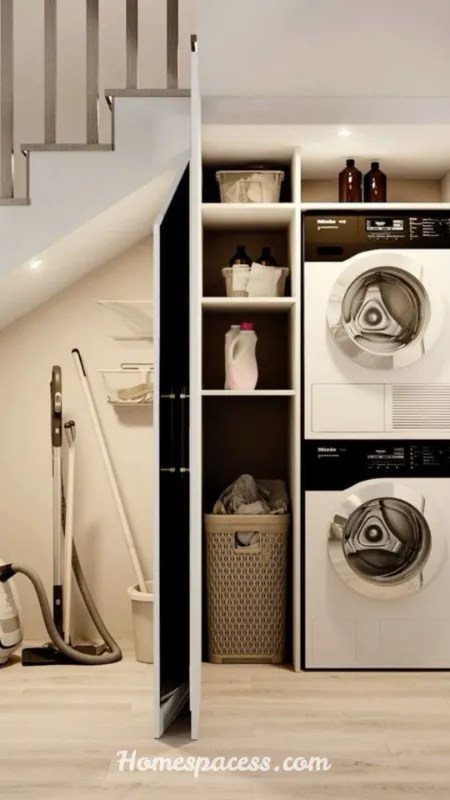
Concealing a laundry area under the stairs solves one of the most persistent challenges in smaller homes where to put the washing machine without dedicating a full room to it. A well-designed understairs laundry storage solution can house a washing machine, condenser dryer, ironing board, laundry baskets, and cleaning supplies in a compact, fully integrated unit. Sliding or bi-fold doors keep the whole area hidden when not in use.
The key considerations for an understairs laundry station are plumbing access and ventilation. For washing machines, a cold water supply and waste pipe are needed; these are often easier to access in ground-floor understairs areas close to the kitchen. Condenser dryers are ideal here since they don’t require external venting. A pegboard panel on the inside of the door provides space for laundry accessories like dryer sheets, stain removers, and garment brushes.
A couple in a 2-bedroom flat with no separate utility room installed a full laundry setup under their staircase including a washer-dryer combo, two laundry baskets on pull-out runners, and an integrated folding shelf. The entire station closes behind mirrored bi-fold doors that make the hallway appear larger. This approach demonstrates that smart home organization is as much about concealment as it is about storage capacity.
Style Note:
Mirror-fronted bi-fold doors for the laundry station serve double duty concealing the utility area while visually expanding a narrow hallway. A win-win for small home design.
Pro Tip:
Install a small pull-out counter or fold-down shelf at working height for folding laundry. This tiny addition eliminates the habit of carrying laundry to another room, making the station significantly more practical.
Pet Station A Dedicated Space for Your Four-Legged Family
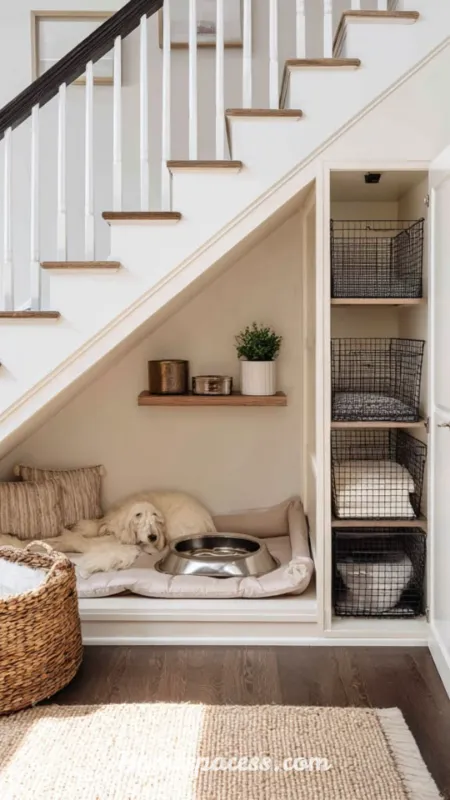
The space under the stairs is an ideal location for a dedicated pet area a cozy, semi-enclosed zone that gives pets their own territory while keeping pet clutter contained and out of the main living areas. A custom-built pet station under the stairs can include a dog bed alcove, built-in storage for leads, food bags, grooming supplies, and a feeding station with recessed bowls at the correct height for the animal.
The enclosed, den-like quality of the understairs space is naturally appealing to dogs and cats, who instinctively seek out quiet, sheltered resting spots. For dogs, a half-door or gated entrance allows them to feel secure while remaining visible from the hallway. For cats, a fully enclosed cat house with a small entrance hole is even simpler to build and can include a built-in litter tray concealed behind a panel.
A dog owner renovating a family home in the suburbs built a bespoke understairs dog den with the dog’s name carved into the entrance arch, a memory foam bed insert, a storage drawer for accessories, and a mounted lead hook at the door. The dog adopted the space immediately, and the hallway previously cluttered with dog paraphernalia was transformed. It’s a perfect example of how pet-friendly home design can be both functional and genuinely thoughtful.
Style Note:
Use easy-clean materials painted MDF, tiled floor insert, wipeable cushion covers to make the pet nook hygienic and low-maintenance without sacrificing warmth and comfort.
Pro Tip:
Build in a small nightlight or LED strip at low level for the pet area. Pets especially cats appreciate a gently lit space, and it makes nighttime retrieval of leads or bowls much easier.
Cupboard with Integrated Coat and Hat Storage
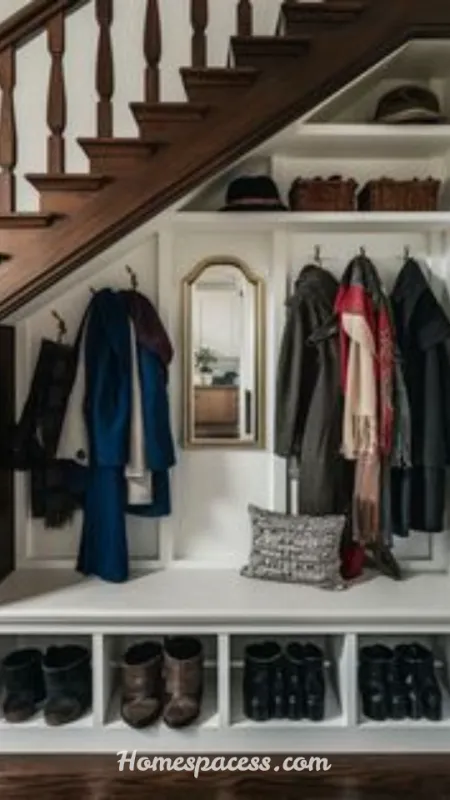
A classic but underrated under stairs storage idea is a well-designed coat cupboard with integrated hat, glove, scarf, and bag storage. The difference between an average coat cupboard and an exceptional one lies in the details: adjustable rail heights, pull-out hooks for bags, upper shelf dividers for hats and helmets, and lower shoe racks that use every millimeter of available depth. A properly designed coat storage system eliminates the hallway chaos that plagues most homes.
Beyond standard coat rails, innovative coat storage ideas include a pull-out valet rail that extends forward for easy hanging access, retractable hooks on the back of the door for daily-use items, and labeled zones for each family member. Built-in umbrella storage often a standalone problem can be integrated into a slim slot at the front of the cupboard, keeping wet umbrellas contained and separated from dry coats.
A family with three children converted their understairs cupboard into a fully customized coat station, with three individual sections one per child each with its own rail, hook row, shoe tray, and basket for accessories. The daily morning routine, previously a stressful scramble for hats and shoes, became significantly smoother. Small, functional design improvements like this have a disproportionate impact on daily quality of life.
Style Note:
Paint the interior of the coat cupboard in a contrasting color to the hallway a cheerful yellow or terracotta to make opening the door feel like a small, pleasant visual surprise.
Pro Tip:
Install a motion-activated LED light inside the cupboard. It activates the moment the door opens, making it effortless to find items quickly especially important during rushed morning departures.
Integrated Home Gym Equipment Storage
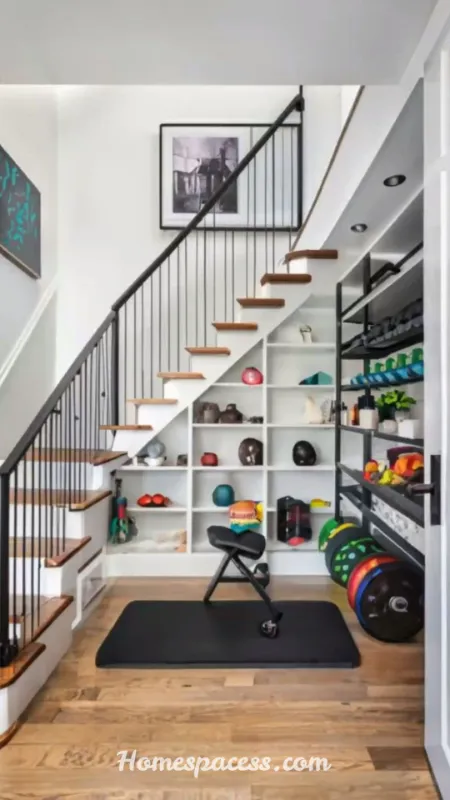
With the growth of home fitness culture, finding dedicated storage for gym equipment has become a genuine household challenge. The understairs void is an excellent location for a home gym equipment storage station tall enough to store yoga mats, foam rollers, and resistance bands vertically, and deep enough to accommodate dumbbells on lower shelves. Custom-built storage in this space can hold a surprising amount of fitness gear in an organized, accessible way.
The design approach for fitness equipment storage prioritizes durability and weight load capacity. Lower shelves and floor areas should be reinforced to handle heavy dumbbells and kettlebells, using solid timber or steel shelf standards rather than lightweight alternatives. Upper zones handle lighter equipment resistance bands, skipping ropes, yoga blocks ideally in labeled hooks or bins. A fold-out workout mat area can even be incorporated if depth allows.
A personal trainer working from home built an understairs gym station with wall-mounted dumbbell racks at floor level, a vertical yoga mat holder, a pull-out rail for resistance bands, and a small monitor for streaming workout videos. The entire setup occupies a space previously used for miscellaneous household clutter, and the convenience of having equipment organized and accessible has measurably increased the homeowner’s workout frequency.
Style Note:
Industrial-finish materials black steel shelving, rubber matting, and raw wood work well for a gym aesthetic that looks intentional rather than domestic.
Pro Tip:
Use a wall-mounted pegboard system for lightweight gym accessories. Pegboards are endlessly reconfigurable, allowing you to adapt the storage layout as your equipment collection evolves.
Smart Storage Cupboard with Custom Shelving Zones
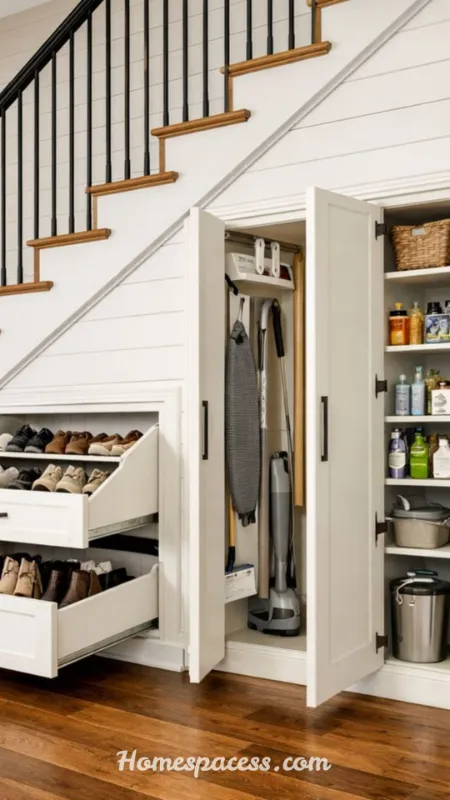
A versatile and timeless option, the fully customized under stairs storage cupboard uses intelligent zone-based shelving to address multiple household storage needs simultaneously. Rather than dedicating the entire space to a single use, a smart cupboard divides the area into distinct zones a deep lower zone for bulky items, a mid-level zone for frequently accessed household items, and an upper zone for rarely needed seasonal storage.
The zoning approach requires careful storage planning before the build begins. Measuring your actual belongings and mapping them to the available space rather than building generic shelves and filling them afterward leads to dramatically better outcomes. Custom-built understairs shelving can incorporate variable shelf depths (shallower at the top, deeper at the bottom), pull-out wire baskets, interior drawer dividers, and label holders to create a genuinely organized system.
A professional organizer helped a client design a household command center within their understairs cupboard, complete with a zone for cleaning supplies, a filing zone for household documents, a charging station for devices, and a top shelf for seasonal decorations. The transformation from a cluttered, unusable void to a highly functional household hub took less than two weeks. This kind of purposeful storage design consistently produces the highest satisfaction among homeowners who undertake it.
Style Note:
Install interior lighting LED strips along the front edge of each shelf so the entire cupboard is well-lit when the door opens. This single detail transforms usability and makes the space genuinely pleasant to interact with.
Pro Tip:
Use deep lower shelves (400–500mm) for bulky items and shallower upper shelves (200–250mm) for small items, so everything remains visible and accessible without over-reaching.
Final Thoughts
The space beneath your staircase is one of the most versatile and valuable areas in your home and with the right approach, it can be transformed into genuinely useful, beautiful storage that improves daily life. From pull-out shoe drawers to home offices, from wine storage to children’s dens, the best under stairs storage ideas are the ones tailored to your specific lifestyle and needs.
The key is planning with purpose: measure carefully, design for how you actually live, and invest in quality materials and hardware that will last. Don’t let this potential goldmine of storage space sit empty or cluttered another day take one idea from this guide and start planning your transformation today.
Trend Analysis: Under Stairs Storage in 2026 and Beyond
The biggest trend reshaping under stairs storage design in 2026 is the integration of smart home technology into built-in storage systems. Homeowners are increasingly commissioning units with integrated wireless charging pads, USB hubs, motion-activated lighting, and even small screens that display calendar information or smart home controls. What was once purely a functional carpentry project is becoming a tech-enabled living system particularly popular among Gen Z and Millennial homeowners who expect their home environment to work intelligently.
A parallel trend is the shift away from closed, concealed storage toward open, display-oriented storage that treats the understairs zone as an interior design feature rather than a utility space. Influenced by Japandi and biophilic design principles, more homeowners are incorporating natural materials oak, rattan, linen and living plants into their understairs displays. This reflects a broader cultural move toward intentional home curation over simple accumulation.
Looking ahead, the emergence of modular, flat-pack understairs storage systems from premium furniture brands (currently dominated by bespoke joinery) suggests that sophisticated understairs solutions will become accessible at much lower price points within the next 3–5 years. Companies in Scandinavia and the Netherlands are already developing configurable storage modules sized to standard residential staircases a development that will democratize high-quality under stair organization significantly.
Expert Insights: What Professional Designers Always Consider
Experienced interior designers and architects consistently identify one critical mistake in DIY understairs storage projects: failing to account for structural constraints before designing the storage system. The strings (the diagonal beams on either side of the staircase) and any internal supporting structures within the void must be fully mapped before a build begins. Drilling through a structural element without professional assessment can compromise the integrity of the staircase an expensive and potentially dangerous error.
Professional organizers emphasize the importance of behavioral design in storage systems building solutions that naturally encourage people to use the storage correctly, rather than simply providing capacity. For example, shoe storage that requires bending down twice is less likely to be used consistently than pull-out drawers at standing height. The most effective under stairs storage designs are those that minimize friction between the user and the storage action.
From a renovation investment perspective, property professionals note that under stairs space conversions consistently deliver strong returns. A basic shoe storage and coat cupboard can be completed for £500–£1,500 and adds immediately perceptible order to the home. A premium conversion such as a cloakroom or home office can cost £3,000–£10,000+ but adds genuine, measurable resale value. The key expert insight: always design for the *next buyer* as well as for yourself.
Sustainability and Long-Term Value: Building Storage That Lasts
Sustainable under stairs storage begins with material choices. Solid hardwood (oak, ash, walnut) and FSC-certified plywood significantly outperform MDF in both durability and environmental impact. While the upfront cost is higher, solid timber construction eliminates the need for replacement within the home’s lifetime, reducing long-term waste and expense. Increasingly, environmentally conscious homeowners are specifying reclaimed timber for shelving sourced from demolished buildings or fallen trees which adds unique character while avoiding the embodied carbon of new production.
Hardware longevity is a frequently underestimated factor in storage design durability. Drawer runners, hinges, and handles are the highest-wear components in any built-in storage system. Specifying commercial-grade, soft-close drawer runners with a rated cycle count of 100,000+ (rather than domestic-grade alternatives rated at 30,000–50,000 cycles) dramatically extends the lifespan of pull-out drawers and cabinets. This is particularly important in high-traffic hallway shoe storage areas where drawers may be opened multiple times daily.
From a long-term value perspective, built-in storage consistently outperforms freestanding furniture as an investment. Unlike freestanding furniture, which depreciates and cannot be sold with the property, built-in under stairs storage is considered a permanent fixture and contributes to a home’s overall valuation. Estate agents report that bespoke built-in storage particularly in hallways, bedrooms, and kitchens is one of the details most likely to be called out positively by buyers viewing a property for the first time.
Future Predictions: The Next Generation of Under Stairs Storage
The next frontier in under stairs storage innovation is the development of adaptive storage systems modular units that can be reconfigured without specialist tools as a household’s needs change. Imagine a shelving system that a parent installs as a children’s toy zone when kids are young, then reconfigures into a home office as they grow up, and eventually becomes a wine storage area in later years all using the same structural framework. Several European design studios are already prototyping systems based on this principle, with commercial launches anticipated by 2026–2027.
AI-assisted storage design is emerging as a transformative tool for homeowners. Apps currently in development allow users to photograph their understairs void, input their storage requirements, and receive an AI-generated storage plan complete with materials list and assembly instructions in minutes. Combined with the growth of made-to-order joinery services that allow online customization and delivery of pre-cut components, this will make high-quality custom storage accessible to anyone with basic DIY skills.
The integration of biometric and smart locking technology into understairs storage is a niche but growing area, driven by the desire to create secure home storage for valuables, medication, or household documents within the main living space. Fingerprint-access drawer systems and app-controlled cabinet locks are already available at the luxury end of the market and are expected to become mainstream in the next 5 years as hardware costs fall. This blurs the line between practical storage and home security in a genuinely useful way.
Common Mistakes to Avoid in Under Stairs Storage Design
The most common mistake homeowners make when planning under stairs storage is measuring only the floor footprint without accounting for the sloping ceiling height. The usable volume of an understairs space is significantly less than the floor area suggests, because the ceiling height decreases sharply from the tall end (at the bottom of the stairs) to the shallow end (at the top). Failing to measure the height at multiple points leads to storage designs that physically cannot be installed, or that waste the tallest, most valuable section of the void.
A second widespread error is choosing closed, opaque storage for every item. While a clean, cupboard-door aesthetic is appealing, completely hiding all storage means you frequently forget what you have, leading to duplication of purchases and an inability to locate items quickly. The best under stair storage systems combine closed storage for ugly or bulky items with open or glass-fronted sections for frequently accessed items. This “visible-and-hidden” balance is a design principle that professional organizers consistently recommend.
Finally, many homeowners underestimate the importance of access design specifically, how the storage is accessed, not just what it contains. A deep understairs cupboard where everything is stored at the back becomes inaccessible and frustrating in daily use. Pull-out shelves, rotating carousel units, and tiered drawer systems that bring the back of the storage to the front are essential in deep voids. Ergonomic access design is the single factor that most distinguishes a storage system that gets used from one that gets abandoned.

Team Home Spacess shares simple, practical design ideas that work for real families. The team focuses on cozy décor, soft colors, and natural textures that make a space feel truly lived-in. From everyday decorating tips to creative home projects, Team Home Spacess is dedicated to helping readers create warm, comfortable, and inviting spaces with a fresh and personal touch.