

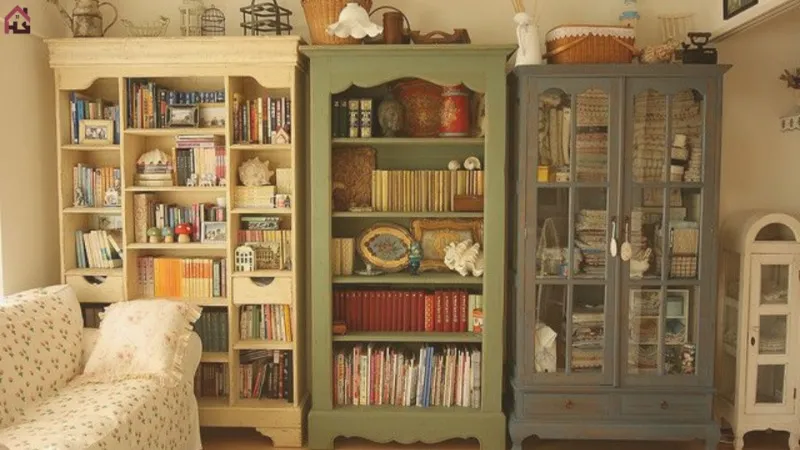
Most bookshelves end up as visual clutter too many books, no breathing room, zero personality. If your shelves feel more like storage than a style statement, you’re not alone. This guide gives you 10 proven bookshelf decor ideas, expert insights, trend forecasts, and the mistakes almost everyone makes so your shelves finally reflect the space you deserve.
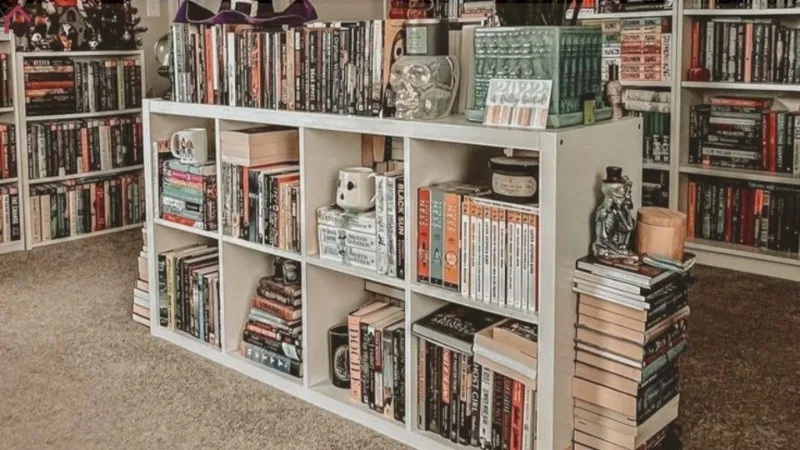
One of the most visually powerful bookshelf decor ideas is arranging books by color. Instead of organizing by author or genre, group titles into color families warm tones like red, orange, and yellow on one side, cool tones on the other. This creates an instant gallery-worthy look that draws the eye naturally across the shelf.
Interior designers often call this the “rainbow effect,” but a more refined version uses just two or three coordinated hues that match your room’s existing palette. For example, a living room with navy accents might feature a shelf organized in white, cream, and deep blue spines. This technique works especially well on open floating shelves where the books themselves are the primary décor element.
Pro Insight:
Don’t aim for a perfect rainbow. Grouping just 3 colors that match your throw pillows or rug creates a cohesive, designer-level look without buying anything new.
Layering with Art & Objects
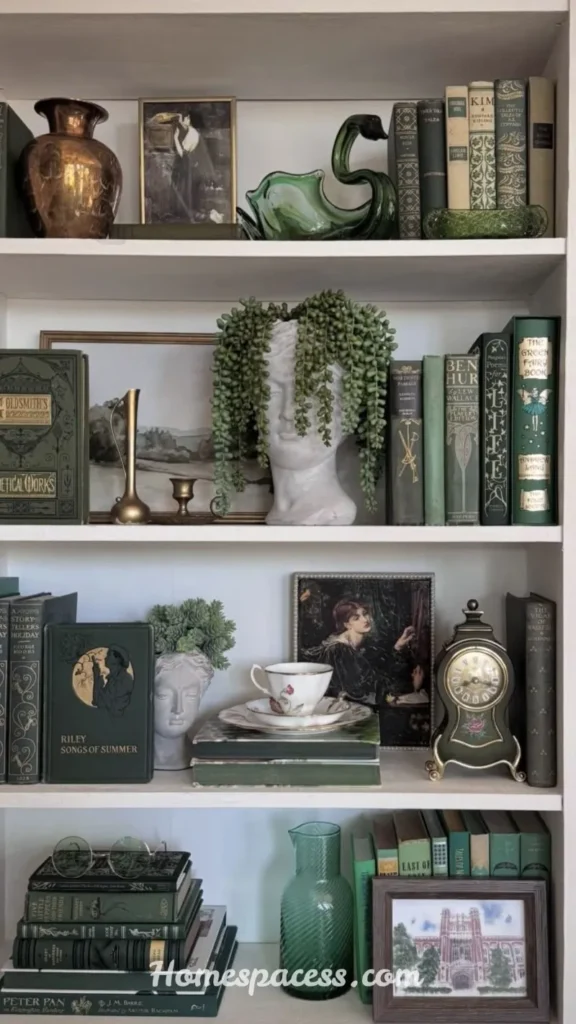
A flat row of books is visually monotonous. The fix? Layering. Place a small framed print or a decorative object in front of a book stack to create depth. Interior stylists refer to this as “the layered shelf” it mimics how a professional designer would style a vignette. Think of it as visual storytelling: your shelf should have a foreground, midground, and background.
Small ceramic sculptures, a leaning photograph, a vintage clock, or even a beautiful candle holder can transform a single shelf section into a mini art installation. The key principle is odd groupings three items almost always look more intentional than two or four. A stack of books, a small plant, and a candle is a classic trio that works in virtually any style of home.
Styling Tip
Use the “triangle rule” arrange three objects at different heights so the eye travels up, across, and down. This creates natural visual rhythm without requiring an expensive designer.
Must Read: Front Garden Ideas for Every Style From Classic to Modern Homes
“Less Is More” Shelf Edit
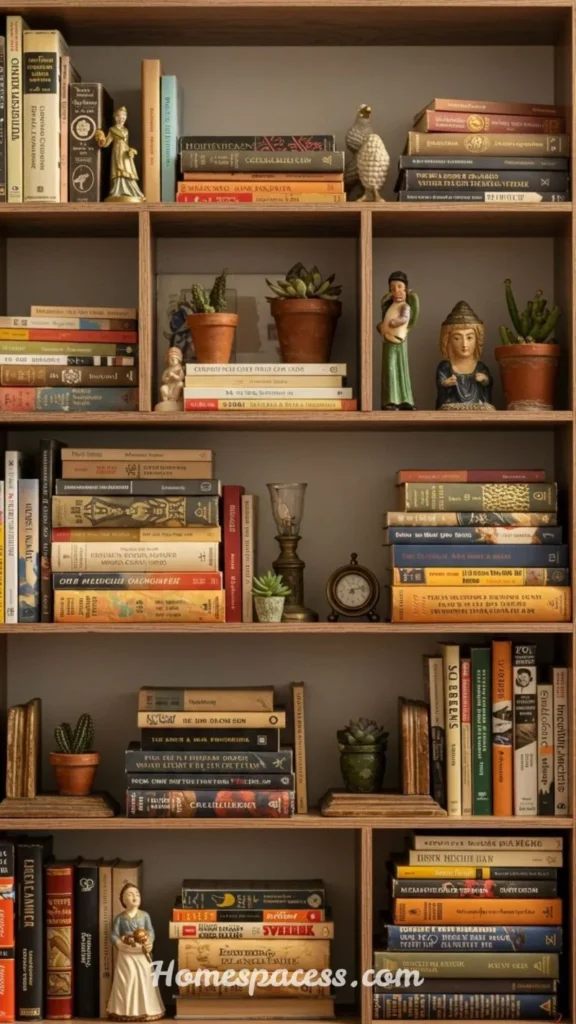
Overcrowded shelves are the most common bookshelf mistake. When every inch is filled, nothing stands out the eye has nowhere to rest. A curated shelf uses roughly 60–70% of its capacity, leaving meaningful gaps that let individual objects breathe. This isn’t about having fewer things; it’s about giving each item the space it needs to be seen.
Start by removing everything. Then reintroduce only the items that are either beautiful, meaningful, or functional. If something is just “taking up space,” consider donating or boxing it. This edit process borrowed from the capsule wardrobe philosophy gives your bookshelf a timeless, intentional look rather than a chaotic accumulation. Many interior designers recommend doing this seasonal shelf edit every three to four months.
Read More: Birthday Party Ideas for a Personal and Creative Touch
Plants as Shelf Anchors
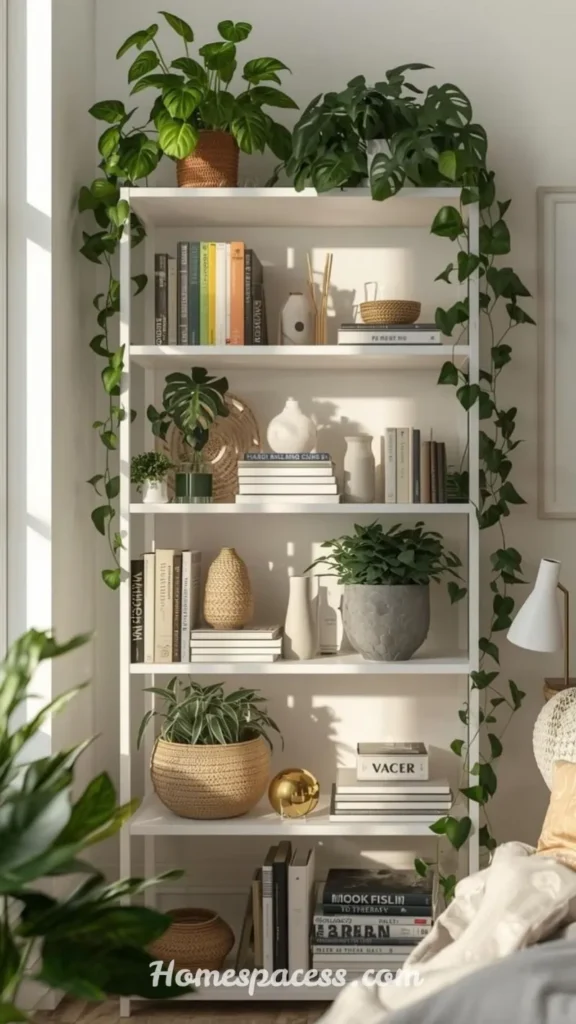
Incorporating living plants is one of the most searched bookshelf styling ideas for good reason they add life, color, and organic texture that no decor object can replicate. Trailing plants like pothos or string of pearls cascade beautifully over shelf edges, creating a lush, layered look. Upright succulents or a small snake plant work well as vertical anchors at the end of a row of books.
The practical challenge is light. Most bookshelves are not near windows, so low-light tolerant plants are essential. Pothos, ZZ plants, and ferns thrive in indirect light and can survive the drier air of an interior room. If your shelf is in a truly dark corner, high-quality silk plants have become so realistic that most guests cannot tell the difference especially when styled alongside real objects.
Mini Scenario:
A dark walnut bookshelf with a trailing pothos, a stack of cream-spined books, and a single brass figurine this combination of warm wood, living green, and metallic accent is hard to beat for a cozy, curated look.
Read Also: Creative Twin Bedroom Ideas with Modern Decor and Storage
Mixing Book Orientations
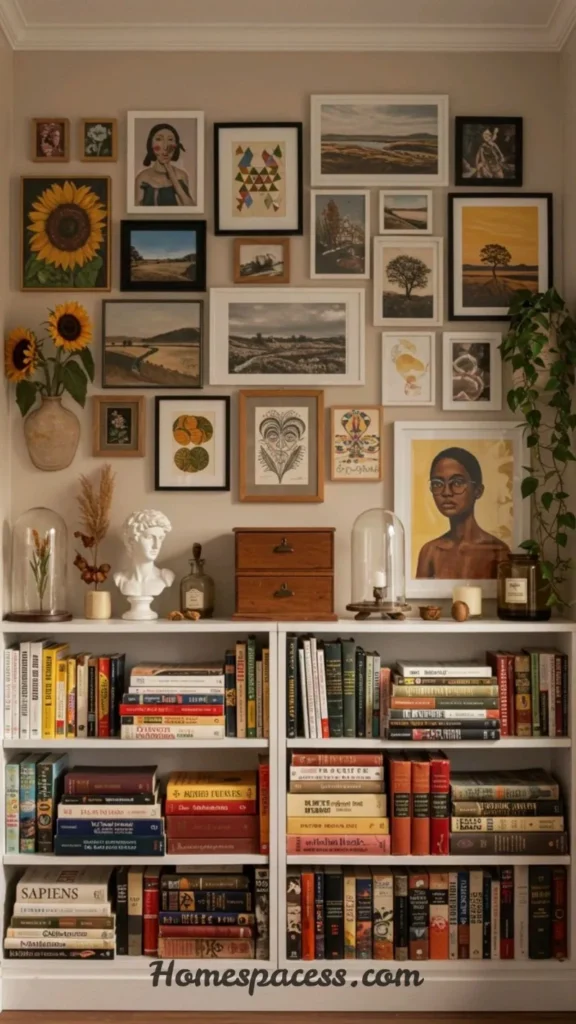
Not every book needs to stand upright. Stacking some horizontally spine out or spine inward breaks the visual monotony and creates natural platforms for small objects. A horizontal stack of three or four books topped with a small plant or a decorative stone is one of the simplest and most effective bookshelf styling techniques used by professional home stylists.
Turning books spine-inward is a controversial but growing trend. When facing the pages outward, books create a uniform wall of cream and white an almost architectural, minimalist effect. It works best in spaces with a modern or Scandinavian aesthetic where the books themselves are secondary to the overall calm of the room. The downside is practical: you can’t easily find what you’re looking for, so this technique works best on a dedicated “display shelf” rather than your everyday reading library.
Don’t Miss: Trendy Funky Bathroom Ideas for a Cool and Modern Bathroom Makeover
Using Baskets & Storage Boxes
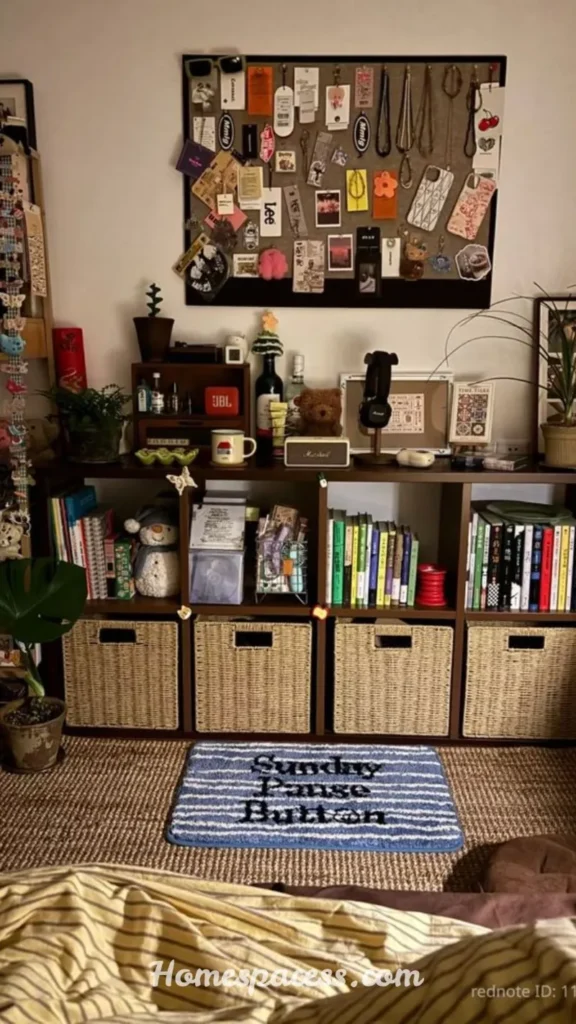
Woven baskets and fabric-covered boxes are workhorses of shelf styling. They provide hidden storage while adding texture and warmth two things a flat shelf of books alone cannot offer. A rattan basket on a lower shelf can hold remote controls, chargers, or kids’ toys, keeping the shelf functional without looking chaotic.
The material matters enormously. Seagrass and rattan have a natural, organic quality that works well in bohemian, coastal, and transitional interiors. For a sleeker, more minimal look, fabric boxes in linen or velvet feel refined and contemporary. Avoid plastic bins, which always read as temporary and out of place on a styled shelf. Even in functional spaces like home offices, a coordinated set of fabric bins in neutral colors elevates the look significantly.
Gallery-Style Shelf Curation
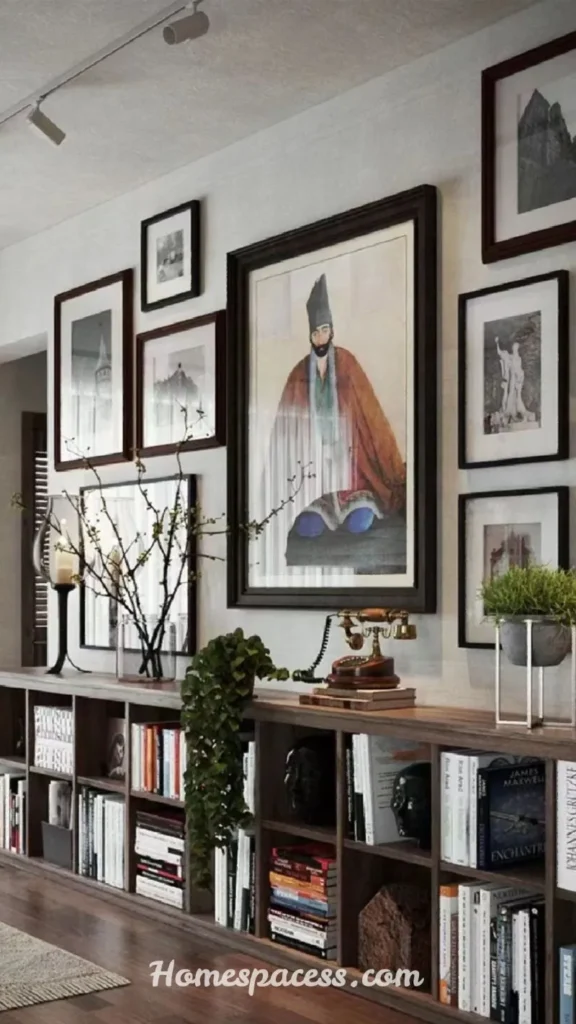
Think of each shelf as a gallery wall in miniature. Treat every section as its own composition a small framed photo leaning against the back panel, a stack of books as a “pedestal,” and a single sculptural object as the “artwork.” When you apply gallery thinking to shelves, the result is cohesive and visually compelling rather than random.
The gallery approach also means considering the shelf as a whole, not just each section individually. Stand back from your bookshelf and squint what shapes and color masses do you see? A good shelf has visual balance: heavy, darker elements on lower shelves and lighter, airier pieces toward the top. This mimics how designers install actual gallery walls, where visual weight guides placement.
Quick Test
Photograph your shelf in black and white. If every zone looks equally gray, you need more contrast add a dark object or a bright plant to create visual hierarchy.
Ambient Shelf Lighting
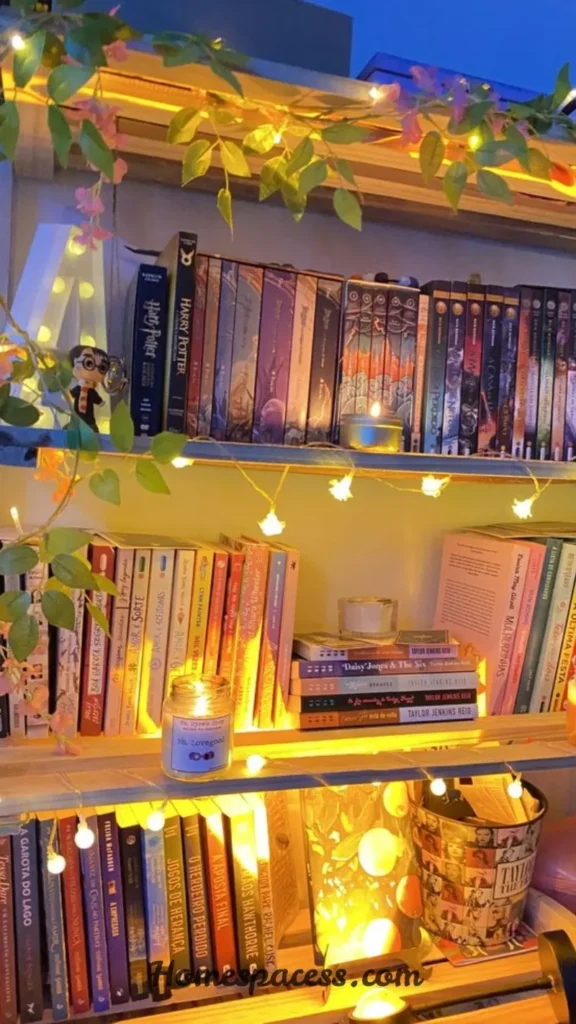
Lighting transforms a bookshelf from flat and forgettable to warm and atmospheric. Battery-powered LED strip lights placed along the back panel or under each shelf edge create a soft glow that makes the entire wall feel intentional. Plug-in puck lights or small clip-on spotlights can highlight a specific object a framed photo, a sculpture, or a favorite plant.
The color temperature of your shelf lighting matters as much as placement. Warm white (2700K–3000K) works beautifully in living rooms and bedrooms, creating that golden “candlelit” quality. Cool white (4000K+) suits home offices and modern interiors where you want clarity and precision. Many smart LED systems now allow you to shift color temperature via a phone app, giving you the flexibility to change the mood of your shelves for different times of day or occasions.
Theme-Based Shelf Storytelling
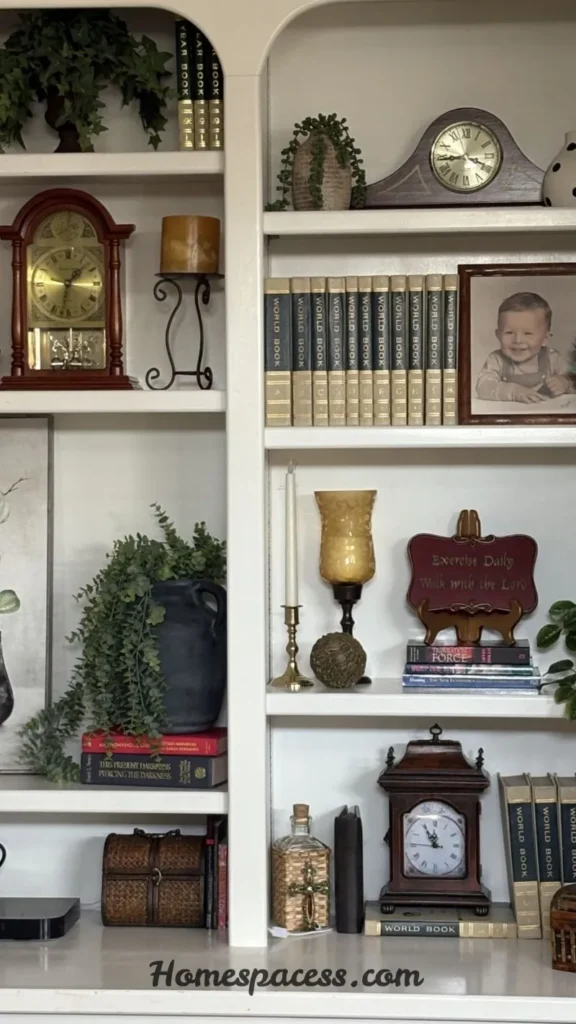
Give your bookshelf a narrative thread. A travel-themed shelf might include a globe, vintage maps folded as bookmarks visible at the top of a book, postcards leaned against the back panel, and books about geography and adventure. A wellness shelf could feature yoga and meditation books, a small crystal, a candle, and a muted plant. This thematic approach makes a shelf feel personally curated rather than randomly assembled.
Storytelling shelves are also excellent for home offices and creative spaces they communicate your identity and interests to anyone who enters the room. The best theme-based shelves tell a story without feeling like a museum display. The key is restraint: choose a maximum of five to seven hero objects that anchor the theme, then fill around them with books that reinforce it. Anything that doesn’t “belong” in the story gets removed.
Negative Space Technique
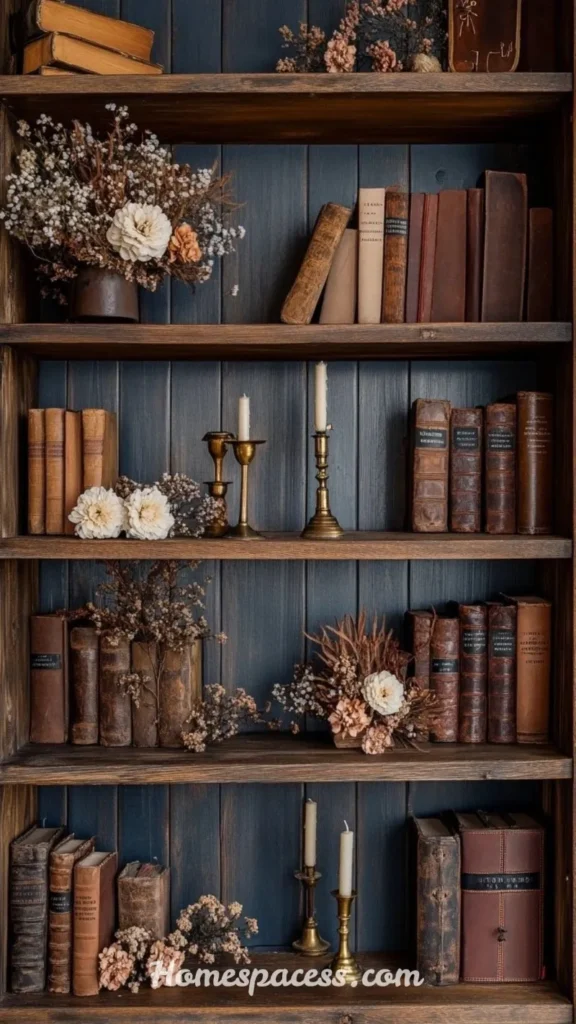
Negative space intentional empty areas on a shelf is perhaps the most underused and most powerful bookshelf decor technique. An empty section of shelf doesn’t read as “unfinished”; it reads as “confident.” It gives the eye a place to rest between the busier, styled sections and makes individual objects pop with more visual impact.
Professional interior photographers always introduce negative space before shooting a shelf, even if it wasn’t there in real life. The reason is simple: emptiness creates contrast, and contrast creates drama. In practical terms, this means leaving at least one full section of a five-section bookshelf completely empty, or leaving significant breathing room above items so they don’t feel crowded against the shelf above. This single technique alone can make an average shelf look professionally styled overnight.
Conclusion
Great bookshelf decor ideas aren’t about spending more they’re about seeing more clearly. The principles in this guide negative space, layering, material discipline, lighting, and thematic curation give you a repeatable framework that works in any home, any budget, and any style. Your bookshelf is one of the most personal spaces in a room; it’s worth the extra ten minutes of intentional styling.
As trends evolve toward lived-in authenticity, biophilic textures, and smart integration, the most future-proof approach remains the same: choose objects that mean something, arrange them with purpose, and leave room for the shelf to breathe. Start with just one shelf this weekend pick your three favorite objects, remove everything else, and see what happens.
Trend Analysis
2026 and Beyond
The biggest shift in bookshelf styling for 2026 is the move away from “perfectly curated” aesthetics toward what designers are calling “lived-in luxury.” Social media, which previously drove hyper-organized, color-blocked shelves, is now rewarding shelves that look real imperfectly stacked, personally meaningful, with evidence of actual use. This shift mirrors the broader interior design pivot from sterile minimalism toward warm, tactile, story-rich spaces.
Biophilic design is accelerating on shelves not just one trailing plant, but multi-plant micro-ecosystems where moss frames, air plants, and larger leafy species coexist. Simultaneously, upcycled and vintage objects are replacing generic décor from big-box stores. A shelf decorated with thrifted ceramics, inherited books, and handmade objects communicates authenticity in a way mass-produced items simply cannot.
Biophilic shelving:
Multi-plant micro-ecosystems replacing single decorative plants
Vintage & thrifted objects:
Authenticity over mass-produced décor
Smart ambient lighting:
App-controlled LED strips with circadian color shifts
Digital art integration:
Small digital frames displaying rotating artwork on shelves
Looking further ahead, smart shelving systems with embedded wireless charging, sensor-activated lighting, and RFID book-tracking are already in prototype stages. Within five years, the bookshelf may become an active part of a smart home ecosystem not just a display surface, but a functional interface that knows what you own, suggests what to read next, and adjusts its lighting automatically based on time of day.
Expert Practical Tips for Bookshelf Styling
Interior stylists who work on magazine shoots and showroom installations use a few specific techniques that most home decorators never consider. The first is the “rule of threes with variation” group three objects, but ensure they vary in height, shape, and texture. A tall candle, a round ceramic bowl, and a flat stack of books create far more visual interest than three similarly sized objects.
A second expert insight: always style from the back of the shelf outward. Many beginners place objects at the front first, then try to fill in behind them. Professionals work in reverse back objects first (often leaning art or a tall plant), then build forward in layers. This prevents a flat, one-dimensional result and ensures depth in every section. Think of it as building a stage set rather than filling a storage unit.
Real-World Optimization
Seasonal rotation is the most overlooked shelf optimization. Swapping just three or four objects every season adding pinecones and amber candles in autumn, fresh botanicals in spring keeps your shelf feeling current without any significant cost or effort.
The third expert-level move is controlling material variety. A shelf with too many materials glass, wood, metal, ceramic, fabric, plastic feels visually chaotic. Professionals limit decorative materials to three. Choose a primary material (say, natural wood), a secondary (ceramic), and an accent (brass). Every non-book object on the shelf should fall into one of these three material families. The result is a shelf that feels intentional and cohesive even if you don’t consciously notice why.
Sustainability & Long-Term Value in Bookshelf Decor
The most sustainable bookshelf is one you don’t need to redecorate constantly. Investing in a few high-quality, timeless objects a hand-thrown ceramic, a solid brass bookend, a well-framed print costs more upfront but delivers visual value for decades. Compare this to cycles of cheap trend-chasing décor from fast-furniture retailers, which quickly looks dated and ends up in landfill.
The growing “slow home” movement encourages treating shelf objects the way fashion minimalists treat a capsule wardrobe. Each piece is chosen deliberately, cared for properly, and used for a long time. In practical terms, this means opting for natural materials over synthetic ones a terracotta pot will look better in ten years than a plastic one; a wooden bowl develops character with age while a resin one degrades.
Books themselves are one of the most sustainable décor elements available. They represent accumulated human knowledge, they last for generations, they appreciate in sentimental value, and they don’t go out of style. A shelf full of books you’ve actually read is both more sustainable and more personally meaningful than one filled with objects that look good on social media but carry no personal story. For long-term bookshelf value, the content of your shelves matters as much as the styling.
Future Predictions
The Next Generation of Bookshelf Design
The intersection of technology and interior design will reshape how we think about bookshelves within the next decade. Modular smart shelving systems that can be reconfigured via an app and feature integrated sensors for lighting, temperature, and humidity (critical for protecting rare books) is already being developed by premium furniture companies in Scandinavia and Japan. These systems will become accessible to mainstream consumers by the early 2030s.
Digital-physical hybrid shelving is another emerging category. Small, high-resolution digital art frames that can display rotating artwork, family photos, or even AI-generated images on demand are already popular shelf accessories. Future iterations will likely integrate seamlessly into shelf design, with frames that are indistinguishable from physical artwork and can switch between “static art mode” and “ambient display mode” based on time of day or who enters the room.
Perhaps most intriguingly, AI-powered personalization will influence bookshelf curation. Future tools may analyze the colors, proportions, and lighting of your room and generate a recommended shelf layout with specific object placement essentially an on-demand interior designer for your shelves. Several proptech and interior design startups are already building early versions of this technology, suggesting it will be mainstream within five to seven years.
Common Mistakes
(and How to Fix Them)
- Overfilling every shelf section. No breathing room means no visual hierarchy. Fix: Remove 30% of items and observe the improvement immediately.
- Using objects of identical height. Same-height groupings create a flat, monotonous line. Fix: Always introduce variation one tall, one medium, one low.
- Ignoring the back panel. Most shelves have a back panel that goes completely unstyled. A coat of paint, removable wallpaper, or even a pinned fabric can transform the entire shelf character.
- Mixing too many décor styles. A shelf with rustic, modern, maximalist, and minimalist objects in the same space feels chaotic. Fix: Choose one aesthetic direction and edit ruthlessly.
- Forgetting lighting entirely. A beautifully styled shelf in a dark corner is invisible. Even a single plug-in puck light pointed at the shelf changes everything and costs less than most décor objects.
- Styling only for photos, not for daily life. If your shelf is impractical books you can’t access, plants you forget to water, objects that fall when you walk past it will look deteriorated within weeks. Style for real life first, Instagram second.
FAQ’S About Bookshelf Decor Ideas
How can I make my bookshelf look stylish?
You can add plants, candles, picture frames, and small decor items with books to create a balanced and stylish look.
What colors work best for bookshelf decor?
Neutral colors like white, beige, black, and wood tones work well and match most home styles.
How do I decorate a small bookshelf?
Use fewer items, stack books neatly, and add one or two small decorative pieces to keep it clean and organized.
Can I decorate a bookshelf on a budget?
Yes, you can use thrifted decor, DIY items, small plants, and affordable baskets for beautiful bookshelf decor ideas.
What should I avoid when decorating bookshelves?
Avoid overcrowding the shelves with too many items. Keep some empty space for a neat and modern look.

Team Home Spacess shares simple, practical design ideas that work for real families. The team focuses on cozy décor, soft colors, and natural textures that make a space feel truly lived-in. From everyday decorating tips to creative home projects, Team Home Spacess is dedicated to helping readers create warm, comfortable, and inviting spaces with a fresh and personal touch.