

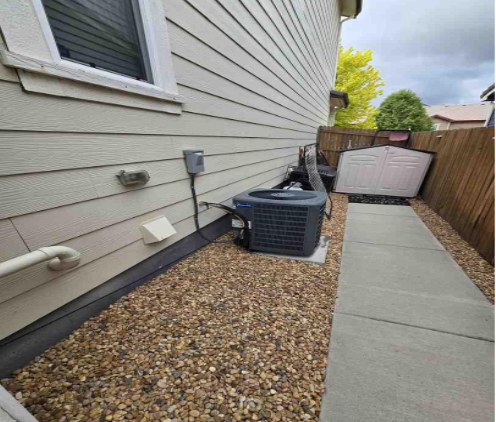
Key Differences Between Central Air and Ductless Mini Splits
Colorado’s Front Range homes face unique HVAC challenges, from hot, dry summers to surprisingly cold winters and significant altitude changes. Choosing the right cooling and heating system is more than just about comfort; it impacts your energy bills and overall home efficiency. Many homeowners find themselves weighing their options, particularly when deciding between central air vs mini split for front range homes. This decision is key for maintaining ideal indoor temperatures year-round, especially with our region’s distinct climate patterns. We understand the need for reliable, efficient systems that stand up to Colorado’s demands.
This guide aims to cut through the confusion, offering a practical comparison tailored for our local environment. We will explore the key differences between central air conditioning and ductless mini-split systems. Our focus will be on energy efficiency, installation costs, operational performance in Colorado’s unique climate, and long-term value. We will also cover specific considerations like existing ductwork, noise levels, heating capabilities for cold winters, and available incentives. By the end, you will have a clearer understanding of which HVAC solution best fits your specific needs and the unique demands of a Front Range home. For more detailed local insights, consulting with Front Range HVAC experts can provide tailored advice.
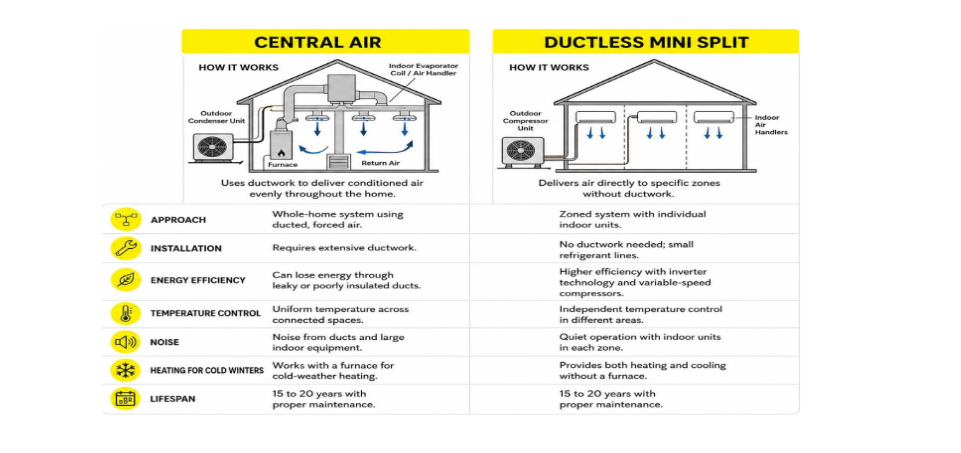
When evaluating central air versus mini-split systems, the fundamental difference lies in their approach to air distribution. Central air conditioning relies on a network of ducts to circulate conditioned air throughout a home, creating a uniform temperature across all connected spaces. This “forced air” method typically involves a single outdoor condenser unit and an indoor evaporator coil connected to a furnace or air handler. The system pulls warm air from various rooms, cools it, and then pushes it back through vents.
Ductless mini-split systems, on the other hand, operate without extensive ductwork. They consist of an outdoor compressor unit connected to one or more individual indoor air handlers via small refrigerant lines. Each indoor unit is mounted on a wall or ceiling in a specific zone, delivering conditioned air directly into that space. This “ductless technology” allows for independent temperature control in different areas of the home, a significant departure from the whole-house approach of central air.
Both systems are designed for a long service life, often between 15 to 20 years with proper maintenance. However, the presence or absence of ductwork introduces distinct advantages and disadvantages. Central air offers a discreet aesthetic, as the distribution system is hidden, but can suffer from significant “duct loss”—where conditioned air escapes through leaks or poor insulation, reducing efficiency. Mini-splits avoid this inherent energy loss, delivering air directly to where it’s needed.
Energy Efficiency and SEER2 Ratings in High Altitudes
Energy efficiency is a critical factor for Front Range homeowners, especially with fluctuating energy costs. The industry standard for measuring cooling efficiency is the Seasonal Energy Efficiency Ratio 2 (SEER2). As of October 2026, SEER2 standards are fully embraced, reflecting more accurate real-world performance by accounting for external static pressure in ducted systems.
Mini-split systems generally boast superior SEER2 ratings, often ranging from 18 to over 38. This remarkable efficiency is largely due to their use of “inverter technology” and variable-speed compressors. Unlike traditional central air units that cycle on and off at full power, inverter-driven compressors can modulate their speed to precisely match the cooling demand. This continuous, low-power operation consumes less energy and maintains more consistent temperatures.
In contrast, typical central air systems usually fall within a SEER2 range of 13 to 21, though high-end models can reach into the mid-20s. While modern central air units are more efficient than their predecessors, they still contend with the inherent inefficiencies of ductwork. Studies indicate that central air systems can lose a significant portion of conditioned air—potentially 20-30%—through leaks, poor insulation, or “thermal bypass” within the ductwork. This means a substantial amount of energy is wasted before the air even reaches your living space.
For Front Range homes, the “thin air” at high altitudes also plays a role. HVAC systems, particularly central air, have to work harder to move and condition the less dense air. This can increase the “electrical load” and impact overall efficiency. Mini-splits, by delivering air directly and often having more flexible fan speeds, can sometimes adapt better to these conditions, potentially leading to lower energy consumption.
Sound Profiles and Decibel Ratings for Living Spaces
The quiet operation of an HVAC system significantly contributes to home comfort, especially in bedrooms and home offices. When comparing “sound profiles and decibel ratings,” mini-split systems generally have a distinct advantage.
Mini-split indoor units are remarkably quiet, typically operating between 25-35 dB, which is comparable to a whisper or the stillness of a library. Advanced models can achieve even lower levels, sometimes as quiet as 20 dB, offering near-silent comfort. This is because the loudest components, such as the compressor, are located in the outdoor unit. The indoor handlers contain only a fan, which is often designed with “sound dampening” features.
Central air systems, while not necessarily “loud,” produce a more noticeable ambient sound. Their indoor blower motors and the rush of air through ducts create noise that can range from 50-75 dB, akin to gentle rainfall or a running refrigerator. The outdoor condensers for central air also contribute to noise, typically operating in a similar range. The “compressor cycling” of traditional central air units, which frequently turn on and off at full power, can also be a source of intermittent noise.
For homes with noise-sensitive areas like bedrooms or dedicated home offices, the “bedroom acoustics” can be greatly enhanced by the quiet operation of mini-splits. The absence of ductwork also eliminates potential noise from duct vibrations, air turbulence, and pressure losses that can occur in central air systems.
Evaluating Installation Costs and Home Layouts Along the Front Range
The initial “upfront investment” for any new HVAC system is a major consideration for Front Range homeowners. However, comparing costs isn requires looking beyond the sticker price to consider the full scope of the project, including “structural modifications” and the home’s existing infrastructure.
For central AC, installation costs can vary widely. If your home already has existing, well-maintained ductwork, the process is generally more straightforward, involving replacing the outdoor unit, indoor coil, and potentially the furnace. However, if your Front Range home lacks ductwork—common in older or historic properties—installing a central air system becomes a much more extensive and costly endeavor. This would require designing and installing a complete duct network, which can involve significant drywall removal, patching, and painting, leading to substantial labor and material expenses.
Mini-split systems offer a different cost dynamic. Their installation is typically less invasive, as it only requires small holes in exterior walls for refrigerant lines and electrical conduits. This makes them a flexible option regardless of whether a home has existing ducts. For a single-zone mini-split, the cost can be quite manageable. For “multi-zone layouts,” where several indoor units connect to a single outdoor unit, the costs will increase with each additional zone.
Evaluating the “total ownership cost” should factor in both installation and long-term operating expenses. While mini-splits might have a higher unit cost per ton of cooling, their installation flexibility and superior energy efficiency can often lead to greater savings over the system’s lifespan, especially in homes without existing ducts or those seeking zoned comfort.
Retrofitting Historic Homes vs Newer Builds with Ductwork
The choice between central air and mini-splits is heavily influenced by a home’s age and construction. “Historic homes” along the Front Range, often built before central air was common, frequently lack the space or structural design for traditional ductwork. Installing ducts in these properties can be incredibly disruptive and expensive, potentially compromising the home’s “architectural integrity” by requiring extensive modifications to walls, ceilings, and floors, including dealing with original “plaster walls.” In such cases, mini-splits are an ideal solution, providing modern comfort without the need for invasive renovations. Their discreet refrigerant lines can often be routed through inconspicuous pathways, preserving the home’s character.
Conversely, “newer construction” homes, including many “ranch layouts” or multi-story designs built in recent decades, typically come equipped with “existing ductwork.” For these properties, upgrading to a new central air system can be a more straightforward and cost-effective option, as much of the necessary infrastructure is already in place. The main considerations then become the condition and sizing of the existing ducts. If the ductwork is old, leaky, or improperly sized, even a new central air unit may not perform efficiently.
For homes with good existing ductwork, central air offers the advantage of hidden equipment and a familiar whole-home cooling experience. However, for additions, converted attics, or finished basements in either historic or newer homes, mini-splits can provide targeted cooling and heating without overtaxing an existing central system or requiring costly duct extensions.
Sizing and Installation Guidance from Front Range HVAC Experts
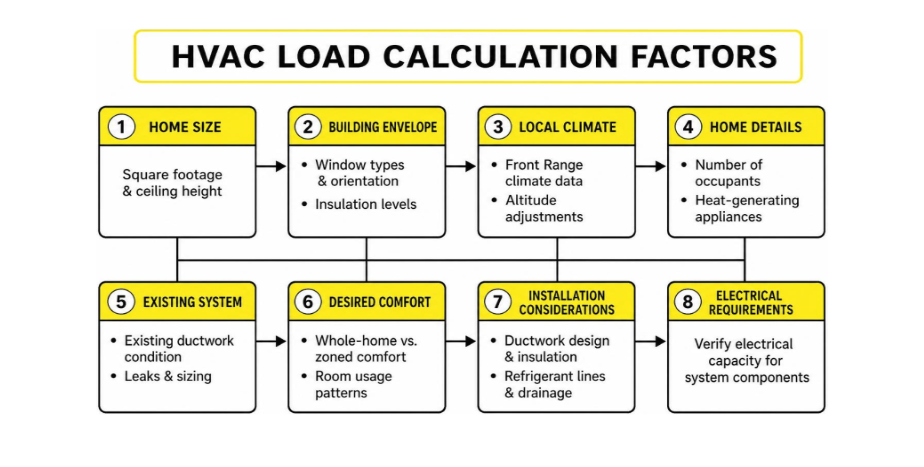
Proper sizing and installation are paramount for any HVAC system’s efficiency and longevity, especially in the unique climate of the Front Range. Undersized systems will struggle to maintain comfort, while oversized units will cycle too frequently, wasting energy and reducing indoor humidity control. This is where professional “load calculations” become indispensable.
A comprehensive load calculation, often referred to as a “Manual J” calculation, takes into account numerous factors specific to your home: square footage, ceiling height, window types and orientation, insulation levels, local climate data, and even the number of occupants and heat-generating appliances. For Front Range homes, these calculations must also incorporate “altitude adjustments.” Thinner air at higher elevations affects how efficiently HVAC equipment transfers heat, meaning a system sized for sea level would be inadequate here.
Beyond sizing, the quality of installation directly impacts performance. For central air, this includes ensuring airtight duct connections, proper insulation, and correct refrigerant charge. For mini-splits, it involves precise routing of “refrigerant lines,” ensuring proper drainage, and verifying adequate “electrical capacity” for the outdoor and indoor units.
Choosing experienced and reputable Front Range HVAC experts is crucial. They understand the nuances of local building codes, climate challenges, and the specific requirements for both central air and mini-split systems. Their expertise ensures your system is not only correctly sized but also installed to maximize efficiency, reliability, and comfort for years to come.
Operational Performance in Colorado’s Unique Semi-Arid Climate
Colorado’s Front Range is renowned for its “unique semi-arid climate,” characterized by intense sunshine, low humidity, and significant “temperature swings” – often seeing daily variations of 30-40 degrees or more. These conditions present specific demands on HVAC systems, requiring them to be highly responsive and efficient to ensure “year-round comfort.”
In the hot, dry summers, both central air and mini-splits must effectively cool homes, but the dry air can sometimes make the heat feel more intense. While central air systems can be paired with whole-home humidifiers for winter, their dehumidification capabilities during cooling are often a byproduct of the cooling process. Mini-splits, with their variable-speed compressors, can sometimes offer more precise dehumidification by running longer at lower speeds.
The “high altitude” affects system performance by reducing air density, which can make fans and compressors work harder to move air and transfer heat. This means “system responsiveness” is key to rapidly adapting to the sudden drops in temperature that can occur from afternoon thunderstorms or as evening approaches. Mini-splits, with their localized control, can quickly adjust to changes in individual zones. Central air, while providing uniform cooling, might take longer to cool down a large home after a significant temperature spike.
Cold-Climate Heat Pump Heating vs Traditional Forced Air
While the discussion often centers on cooling, the heating capabilities of both systems are equally vital for Front Range winters. Most modern mini-splits are actually “cold-climate heat pumps,” meaning they can provide both cooling in summer and highly efficient heating in winter. These advanced systems utilize inverter technology to extract heat from the outdoor air, even when temperatures drop significantly below freezing. Many are equipped with “Hyper-Heat technology,” allowing them to maintain substantial heating capacity even when outdoor temperatures are well into sub-zero ranges, reducing the need for supplemental heat.
Traditional central air systems, on the other hand, are typically paired with a “gas furnace” for heating. This “traditional forced air” heating method burns natural gas (or propane) to generate heat, which is then distributed through the ductwork. While gas furnaces are powerful and reliable in extreme cold, they rely on fossil fuels.
For homes considering a full electric solution or aiming to reduce natural gas consumption, a cold-climate heat pump mini-split can be a compelling option. However, for the very coldest days on the Front Range, some homeowners opt for “dual-fuel heating” systems. This setup combines a heat pump (often a mini-split or a central heat pump) with a conventional gas furnace. The heat pump handles most of the heating needs efficiently, and the gas furnace automatically kicks in as a “dual-fuel backup” when outdoor temperatures drop below the heat pump’s optimal operating range, ensuring consistent warmth and reliability. Heat pumps also undergo “defrost cycles” in winter to prevent ice buildup on the outdoor coil, a normal part of their operation.
Managing Extreme Daily Temperature Swings and Dry Air
The Front Range experiences “extreme daily temperature swings” that can challenge any HVAC system. It’s not uncommon for a warm, sunny afternoon to quickly turn into a chilly evening, especially in the shoulder seasons. This phenomenon, known as “diurnal swings,” demands a system that can rapidly adapt from cooling to heating, or vice versa, without excessive energy consumption.
Mini-split systems excel in this environment due to their “independent zoning” capabilities. Each indoor unit can be set to a different temperature or even heating/cooling mode, allowing you to precisely control comfort in occupied rooms while minimizing energy use in “unoccupied zones.” If the sun is beaming into your home office, you can cool that room without overcooling the rest of the house. As evening temperatures drop, you can switch the bedroom unit to heat without affecting other zones.
Central air systems, while providing uniform “whole-home humidification” (if equipped with an add-on humidifier), offer less flexibility in managing these swings across different areas. While some central systems can be zoned, it’s typically more complex and costly to implement than with mini-splits.
Both systems can benefit from additional measures to enhance “indoor comfort” in our dry climate. For central air, integrating a whole-home humidifier is a common solution to combat the dryness, especially in winter. Mini-splits typically don’t offer integrated humidification, but portable humidifiers can be used in individual zones. “Air filtration” is another important consideration. Central air systems can integrate advanced whole-home filtration, while mini-splits rely on individual unit filters, which require more frequent cleaning.
Recommendations from Front Range HVAC Experts for Maximizing Long-Term Value
Investing in a new HVAC system is a significant decision for any Front Range homeowner, and understanding its impact on “long-term value” is crucial. This includes not only the immediate comfort and efficiency benefits but also considerations like “home resale value” and the overall “appraisal impact.”
Historically, central air conditioning was often seen as the gold standard for resale value due to its discreet nature and whole-home comfort. However, as of October 2026, the market is shifting. Energy-conscious buyers are increasingly valuing homes with high-efficiency systems that promise lower utility bills. Multi-zone mini-split systems, particularly those with high SEER2 ratings, are gaining recognition for their energy savings and personalized comfort, making them an attractive feature for many potential buyers. For homes that previously lacked any cooling, adding a mini-split can significantly increase property appraisal.
Regardless of the system chosen, “routine maintenance” is the cornerstone of maximizing its lifespan and efficiency. Neglecting maintenance can lead to premature breakdowns, higher operating costs, and a shorter “system longevity.” This includes regular “filter cleaning” or replacement, professional tune-ups, and keeping outdoor units clear of debris.
Navigating Local Colorado Rebates and Federal IRA Tax Credits
Making an energy-efficient choice for your Front Range home can also unlock significant financial benefits through various incentives. The “Inflation Reduction Act” (IRA), enacted by the federal government, provides substantial “federal tax credits” for homeowners who install qualifying high-efficiency HVAC equipment.
As of October 2026, these tax credits offer up to $2,000 for qualifying heat pump systems, which includes most modern mini-split heat pumps. In contrast, cooling-only central AC units typically qualify for a smaller credit, often capped at $600. This disparity can help bridge the initial cost gap for some mini-split installations, making them a more financially attractive option.
Beyond federal incentives, many “utility rebates” are available for Colorado homeowners. Local energy providers often offer programs for installing “ENERGY STAR” certified equipment, which signifies superior “energy efficiency.” These programs can provide additional cash-back incentives or discounts. We always recommend checking with your local utility company and consulting with your HVAC professional to understand all available “heat pump incentives” and other rebates that could apply to your specific installation. These incentives can significantly reduce the overall cost of upgrading to a more efficient system.
Why Front Range HVAC Experts Recommend Hybrid Configurations
For many Front Range homes, the ideal solution isn’t necessarily an “either/or” choice between central air and mini-splits, but rather a “hybrid HVAC” approach. This strategy combines the strengths of both systems to create a custom-tailored comfort solution that addresses specific home challenges and maximizes efficiency.
“Front Range HVAC experts” frequently recommend hybrid configurations for homes with particular needs, such as “multi-story homes” where upper floors tend to be warmer, or properties with “attic conversions” and “finished basements” that may not be adequately served by existing ductwork. In these scenarios, a central air system can efficiently handle the main living areas, providing uniform comfort and discreet aesthetics. Simultaneously, mini-split units can be installed in “problem” areas or additions, offering “supplemental zoning” and precise temperature control where it’s needed most.
This approach ensures “balanced airflow” throughout the entire home, eliminating hot and cold spots without overtaxing a single system. It allows homeowners to take advantage of the high efficiency and individualized control of mini-splits in specific zones, while still benefiting from the whole-home distribution of central air in other areas. A hybrid system can be particularly effective in older homes where extending ductwork is impractical, or in newer homes where additions create new comfort demands.
Frequently Asked Questions About Front Range Cooling Solutions
Homeowners often have specific questions when considering central air versus mini-split systems, especially concerning “inverter efficiency,” “maintenance frequency,” and “winter heating performance.” Let’s address some of the most common inquiries.
Can a mini split completely replace a central furnace in Colorado winters?
Yes, in many cases, a modern “cold-climate heat pump” mini-split can indeed completely replace a central furnace for heating in Colorado winters. These advanced systems are designed to extract heat from outdoor air even in very low temperatures, with some models maintaining significant heating capacity well into “sub-zero reliability.”
However, for homes in areas experiencing prolonged periods of extreme cold, or for homeowners seeking extra peace of mind, a “dual-fuel backup” system might be considered. This setup integrates a heat pump (mini-split) with a traditional furnace, allowing the furnace to automatically take over when temperatures drop below the heat pump’s most efficient operating range. This ensures consistent warmth regardless of how harsh the winter gets. Consulting with a local HVAC professional is crucial to determine the best approach for your specific home and comfort preferences.
How much energy do ductless mini splits save compared to central AC?
Ductless mini-splits typically offer substantial energy savings compared to central AC systems, particularly older models. The primary reasons for this are the “duct loss elimination” and superior “zone control.” Central air systems can lose a significant percentage of conditioned air through leaky or poorly insulated ducts. Mini-splits bypass this issue entirely by delivering air directly to the living space.
Furthermore, mini-splits allow for precise “zone control,” meaning you only cool or heat the rooms you are actively using. This eliminates wasted energy on unoccupied areas. While specific savings vary based on home size, insulation, usage patterns, and the efficiency of the old system, many homeowners report a noticeable “utility bill reduction,” with some experiencing monthly electricity savings in the range of 25-40% compared to traditional central air.
How frequently do mini split and central AC air filters need maintenance?
Maintaining air filters is crucial for the efficiency and air quality of both systems, but the “maintenance frequency” differs.
For central air systems, filters generally need replacement every 30 to 90 days, depending on factors like pet ownership, allergies, and overall household activity. Regular “filter replacement intervals” ensure proper airflow and prevent dust and debris from accumulating on the indoor coil, which can reduce efficiency and potentially damage the system.
Mini-split systems typically use “reusable filters” within each indoor unit. These filters should be cleaned more frequently, usually every 14 to 45 days. Cleaning involves simply removing and rinsing them under water. This more frequent attention to “airflow maintenance” is essential for mini-splits to operate efficiently and maintain good indoor air quality. Both systems also require annual professional tune-ups to ensure optimal performance and longevity.
Conclusion
Choosing between central air and a mini-split system for your Front Range home involves a careful consideration of various factors, each playing a crucial role in your comfort and long-term investment. Our “system comparison summary” highlights that central air excels in providing discreet, whole-home uniformity, especially in properties with existing, well-maintained ductwork. Mini-splits, conversely, shine in their energy efficiency, “personalized comfort” through zoning, and adaptability for homes without ductwork or for specific problem areas.
The unique demands of our Colorado climate, including high altitude, extreme temperature swings, and dry air, underscore the importance of selecting a system with strong “climate adaptability” and responsiveness. Both systems have evolved significantly, with modern iterations offering impressive efficiency and performance.
The best choice is one that aligns with your home’s specific layout, your comfort preferences, and your budget for both initial installation and long-term operational costs. For many Front Range residents, a hybrid approach—combining central air for main living spaces with mini-splits for additions or challenging zones—offers a balanced and highly effective solution. By prioritizing “long-term efficiency” and considering the potential “investment return” through energy savings and enhanced home value, you can make an informed decision that ensures comfortable and cost-effective living for years to come.

Team Home Spacess shares simple, practical design ideas that work for real families. The team focuses on cozy décor, soft colors, and natural textures that make a space feel truly lived-in. From everyday decorating tips to creative home projects, Team Home Spacess is dedicated to helping readers create warm, comfortable, and inviting spaces with a fresh and personal touch.