

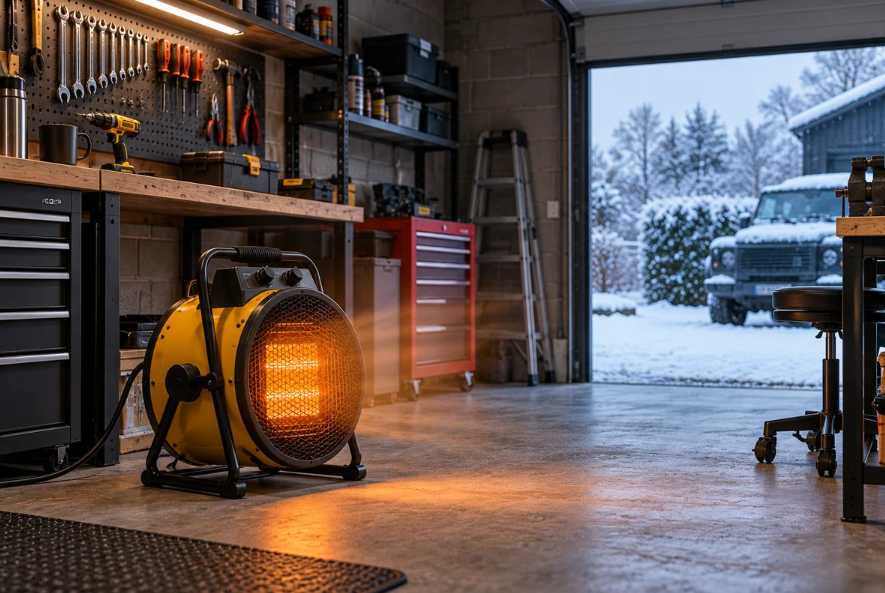
A cold workspace slows people down long before it becomes unbearable. Fingers lose dexterity, adhesives and paints cure poorly, and workers spend more time warming up than working. Portable electric heaters offer a flexible answer, since they need no fuel lines, produce no combustion gases, and can move to wherever the work is. Picking the wrong one, however, leads to tripped breakers, uneven warmth, or a safety hazard. The sections below cover how to match a heater to the space, how to size it, what electrical requirements apply, which safety features matter, and where to place the unit for the best result.
Match the Heater Type to the Work
Portable electric heaters fall into a few broad categories, and each suits different conditions. Forced-air heaters use a fan to blow air across heated elements, warming the air in a room quickly. They work well in enclosed workshops and garages where the goal is to raise the overall temperature. Many models include a thermostat, so they cycle on and off to hold a set level.
Radiant or infrared heaters warm objects and people directly, without relying on air movement. That makes them useful in drafty or open areas, such as a job site with doors left open, where heated air would escape. A worker standing in the path of the radiant heat feels warm even when the surrounding air remains cold.
Some units combine both approaches, or add features such as oscillation, adjustable heat settings, and portable frames with wheels. Rugged construction with metal housings and protective guards suits industrial environments, while lighter consumer models are designed for occasional use in a home garage.
Think about how the heater will be used before choosing. A shop that runs all day needs a durable unit built for continuous duty. A garage used on weekends may need less capacity but benefit from easy storage. A job site calls for something that can be carried, stand on uneven ground, and survive occasional knocks.
Sizing the Heater to the Space
Sizing is where most buying mistakes happen. A heater that is too small never reaches the target temperature, runs continuously, and frustrates the people in the room. A unit that is too large cycles frequently, wastes electricity, and may overload the circuit.
Heater capacity is expressed in watts or kilowatts, and in many catalogs also in BTU per hour. One watt produces about 3.41 BTU per hour, so a 5,000-watt heater delivers roughly 17,000 BTU per hour. Product pages at suppliers such as Industrial Fans Direct list wattage, BTU output, voltage, and amperage together, which makes side-by-side comparison straightforward.
A common rule of thumb for an insulated space with a standard ceiling height is roughly ten watts per square foot, adjusted for conditions. Poor insulation, large doors, uninsulated concrete floors, high ceilings, and very cold climates each raise the requirement. A garage with a metal overhead door loses heat quickly, so it may need considerably more capacity than its floor area suggests.
Account for the temperature rise you actually need. Heating a space from 40 degrees Fahrenheit to 65 requires less than heating from 10 degrees to 65. Calculate the difference between the outdoor design temperature and the target indoor temperature, then consider the volume of the space and its insulation level. For uncertain cases, choose a unit with an adjustable thermostat and slightly more capacity than the minimum, so it can reach the target without running flat out.
Voltage, Amperage, and Circuit Limits
Electrical requirements determine whether a heater can run at all. Small portable units typically operate on standard 120-volt circuits, and larger models need 208, 240, or 480 volts, sometimes with three-phase power. Check the nameplate rating and confirm that the supply matches before purchase.
Circuits have limits. A 15-amp, 120-volt circuit supports a maximum of 1,800 watts, and electrical codes in many regions limit continuous loads to 80 percent of that, around 1,440 watts. Heaters run for hours, so they count as continuous loads. Plugging a 1,500-watt heater into a circuit shared with other tools can trip the breaker repeatedly or create a fire risk.
Before ordering from a supplier like Industrial Fans Direct, confirm the receptacle type, the breaker size, and the wire gauge serving the location. Higher-power heaters often require a dedicated circuit and hardwired or locking connections installed by a qualified electrician. Never replace a plug or modify a cord to fit an outlet it was not designed for.
Extension cords deserve special caution. Heaters draw high current, and a light-duty cord can overheat. If a cord is unavoidable, use a heavy-gauge, short, and properly rated one, plug it directly into the wall, and avoid daisy chaining. Many manufacturers advise against extension cords altogether, so follow the instructions supplied with the product.
Safety Features That Matter
A heater runs for long periods, often unattended or near materials that can burn, so safety design deserves close attention. The following features are worth looking for:
- Tip-over protection that shuts the unit off if it falls or is knocked askew
- Overheat protection that cuts power if internal temperatures exceed safe limits
- A thermostat that holds temperature without constant adjustment
- Guards or grilles that keep hands, cords, and debris away from hot elements
- Certification marks from recognized testing laboratories, showing the product met applicable standards
- A cord and plug rated for the load, with strain relief where it enters the housing
Electric heaters avoid carbon monoxide, which is a clear advantage over fuel-burning units in enclosed spaces. They still carry fire risks if placed near flammable items, and they can present burn and shock hazards. Workshops and garages often hold solvents, sawdust, paint, rags, and fuel, so keep the area around the heater free of these. Store flammable liquids in approved containers away from the work area.
Add basic monitoring. A smoke alarm in the space provides early warning, and a fire extinguisher rated for electrical fires should be within reach. Inspect cords and plugs before each season, and replace any unit with damaged insulation, discoloration, or a loose connection.
Placement and Everyday Use
Where a heater sits shapes how well it works. Place it on a stable, level, non-combustible surface, and keep the clearances listed in the manual, which are commonly several feet on all sides and above. Never cover a heater or drape clothing over it to dry.
For forced-air models, point the airflow along the length of the space and toward the area where people work, rather than straight at a wall. Raising the unit slightly off the floor, within the manufacturer’s guidelines, can improve circulation and keep it away from dust and water. In a large shop, two smaller heaters at opposite sides can distribute warmth more evenly than one large unit in a corner.
Radiant heaters work best aimed at the work position, with a clear line of sight between the heater and the people it serves. Avoid directing them at reflective surfaces, plastic items, or vehicles with sensitive finishes.
Pair the heater with simple measures that conserve energy. Close doors, seal gaps around overhead doors, hang insulated curtains, and heat only the zone in use. Turn the heater off when nobody is present. Review the setup at the start of each winter, as changes in the shop layout can alter airflow, clearances, and electrical loads.
Final Analysis
The right portable electric heater comes from matching four things: the type of heat to the work, the capacity to the space, the voltage and amperage to the available circuit, and the safety features to the conditions. A little calculation before purchase prevents most of the common problems, such as underpowered units and tripped breakers. Careful placement and basic housekeeping then keep the heater safe and effective through the season. With those pieces in place, workshops, garages, and job sites stay comfortable enough that people can focus on the job instead of the cold.

Team Home Spacess shares simple, practical design ideas that work for real families. The team focuses on cozy décor, soft colors, and natural textures that make a space feel truly lived-in. From everyday decorating tips to creative home projects, Team Home Spacess is dedicated to helping readers create warm, comfortable, and inviting spaces with a fresh and personal touch.