

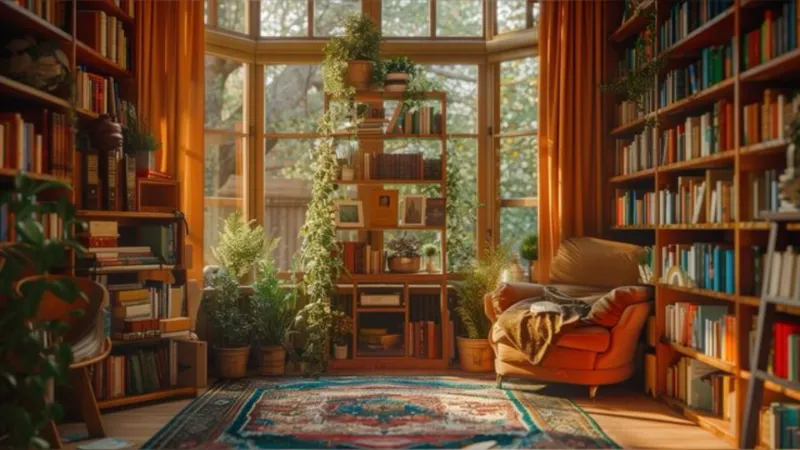
A cramped corner and a stack of unread books does not have to stay a wasted opportunity. Many homeowners assume a real home library needs a spare bedroom or a mansion-sized study, so the idea gets shelved before it starts.
The truth is simpler: small library room ideas work because they lean on smart layout, vertical storage, and intentional lighting rather than square footage. This guide walks through nine practical, tested approaches to turn even a tiny nook into a small home library you will actually use.
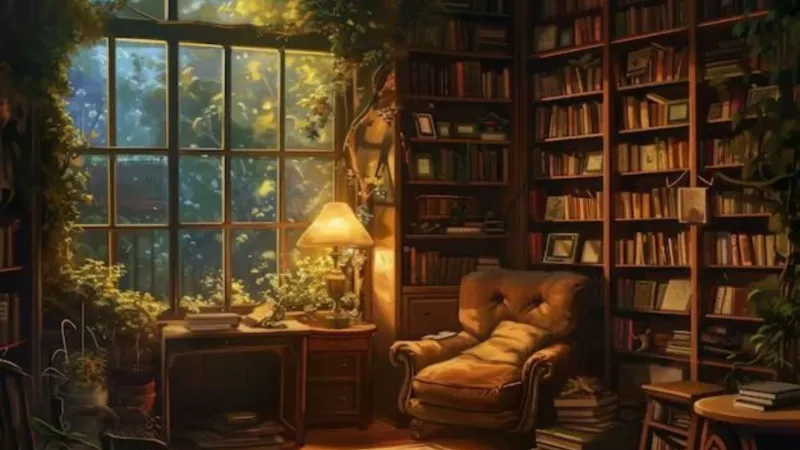
Whether you are converting a closet, a landing, or a slice of your living room, these small library design strategies balance function, comfort, and style. Each idea below includes a styling note and a pro tip so you can apply it the same afternoon you read it.
Turn a Reading Nook Into a Functional Small Library Corner
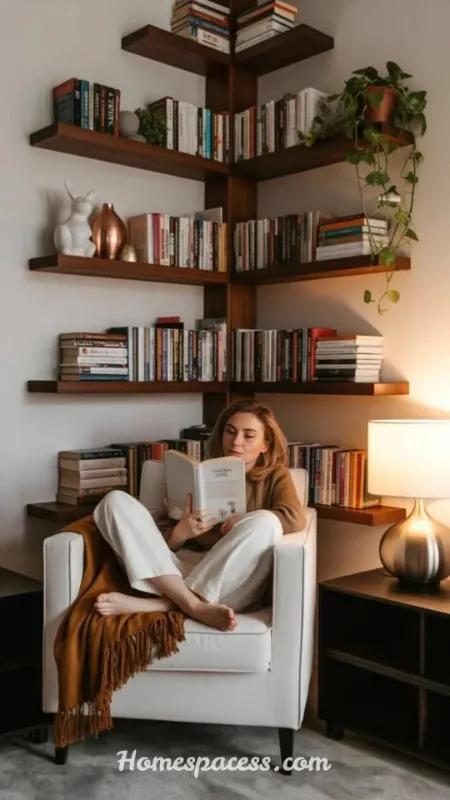
The fastest way to start designing a small home library is to claim one corner and commit to it fully. A single armchair, a slim floor lamp, and one tall bookshelf can transform an ignored corner into a reading nook that feels intentional rather than accidental.
Anchor the space with a rug that visually separates it from the rest of the room. This small trick tells your brain the corner is a destination, not just leftover floor space, which matters more than most people expect in small space library planning.
A reading light on a dimmer switch extends the corner’s usefulness into the evening. Warm 2700K bulbs keep the nook cozy without glare, which is essential in compact library design where light sources sit close to the seating.
| Style Note: Pair a deep-toned accent chair with lighter walls so the seating area pops without shrinking the room visually. |
| Pro Tip: Measure your chair’s swing radius before placing shelves; 30 inches of clearance keeps the nook usable, not cramped. |
See Related Articles: 11 best Small Home Office Ideas That Interior Designers Swear By in 2026
Use Floor-to-Ceiling Shelving for Maximum Small Library Storage
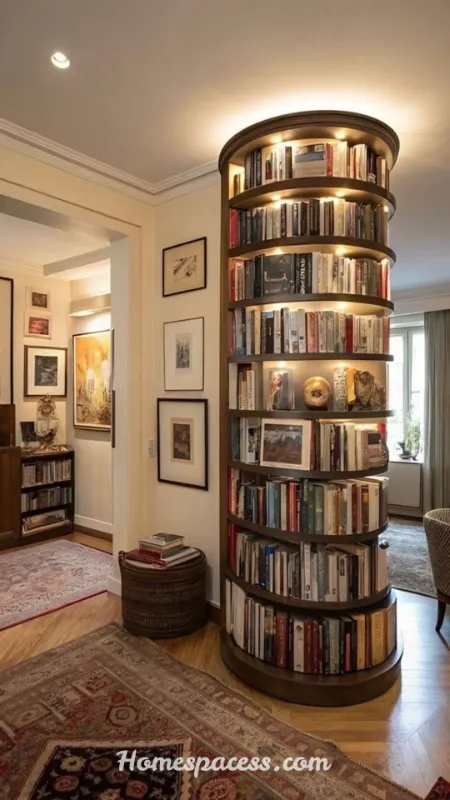
Vertical space is the most underused asset in small library room ideas, and floor-to-ceiling shelving solves that instantly. Instead of spreading books across a wide, low unit, stack shelving up to the ceiling to multiply storage without adding footprint.
This approach works especially well in rooms with 9-foot or taller ceilings, where the top shelves can hold decorative baskets or rarely used volumes. A rolling library ladder is a classic touch, but a simple step stool works just as well for small home library shelving.
Consider open shelving on the top two-thirds and closed cabinets below. This split keeps books visible where they matter and hides clutter, bulky binders, or seasonal items at eye level, which is a common library storage solution used by professional organizers.
| Style Note: Group books by color or size on the top shelves to create a calm visual rhythm from across the room. |
| Pro Tip: Anchor tall shelving units to wall studs; unsecured units are a real tipping hazard in narrow rooms. |
You May Also Like: Stunning Grazing Table Ideas to Wow Every Guest
Add a Built-In Window Seat With Hidden Storage
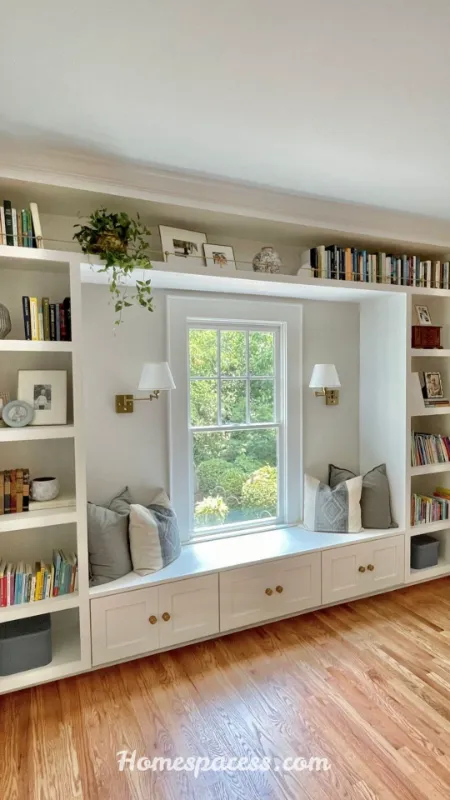
A window seat is one of the most efficient small library design strategies because it merges seating, storage, and natural light into a single footprint. Built-in benches with a hinged or drawer base can hold dozens of books without taking up floor space.
Position the seat under the brightest window in the room so daytime reading needs no artificial light. This placement also frees up wall space elsewhere for additional compact library shelving, since the window wall is otherwise hard to use for tall furniture.
Cushion the seat with a firm foam insert covered in a durable, washable fabric. In a small home library, this bench often doubles as guest seating, so comfort and easy cleaning both matter.
| Style Note: Layer two throw pillows and a lumbar cushion to make the window seat feel finished, not like an afterthought bench. |
| Pro Tip: Use piano hinges on the seat lid so it stays supported open while you dig through the storage below. |
Recommended for You: Smart Library Office Room Ideas to Design a Beautiful and Functional Reading Space
Design a Ladder-Access Library Wall in a Tight Footprint
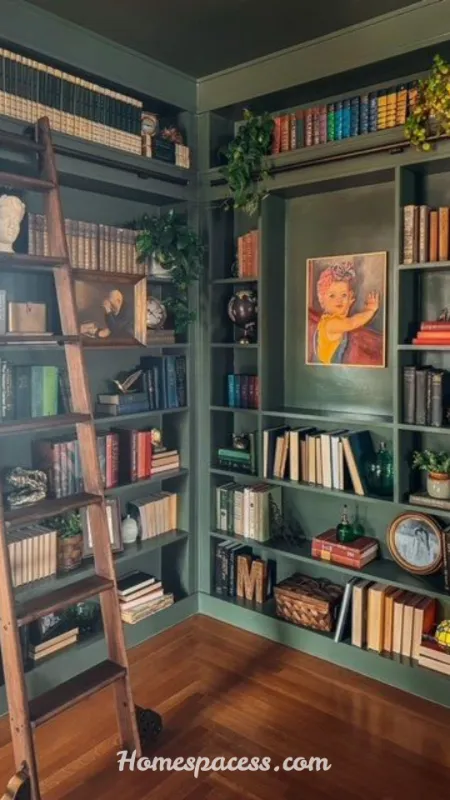
For rooms under 100 square feet, a single dedicated library wall often outperforms scattered shelving. This is one of the more dramatic small space library approaches, turning one wall into a floor-to-ceiling backdrop that instantly signals a serious reading room.
A sliding or rolling ladder keeps the top shelves accessible without permanent floor clutter from a stepstool. Many homeowners find this single design choice does more to create a genuine home library aesthetic than any other single upgrade.
Keep the opposite wall intentionally light, whether that is a window, a mirror, or a pale paint color. This contrast keeps the room from feeling boxed in, which is the biggest risk in any small space library with dense shelving.
| Style Note: Choose a matte black ladder track against white shelving for a striking, gallery-like contrast. |
| Pro Tip: Confirm your ceiling height and shelf depth match your ladder hardware specs before installation; return policies on custom rails are often strict. |
Discover More: Front Door Decor Ideas to Instantly Boost Your Curb Appeal
Convert an Unused Closet Into a Micro Library
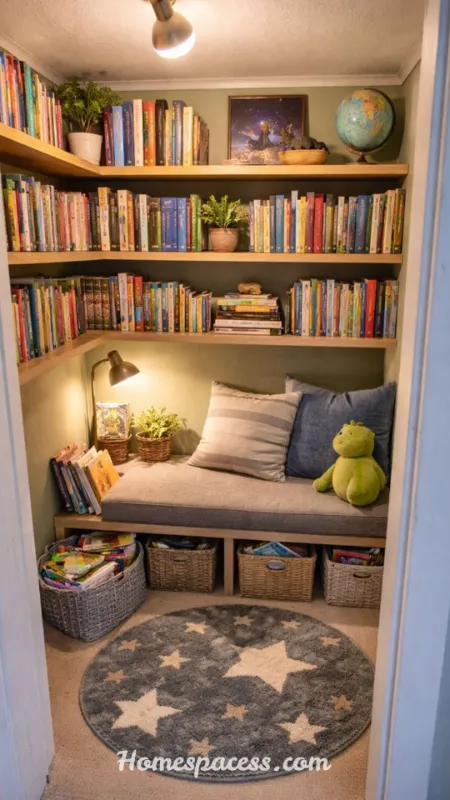
A deep reach-in closet, once cleared out, is a surprisingly capable home for small library room ideas. Removing the closet doors and adding shallow shelving creates a self-contained reading alcove that barely registers as lost space in the rest of the home.
Install a small bench or floor cushion just outside the closet opening so the space still feels like a room, not a storage unit. This detail is what separates a genuine micro library from a glorified bookshelf.
Add a battery-powered puck light or a plug-in sconce inside the closet frame, since most closets lack adequate overhead lighting. Good light is non-negotiable in any compact library design, and closets are usually the dimmest spot in the house.
| Style Note: Paint the interior back wall a saturated color to give the converted closet a boutique, intentional feel. |
| Pro Tip: Measure book depth, not just shelf width; most paperbacks and hardcovers need at least 8 inches of shelf depth to sit flush. |
See Also: Front Door Entryway Ideas: Stunning Ways to Create a Welcoming Home Entrance
Multi-Purpose the Room With a Fold-Down Desk
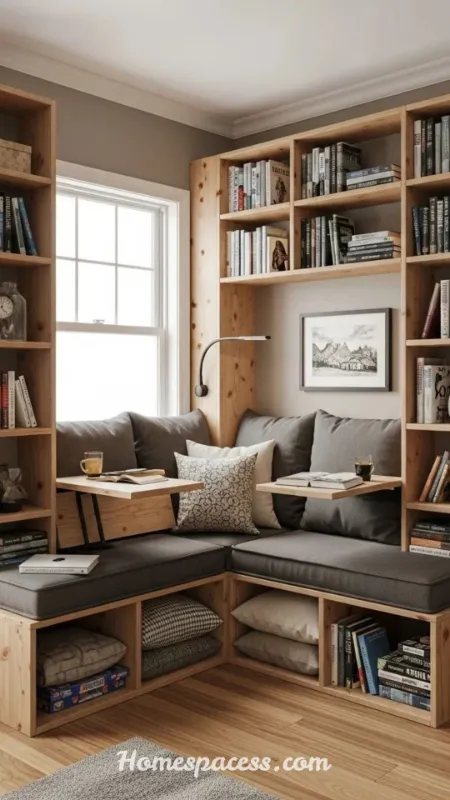
Many small home libraries also need to function as a workspace, guest room, or hobby nook. A wall-mounted fold-down desk keeps the room flexible without permanently sacrificing floor space, making it one of the most practical multi-use library solutions for small homes.
When folded up, the desk becomes nearly invisible against the surrounding shelving, preserving the room’s primary identity as a reading space. This is especially useful in apartments where a dedicated home office library is a luxury few floor plans allow.
Choose a desk with at least 20 inches of depth when open, enough for a laptop and a notebook without feeling cramped. Pair it with a slim stool that tucks fully under the desk when not in use.
| Style Note: Match the desk’s wood tone to your shelving so the fold-down unit reads as part of the built-in, not an add-on. |
| Pro Tip: Install the desk hinge at 28 to 30 inches from the floor to match standard desk height once unfolded. |
More on This Topic: Under Stairs Storage Ideas: Smart Ways to Transform Wasted Space into Functional Storage
Layer Lighting for Comfort and Depth

Lighting is one of the most overlooked factors in compact library design, yet it changes how the entire space feels more than any furniture choice. A single overhead fixture flattens a small room; layered lighting adds the depth that makes a library feel established.
Combine three sources: ambient overhead light, a task lamp near the seating, and accent lighting inside or above the shelving. This layering is standard practice in home library lighting design used by interior designers to make small rooms read as curated, not cramped.
Dimmable LED strip lighting tucked under shelf edges adds a soft glow without heat or bulk. It also highlights book spines in the evening, giving the room a boutique bookstore feel long after the sun goes down.
| Style Note: Stick to warm white LEDs (2700K–3000K) throughout; cool white lighting makes small rooms feel clinical rather than cozy. |
| Pro Tip: Test bulb placement before mounting fixtures permanently; even a few inches of difference can create glare on glossy book covers. |
Related Articles: Indoor Plants Ideas to Bring Life, Color, and Freshness to Your Home
Choose a Compact, Multi-Functional Seating Layout
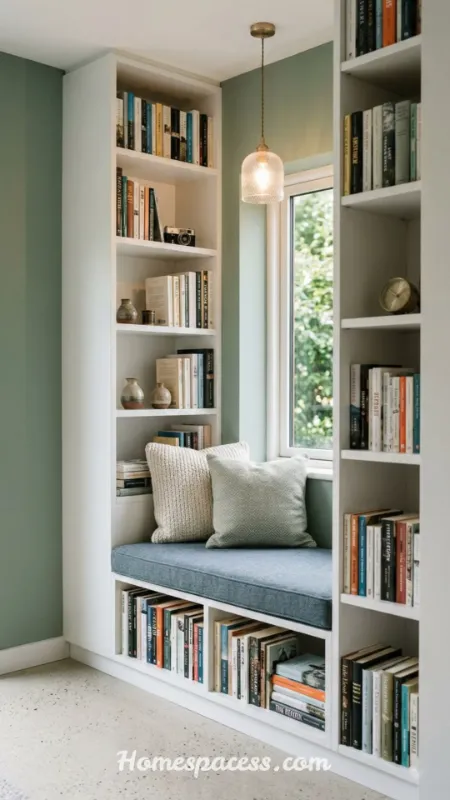
Seating choice can make or break a small library room layout under 80 square feet. A single oversized recliner often eats the room’s usable floor space, while two slim slipper chairs or a loveseat with exposed legs preserve visual openness.
Furniture with visible legs, rather than skirted bases, keeps sightlines open across the floor, an easy trick that makes any compact library design feel larger than its actual dimensions. This is a favorite technique among small-space stagers.
If floor space is extremely tight, a wall-mounted drop-leaf table paired with a single chair creates a flexible reading spot that can be cleared in seconds for other uses.
| Style Note: Select fabric in a tone close to the wall color so seating blends rather than competes with the shelving behind it. |
| Pro Tip: Leave at least 36 inches of walking clearance between seating and shelving to keep the room functional for two people. |
Must Read This Topic: Inspiring Yoga Room Ideas to Create Your Perfect Sanctuary at Home
Use Mirrors and Glass to Visually Expand the Space
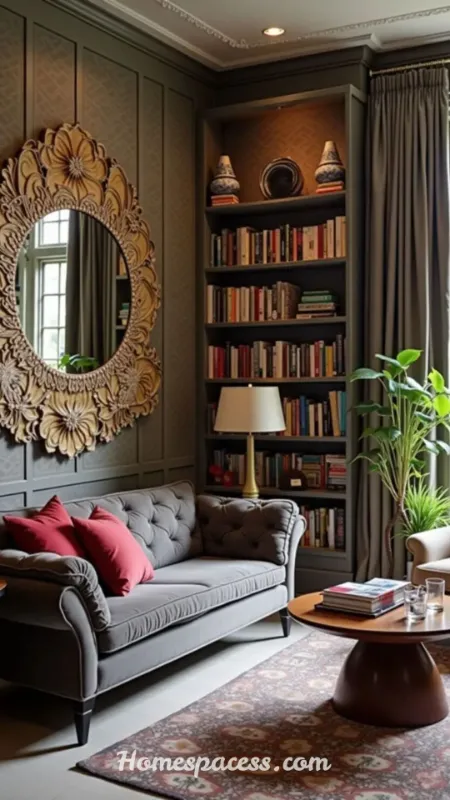
One of the simplest small-space upgrades costs almost nothing: add a mirror. Positioned opposite a window or lamp, a large mirror bounces natural and artificial light across the room, making a tight small library room feel noticeably more open.
Glass-front cabinet doors on lower shelving achieve a similar effect while still protecting books from dust. This detail is common in small home library design because it keeps the room feeling curated rather than boxed in by solid wood fronts.
Avoid placing mirrors directly across from cluttered shelving, since the reflection doubles the visual noise instead of the light. A clean wall or a single art piece opposite the mirror works best.
| Style Note: A vintage arched mirror leaning against the shelving wall adds character while performing the light-bouncing trick. |
| Pro Tip: Angle mirrors slightly to reflect ceiling or window light rather than a cluttered corner, which amplifies brightness without amplifying mess. |
Final Thoughts
A small footprint is not a design limitation; it is simply a different set of rules. From floor-to-ceiling shelving to a single well-lit reading chair, these small library room ideas prove that a genuine home library can fit into almost any corner.
The real takeaway is that intention beats square footage every time. Pick one or two ideas from this guide, measure carefully, and start building a small home library that earns its place in your home.
Going Deeper: Expert Perspective on Small Library Design
Trend Analysis: Small Library Room Design in 2026 and Beyond
In 2026, small library room ideas are shifting away from the all-white minimalist shelving that dominated the last decade. Designers are now favoring warm wood tones, deep jewel-colored walls, and textured wallpaper behind open shelving to give small libraries a lived-in, layered feel.
Multi-functional furniture is also trending upward as more homes convert guest rooms and awkward nooks into reading spaces. Fold-down desks, storage benches, and modular shelving units that can be reconfigured are replacing fixed built-ins, giving homeowners flexibility as their needs change year to year.
Biophilic touches, such as a single trailing plant on a high shelf or a live-edge wood reading surface, are appearing more frequently in small home library design. This reflects a broader shift toward rooms that feel calming and grounded rather than purely decorative.
Expert Insights: Practical Tips for Living With a Small Library
Interior designers who specialize in compact spaces consistently point to one rule: edit your book collection before you shelve it. A curated 150-book library styled with intention reads as far more sophisticated than 400 books crammed spine-out with no breathing room.
A recurring real-world scenario: a couple converting a 7-by-9-foot spare room found that adding a single reading chair before finishing the shelving helped them judge sightlines accurately. Furnish the seating first, then build shelving around the confirmed layout rather than guessing dimensions on paper.
Professional organizers also recommend the 80/20 rule for small library storage: keep 80 percent of shelving for books and display, and reserve 20 percent for baskets or bins that catch mail, chargers, or seasonal decor. This keeps the room from becoming general clutter storage.
Sustainability and Long-Term Value in Small Library Design
Choosing solid wood or FSC-certified shelving over particleboard alternatives costs more upfront but pays off over a decade of use. Small libraries see frequent handling, from sliding books in and out to leaning on shelf edges, and solid materials hold up far better under that daily wear.
Built-in shelving also adds measurable resale value in real estate markets where home offices and reading rooms are in demand post-2020. A well-executed small library room can function as a selling point rather than a niche feature when the home eventually goes to market.
From a long-term cost perspective, investing in adjustable shelving brackets rather than fixed shelves allows the room to adapt as book collections grow or shrink, avoiding a full remodel later. This flexibility is a strategic advantage that flat, non-adjustable units cannot offer.
Future Predictions: Where Small Home Libraries Are Headed
Smart lighting integration is likely to become standard in small home library design within the next few years, with app-controlled color temperature replacing simple dimmer switches. This allows a single room to shift from bright task lighting during the day to warm ambient light in the evening automatically.
As remote work stays common, expect more small libraries to double as video-call backdrops, pushing demand for shelving styled with intentional negative space rather than wall-to-wall books. This crossover between home office library design and on-camera presentation is already influencing shelf styling trends.
Modular, tool-free shelving systems are also expected to grow in popularity, especially among renters who want the floor-to-ceiling look without permanent wall damage. Expect more furniture brands to release stackable, freestanding units designed specifically for small-footprint reading rooms.
Common Mistakes to Avoid When Planning a Small Library Room
The most frequent mistake when planning a small library room is overbuying shelving before measuring the actual book collection. Homeowners often install units sized for an aspirational library rather than the one they own, leaving half-empty shelves that make the room feel unfinished.
Skipping lighting planning is another common oversight. A room stacked with dark wood shelving and no layered lighting will feel like a storage closet rather than a retreat, regardless of how well the furniture is arranged.
Finally, many homeowners ignore weight limits when mounting shelving into drywall alone. Books are heavier than most people estimate, and shelving anchored without hitting wall studs is a leading cause of shelf failure in compact library design projects.

Team Home Spacess shares simple, practical design ideas that work for real families. The team focuses on cozy décor, soft colors, and natural textures that make a space feel truly lived-in. From everyday decorating tips to creative home projects, Team Home Spacess is dedicated to helping readers create warm, comfortable, and inviting spaces with a fresh and personal touch.