

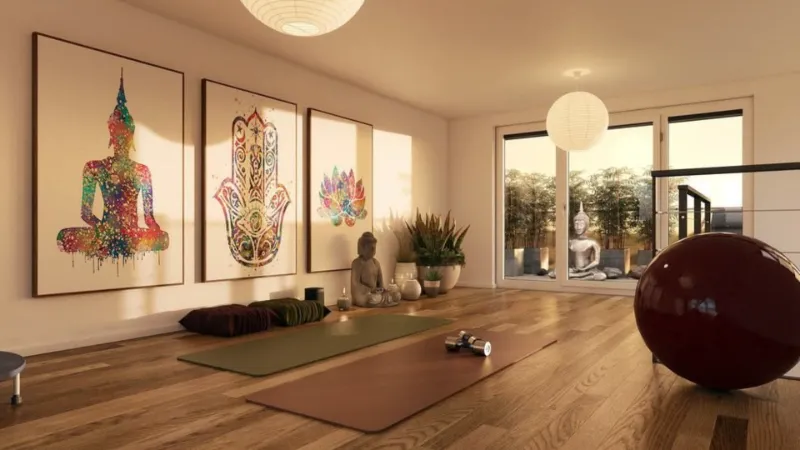
Your home yoga practice deserves a space that actually supports it. Here’s how to design one that calms the mind, motivates the body, and stands the test of time.
Most people who do yoga at home don’t have a dedicated space they roll out a mat in the living room, push the coffee table aside, and hope nobody walks in. The result? Distracted sessions, inconsistent practice, and a half-hearted relationship with something that deserves far more. A thoughtfully designed yoga room changes all of that.
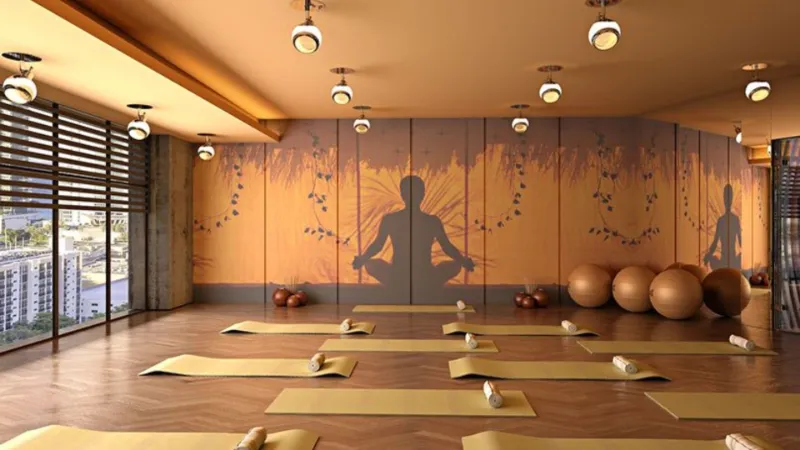
Whether you’re converting a spare bedroom, reclaiming a basement corner, or carving out a nook in a studio apartment, the principles remain the same: reduce visual noise, support proper movement, and create an atmosphere that signals “this is practice time” to your nervous system. This guide covers 10 of the best yoga room ideas backed by interior design principles, wellness research, and real-world experience to help you build a space that works as hard as you do.
Maximize Natural Light for an Energizing Practice Space
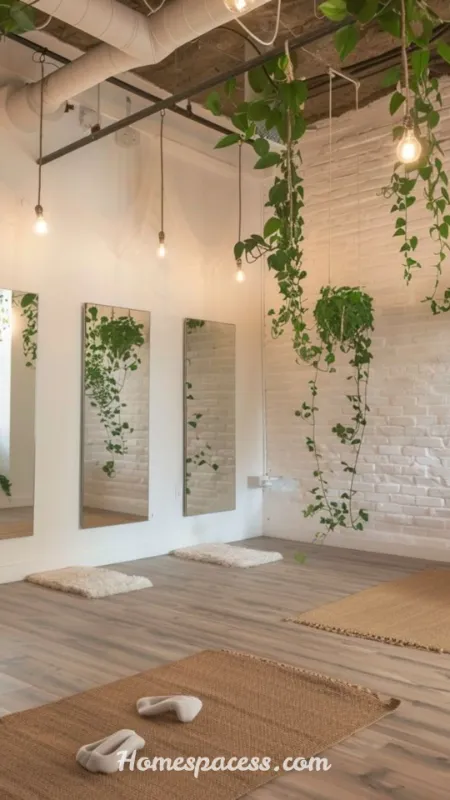
Natural light is the single most underrated element in yoga room design. Studies on circadian rhythm and mood consistently show that exposure to daylight improves focus, reduces cortisol, and supports the kind of calm alertness that enhances a yoga practice.
If your room has windows, treat them as the architectural feature they are don’t hide them behind heavy curtains or large furniture. Orient your mat so you face the light during morning sessions and move parallel to it in the afternoon to avoid glare during prone poses.
If your available space lacks good natural light, don’t give up work with what you have. North-facing rooms receive consistent, cool-toned light that’s excellent for long, focused sessions. South-facing rooms flood with warmth in winter and can feel inspiring for vinyasa flows. Skylights, if you have the ability to install them, are transformative: top-down light creates a studio-like quality that feels both focused and expansive. Even a single enlarged window can completely change how a room feels during practice.
Consider installing sheer, neutral-toned linen curtains that diffuse rather than block light. This gives you control over glare during hot afternoon sessions while preserving the ambient glow that makes a space feel alive. Avoid blackout curtains in yoga rooms unless you specifically practice pranayama or yoga nidra (where darkness is beneficial) the light itself is part of the design.
Style Note:
Pair east-facing windows with light bamboo flooring to amplify morning warmth. For west-facing rooms, use cream-toned walls that soften the golden late-afternoon light rather than intensifying it. Linen drapes in sand or ivory add texture without interrupting the natural luminosity.
💡Pro Tip:
Place a large mirror opposite your best window to effectively double the perceived natural light in the room. This is a technique borrowed from professional yoga studio design it works just as powerfully in a home setting without any renovation.
Top Stories: Best Gaming Chair Ideas for Comfortable and Stylish Gaming Rooms
Choose the Right Yoga Room Flooring for Comfort and Safety
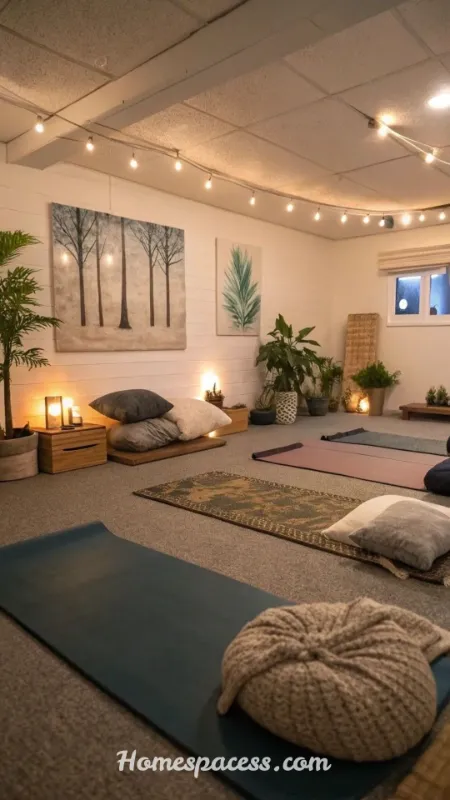
Flooring is the foundation of your yoga room literally. The wrong surface can cause joint strain, mat slippage, and discomfort during seated sequences. The ideal yoga flooring provides just enough cushion to protect knees and hips, while being firm enough to support balance poses with stability.
Cork flooring has emerged as the top professional recommendation: it’s naturally antimicrobial, slightly warm underfoot, sustainably sourced, and provides a medium-density base that works with or without a mat. It also has a quiet natural appearance that never competes with the room’s overall aesthetic.
Avoid wall-to-wall carpet, which traps dust and allergens, makes balance poses unpredictable due to its spongy give, and becomes hygienic nightmare after years of barefoot practice. Polished concrete, popular in modern studios, looks striking but is hard and cold only practical with high-quality mats and in warm climates.
Consider adding a small area rug near your bolster storage for a designated meditation corner this breaks the room into functional zones without walls. A hemp or jute rug adds natural texture and signals a transition from active practice to stillness, which is a subtle but effective psychological cue for your nervous system.
Style Note:
For a cohesive aesthetic, match your flooring tone to your wall palette. Warm-toned cork pairs beautifully with sage green or warm white walls. Lighter natural wood floors work well with dusty blue or terracotta tones, creating a grounded, earthy atmosphere without feeling rustic.
💡Pro Tip:
If you can’t change your flooring, invest in an extra-large yoga mat (200cm × 100cm) or a full-room cork tile overlay. These portable solutions are reversible, affordable, and make any surface practice-ready without a renovation commitment.
Keep Reading: Smart Boys Bedroom Ideas: Cool & Modern Designs for Kids
Use a Calming Color Palette That Supports Mental Clarity
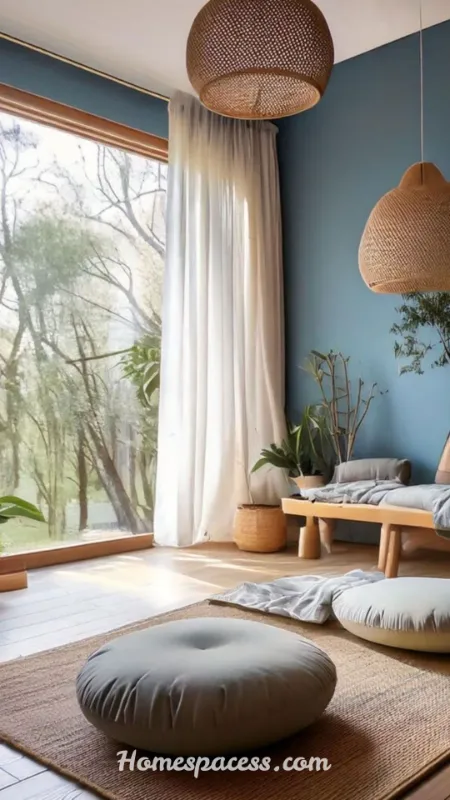
Color psychology plays a direct role in how the body responds to a space. For a yoga room, the goal is a palette that eases the transition from an active, stimulated mind to a focused, present state. The most effective yoga room colors are muted, desaturated, and rooted in nature.
Dusty sage green, warm white, soft terracotta, sand, and pale clay tones dominate the best-designed home yoga spaces globally and for good reason. These hues reduce visual stimulation, lower perceived stress, and make the room feel like a deliberate retreat rather than a functional corner of the house.
Avoid highly saturated or cool-toned colors like electric blue, bright yellow, or stark white. While these can be energizing in a gym or office, they work against the parasympathetic nervous system activation that yoga is designed to produce.
Consider a two-tone approach: a slightly deeper shade on the wall you face during practice (your focal wall), and a lighter, complementary tone on the remaining three walls. This creates a natural focal point without any art or decoration, and subtly draws the eye during meditation. It’s a technique used in professional retreat center design that translates beautifully at home.
Style Note:
The current leader in yoga room color palettes is “warm mineral” a family of tones inspired by desert and clay landscapes: dusty rose, warm putty, aged terracotta, and sage. These tones photograph beautifully, age gracefully, and create an inherently calming atmosphere regardless of lighting conditions.
💡Pro Tip:
Test your paint color at three different times of day morning, midday, and evening before committing. Natural and artificial light interact dramatically with paint tones. A sage green that looks perfect in daylight can shift to a murky gray under warm bulbs at night if not chosen carefully.
Latest Articles: Trendy Baby Nursery Ideas for Boys That Make Your Room Look Amazing
Design Smart, Minimal Storage for Your Yoga Equipment
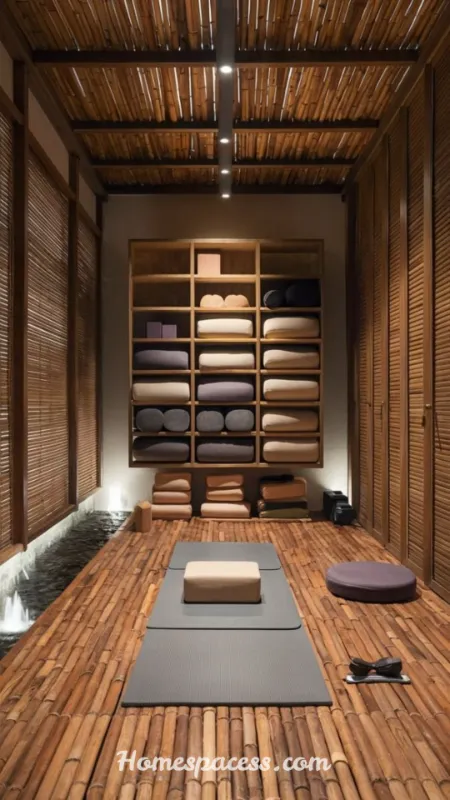
Clutter is the enemy of calm. One of the most overlooked aspects of designing a home yoga room is integrating storage solutions that keep props accessible without making them visually dominant. Yoga props blocks, straps, bolsters, blankets, wheels are practical tools, but when scattered across the floor or piled on a folding chair, they disrupt the visual stillness that makes a yoga space feel like a sanctuary.
Natural materials bamboo, rattan, wicker add warmth and keep the aesthetic in harmony with the wellness environment. For mats and bolsters, a wall-mounted hook rail or a simple ladder shelf keeps things off the floor and creates a clean line that makes the room feel larger and more open.
For small rooms, think vertically. A floor-to-ceiling shelving unit along one wall with props on the lower shelves and decorative items higher up maximizes storage without encroaching on practice space. Alternatively, a bench with an integrated storage cavity at the entrance of your yoga space serves double duty as a seat for removing shoes and a chest for blankets and smaller props. This practical detail is common in commercial studios but rarely applied in home settings.
Style Note:
Choose storage in the same tonal family as your walls for a built-in, seamless look. White shelves against white walls disappear visually. Warm wood tones on sage walls create beautiful contrast. Avoid black storage units in yoga rooms they anchor the space too heavily and work against the sense of lightness the room should embody.
💡Pro Tip:
Use identical baskets or bins for items that don’t need to be on display resistance bands, extra straps, healing crystals, journal. Matching containers create visual order instantly. IKEA’s Knipsa or similar woven baskets are a budget-friendly solution that looks far more elevated than it costs.
You May Also Like: Trendy Funky Bathroom Ideas for a Cool and Modern Bathroom Makeover
Use Strategic Mirror Placement to Enhance Alignment and Space
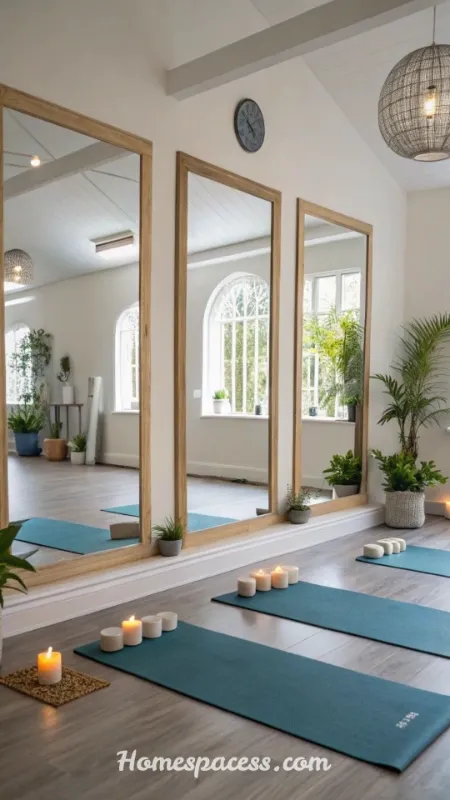
Mirrors in a yoga room serve two functions that are often in tension: they expand the perceived space and allow you to check alignment both valuable but they can also create visual stimulation that works against a meditative atmosphere. The key is strategic placement rather than full-coverage mirroring (which can feel more “gym” than “sanctuary“).
A single, large-format mirror on one wall ideally your lateral wall rather than the wall you face during practice gives you alignment visibility during standing sequences without dominating your meditative focal point.
Lean-against-the-wall mirrors are preferable to fixed wall-mounted mirrors in yoga rooms for two reasons: they’re adjustable, and they have a more casual, studio-like quality that feels less clinical. Large arched mirrors, in particular, have become a signature element of elevated yoga room design their curved form adds softness, and their height is practical for seeing full-body alignment in standing poses.
Style Note:
For a boutique-studio feel at home, lean two identical narrow mirrors side by side to create a diptych effect. Frame them identically in natural rattan and space them 10cm apart. This creates visual interest, ample alignment reference, and a decor moment that doesn’t feel like a standard “mirror wall.”
💡Pro Tip:
During meditation and restorative yoga, cover your mirror with a flowing linen cloth or a lightweight tapestry. This removes the visual noise of your own reflection during inward-focused practices a technique used in many professional meditation centers that’s easily replicated at home.
Must Read Articles: Stunning Living Room Carpet Ideas: Transform Your Space with Style, Comfort & Expert Insight
Incorporate Biophilic Design to Connect With Nature Indoors
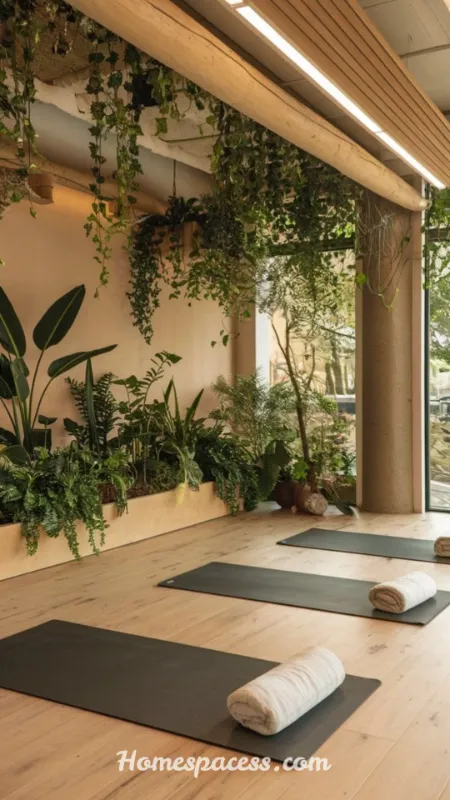
Biophilic design the intentional integration of natural elements into interior spaces is not a trend. It’s a response to a fundamental human need. Research published in multiple environmental psychology journals confirms that proximity to natural elements (plants, water, wood, stone, natural light) measurably lowers cortisol, reduces heart rate, and improves mood. In a yoga room, where the entire point of the practice is to shift the nervous system out of stress mode, biophilic design is not decoration it’s functional design.
The most accessible biophilic element is indoor plants. Hanging plants in macramé holders near windows add height and movement their gentle swaying in air currents becomes a passive, calming focal point during longer holds. For beginners, snake plants and ZZ plants thrive in almost any light condition and require minimal maintenance, removing the stress of keeping them alive.
Beyond plants, introduce natural materials throughout the room: a rough-cut stone as a bookend on your prop shelf, a driftwood decorative element, a water feature (even a small desktop fountain contributes significantly to the sensory atmosphere). Raw wood surfaces, woven hemp textiles, and ceramic bowls filled with river pebbles all carry the same restorative quality.
Style Note:
The “grounded botanicals” aesthetic pairs dark emerald plant foliage against warm terracotta walls and pale wood floors. This three-toned natural palette green, clay, wheat is the signature look of the most-photographed home yoga spaces on Pinterest and Instagram in 2026–2027, for good reason: it works in virtually every lighting condition.
💡Pro Tip:
Group plants in odd numbers (three, five, or seven) at varying heights this mimics how plants grow naturally in the wild and looks far more intentional than evenly spaced, same-height arrangements. Place the tallest behind, the mid-height in the center, and the smallest in front for a layered botanical vignette.
Reader Favorites: Wall Painting Ideas That Make Your Home Feel Warm and Inviting
Create a Personal Altar or Focal Point to Anchor Your Practice
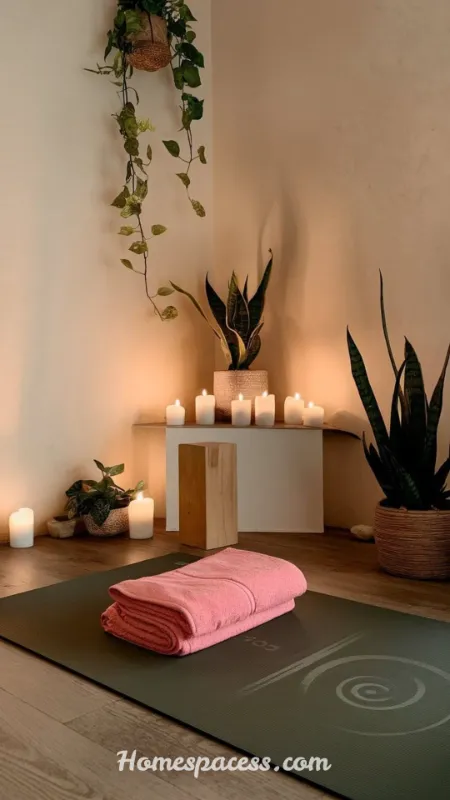
Every meaningful yoga space has a focal point something that the eyes and mind can return to when attention wanders. In traditional yoga studios, this is often a Ganesh statue, a mandala tapestry, or a simple candle. In a home yoga room, your focal point should be deeply personal. This intentional focal point shifts the room from generic to sacred from any room to your room.
A small floating shelf at eye level when seated, holding a candle, a plant cutting in a ceramic vase, a meaningful stone, and perhaps a small deity or symbolic figure this composition takes minutes to create and has a disproportionate impact on how the space feels. It signals to your mind that something different happens here, and over time that signal becomes a conditioned response that deepens your practice simply by walking into the room.
Rotating your altar seasonally keeps it feeling alive rather than static. In winter, add warmer tones amber candles, cinnamon sticks, dried seed pods. In spring, fresh flowers, green stones, lighter fabrics. This seasonal rotation is a practice in itself a mindful acknowledgment of time and change and it prevents the altar from becoming background noise that you stop seeing over time.
Style Note:
Keep altar compositions to an odd number of elements typically three or five for visual balance. Use varying heights (tall candle, medium vase, small stone) to create a natural cascade. Limit your color palette on the altar to two tones maximum to avoid visual clutter in what should be a point of simplicity and rest.
💡Pro Tip:
Place your altar below a small wall-mounted light or directly in a pool of natural light. The way light falls on a carefully arranged surface creates a sense of sacred space in any culture, any context. It’s one of the oldest visual cues for “something meaningful happens here” and it works in a yoga room just as powerfully as in any temple.
Recommended for You: Kitchen Lighting Ideas to Create a Cozy and Modern Cooking Space
Design Your Yoga Room’s Sound Environment for Deeper Focus
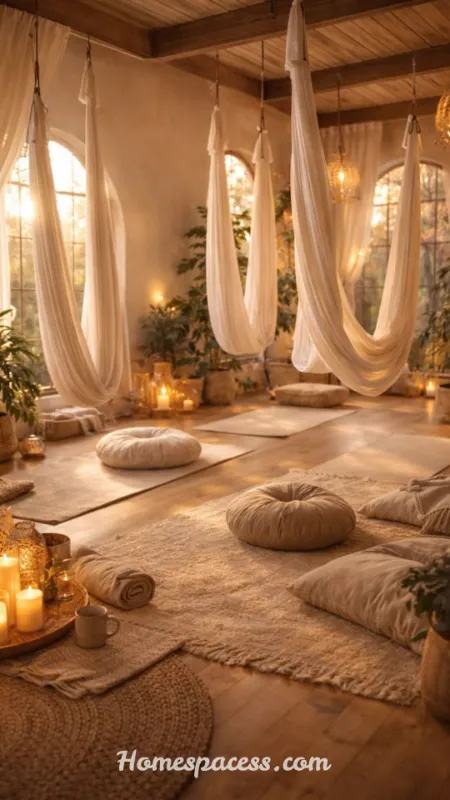
Sound is the most overlooked dimension of yoga room design and often the one that makes or breaks a session. Hard surfaces (tile, concrete, large windows) create reverberant, echo-heavy acoustics that make every movement louder and every thought more distracted. Soft surfaces textiles, plants, rugs, curtains absorb sound and create the acoustic quality of studios that seem naturally quieter even without professional soundproofing.
A quality wireless speaker not a phone on a shelf dedicated to your yoga room changes the quality of practice significantly. Sound becomes part of the environment rather than an afterthought. Position it at ear level when seated, at the corner of the room rather than directly in front of you, so the sound envelopes the space rather than addressing you directly. This is a professional studio setup principle that most home practitioners miss entirely.
For practitioners who work with silence, consider a small white noise machine or a desktop fountain. These mask external sounds (traffic, neighbors, household noise) without adding stimulating music. The sound of moving water is particularly effective because it triggers alpha brainwave patterns associated with relaxed alertness exactly the state that supports deep yoga practice.
Style Note:
Integrate your speaker into the room’s aesthetic rather than treating it as a technical device. Many high-quality speakers now come in natural materials or neutral finishes Sonos Era 100 in white or black, Transparent Speaker in clear acrylic that blend into a yoga room without becoming a focal point. Consider building it into a bookshelf vignette surrounded by natural objects.
💡Pro Tip:
Create two or three dedicated playlists for different practice types active vinyasa, restorative, and pure silence/nature sounds and link them to your smart home or speaker’s quick-play feature. Removing the decision of what to play before practice eliminates a small friction point that, consistently, makes you more likely to actually get on the mat.
Discover More: Front Garden Ideas for Every Style From Classic to Modern Homes
Layer Your Yoga Room Lighting for Any Time of Day
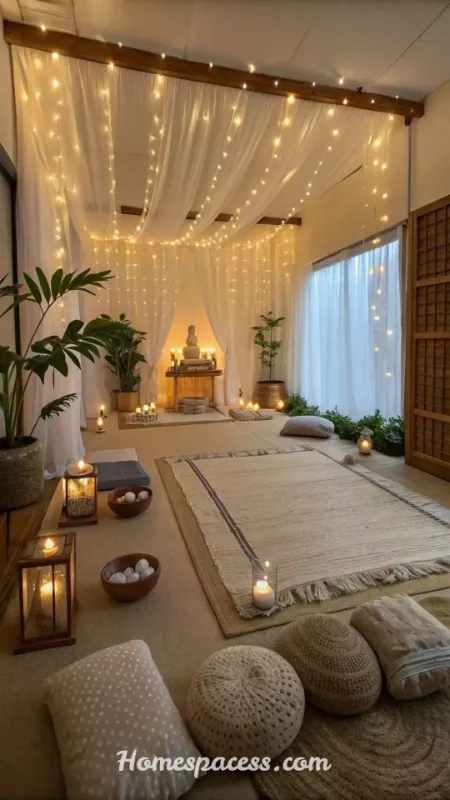
A yoga room that works beautifully at 7am should feel equally supportive at 7pm and those two lighting needs are very different. At dawn, you want bright, slightly cool light that supports wakefulness and clear focus. In the evening, warm, dim, indirect light eases the transition into restorative practice or meditation.
Achieving both without two separate rooms requires a layered lighting system: a primary overhead light for general illumination, a secondary warm-toned lamp or sconces for evening practice, and small accent lights (string lights, candles, Himalayan salt lamps) for the lowest-light sessions and meditation.
A smart bulb in your ceiling fixture Philips Hue, LIFX, or similar can shift from 6500K cool daylight to 2700K warm amber at the touch of a button or a scheduled automation. Program two scenes: “Active Practice” (bright, cool) and “Restorative” (dim, warm). This single investment transforms how the room supports different styles of practice without any additional fixtures.
Avoid fluorescent or cheap LED lighting in yoga rooms at all costs. These light sources emit at a color temperature and flicker frequency that creates subtle neurological stress studies have shown measurable increases in eye strain and cortisol with prolonged exposure.
Style Note:
String lights are not just for bedrooms. Warm Edison-style string lights draped along a bookshelf, woven through plants, or hung across a window create a golden ambient glow that no lamp can replicate. In a yoga room, this “lantern light” effect is the single most atmospheric detail you can add for under £30/$30, and it photographs beautifully for those who document their practice.
💡Pro Tip:
Install a dimmer switch as your first lighting upgrade if you do nothing else. A standard overhead light on full brightness creates clinical, gym-like energy. The same light at 40% dimness creates an intimate, focused atmosphere. Dimmers cost less than £15/$15 and are a 20-minute DIY installation that makes an immediate difference.
Use Aromatherapy and Intentional Scent to Deepen Your Practice
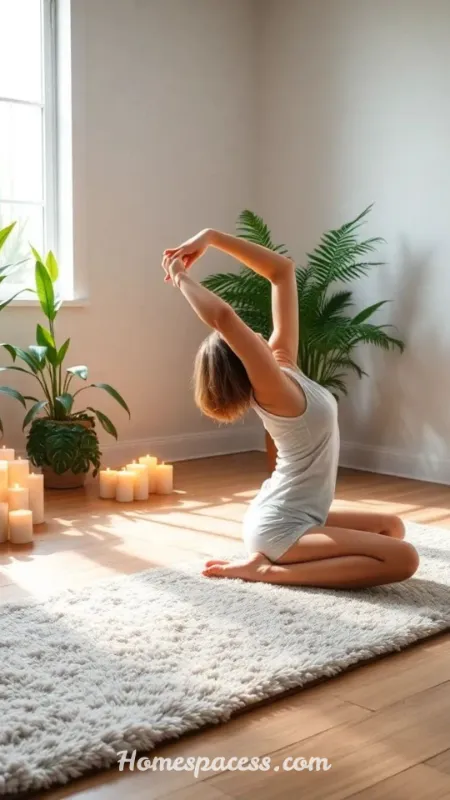
Scent is the fastest route to the limbic system the brain’s emotional center which is why it’s the most powerful and least utilized tool in yoga room design. When you pair a specific scent consistently with your yoga practice, the olfactory system forms a strong associative memory: within weeks, simply smelling that scent will begin to shift your nervous system into practice mode before you’ve even moved.
Lavender, sandalwood, frankincense, and eucalyptus are the four most evidence-supported essential oils for yoga practice. Lavender reduces anxiety and slows heart rate ideal for restorative and yin yoga. Frankincense has been shown to activate TRPV3 channels in the brain, producing calming, mildly euphoric effects appropriate for deep practice. A high-quality ultrasonic diffuser is the safest and most consistent delivery method avoid burning synthetic incense, which can irritate airways.
The goal is a subtle, background note not an overwhelming fragrance. Run your diffuser for 15–20 minutes before your session begins, then turn it off during practice. This creates a scented atmosphere without continuously adding more fragrance, which can become distracting as the session deepens. The residual scent in the room is exactly enough.
Style Note:
Your diffuser is a design object choose accordingly. Ceramic diffusers in matte white or warm stone tones look elegant on an altar or prop shelf. Avoid cheap plastic diffusers with LED color-changing lights; the moving light is visually distracting during meditation and the materials degrade quickly with daily use of essential oils.
💡Pro Tip:
Keep a “practice scent” strictly for your yoga room don’t wear it, burn it elsewhere, or use it while doing other activities. The more exclusively you associate the scent with practice, the stronger the conditioned response becomes. Within four to six weeks, most practitioners notice that the scent alone initiates a measurable shift toward calm focus.
Conclusion
Designing a yoga room is really an act of self-investment. When you create a space that genuinely supports your practice with the right light, surfaces, atmosphere, and intention your yoga transforms because your commitment to it becomes structural rather than aspirational.
The best yoga room ideas aren’t about perfection or expense. They’re about removing friction, reducing distraction, and creating an environment that makes stepping onto the mat the easiest, most natural thing you do each day. Start with one change: a dimmer switch, a dedicated mat space, a single plant in natural light.
✦ Advanced Insights
Yoga Room Design Trends: 2026 Reality and 2027–2030 Forecast
Warm Mineral Aesthetics
Terracotta, clay, sage, and warm putty have displaced the cool gray-white minimalism of the previous decade. Tactile, earthen materials handmade ceramics, raw linen, natural cork define the current peak.
Tech-Integrated Stillness
Smart lighting, AI-curated soundscapes, and connected diffusers are being integrated silently — invisible technology that adapts the room’s atmosphere without visual intrusion or complexity.
Bioclimatic Rooms
Climate-responsive yoga spaces that automatically adjust humidity, temperature, and air quality for different practice types are moving from boutique spas into high-end residential design.
AI Practice Integration
Rooms designed around embedded posture-sensing cameras and AI coaching overlays are in prototype phase expect home-accessible versions to reshape what a “smart yoga room” means by 2028.
The most significant shift in 2026 is the move away from “yoga room as aesthetic statement” toward “yoga room as functional ecosystem.” Practitioners are now thinking about their space the way athletes think about training equipment with attention to performance metrics, recovery outcomes, and long-term adaptability. This means investing in room elements (lighting, acoustics, air quality) that directly serve the practice rather than just photographing well.
One trend worth watching closely: the integration of near-infrared (NIR) light panels into yoga rooms. Used widely in recovery clinics for muscle repair and nervous system regulation, portable NIR panels are being adopted by advanced home practitioners for pre- and post-practice use. This is the leading edge of the convergence between wellness technology and interior design and it’s moving into the mainstream faster than most expect.
Expert Insights: What Interior Designers and Yoga Teachers Actually Recommend
The most consistent advice from yoga teachers with dedicated home practice spaces? Start with function, add form. Every great yoga room begins with a clear answer to the question: “What type of yoga do I practice most?” A power yoga practitioner needs open floor space, excellent airflow, and bright light.
A yin or restorative practitioner needs warmth, soft lighting, abundant prop storage, and insulation from external sound. Trying to make one room serve both purposes equally often results in a compromise that serves neither so identify your primary practice type first.
Interior designers who specialize in wellness spaces consistently emphasize one principle that home practitioners overlook: the entry experience matters. How you enter your yoga room begins the psychological shift from everyday mode to practice mode.
This is why many studio designers spend considerable attention on the transition space a shoe-removal area, a small bench, a door with a frosted panel, or even simply a threshold rug. Creating a literal and symbolic transition point between the outside world and your practice space is one of the highest-impact and lowest-cost improvements you can make to a home yoga room.
Real-world optimization advice from experienced practitioners: keep your mat permanently rolled out in your yoga room. The act of setting up finding the mat, clearing the floor, moving furniture is the single biggest obstacle to daily practice. A mat already on the floor is a visual invitation that requires no decision, no effort, and no preparation. Combined with a pre-set lighting scene and a favorite playlist ready to play, you remove virtually all friction from the moment of deciding to practice to actually being in downward dog.
Sustainable Yoga Room Design: Long-Term Value and Environmental Alignment
There is an inherent tension in designing a yoga space using materials that conflict with the environmental values that many yoga philosophies espouse. The principle of ahimsa (non-harm) extends naturally to the materials we choose and the home design industry has significant blind spots here. Many “yoga-aesthetic” products synthetic rattan, fast-fashion cushion covers, mass-produced “Himalayan” salt lamps are far from the sustainable, ethical sources their marketing implies. Designing a genuinely sustainable yoga room means looking beyond aesthetics to provenance.
The most durable investment choices for a yoga room are also the most sustainable ones: solid cork or hardwood flooring (lasts decades, not years), natural linen textiles (age beautifully and biodegrade), handmade ceramic objects (last lifetimes), and quality yoga mats made from natural rubber rather than PVC. The paradox is that sustainable materials in this space are almost universally more beautiful, more functional, and more aligned with the aesthetic of an elevated practice space than their synthetic alternatives.
From a long-term value perspective, a yoga room is one of the few home improvement investments that generates returns that compound over time. A dedicated practice space increases the frequency and depth of practice, which has documented benefits for physical health, mental resilience, and stress management.
These benefits have calculable economic value reduced medical costs, improved productivity, lower prescription medication use that easily justify the initial investment. Design your yoga room as a long-term health infrastructure decision, not a décor project.
Future of Home Yoga Rooms: Innovations Reshaping the Space by 2030
The convergence of wearable biometric technology and smart home systems is set to transform home yoga rooms fundamentally within the next four years. Imagine a room that automatically adjusts its lighting temperature, plays the appropriate soundscape, and activates the diffuser to a specific blend all based on biometric data from your wearable that tells the room your heart rate variability, sleep quality, and stress level before you’ve touched your mat. This isn’t speculative fiction the component technologies all exist. It’s an integration problem, and several wellness tech companies are actively solving it.
Augmented reality is a second transformative force. Early-stage AR yoga guidance systems which overlay alignment cues, breathing prompts, and posture corrections directly into your field of view via lightweight glasses are in active development. These systems would transform any room into a responsive, personalized studio without the need for large screens or external cameras, preserving the aesthetic integrity of the space while dramatically elevating the quality of guidance available to home practitioners.
Perhaps most surprisingly, material science innovations will change the flooring category significantly. Self-heating floor systems (currently in development using graphene-infused materials) could allow yoga room floors to warm to precise temperatures for different practice types eliminating the discomfort of cold-floor morning practice, which is a significant barrier to early-session consistency. The floor itself becomes an active participant in the practice experience, not merely a surface. These innovations are closer to market than most consumers realize.
Common Yoga Room Design Mistakes (And How to Avoid Them)
Underestimating the space you actually need
A yoga mat is 183cm × 61cm. You need at least 50cm of clearance on all sides for arms-extended poses. Most people design their yoga room around the mat alone and realize they can’t do warrior II without touching the wall. Measure first; decorate second.
Using the room for other activities
The moment your yoga room becomes a guest room, home office, or laundry folding station, it stops being a yoga room psychologically. Even if you clear it before practice, the residual associations interrupt the mental shift into practice mode. Protect the room’s single purpose fiercely.
Prioritizing aesthetics over airflow
A visually beautiful room that gets stuffy during vigorous practice is a room you’ll avoid. Good air circulation — via window, fan, or HVAC is non-negotiable. Heat and CO₂ accumulation during practice measurably reduces performance and creates an aversion response over time.
Ignoring acoustic isolation from the rest of the house
A yoga room adjacent to a kitchen, TV room, or children’s play area will be constantly disrupted. Even through closed doors, household sound breaks concentration and undermines the value of the space. A door draft stopper, heavy curtain at the entry, or acoustic panel behind the door makes a significant practical difference.
Designing for photos, not practice
Many home yoga rooms are designed to look beautiful on social media but fail as functional practice environments. Oversized wall art that creates visual distraction during meditation, decorative items that clutter the floor, or aesthetic choices that compromise functionality are common pitfalls. Always test your design decisions against the actual experience of practice, not just the visual.

Team Home Spacess shares simple, practical design ideas that work for real families. The team focuses on cozy décor, soft colors, and natural textures that make a space feel truly lived-in. From everyday decorating tips to creative home projects, Team Home Spacess is dedicated to helping readers create warm, comfortable, and inviting spaces with a fresh and personal touch.