

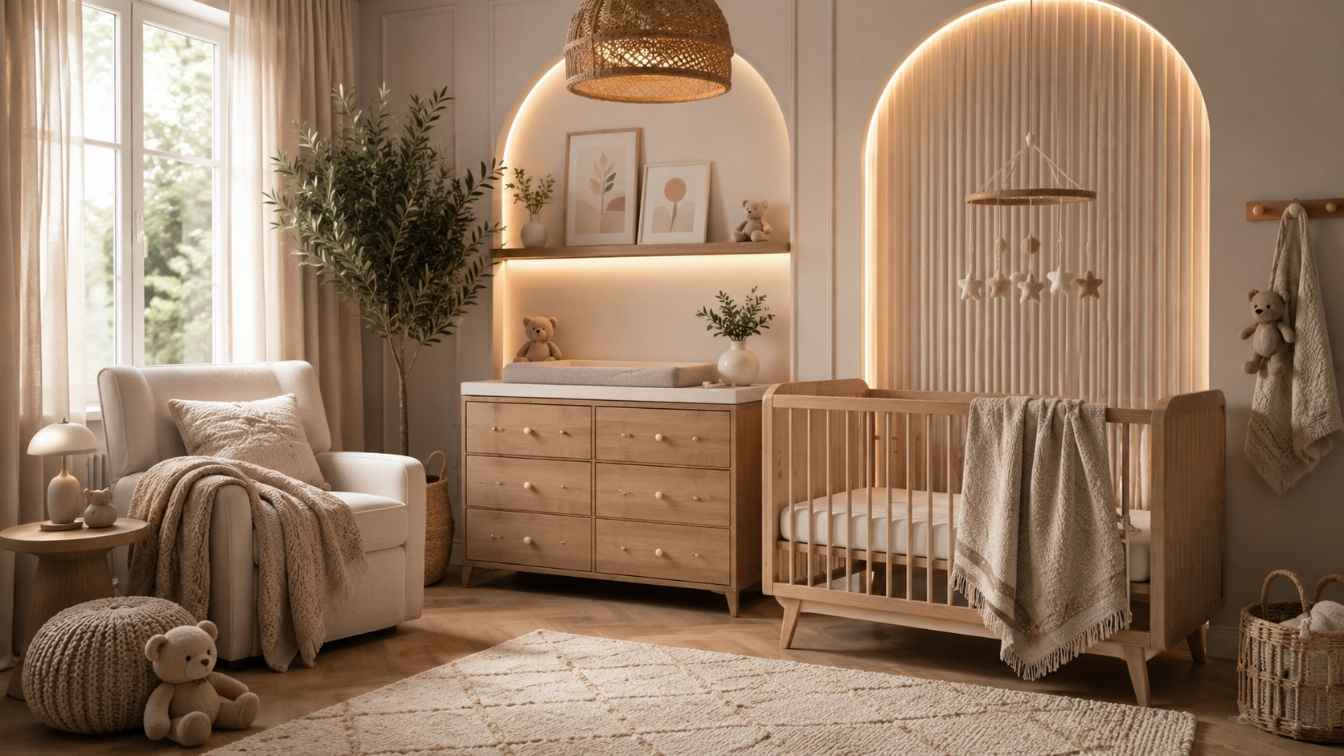
Baby Nursery Ideas for Boys focus on simple design, safety, and comfort. Soft color palettes like blue, beige, and green create a calm mood. Furniture stays minimal and useful. Storage helps keep items in place. Lighting remains soft and gentle. Wall decor adds a playful touch. Themes like animals or nature bring charm. Clean layouts make movement easy. Every detail supports daily routine. The nursery becomes peaceful and practical. Parents feel relaxed in a well-planned space. The baby feels secure and happy.
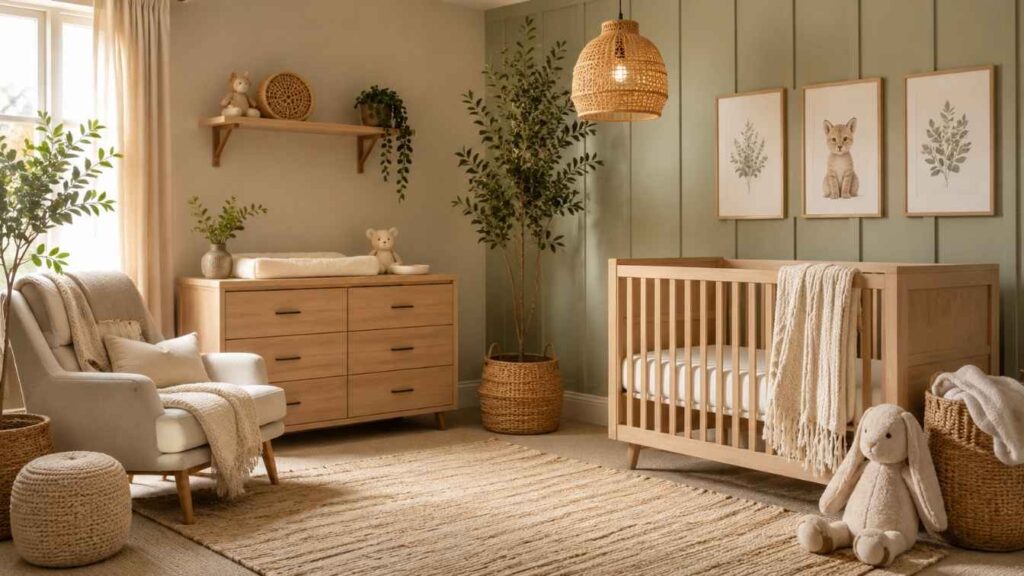
Baby Nursery Ideas for Boys include modern trends and simple setups. Neutral tones stay popular. Wooden furniture adds warmth. Soft textiles improve comfort. Simple wall art keeps the room light. Organized shelves save space. Small rooms use smart layouts. Large rooms allow more creativity. Safety remains the top priority. Every item serves a purpose. The room stays clean and fresh. A balanced design supports both baby and parents. The nursery becomes a calm place for rest and care.
Classic Nautical & Ocean Explorer Nursery
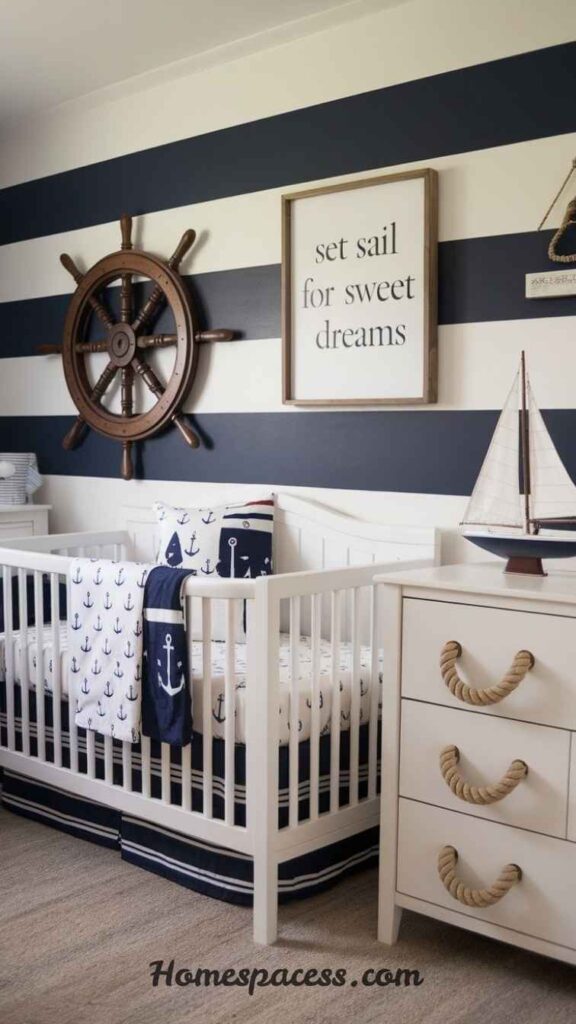
The nautical theme remains one of the most enduring baby nursery ideas for boys, and for good reason it combines calm blues, crisp whites, and natural textures that create a soothing environment ideal for sleep. Think navy-and-white striped bedding, rope-accented shelves, and a hand-painted mural of a gentle lighthouse. Anchor motifs and compass rose wall art add visual interest without overwhelming the senses.
What makes this theme stand out is its scalability. A toddler-age boy can graduate from soft ocean prints to actual maps, globe decor, and explorer-themed books displayed on low shelves. The neutral white-and-navy palette is easy to refresh with new accessories as he grows, making it one of the most cost-efficient choices in the long run. Adding a soft blue-grey paint like Benjamin Moore’s “Quiet Moments” creates depth without feeling cold.
Pro Tip: Use sea-grass or jute rugs instead of synthetic ones they’re non-toxic, naturally antibacterial, and double as a sensory texture for curious crawlers. Pair with dimmable rope-light sconces for a cozy, adjustable glow during nighttime feeds.
Must Read: Top Dining Table Decor Ideas to Make Your Dining Area Look Amazing
Woodland Forest Adventure Nursery
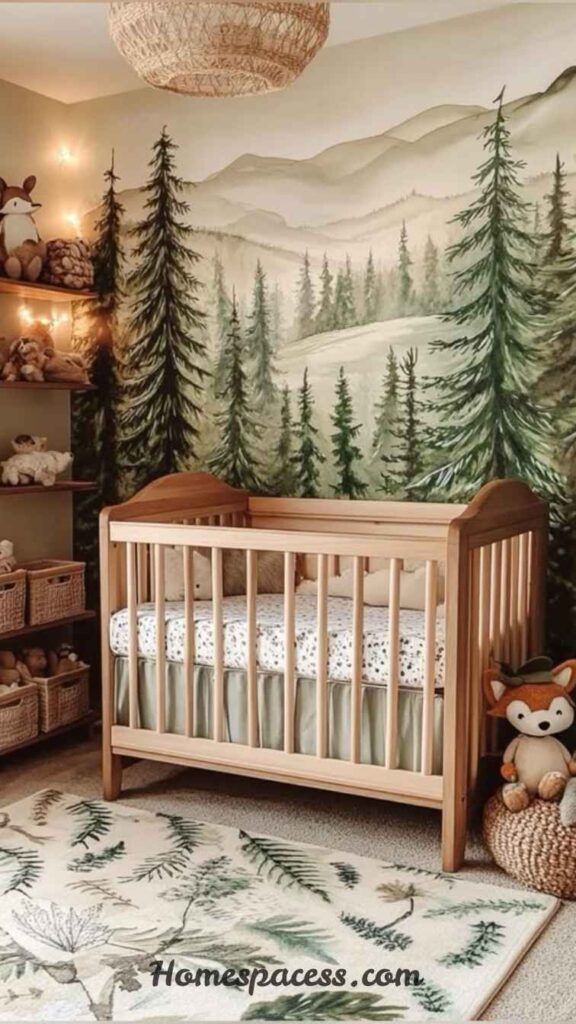
The woodland nursery taps into biophilic design principles the science-backed idea that children thrive when surrounded by natural elements. For boys, this translates to earthy greens, warm taupes, and charming forest animal characters: foxes, owls, deer, and hedgehogs. A large tree wall decal or mural anchors the room, while mushroom-shaped nightlights cast a warm amber glow.
Unlike heavily branded themes, the woodland look is highly adaptable. You can easily incorporate real wood elements a reclaimed wood crib, floating oak shelves, or a birch branch mobile that will still look beautiful in a 5-year-old’s room. This theme works equally well in small nurseries, as vertical murals draw the eye upward, making ceilings feel higher and rooms feel more spacious.
Pro Tip: Choose low-VOC or zero-VOC paints in sage green and warm beige. Newborns breathe 2–3× more air per body weight than adults, so indoor air quality is genuinely critical. Brands like ECOS Paints and Sherwin-Williams’ Harmony line are excellent choices.
Read Also: Elegant Mini Bar Ideas for a Stylish Home Makeover
Outer Space & Cosmos Nursery
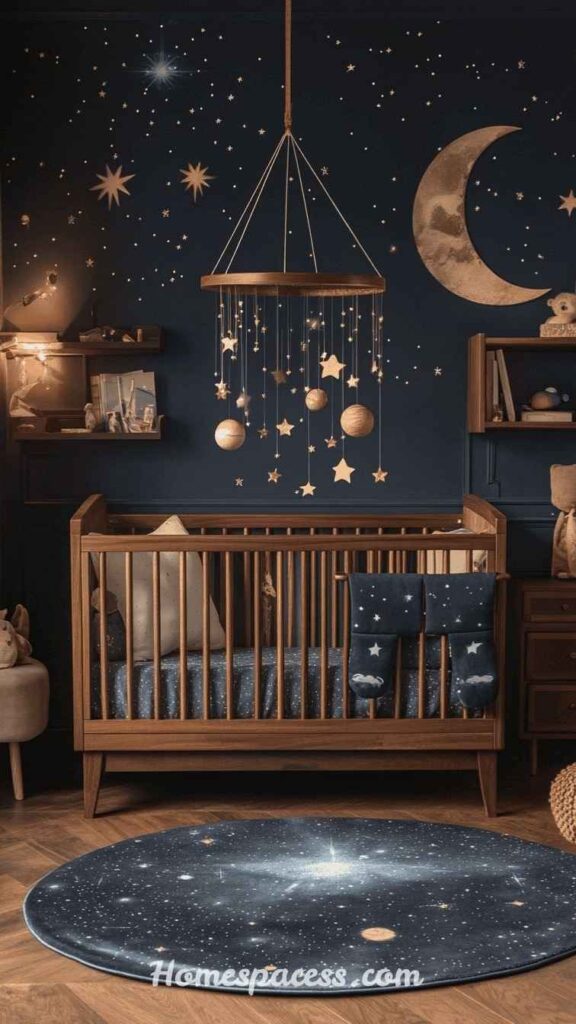
Few baby nursery themes for boys spark the imagination quite like outer space. A deep navy or near-black ceiling covered with glow-in-the-dark constellation stickers creates a magical sleep environment the stars literally come out when the lights go off. Complement this with silver rocket mobiles, planet-print curtains, and a plush astronaut stuffed toy. The contrast between dark ceilings and lighter walls keeps the room feeling open rather than cave-like.
From an educational standpoint, space nurseries offer a uniquely rich visual environment. Research on infant visual development shows that high-contrast patterns like white stars on a dark background are among the most stimulating visuals for babies under 6 months. As your boy grows, add an actual telescope to a corner nook, and the room evolves naturally into a STEM-focused sanctuary.
Pro Tip: Use a Himalayan salt lamp as your secondary light source. It casts a warm pinkish-amber glow that doesn’t interfere with melatonin production critical for establishing healthy sleep cycles in infants. It also pairs visually with the “warm star” aesthetic beautifully.
Read More: Simple Outdoor Kitchen Ideas for Easy Backyard Cooking Setup
Minimalist Scandinavian Calm Nursery
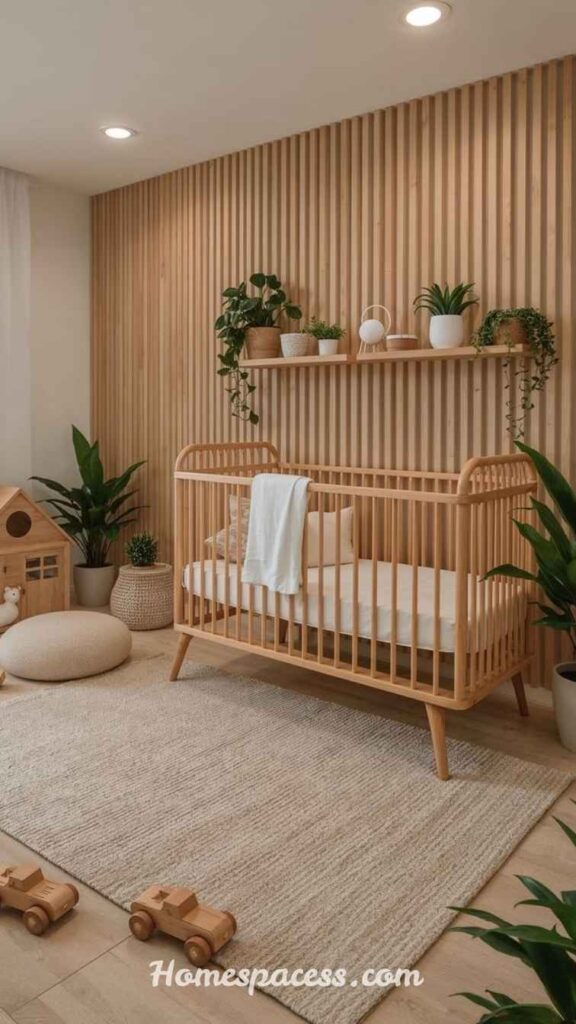
Scandinavian nursery design is having a sustained revival and it’s arguably the smartest long-term investment for a boy’s nursery. The philosophy is simple: clean lines, natural materials, functional furniture, and a palette built on whites, warm greys, and natural wood tones. A Stokke Tripp Trapp chair, a birch-ply crib, and a single oversized monochrome art print are all you need to achieve this effortlessly stylish look.
The genius of this approach lies in its neutrality. There are no cartoon characters to tire of, no branded merchandise to replace seasonally. Every item serves a dual purpose the wooden storage bench becomes a toy chest; the low bookshelf doubles as a room divider. Parents who invest in this aesthetic report spending significantly less on nursery updates over 3–5 years compared to more themed approaches.
Pro Tip: Layer textures chunky knit throw, linen curtains, and a sheepskin rug to create warmth in an otherwise minimal space. Texture stimulates a baby’s tactile development and prevents the room from feeling sterile or cold.
Don’t Skip: Baby Room Ideas That Make Small Nurseries Look Bigger and Brighter
Jungle Safari Nursery for Boys
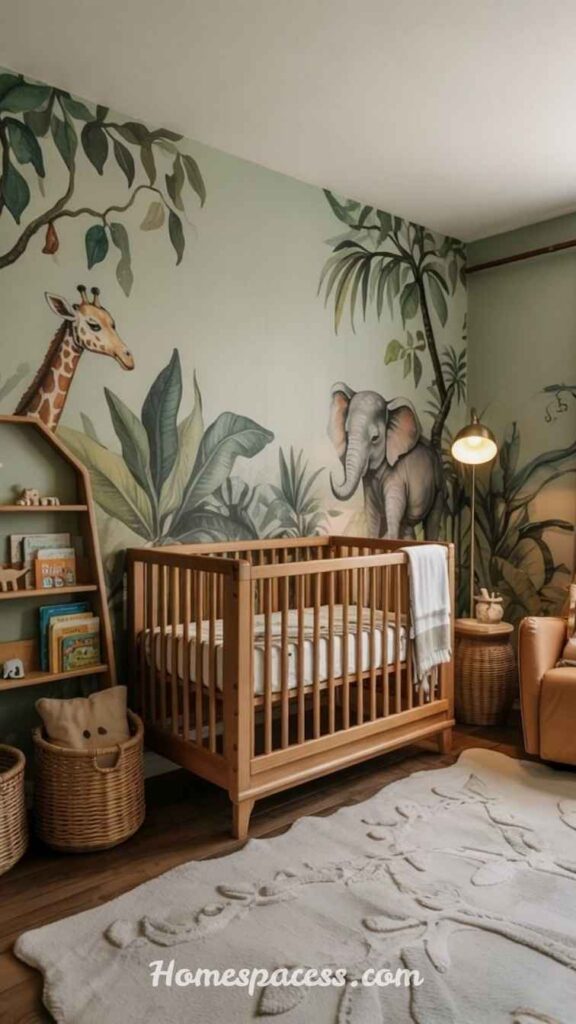
The jungle safari nursery channels warmth, adventure, and natural richness in a way that feels distinctly boyish without resorting to clichés. Think terracotta-painted walls, large-leaf monstera wall decals, rattan furniture, and plush safari animals lions, giraffes, and elephants arranged at baby’s eye level. Warm browns and olive greens dominate, with pops of terracotta and rust that feel both modern and earthy.
What separates a well-designed safari nursery from a generic one is the layering of authentic natural materials. Real rattan baskets for toy storage, a genuine cactus (kept out of reach) on a high shelf, and linen or cotton canvas prints of actual wildlife photography rather than cartoonish illustrations elevate the space significantly. This theme photographs beautifully, which matters for parents who document their child’s early milestones.
Pro Tip: Mount a large wall mirror at a low height (40–50 cm from the floor). Babies as young as 2 months are fascinated by their own reflection, and this simple addition provides hours of self-discovery stimulation during tummy time no batteries required.
Construction & Little Builder Nursery
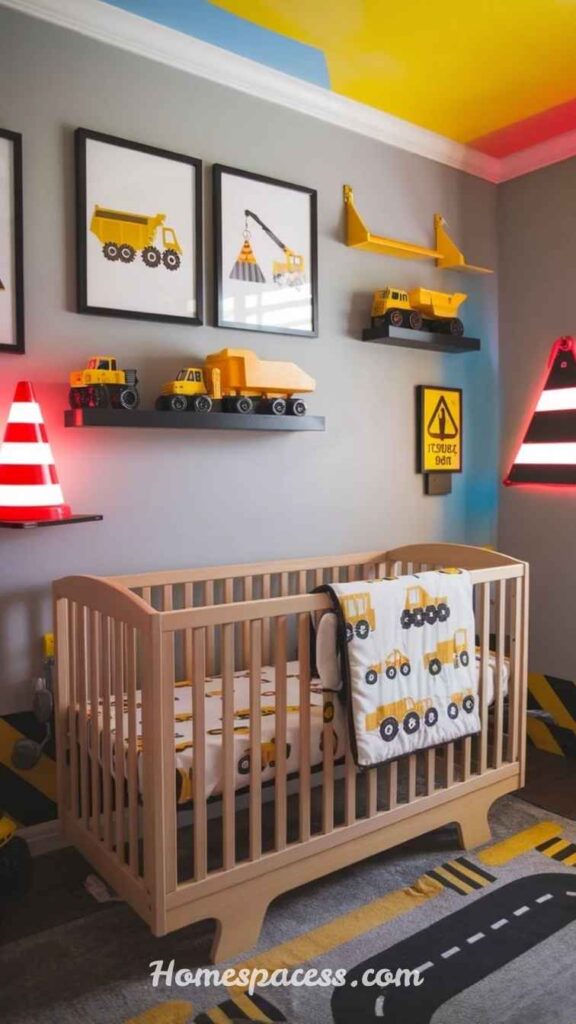
The construction theme is one of the most underutilized baby nursery ideas for boys and it’s a gem. Bold yellows, blacks, and whites create a high-contrast, visually stimulating environment perfect for infant development. Think dump truck mobiles, blueprint-style wall art, a “hard hat area” sign above the crib, and striped hazard-tape accent details on shelves. The palette is cheerful without being saccharine.
This theme scales remarkably well into toddlerhood, when boys become genuinely obsessed with trucks, cranes, and building blocks. The nursery essentially grows with them replace the wall art with actual vehicle posters, add a LEGO Duplo station, and the construction theme becomes a full creative play environment. It’s one of few themes that gets better with age rather than more dated.
Pro Tip: Use chalkboard paint on one section of the wall even just a 1-metre square. This gives a toddler a built-in creative outlet and avoids the inevitable crayon-on-walls situation most parents dread. Frame it with simple wood trim to make it look intentional and designed.
Vintage Storybook Nursery
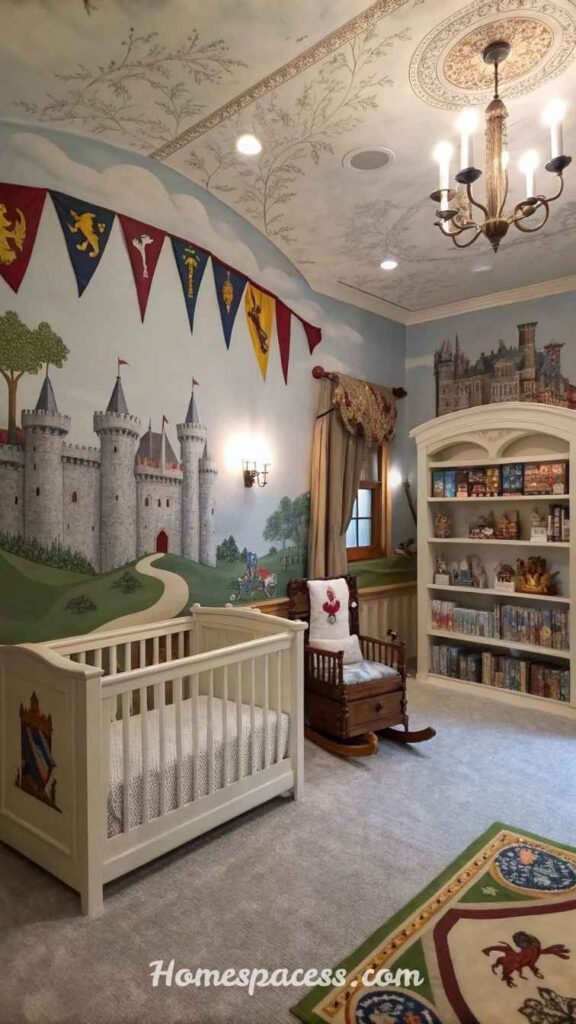
The vintage storybook nursery draws on the golden age of illustrated children’s literature think Beatrix Potter, Winnie the Pooh, and The Wind in the Willows. Warm creams, dusty blues, and sage greens set the tone. Antique-style illustration prints in mismatched wood frames, a small reading nook with a teepee tent, and a wooden train set on a low shelf create an atmosphere of wonder and quiet discovery.
This theme is deeply intentional in its design philosophy it prioritizes books and storytelling as the central activity of the room. A low-mounted display shelf for forward-facing books is a key element; research consistently shows that when book covers are visible rather than spines, children interact with books far more frequently. The storybook nursery thus functions as an early literacy environment from day one.
Pro Tip: Incorporate a record player with children’s audiobooks or classical lullabies. Auditory stimulation through varied music types has been linked to stronger early language acquisition. A small Crosley or a Bluetooth-enabled vintage-style speaker sits beautifully on a painted wooden crate.
Modern Geometric & Abstract Art Nursery
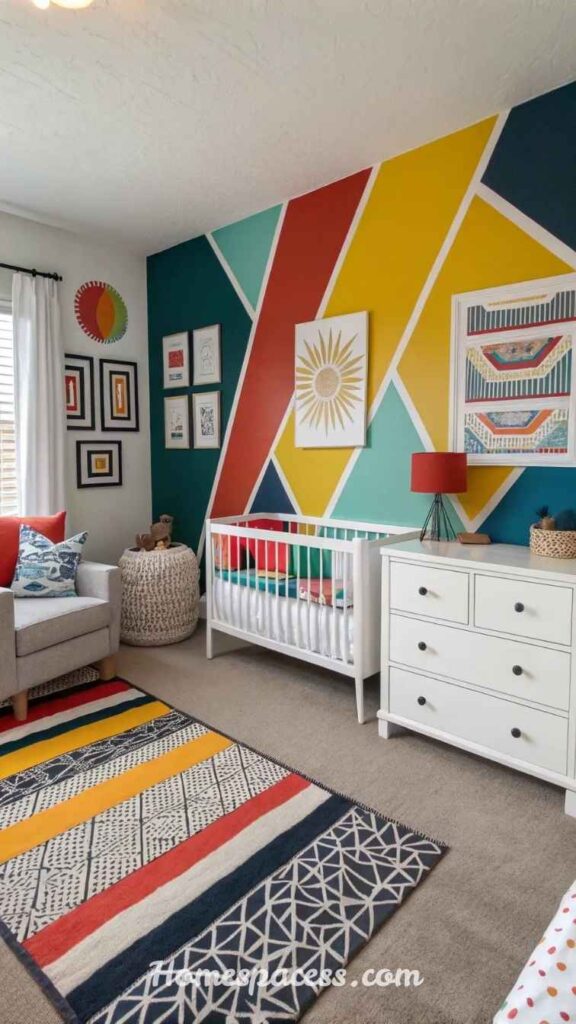
For design-conscious parents who want a nursery that feels elevated and gallery-worthy, the geometric and abstract art theme is unmatched. High-contrast black-and-white shapes, colorful Mondrian-inspired prints, and bold triangle or hexagonal wall patterns stimulate infant brain development while satisfying an adult’s aesthetic sensibility. This is one nursery where your design choices genuinely double as early visual education tools.
The palette here is flexible monochrome, primary colors, or a sophisticated tertiary palette of mustard, teal, and blush all work. The key is intentional repetition: choose one geometric motif say, triangles and carry it through the rug, the mobile, the cushions, and the wall art. Coherence is what separates a thoughtfully curated geometric nursery from a busy, overwhelming one.
Pro Tip:
Print your own art. Sites like Canva or Adobe Express let you create custom high-contrast geometric prints for under $10, printed at any local print shop. This gives you complete design control and makes the room genuinely unique no mass-produced nursery prints in sight.
Conclusion
Designing the perfect baby nursery for boys is far more than picking a theme and matching the curtains. When you approach it with intention choosing a cohesive theme that grows with your child, investing in quality materials, optimizing for sleep and sensory development, and planning for long-term value you create a space that genuinely supports your baby’s wellbeing and your own sanity. These baby nursery ideas for boys are your starting point, not a checklist.
The best nursery is one that works for your specific baby, in your specific space, for your specific lifestyle. Trust your instincts, buy less but buy better, and remember: the thing your son will remember most about his early room is the warmth he felt in it not the colour of the walls. Start with one idea from this guide, make it yours, and enjoy every moment of the process.
Trend Analysis
Baby Nursery Ideas for Boys in 2026–2027
Rising Trend
Biophilic Design
Fading Fast
Generic “Blue Everything”
Color of the Year
Warm Terracotta + Sage
Material Trend
Certified Organic + Rattan
In 2026, the most significant shift in boys’ nursery design is the move away from gender-coded blue palettes toward warmer, earthier tones terracotta, warm sage, dusty ochre, and clay. Interior designers who specialize in children’s spaces report that millennial and Gen Z parents are actively rejecting the idea that “blue is for boys,” opting instead for richly layered, gender-neutral-leaning palettes that feel sophisticated and timeless rather than prescriptive.
Another major trend is the integration of sensory design principles. Nursery designers are now approaching infant rooms less as aesthetic spaces and more as sensory learning environments. This means thoughtful texture layering (rough, smooth, soft, ridged), acoustic control through soft furnishings, and curated visual zones each corner of the room serving a distinct developmental function, from stimulating awake-time to calming sleep-time cues.
Looking ahead to 2026, smart nursery integration is the next frontier. Circadian lighting systems (like the Philips Hue Go) that automatically shift from bright daylight tones during awake time to warm amber as bedtime approaches are becoming mainstream. Expect voice-activated white noise systems, app-synced humidity monitors built into nursery furniture, and even AI-assisted sleep environment optimization to become standard in premium nursery design.
Expert Practical Tips
for Designing a Boy’s Nursery That Actually Works
One insight most nursery guides miss: design for the parent, not just the baby. You will spend hundreds of hours in this room feeding at 2am, rocking, soothing, and sitting on the floor. The height of the crib, the position of the rocking chair relative to the window, and the accessibility of the changing station will affect your quality of life more directly than any wall decal. A nursery that works poorly at 3am is a beautiful nursery that fails.
Pediatric occupational therapists consistently recommend creating two distinct zones in a nursery: an active/stimulating zone (near natural light, with high-contrast visuals and floor play space) and a calm/sleep zone (blackout curtains, minimal visual stimulation, neutral textures). Even in small nurseries of 10–12 square metres, this functional zoning dramatically improves a baby’s ability to self-regulate and transition between wake and sleep states.
Another expert insight: invest in your lighting before anything else. Most nursery lighting is either too bright for night feeds or too dim for diaper changes. The solution is a triple-light setup a dimmable overhead fixture, a warm-glow nightlight near the crib, and a bright task light above the changing table with a separate switch. This gives you full control over the room’s mood at any hour without disturbing a sleeping baby.
Sustainability, Long-Term Value
Strategic Nursery Planning
The most expensive nursery mistake parents make is designing for a newborn rather than a 0–5 year old. A room that’s perfect for an infant often requires a near-complete overhaul by age 2 meaning double the budget, double the waste. The strategic approach is to choose a theme and furniture range with explicit longevity: convertible cribs that become toddler beds (like the Ikea Sundvik or Stokke Sleepi), modular shelving that grows with storage needs, and a colour palette that works as well for a 4-year-old as for a newborn.
From a sustainability standpoint, the nursery industry is one of the most wasteful in the home furnishings sector products are used for 18–24 months on average and then discarded or replaced. Opting for certified organic cotton textiles (GOTS-certified), FSC-certified solid wood furniture, and natural latex mattresses instead of synthetic foam significantly reduces both environmental impact and your child’s exposure to off-gassing chemicals. Organic mattresses, in particular, are worth the premium investment a baby spends 16–18 hours a day on their mattress in the first months.
Consider the secondary market when making nursery purchases. Premium solid wood nursery furniture from brands like Oeuf, Babyletto, or Leander holds 50–70% of its resale value, meaning your net cost over 5 years is often lower than buying budget flat-pack furniture that can’t be resold. This is a financial argument for quality that most nursery guides never make but it’s one of the most actionable insights for budget-conscious parents planning ahead.
Future Predictions
What Boy’s Nursery Design Will Look Like by 2027
The next wave of nursery innovation will be driven by sleep science and AI personalization. We’re already seeing early-stage products that use heart-rate and breath-pattern monitoring (embedded in mattress pads, not worn) to dynamically adjust room temperature, ambient sound, and lighting in real time based on the baby’s sleep cycle stage. By 2027, these will be mainstream features in mid-range nursery technology, fundamentally changing how we think about the nursery as an “environment” versus a “decorated room.”
Augmented Reality (AR) will reshape how parents design nurseries before purchase. Apps that currently allow basic furniture visualization in your room will evolve to include acoustic modelling (predicting how sound will behave in your specific room shape), lighting simulation across different times of day, and even AI-generated theme suggestions based on your home’s existing aesthetic. This will reduce the common problem of parents investing in a theme they imagined looking different in reality.
Expect modular, reconfigurable nursery systems to dominate the market. Inspired by the concept of “forever furniture,” brands will increasingly offer nursery ecosystems where the same frame becomes a crib, then a toddler bed, then a sofa-bed base for sleepovers reducing both cost and environmental impact. The nursery of 2027 won’t be designed for one phase of childhood. It’ll be engineered for all of them.
Common Mistakes
Parents Make When Designing a Boy’s Nursery
- Over-decorating the walls: Babies under 3 months perceive high contrast but are easily overstimulated by too many competing visual elements. A single large-scale mural or two to three carefully placed prints are more developmentally appropriate and more beautiful than a wall covered in every adorable print you found on Etsy.
- Skipping the blackout solution: A thin curtain liner is not a blackout solution. Melatonin production in infants is acutely sensitive to light. Invest in proper blackout blind liners or custom blackout Roman blinds this single change can meaningfully improve infant sleep duration, which improves everything else in your life.
- Placing the crib near a window or vent: Drafts and direct sunlight are sleep disruptors and temperature risks. The safest and most sleep-supportive crib placement is on an interior wall, away from windows, vents, and radiators even if this means the room “looks less symmetric.”
- Buying furniture before measuring doorways: This is more common than it should be. Large cribs and wardrobes sometimes don’t fit through standard doorways, requiring disassembly or return. Measure the narrowest point of your hallway and stairwell before ordering anything with dimensions over 75 cm wide.
- Ignoring acoustics entirely: Hard floors, bare walls, and glass surfaces create echo and amplify sound meaning every noise wakes the baby. Rugs, curtains, upholstered furniture, and even soft wall art all reduce room reverberation significantly. Good acoustic design is one of the most overlooked components of a functional, sleep-supportive nursery.

Team Home Spacess shares simple, practical design ideas that work for real families. The team focuses on cozy décor, soft colors, and natural textures that make a space feel truly lived-in. From everyday decorating tips to creative home projects, Team Home Spacess is dedicated to helping readers create warm, comfortable, and inviting spaces with a fresh and personal touch.