

Picking a gaming laptop in 2026 is harder than it sounds. Specs change fast, marketing terms are confusing, and one wrong choice can waste hundreds of dollars. That’s exactly why TheLaptopAdviser Expert Gaming Reviews 2026 exists to cut through the noise and give you clear, tested, and honest advice before you spend your money.
This guide explains what makes a review trustworthy, how to compare gaming laptops the right way, and which factors actually matter for real-world gaming performance. Whether you’re buying your first gaming laptop or upgrading an old one, you’ll find practical, no-fluff answers here.
What Is TheLaptopAdviser Expert Gaming Reviews 2026
TheLaptopAdviser Expert Gaming Reviews 2026 is a resource built to help everyday shoppers and tech professionals compare gaming laptops using clear, structured criteria instead of vague marketing claims. Instead of just listing specs, the goal is to explain what those specs mean for actual gameplay, battery life, and long-term value.
A good review answers three simple questions:
- Does this laptop run the games you want, at the settings you want?
- Will it last more than two years without major performance drops?
- Is the price fair compared to similar models on the market?
If a review can’t answer these three things clearly, it’s not helpful. That’s the standard this guide follows.
Why Trustworthy Gaming Laptop Reviews Matter
Trustworthy reviews matter because gaming laptops are expensive, and specs alone don’t tell the whole story. Two laptops with the same graphics card can perform very differently depending on cooling design, power limits, and screen quality.
Here’s why relying on real testing and clear explanations beats trusting a spec sheet alone:
- Marketing numbers can mislead. A graphics card model number doesn’t tell you its power wattage, which affects real performance.
- Cooling design changes everything. Two laptops with the same chip can run 15-20% apart in frame rates because of thermal design.
- Battery claims are often best-case scenarios. Real gaming battery life is usually much shorter than advertised video playback numbers.
- Build quality varies by price tier. Hinges, keyboards, and trackpads wear differently over time.
This is where a dedicated review resource earns its value by testing these details instead of repeating spec sheets.
Read More: Is American Fashion Alaikas Com Actually Worth Your Money in 2026
How TheLaptopAdviser Tests and Reviews Gaming Laptops

A reliable review process follows a consistent method for every laptop, so comparisons stay fair. Here’s the general framework recommended for evaluating any gaming laptop, whether you’re reading a review or testing one yourself.
Step 1: Real Game Benchmarks
Run the same set of popular games at the same settings across multiple laptops. Compare average frame rates, not just peak numbers.
Step 2: Thermal and Noise Testing
Play for at least 30 minutes and track temperature and fan noise. A laptop that overheats after 20 minutes isn’t ready for long gaming sessions.
Step 3: Battery Life Under Load
Test battery life while actually gaming, not just watching video. This number is usually far lower and much more useful.
Step 4: Build Quality Check
Look at the keyboard travel, trackpad accuracy, hinge sturdiness, and port selection.
Step 5: Price-to-Performance Comparison
Compare the price against similar specs from competing brands to judge real value.
This structured approach is what separates a helpful review from a copy-paste spec list.
Don’t Miss This: OnlyWorkMoods com: Review 2026 What It Actually Is (And Why So Many Sites Are Writing About It)
Key Specs to Compare Before Buying
The specs that matter most for gaming are the GPU, CPU, RAM, storage, display, and cooling system. Here’s what each one actually means for your gaming experience.
Graphics Card (GPU)
The GPU is the single most important factor for gaming performance. Look at the actual model name and, if available, its power wattage a higher-wattage version of the same GPU model can perform noticeably better.
Processor (CPU)
The CPU matters more in games that rely on physics, AI behavior, or open-world simulation. For most modern titles, a mid-range CPU paired with a strong GPU works better than the reverse.
RAM (Memory)
16GB is the realistic minimum for gaming in 2026. 32GB is worth it if you also stream, record, or run background apps while gaming.
Storage
A fast SSD (NVMe) is important for load times. Look for at least 512GB, though 1TB is more comfortable for larger game libraries.
Display (Screen)
Refresh rate matters as much as resolution for competitive gaming. A 1080p or 1440p screen at 144Hz or higher is often smoother in practice than a 4K screen at 60Hz.
Cooling System
Vapor chamber cooling and multiple fans generally handle sustained gaming better than basic single-fan designs, especially during long sessions.
Gaming Laptop Comparison Table
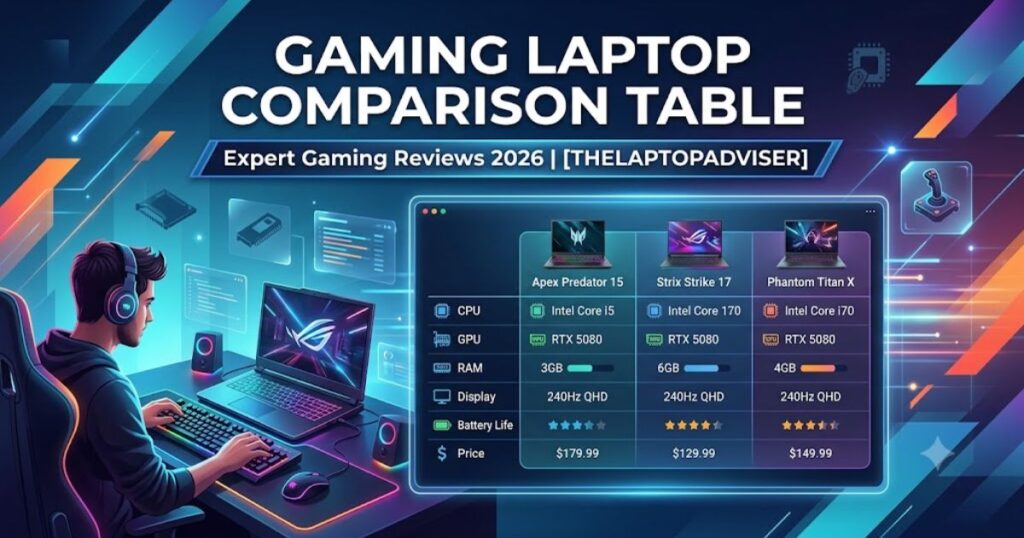
| Feature | Budget Tier | Mid-Range Tier | Premium Tier |
|---|---|---|---|
| Price Range | $700 – $1,000 | $1,000 – $1,600 | $1,600+ |
| GPU Performance | 1080p gaming, medium settings | 1080p/1440p, high settings | 1440p/4K, high to max settings |
| RAM | 8–16GB | 16GB | 16–32GB |
| Display Refresh Rate | 60–120Hz | 144Hz | 165Hz+ |
| Cooling | Basic dual-fan | Improved dual-fan | Vapor chamber, multi-fan |
| Battery Life (gaming) | 2–3 hours | 2–4 hours | 3–5 hours |
| Build Quality | Plastic-heavy | Mixed materials | Metal chassis common |
Note: These are general industry ranges based on typical 2026 market pricing, not guarantees for any single model. Always check current specs before buying, since prices and configurations change often.
Also Read This: Playing Games Blog PlayBattleSquare: The Complete Guide for Gamers in 2026
Pros and Cons of Buying Based on Reviews
Pros:
- Saves time by narrowing down choices before you shop
- Helps you avoid overpaying for marketing-heavy features you won’t use
- Reduces the risk of buyer’s remorse from misunderstood specs
- Gives you real-world context, like thermal and noise behavior
Cons:
- Reviews can go outdated quickly as new models launch
- Individual units can vary slightly even within the same model
- Personal use cases (like streaming or content creation) may need extra research beyond a general review
Common Mistakes Buyers Make
Most buyers overpay or underperform because they focus on the wrong specs. Here are the mistakes to avoid:
- Chasing high RAM over GPU quality. More RAM won’t fix a weak graphics card.
- Ignoring cooling design. A powerful GPU throttled by poor cooling won’t perform as advertised.
- Buying based on brand alone. Performance varies by specific model, not just brand reputation.
- Skipping battery expectations. Gaming laptops are not built for all-day battery life away from a charger.
- Overlooking upgrade options. Some laptops allow RAM or storage upgrades later; others don’t.
Expert Tips for Choosing the Right Gaming Laptop
- Match the laptop to the games you actually play, not the games you might play someday.
- If you play competitive shooters, prioritize refresh rate over resolution.
- If you play story-driven or visually heavy games, prioritize GPU power and screen quality.
- Check independent benchmark videos, not just written specs, before buying.
- Buy from retailers with a clear return policy in case the unit has issues.
- Don’t ignore the keyboard and trackpad if you’ll use the laptop without a mouse.
Budget vs Premium Gaming Laptops
The right choice between budget and premium gaming laptops depends on which games you play and how long you want the laptop to last. Budget laptops handle popular esports titles and older AAA games well at 1080p. Premium laptops make more sense if you play graphically demanding new releases or want the laptop to stay relevant for three to four years without dropping settings.
If you’re a beginner, a mid-range option often gives the best balance between price and performance. Professionals who game and work (video editing, 3D rendering, streaming) usually benefit more from premium builds with stronger CPUs and more RAM.
Frequently Asked Questions
What is TheLaptopAdviser Expert Gaming Reviews 2026?
It’s a review and comparison resource that helps buyers understand gaming laptop specs, performance, and value before making a purchase in 2026.
How much RAM do I need for gaming in 2026?
16GB is the realistic minimum for most modern games. 32GB helps if you multitask, stream, or run background apps while gaming.
Is a higher refresh rate better than higher resolution for gaming?
For competitive and fast-paced games, yes. A 144Hz 1080p screen often feels smoother than a 60Hz 4K screen during gameplay.
Do gaming laptops have good battery life?
Not usually during actual gaming. Expect 2 to 5 hours under gaming load, even if the advertised battery life is much higher.
What’s the difference between budget and premium gaming laptops?
Budget laptops handle esports and lighter games well at lower cost. Premium laptops offer stronger GPUs, better cooling, and longer relevance for demanding games.
How important is cooling in a gaming laptop?
Very important. Poor cooling can cause the CPU and GPU to slow down during long sessions, reducing real performance even if the specs look strong on paper.
Can I upgrade a gaming laptop later?
Some models allow RAM and storage upgrades, while others have everything soldered in. Always check upgradeability before buying if this matters to you.
Should I buy a gaming laptop based on GPU model name alone?
The same GPU model can have different power limits between laptops, which affects real performance. Check the wattage if it’s listed.
What is the best gaming laptop for beginners?
A mid-range laptop with a solid GPU, 16GB RAM, and a 144Hz display is usually the safest starting point for beginners.
How often should gaming laptop reviews be updated?
Ideally every few months, since new GPU and CPU generations can shift value and performance rankings quickly.
Conclusion
Choosing the right gaming laptop doesn’t have to be stressful. With TheLaptopAdviser Expert Gaming Reviews 2026, you get a clear framework for comparing GPUs, CPUs, cooling, and battery life instead of guessing based on marketing terms. Focus on the specs that match your actual games, check real-world testing over spec sheets alone, and you’ll make a purchase you’re happy with for years to come.

Team Home Spacess shares simple, practical design ideas that work for real families. The team focuses on cozy décor, soft colors, and natural textures that make a space feel truly lived-in. From everyday decorating tips to creative home projects, Team Home Spacess is dedicated to helping readers create warm, comfortable, and inviting spaces with a fresh and personal touch.