

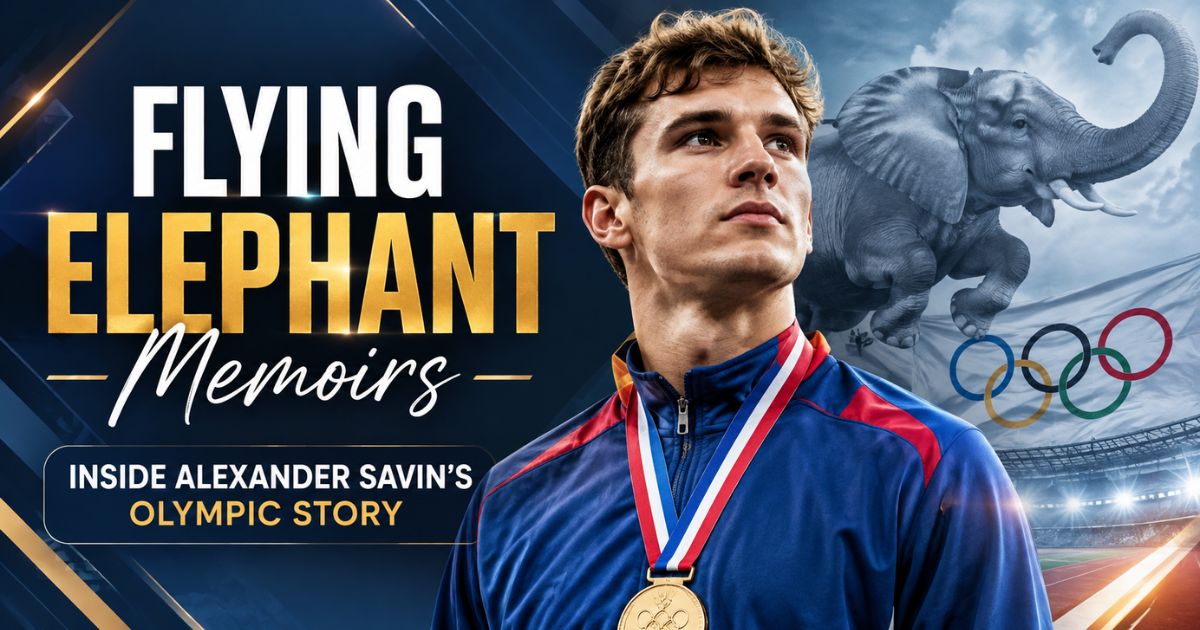
If you searched for Flying Elephant Memoirs, you’re likely trying to find out what this book is, who wrote it, and whether it’s worth your time. In short: The Flying Elephant: Memoirs of an Olympic Champion is a Kindle memoir by Aleksandr Savin, a Soviet volleyball player who won Olympic gold in 1980. This guide explains the man behind the book, the story it tells, and what to expect before you buy.
I put this guide together by cross-checking publisher descriptions of the memoir against verified sports records, including the International Volleyball Hall of Fame and Olympic archives. Where a claim about the book’s contents comes only from marketing copy, I’ve said so, so you know exactly what’s confirmed and what isn’t.
What Is Flying Elephant Memoirs?
Flying Elephant Memoirs is the short name readers use for The Flying Elephant: Memoirs of an Olympic Champion, a Kindle memoir written by former Soviet volleyball player Aleksandr Savin. The book covers his path from a small-town athlete to an Olympic gold medalist and Hall of Fame middle blocker.
Unlike a typical highlight-reel sports book, the memoir is described by its publisher as focusing on the training, pressure, and personal sacrifice behind Savin’s career, not just his medals. It sits in the growing category of athlete-written memoirs that blend personal storytelling with sports history.
A few quick facts about the book, based on publisher listings:
- Format: Kindle edition (self-published)
- Author: Aleksandr (Alexander) Savin
- Genre: Sports memoir / autobiography
- Subject: Soviet volleyball, the 1976 and 1980 Olympics, CSKA Moscow
- Length: Listed at roughly 500 pages in publisher descriptions, with photographs from Savin’s career
Because this is a self-published Kindle title rather than a title from a major publishing house, independent reviews and press coverage are limited. That’s worth knowing before you buy, and we’ll cover it more in the pros and cons section below.
Related Post: ErikkaPost com: What the Site Actually Is (Verified, Fact-Based Guide)
Who Is Alexander Savin?
Aleksandr Borisovich Savin is a real, well-documented Soviet volleyball player, born July 1, 1957, in Taganrog, Russia. He is one of the most decorated middle blockers in volleyball history, and his career is independently confirmed by the International Volleyball Hall of Fame and Olympic records, separate from the memoir itself.
Early Life and Rise to the National Team
Savin grew up in Obninsk, in Russia’s Kaluga Oblast, after his family moved there when he was young. He started playing volleyball as a schoolboy under coach Vladimir Pitanov, and the youth sports school in Obninsk now carries his name.
Olympic and International Career
Savin represented the Soviet Union at two Olympic Games:
- 1976 Montreal Olympics: He played all five matches and won a silver medal after the USSR lost the final to Poland.
- 1980 Moscow Olympics: Four years later, he played all six matches and won gold with the Soviet team on home soil.
Beyond the Olympics, Savin’s trophy case includes gold medals at the 1977 FIVB World Cup, the 1978 FIVB World Championship, and multiple European Championship titles through the mid-1980s. He was inducted into the International Volleyball Hall of Fame in 2010, cementing his reputation as one of the sport’s greatest middle blockers.
Quick facts table:
| Detail | Information |
|---|---|
| Full name | Aleksandr Borisovich Savin |
| Born | July 1, 1957, Taganrog, Soviet Union |
| Height | 200 cm (6 ft 7 in) |
| Position | Middle blocker |
| 1976 Olympics | Silver medal (Montreal) |
| 1980 Olympics | Gold medal (Moscow) |
| Hall of Fame | Inducted 2010 |
| Club team | CSKA Moscow |
Don’t Miss: TheSindi com Review 2026: What It Really Is (and Isn’t) Before You Trust It
Why Is the Book Called “Flying Elephant”?

The nickname “Flying Elephant” describes the contrast between Savin’s large frame and his surprisingly light, powerful jumping ability at the net. At around 6 ft 7 in, he was one of the bigger players of his era, yet teammates and opponents reportedly used the nickname because his vertical leap and blocking speed didn’t match his size.
That contradiction, big yet graceful, grounded yet airborne, is the central metaphor of the memoir’s title. It’s meant to suggest that something which looks physically unlikely can become real through years of disciplined training, which lines up with the book’s stated focus on the work behind the wins rather than the wins themselves.
What’s Inside the Memoir
Based on publisher and retailer descriptions, the memoir is organized loosely around four stages of Savin’s life: childhood, rise through Soviet volleyball, his Olympic career, and life after retirement, including coaching.
Childhood and Early Training
The opening chapters reportedly cover Savin’s childhood in Obninsk and how early family support and access to a local sports school shaped his path into competitive volleyball, long before international recognition.
Life Inside CSKA Moscow and the Soviet System
A large part of the book is said to focus on training inside CSKA Moscow, one of the most demanding sports institutions in the Soviet Union. Publisher descriptions say this section explains how a combination of strict discipline and early sports science created world-class athletes, and how that system shaped Savin’s mindset as much as his physical skills.
The 1976 and 1980 Olympics
The memoir covers both Olympic appearances: the disappointment of losing the 1976 final to Poland, and the pressure of competing on home soil at the 1980 Moscow Games during a politically tense period marked by a partial boycott. According to the publisher’s description, this section pairs match-level detail with Savin’s personal account of the emotional weight of competing for his country at home.
Life After Retirement
The closing chapters reportedly turn to Savin’s transition out of competitive play and into coaching, along with reflections on what elite sport cost him personally. This kind of “after the medal” content is often what separates a memoir from a straightforward career recap.
A note on sourcing: Specific details like page count, the exact number of photographs, and quoted lines attributed to Savin come from promotional listings for the book, not from independent review outlets. Treat those specifics as publisher claims rather than independently confirmed facts until you’ve read the book yourself.
Must Read: WallPostMedia com Review 2026: What This Site Actually Is (And Why So Many “Reviews” Get It Wrong)
Pros and Cons
Pros
- Written by a genuinely accomplished, independently verifiable Olympic champion
- Covers a period of sports history, Cold War-era Soviet volleyball, that’s rarely documented in English-language memoirs
- Focuses on process and mindset, not just wins, which can appeal to coaches and athletes in any sport
- Available instantly as a Kindle edition
Cons
- Self-published, so it hasn’t gone through the editorial vetting of a major sports publisher
- Independent reviews and press coverage are limited as of 2026
- Readers looking for extensive statistical or match-by-match analysis may find the focus more personal than technical
- English-language readers relying on translation should expect some phrasing that reads differently than a book originally written in English
Who Should Read This Book
This memoir is likely to appeal to:
- Volleyball players and coaches who want insight into Soviet-era training methods
- Sports historians interested in Cold War-era international competition
- Fans of athlete memoirs that focus on mindset and sacrifice over highlight reels
- Olympic history readers curious about the 1976 and 1980 Games from an athlete’s perspective
It may be less suited to readers who want a fast, highlight-driven sports biography, since the stated focus leans reflective rather than purely triumphant.
Flying Elephant Memoirs vs. Other Sports Memoirs

| Feature | Flying Elephant Memoirs | Typical Major-Publisher Sports Memoir |
|---|---|---|
| Publisher | Self-published (Kindle) | Traditional publishing house |
| Editorial review | Limited independent review coverage | Professionally edited and fact-checked |
| Focus | Personal mindset, discipline, sacrifice | Varies; often career highlights |
| Historical angle | Soviet/Cold War-era volleyball | Depends on subject and era |
| Availability | Kindle edition | Print, audiobook, and e-book |
| Author’s credentials | Olympic gold medalist, Hall of Fame inductee | Varies by book |
How to Get a Copy
The memoir is listed as a Kindle edition through major e-book retailers. If you’re considering a purchase:
- Search the exact title, The Flying Elephant: Memoirs of an Olympic Champion, along with the author name, Alexander Savin, to avoid similarly named books.
- Check the “Look Inside” preview if the retailer offers one, so you can judge the writing style before buying.
- Read the retailer’s return or refund policy, since self-published Kindle titles are sometimes non-refundable after download.
As with any self-published title, it’s worth comparing a couple of retailer listings and available previews before you commit, since editorial oversight and formatting quality can vary more than with traditionally published books.
Common Mistakes Readers Make
- Confusing the memoir with an officially licensed Olympic publication. It’s an independently published, self-authored book, not a release from the IOC or FIVB.
- Assuming every promotional detail is independently verified. Marketing copy for self-published books can overstate specifics like photo counts or exact page numbers.
- Skipping Savin’s independently documented career before reading. Knowing his real Olympic and World Championship record (see the table above) helps you judge how the memoir’s claims line up with the historical record.
- Expecting a technical volleyball coaching manual. Based on its description, this is a personal memoir first, and a training guide second.
Expert Tips for Getting the Most From the Book
- Cross-reference key dates and results with independent sources like the International Volleyball Hall of Fame or Olympic archives as you read, especially for the 1976 and 1980 Games.
- Read it alongside general Cold War sports history if you want more context on how Soviet athletic programs like CSKA Moscow operated.
- Take notes on training philosophy if you’re a coach or athlete; memoirs like this often work better as a source of mindset lessons than step-by-step technique.
- Don’t skip the “after retirement” chapters. In most athlete memoirs, this is where the most honest reflection tends to show up.
FAQs about Flying Elephant Memoirs
What is Flying Elephant Memoirs about?
Flying Elephant Memoirs is a Kindle memoir by former Soviet volleyball player Alexander Savin, covering his childhood, his rise through Soviet volleyball, his 1976 and 1980 Olympic appearances, and his life after retirement.
Who wrote Flying Elephant Memoirs?
The book was written by Aleksandr (Alexander) Savin, a Soviet middle blocker who won a silver medal at the 1976 Montreal Olympics and a gold medal at the 1980 Moscow Olympics.
Why is Alexander Savin called the “Flying Elephant”?
The nickname refers to the contrast between his large, 6 ft 7 in frame and his unusually powerful, graceful jumping ability at the net during matches.
Is Flying Elephant Memoirs a true story?
It’s a first-person memoir, and Savin’s core Olympic and World Championship record is independently confirmed by organizations like the International Volleyball Hall of Fame, separate from the book itself.
Is Flying Elephant Memoirs available in print?
Publisher listings describe it as a Kindle edition. Check your preferred retailer directly to confirm current format availability, since this can change over time.
Is Alexander Savin still alive?
Public sports records list Savin as born in 1957 without any indication otherwise; check current news sources for the latest confirmed status if this matters for your research.
What sport did Alexander Savin play?
Volleyball. He played as a middle blocker for the Soviet Union national team and for CSKA Moscow.
Did Alexander Savin win an Olympic gold medal?
At the 1980 Moscow Olympics. He also won a silver medal four years earlier at the 1976 Montreal Olympics.
Is Flying Elephant Memoirs good for volleyball coaches?
It can be useful for coaches interested in Soviet-era training methods and athlete mindset, though it’s a personal memoir rather than a technical coaching manual.
How long is Flying Elephant Memoirs?
Publisher listings describe it as roughly 500 pages, though you should confirm the exact length on your retailer’s product page, since self-published listings can vary.
Conclusion
Flying Elephant Memoirs tells the story of a genuinely accomplished athlete: Alexander Savin, an Olympic gold medalist and Hall of Fame middle blocker whose career is documented well beyond the book itself. The memoir’s promise, an honest look at the discipline and sacrifice behind Soviet-era volleyball success, fits a career that’s clearly backed by real results.
As with any self-published title, go in with reasonable expectations about editorial polish, and treat marketing-specific details as claims to verify rather than confirmed facts, while trusting the well-documented Olympic record underneath the story.

Team Home Spacess shares simple, practical design ideas that work for real families. The team focuses on cozy décor, soft colors, and natural textures that make a space feel truly lived-in. From everyday decorating tips to creative home projects, Team Home Spacess is dedicated to helping readers create warm, comfortable, and inviting spaces with a fresh and personal touch.