

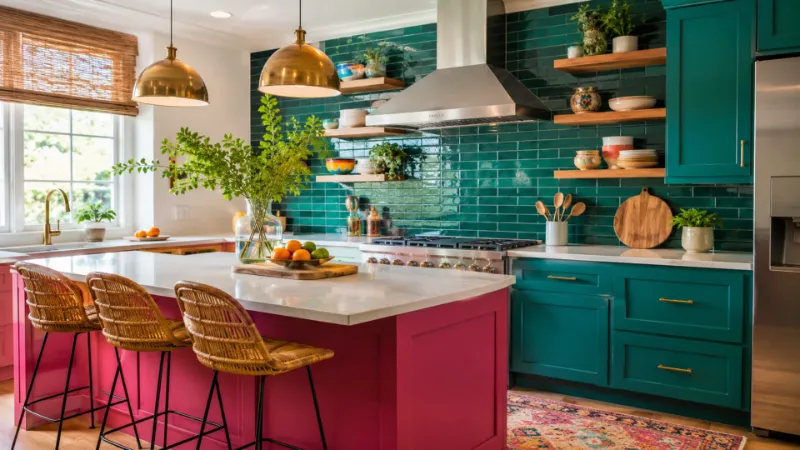
Is your kitchen stuck in a sea of beige and white? You are not alone. Millions of homeowners crave a vibrant, personality-filled cooking space but never take the leap unsure where to start or afraid of making a costly mistake. Here is the truth: colorful kitchen ideas do not have to be overwhelming. When done right, a splash of bold color can completely transform how you cook, feel, and live in your home.
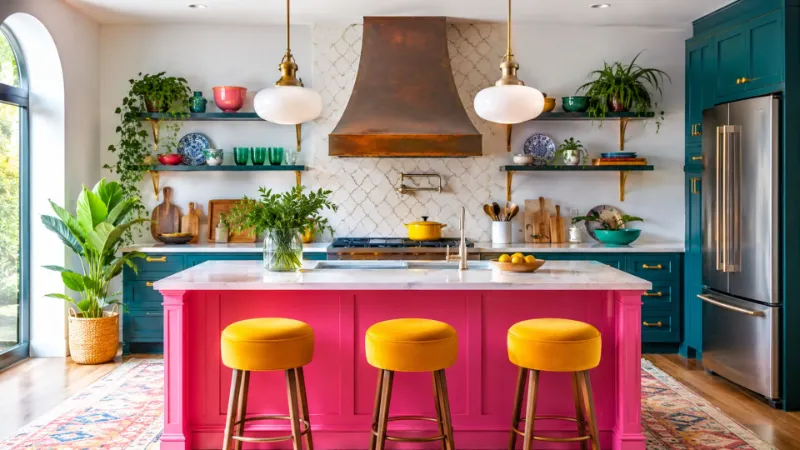
This guide walks you through stunning, expert-backed colorful kitchen ideas that work for every budget and home style. Whether you want a subtle two-tone look or a fully immersive jewel-toned kitchen aesthetic, you will find actionable, design-forward ideas that go far beyond what most interior blogs offer. We have also included pro tips, style notes, trend analysis, and future-focused insights so you can make a decision that looks just as great five years from now.
Bold Blue Cabinets: The Timeless Statement Maker
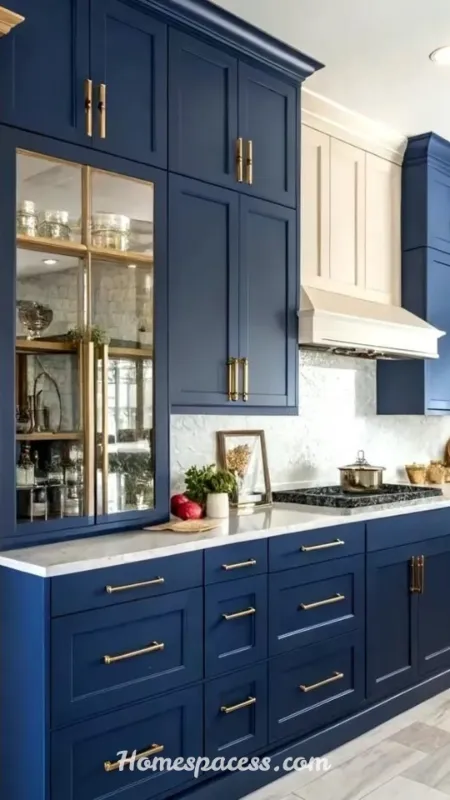
When it comes to colorful kitchen cabinet ideas, nothing commands attention like a deep, saturated navy or cobalt blue. Blue kitchens have surged in popularity precisely because blue is one of the few colors that reads both luxurious and calming at the same time. Paired with brass hardware and white countertops, navy cabinets create a high-end, magazine-worthy aesthetic that works in both modern and traditional homes.
A great real-world example: a Brooklyn brownstone kitchen with flat-panel navy lower cabinets, open upper shelves, and butcher-block counters. The result felt expensive without the price tag. The blue kitchen design added depth to a narrow galley layout that white would have made feel sterile. It is a reminder that color is not just decorative it is a spatial tool.
For best results, use matte or eggshell finishes on cabinetry to avoid a plastic look under kitchen lighting. Consider painting only the lower cabinets blue and keeping uppers white to avoid the space feeling too heavy a technique called two-tone kitchen design, which is one of the biggest kitchen color trends of 2026 and beyond.
🎨 Style Note:
Navy blue pairs beautifully with natural wood accents, matte black or brushed brass hardware, and warm-white subway tiles. Avoid cool-toned whites go for creamy, warm whites to prevent the space from feeling cold.
💡 Pro Tip:
Test your chosen blue in a large paint swatch (at least 12×12 inches) under your kitchen lighting both natural and artificial for at least 48 hours before committing. Blue dramatically shifts tone under warm vs. cool bulbs.
See Related Articles: Island Kitchen Ideas: 13 Stunning Designs That Transform Your Kitchen in 2026
Emerald Green Accents: Where Luxury Meets Nature
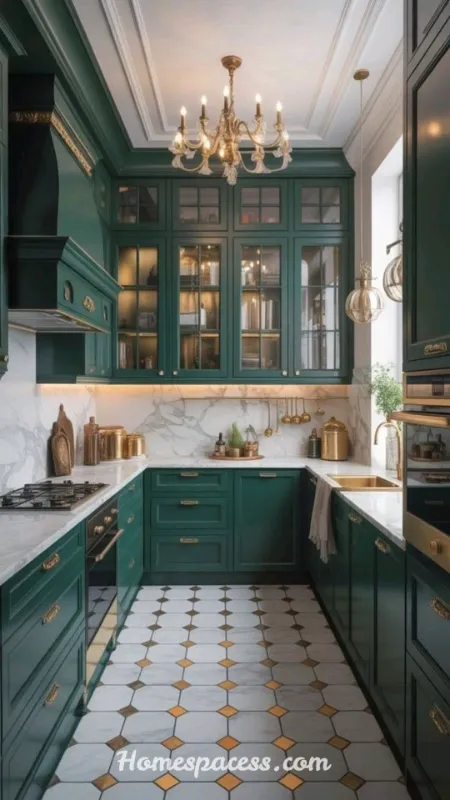
Emerald green has become the go-to bold kitchen color for interior designers who want to communicate sophistication without trying too hard. Unlike trendy mint or sage, deep emerald green has a classical quality it echoes Victorian billiard rooms, Parisian brasseries, and high-end hotels. In a kitchen, it delivers instant richness, especially on an island, a single accent wall, or lower cabinetry.
Consider a scenario: a suburban kitchen with standard white Shaker cabinets receives a single emerald green kitchen island. The change costs only the price of paint and new barstools but visitors consistently describe the space as feeling “designer.” That is the power of strategic color placement. You are using color psychology in kitchen design to elevate the entire room without a full renovation.
Green also connects a kitchen to biophilic design principles the growing trend of bringing nature indoors. Pairing emerald cabinets with live herb plants, natural wood shelving, and stone countertops creates a space that feels both lush and grounding. It is one of the most emotionally satisfying kitchen color combinations available today.
🎨 Style Note:
Emerald green is highly versatile: it works with gold, copper, or black hardware. Avoid chrome it reads too cold against this rich tone. Light marble countertops and beige or terracotta floor tiles create a beautifully balanced look.
💡 Pro Tip:
If you are renting or hesitant to paint cabinets, use emerald green in your bar cart, pendant lights, kitchen textiles (curtains, towels), or a statement backsplash tile to achieve the same visual impact.
You May Also Like: Best Spice Racks Ideas to Transform Your Kitchen Storage
Terracotta and Warm Earth Tones: The Cozy Mediterranean Kitchen
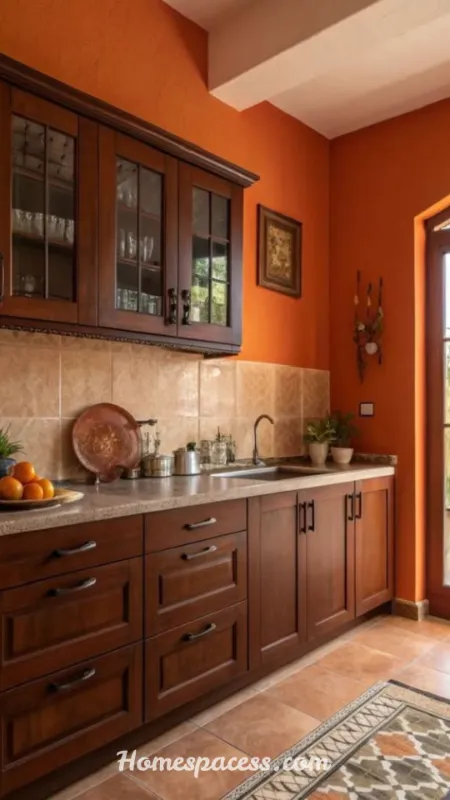
If bold jewel tones feel too dramatic for your taste, warm earth-tone kitchen ideas offer a softer but equally striking alternative. Terracotta, burnt sienna, warm ochre, and rust are enjoying a powerful resurgence largely because they photograph beautifully, age gracefully, and feel inherently warm and welcoming. These tones work especially well in kitchens with natural light and materials like rattan, linen, and raw wood.
A real-life example: a California craftsman kitchen repainted with terracotta-toned lower cabinets, paired with a zellige tile backsplash in warm cream and pale gold. The combination felt sun-drenched, eclectic, and deeply personal. This Mediterranean kitchen aesthetic has gained enormous traction because it bridges the gap between boho kitchen design and more refined, editorial-quality interiors.
From a practical standpoint, warm-toned kitchens tend to feel more welcoming during winter months when natural light is limited. The earthy warm color palette also hides minor cooking splatter and everyday wear better than stark white an underrated benefit that homeowners only discover after living with the choice. This makes terracotta not just beautiful but also a functional, low-maintenance kitchen color choice.
🎨 Style Note:
Layer warm tones: terracotta cabinets, a warm white or cream ceiling, and wood-toned open shelving. Add a cream or oatmeal linen Roman shade. Every surface should feel like it came from the same warm corner of the earth.
💡 Pro Tip:
Terracotta walls or cabinets can make a kitchen feel warmer in both the aesthetic AND literal sense. To balance the coziness, keep countertops light (white marble or pale quartz) and ensure your lighting uses bulbs between 2700K–3000K for a perfect glow.
Recommended for You: Kitchen Lighting Ideas to Create a Cozy and Modern Cooking Space
Two-Tone Kitchen Cabinets: Color Blocking Done Right
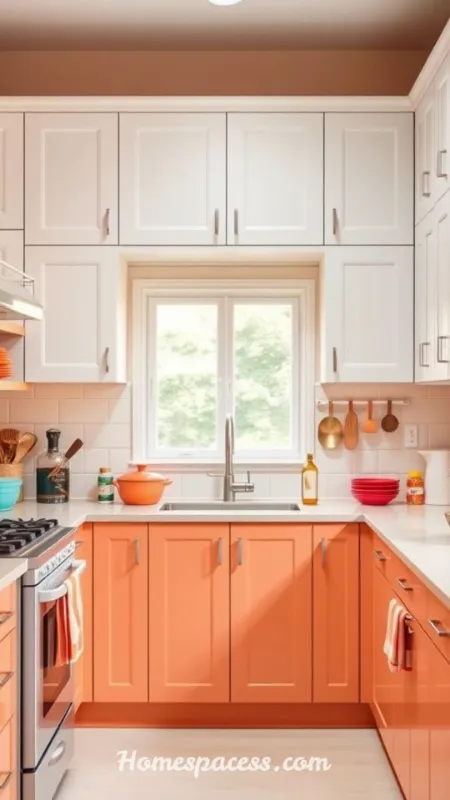
The two-tone kitchen cabinet trend is one of the most practical and design-savvy ways to introduce color without full commitment. The classic formula: painted lower cabinets in a bold color, white or light upper cabinets. This approach visually grounds the kitchen with color while keeping the eye line airy and open a technique borrowed directly from professional interior color theory.
Beyond the classic formula, two-tone kitchens have evolved. Today, designers are playing with island contrast painting the island a completely different color than the perimeter cabinets. For example: sage green perimeter cabinets with a warm mustard yellow island. Or dark charcoal perimeter cabinets with a warm wood-veneer island. These combinations create a focal point in the kitchen that feels intentional and editorial rather than accidental.
One overlooked aspect of the two-tone kitchen: hardware as a unifying element. If your two cabinet colors feel disconnected, matching hardware across both brings instant cohesion. Brushed gold hardware on both sage green and navy cabinets transforms a potentially clashing combination into something that feels deliberately designed. Always consider hardware as the fourth element alongside color, countertop, and backsplash in your kitchen color palette planning.
🎨 Style Note:
The safest two-tone formula: bold lower cabinets (navy, green, terracotta), white or off-white uppers, and a neutral backsplash. For adventurous personalities, try a monochromatic two-tone approach using the same color in two different finishes matte lower, gloss upper.
💡 Pro Tip:
Before choosing two colors, test them on large paint chips placed side by side under your kitchen’s actual lighting. Colors that look great in a paint store can fight or muddy each other under warm incandescent or cool LED kitchen lights.
Explore More: Kitchen Nook Ideas: Transform Dead Corners Into Cozy, Functional Spaces
Colorful Backsplash Tiles: The Low-Commitment Color Injection
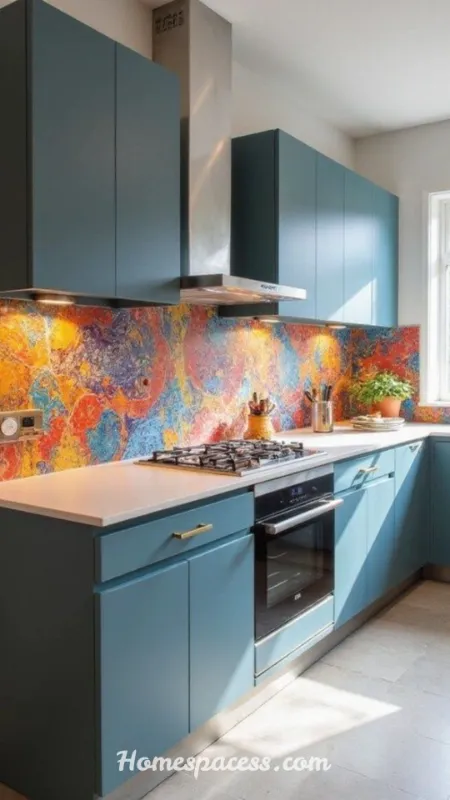
If you are not ready to repaint your cabinets, a colorful kitchen backsplash is the single highest-impact, lower-risk upgrade available. A backsplash occupies the most visually prominent real estate in any kitchen the area directly at eye level when you are cooking. Using vibrant patterned tiles, hand-painted ceramic tiles, or zellige in jewel tones instantly transforms a neutral kitchen into something that feels richly designed.
Consider the case of a rental kitchen with white melamine cabinets and plain white walls. The tenant installed removable peel-and-stick Moroccan-patterned tiles in cobalt blue and white. The kitchen went from forgettable to Instagram-worthy overnight without breaking the lease or the budget. This illustrates a core principle of colorful kitchen decorating: the most effective changes are not always the most permanent ones.
For permanent installations, hand-painted Talavera tiles, zellige tiles, and artisan ceramic subway tiles in color are all trending in 2026. These materials gain character as they age microscopic variations in glaze and pigment mean your backsplash literally improves over time. This is the opposite of printed or mass-produced tile, which tends to look dated quickly. Investing in artisan colorful tiles is a long-term design decision, not just a trend.
🎨 Style Note:
A colorful backsplash works best as the clear hero element. If your tile is bold and patterned, keep cabinetry neutral (white, light grey, or natural wood). If your tile is a solid color, you have more freedom to introduce color elsewhere in the kitchen.
💡 Pro Tip:
When using colorful grout (which dramatically changes the look), choose a grout color that appears in the tile itself. This creates harmony rather than contrast and prevents the grout from competing with the tile’s pattern or color story.
Discover More: 21 Kitchen Decor Ideas That Transform an Ordinary Kitchen Into a Space You Actually Love
Sunshine Yellow Kitchen: Bringing Warmth and Energy
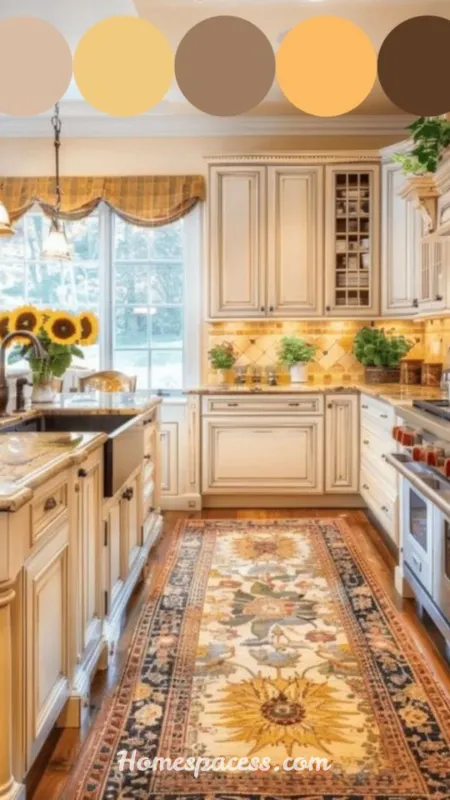
Yellow is the most psychologically energizing kitchen color and the most misunderstood. Many homeowners avoid yellow because of bad ’80s associations with baby-yellow walls and dated appliances. But modern kitchen yellow palettes are entirely different: think warm mustard, golden ochre, saffron, and deep marigold rather than primary school yellow. These nuanced shades feel sophisticated, culturally rich, and beautifully warm in kitchen environments.
A townhome owner in Chicago installed mustard yellow painted cabinets with matte black fixtures in a north-facing kitchen that perpetually felt dark and cold. The yellow transformed the space entirely reflecting the limited natural light and creating the illusion of warmth that windows could not provide. This is precisely why warm yellow kitchen ideas are especially effective in north- or east-facing kitchens that lack abundant sunlight.
Yellow also serves as a natural appetite stimulant a fact well-known in restaurant design and color psychology. Studies have shown that warm colors like yellow and orange encourage social interaction and enjoyment of food. In a home kitchen, this translates to a space that feels more alive, social, and enjoyable to cook in a subtle but real quality-of-life upgrade that pure aesthetics cannot fully capture.
🎨 Style Note:
Mustard yellow cabinets sing against warm white walls, dark walnut countertops, and matte black or copper fixtures. Avoid cool-toned greys or blue-based whites next to yellow hey create a jarring visual tension rather than complementary contrast.
💡 Pro Tip:
Afraid to commit to full yellow cabinets? Start with a yellow kitchen island, yellow pendant lights, or yellow appliances (fridges and ranges now come in bold colors from brands like Smeg and Big Chill) to test the effect before going all in.
See Also: Small Kitchen Ideas: 18 Expert Transformations That Actually Work
Deep Red and Burgundy: The Underrated Power Color
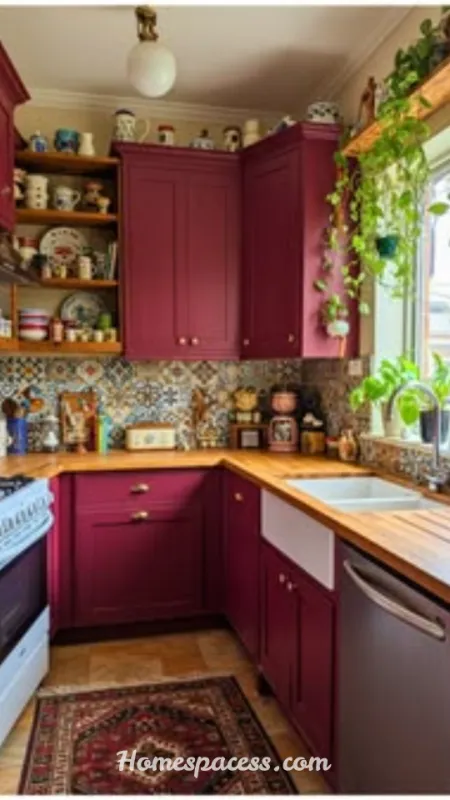
Red is the boldest of all vibrant kitchen color ideas and the least frequently used at scale, which is exactly why it makes such a powerful impression. Deep burgundy, wine red, and oxblood are far more liveable than bright cherry red, and they carry enormous visual weight. Used strategically on lower cabinets, an island, or a single statement wall, these shades signal confidence, drama, and warmth in a way no other color does.
Historically, red kitchen design has roots in both Shaker farmhouse traditions (where deep red barns and trim were common) and in European culinary culture, where bold dining room colors signaled wealth and appetite. A red kitchen island in a white farmhouse kitchen is a direct nod to this tradition it feels simultaneously rooted in history and startlingly modern. Interior designers increasingly describe this effect as “lived-in luxury.”
The key to pulling off a red kitchen successfully is saturation and finish control. Matte red reads as sophisticated and intentional; glossy red reads as retro or kitschy. Pair matte burgundy cabinets with unlacquered brass hardware which develops a natural patina over time and aged-look stone countertops for a kitchen that feels like it has always been there. This is the definition of timeless kitchen color design.
🎨 Style Note:
Burgundy pairs with warm cream, aged wood, and unlacquered brass. The combination feels vintage-luxurious. Avoid pairing burgundy with cool grey or chrome it creates an uneasy clash between warm and cool undertones that no amount of styling can fix.
💡 Pro Tip:
Red and burgundy are highly sensitive to undertone differences in adjacent colors. Use a warm-white ceiling (not bright white) and warm-toned flooring. The more consistently warm your palette, the more the burgundy will glow rather than fight.
Must Read This Post: Colorful Bathroom Ideas to Transform Your Space with Style in 2026
Colorful Open Shelving: Displaying Life in Full Color
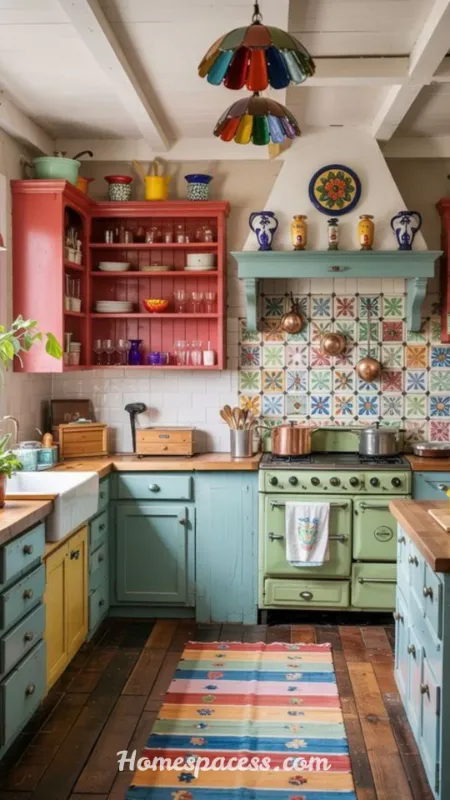
Open shelving is not just a storage solution when done thoughtfully, it is one of the most effective colorful kitchen decorating ideas available. The key is treating shelves as curated color installations rather than simple storage. Grouping dishes, jars, and objects by color family creates a visual rhythm that turns everyday kitchen items into intentional décor elements.
A design-forward approach gaining traction in 2026: painting the interior back wall of open shelving in a rich, contrasting color. White shelves against a deep forest green or cobalt blue back panel create a shadow-box effect that makes everything displayed look more intentional and beautiful. This is essentially free it requires only a small amount of paint but delivers an outsized visual result. It is one of the best budget-friendly colorful kitchen ideas.
A scenario worth considering: a home cook who owns a beautiful collection of vintage copper cookware, ceramic mixing bowls, and hand-thrown pottery installs open shelves with a deep teal back panel. The result turns functional storage into an art installation. Guests inevitably comment on the “display,” not realizing that everything on those shelves is used daily. This is functional color strategy at its finest.
🎨 Style Note:
For the most polished open-shelf look, limit your displayed color palette to 2–3 colors maximum. Introduce neutrals (natural wood cutting boards, linen, jute) to prevent the display from feeling chaotic. Edit ruthlessly negative space is part of the design.
💡 Pro Tip:
Before arranging shelves permanently, lay all your intended items on a table and photograph them. Study the photo to see if the composition works. It is far easier to rearrange on a table than on a mounted shelf especially if items are heavy or fragile.
Don’t Miss This Article: Bedroom Bookshelf Ideas | Smart, Stylish & Space-Saving Ideas to Transform Your Bedroom
Sage Green Kitchen: The Color That Works Everywhere
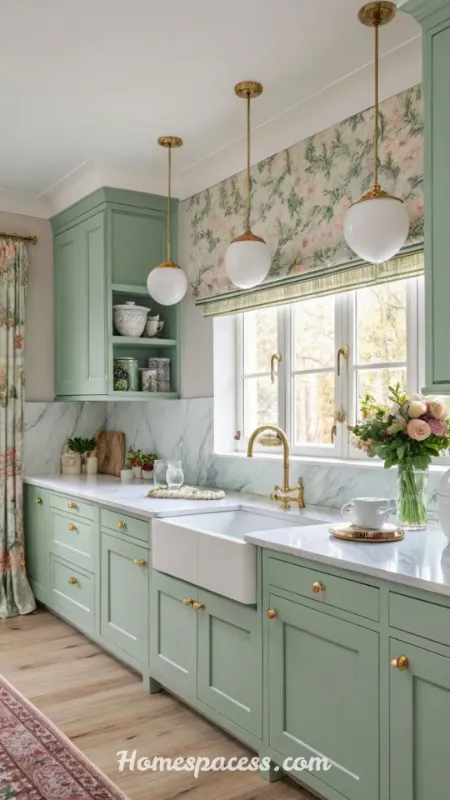
If you need a single colorful kitchen paint idea that is almost guaranteed to succeed, choose sage green. Sage and muted green kitchen designs have dominated interior design for several consecutive years and unlike many trends, there are strong reasons to believe this one has genuine staying power. Sage is essentially a neutral with a green tint: it recedes from the eye without disappearing, works in every lighting condition, and pairs beautifully with virtually every countertop material.
A young professional in a downtown apartment repainted her kitchen walls in warm sage green and swapped her plain bar stools for natural rattan ones. The $80 project created a kitchen that felt entirely new and that she has lived happily with for three years without any desire to change it. That longevity is the true test of a successful color choice and illustrates why sage green kitchen ideas consistently top designer recommendation lists.
From a color theory perspective, sage green sits at the intersection of green and grey it shares grey’s neutrality while adding life and warmth. It works particularly well with natural materials like terracotta floor tiles, woven pendants, oak cabinets, and marble essentially everything trending in contemporary home design right now. Choosing sage green for your kitchen is therefore not just a color choice but an investment in long-term design coherence.
🎨 Style Note:
The best sage green kitchen pairings: warm white walls, oak or walnut accents, brass or unlacquered copper hardware, terracotta tiles or warm stone flooring. Avoid cool-toned greys they pull the sage toward blue-green and drain the warmth.
💡 Pro Tip:
“Sage green” covers a huge range. Look for paints labeled as ‘muted,’ ‘earthy,’ or ‘grey-green’ rather than ‘bright’ or ‘vivid.’ Farrow & Ball’s Mizzle, Sherwin-Williams Privilege Green, and Benjamin Moore’s Cushing Green are industry favorites.
Colorful Appliances: The Personality-Driven Statement
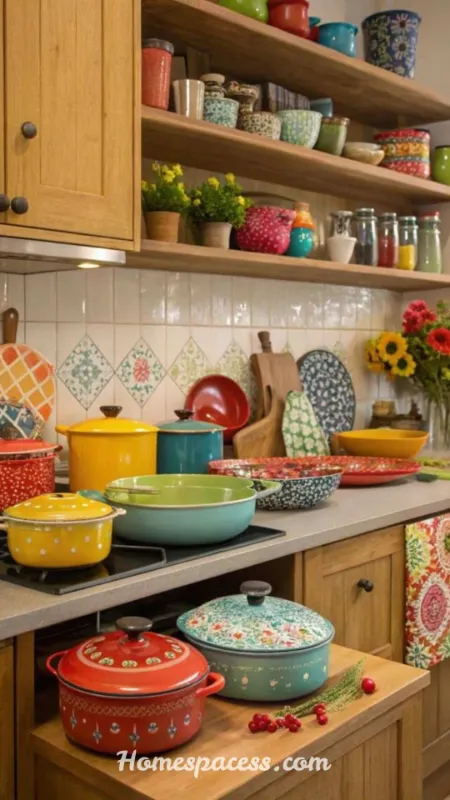
One of the most underutilized colorful kitchen ideas is simply choosing color-forward appliances. Brands like Smeg, Big Chill, Blue Star, and Elmira Stove Works offer refrigerators, ranges, and dishwashers in dozens of bold, beautiful colors from cherry red and cobalt blue to mint green and cream yellow. A single colored appliance in an otherwise neutral kitchen immediately becomes the focal point of the entire room.
This approach is particularly powerful because it requires zero renovation. You are simply purchasing a differently colored version of an item you already need. A mint green Smeg refrigerator in an all-white kitchen transforms the space immediately. A cobalt blue range becomes both a cooking tool and a piece of visual art. These appliances also tend to hold strong resale value in a market where buyers are increasingly looking for homes with personality and character.
Beyond the big-ticket appliances, even small countertop appliances KitchenAid stand mixers, Nespresso machines, toasters, and kettles offer color choices that can be coordinated into a cohesive colorful kitchen theme. Choosing your small appliances in a matching or complementary color (all in cream, or all in matte black, or all in a specific green) creates a sense of intentional curation that elevates the entire kitchen without a single structural change.
🎨 Style Note:
When using colored appliances, keep surrounding elements quieter. A vibrant red range looks best against white cabinets and pale stone countertops. Let the appliance be the star resist the urge to add additional color elements that compete for attention.
💡 Pro Tip:
If you love the look of colored appliances but are worried about resale, choose a color that is already reflected elsewhere in your kitchen in a backsplash tile, a textile, or cabinet accent. This makes the appliance feel intentional rather than random.
Multicolor Kitchen: Controlled Maximalism for the Brave
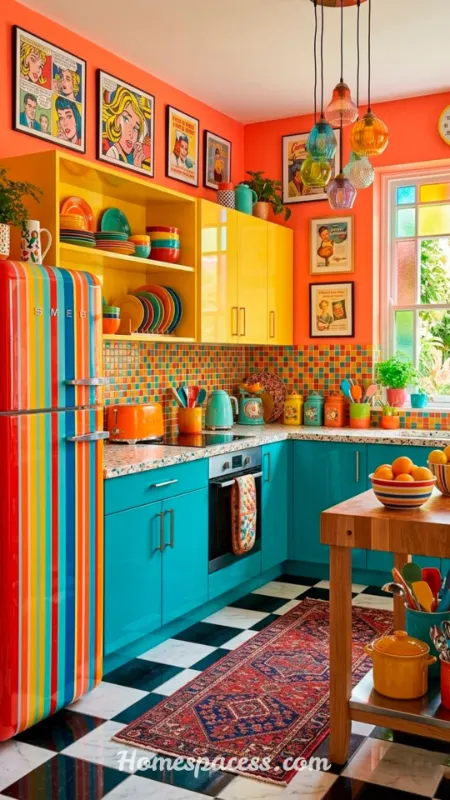
The multicolor kitchen using three or more distinct colors in a coordinated, intentional way is the ultimate expression of colorful kitchen design. It requires the most planning but delivers the most dramatic, personal results. The key word, as always, is intentional. A multicolor kitchen is not a room where random colors were applied without a plan; it is a space where every color choice was made in relationship to the others, creating a cohesive, joyful, layered environment.
A celebrated example: a Victorian terrace kitchen in London’s East End used dark teal uppers, warm mustard lowers, a hand-painted floral tile backsplash, and forest green shelving. Each color was drawn from the tile making the backsplash the design anchor and the cabinets the supporting cast. This is the professional approach to maximalist kitchen color design: choose your most complex element first (often a patterned tile or rug) and build all other color decisions outward from that anchor.
The multicolor kitchen trend is strongly associated with dopamine décor the design philosophy that prioritizes joy, energy, and personal expression over minimalist conformity. This approach gained enormous traction post-2020 as homeowners sought to make their homes feel more emotionally nourishing. A well-executed maximalist colorful kitchen consistently scores as one of the most emotionally positive home environments in residential design studies because living with intentional color is genuinely good for your mental wellbeing.
🎨 Style Note:
In a multicolor kitchen, choose one dominant color (60%), one secondary color (30%), and one accent color (10%). Apply this rule across cabinets, walls, and accessories. Keep floors and ceilings neutral to prevent visual chaos the eye needs somewhere to rest.
💡 Pro Tip:
Use a color wheel to select your multicolor palette. Colors that are analogous (next to each other: green, teal, blue) feel harmonious. Colors that are complementary (opposite each other: orange and blue) feel energetic and bold. Both can work beautifully just choose deliberately.
Conclusion
Colorful kitchen ideas are not a risk they are an investment in joy, personal expression, and everyday quality of life. Whether you start with a single bold cabinet color, a vibrant backsplash tile, or a fully immersive multicolor kitchen palette, the key is to choose with intention, test thoroughly, and trust that a well-chosen color will serve you beautifully for years to come.
From sage green and navy blue to terracotta and jewel tones, the best colorful kitchen ideas are the ones that reflect who you are. Take one idea from this guide, act on it this week, and experience firsthand the remarkable difference color makes. Your kitchen and your mood will thank you.
Colorful Kitchen Trends 2026–2027: Where Color is Heading Next
The kitchen color trends of 2026 represent a decisive break from the all-white kitchen dominance that defined the 2010s. Industry reports from the American Society of Interior Designers (ASID), Pantone, and major paint brands including Benjamin Moore, Farrow & Ball, and Sherwin-Williams all converge on the same narrative: bold, saturated color is back and this time, it is driven by deep demographic and psychological shifts rather than a passing fashion cycle.
The most significant emerging kitchen color trends for 2026 and into 2027 include: deep clay and earthy reds (a continuation of the terracotta movement), forest greens and botanical tones (biophilic design continues to accelerate), and dark moody kitchens in deep navy, charcoal, and even jet black. Simultaneously, warm off-whites and creme-based neutrals are replacing stark white even in “neutral” kitchens, the shift toward warmth is universal. The cold, clinical kitchen aesthetic is definitively fading.
Looking toward 2026, design forecasters at WGSN and The Trend Bible identify “curated chaos” as an emerging macro: homes that feel deeply personal, layered, and eclectic rather than showroom-perfect. For kitchens, this translates to more pattern mixing, non-matching colorful hardware, and surfaces that show craftsmanship and individuality zellige tiles, handmade ceramics, unlacquered metals. The colorful kitchen of the future will feel less like a catalogue and more like a person.
Expert Insights: How Professional Designers Approach Kitchen Color
Professional interior designers approach kitchen color selection through a framework most homeowners overlook: they design for the light first, the color second. The direction and quality of natural light entering a kitchen determines which colors will succeed.
North-facing kitchens need warm tones (yellow, red, terracotta) to compensate for cool blue daylight. South-facing kitchens can carry cool tones (teal, navy, sage) because warm sunlight naturally balances them. Getting this foundation right before choosing paint is the single most impactful insight a professional can offer.
Another expert-level insight: designers routinely use the 60-30-10 color rule in kitchen design. Sixty percent of the space is the dominant color (usually cabinetry and walls), thirty percent is the secondary color (countertops, backsplash, large textiles), and ten percent is the accent color (hardware, small appliances, plants, textiles). This formula prevents any colorful kitchen idea from tipping into visual chaos it creates a mathematical framework for color relationships that the eye perceives as inherently balanced.
Perhaps the most overlooked expert insight: the finish matters as much as the color. A matte navy cabinet and a high-gloss navy cabinet are almost entirely different design elements one reads as sophisticated, quiet, and contemporary; the other as retro, playful, and bold. Before finalizing any kitchen cabinet color idea, always test the intended finish in situ. Color cards and online swatches almost never capture finish accurately, and changing a finish after application is frequently as costly as repainting entirely.
Sustainability and Long-Term Value: Choosing Colors That Last
One of the most economically important but rarely discussed dimensions of colorful kitchen design is its relationship to long-term value and sustainability. Choosing the right color is not just an aesthetic decision; it is a financial one. A well-chosen, timeless kitchen color can significantly increase a home’s perceived value and sale price, while a poorly chosen or aggressively trendy color can actively deter buyers.
From a sustainable design perspective, using high-quality, durable paint on existing cabinets is one of the greenest and most cost-effective kitchen upgrades available. Replacing functional cabinets simply for aesthetic reasons generates enormous construction waste approximately 80% of a demolished kitchen ends up in landfill.
Choosing to repaint rather than replace dramatically reduces your kitchen renovation’s carbon footprint while still achieving a complete visual transformation. This is both economically and environmentally intelligent.
For maximum long-term value, prioritize low-VOC and zero-VOC kitchen paints from brands like Clare, Backdrop, and Benjamin Moore’s Natura line. These formulations are healthier for indoor air quality particularly important in kitchens, where heat can cause off-gassing of volatile compounds from conventional paints. They also maintain color accuracy longer, resisting yellowing and fading that degrade the look of conventional kitchen paints over five to ten years. Investing in quality paint is genuinely the highest-return kitchen upgrade available.
Future Predictions: The Colorful Kitchen of 2030
Looking five years ahead, several converging technologies and cultural forces will reshape what a colorful kitchen can be. The most transformative development is the emergence of smart thermochromic surfaces materials that change color based on temperature or electrical stimulation. These technologies, currently in commercial prototype stage, will allow homeowners to change their kitchen color palette as easily as changing a phone wallpaper. The implications for kitchen design flexibility are profound.
AI-powered color design tools are also maturing rapidly. Platforms like Houzz, Sherwin-Williams Color Snap, and emerging AI interior design apps already allow homeowners to virtually paint and visualize their kitchen in any color before touching a brush.
By 2026–2027, these tools will incorporate real-time lighting simulation allowing you to see exactly how your chosen kitchen color will look at 7am, noon, 6pm, and under artificial light. This will virtually eliminate the risk of poor color decisions for homeowners who use these tools.
Cultural forecasters also predict a continued and deepening interest in kitchens as expressions of identity and culture. As global design influences continue to cross-pollinate via social media, expect to see more regionally inspired kitchen color palettes Spanish Andalusian blues and yellows, Japanese wabi-sabi earthy tones, West African bold patterns, and Scandinavian nature-derived greens. The future of colorful kitchen design is not just bolder it is more globally aware, more personal, and more emotionally intentional than anything that came before.
Common Mistakes in Colorful Kitchen Design (And How to Avoid Them)
The most common mistake homeowners make when pursuing colorful kitchen ideas is choosing color based on paint chips alone, in the store, under fluorescent lighting. Paint chips are approximately one square inch of color viewed under retail lighting the least reliable possible environment for accurate kitchen color assessment.
The professional solution: always purchase a sample pot, paint a large swatch (at least A4 size, ideally larger) on your actual kitchen wall, and observe it for 48–72 hours under your kitchen’s existing lighting at different times of day.
Another frequently overlooked error: ignoring the undertone of your chosen color. Every color has an undertone a secondary hue that becomes visible when paired with other colors. A blue-grey paint on a chip may look perfect, but placed against your warm-toned wood floors, its blue undertone suddenly reads as cold and unfriendly. Before finalizing any kitchen color scheme, deliberately test for undertone compatibility with every permanent surface it will live alongside: floor, countertop, hardware, and ceiling.
Finally, perhaps the most consequential mistake: not considering the kitchen’s connection to adjacent spaces. In open-plan homes, a kitchen that is highly visible from the living room or dining area must be considered as part of the overall home color story not as an isolated room.
A bold kitchen color that clashes with the living room palette creates a jarring, disconnected feel in the home’s most communal space. Before committing to any colorful kitchen design, stand in the adjacent room and ask: does this color conversation between spaces feel harmonious? That simple question prevents most major color mistakes.

Team Home Spacess shares simple, practical design ideas that work for real families. The team focuses on cozy décor, soft colors, and natural textures that make a space feel truly lived-in. From everyday decorating tips to creative home projects, Team Home Spacess is dedicated to helping readers create warm, comfortable, and inviting spaces with a fresh and personal touch.