

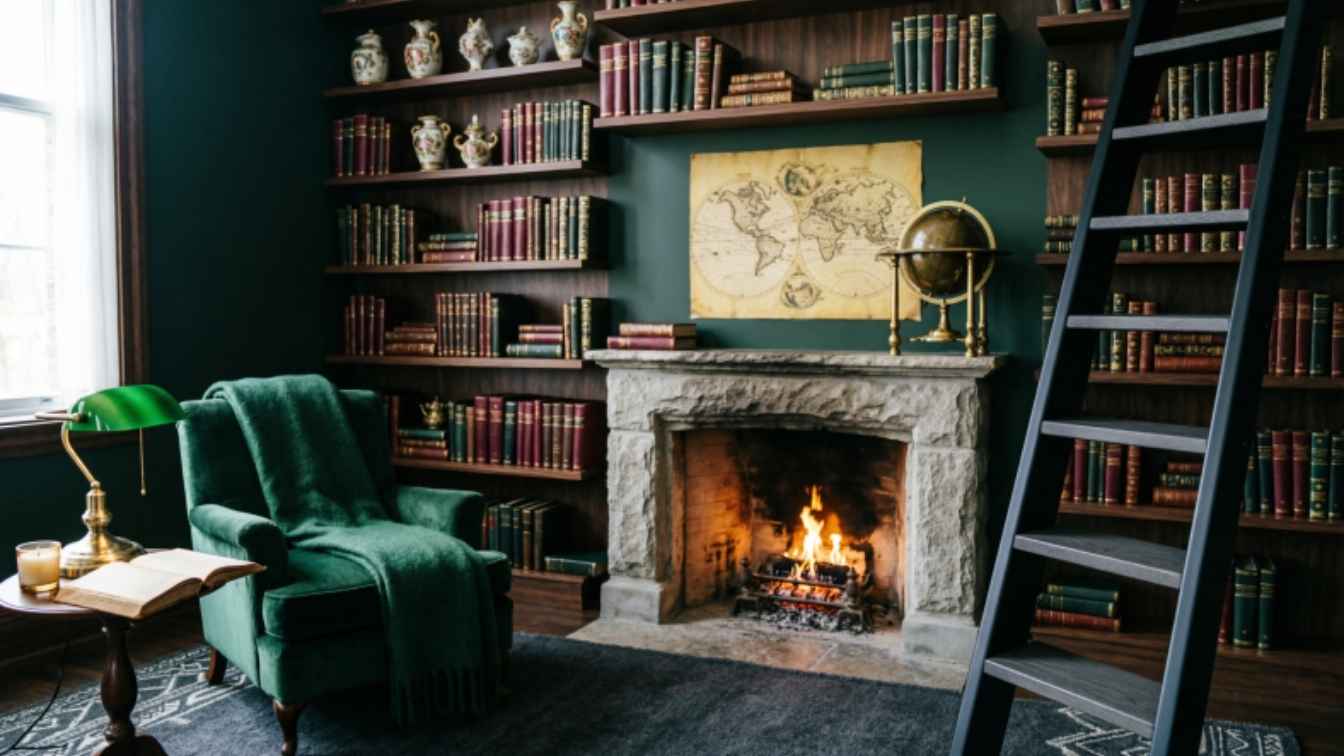
A well-designed library room is not just a storage solution for books it is a carefully engineered environment that shapes how you think, rest, and create.
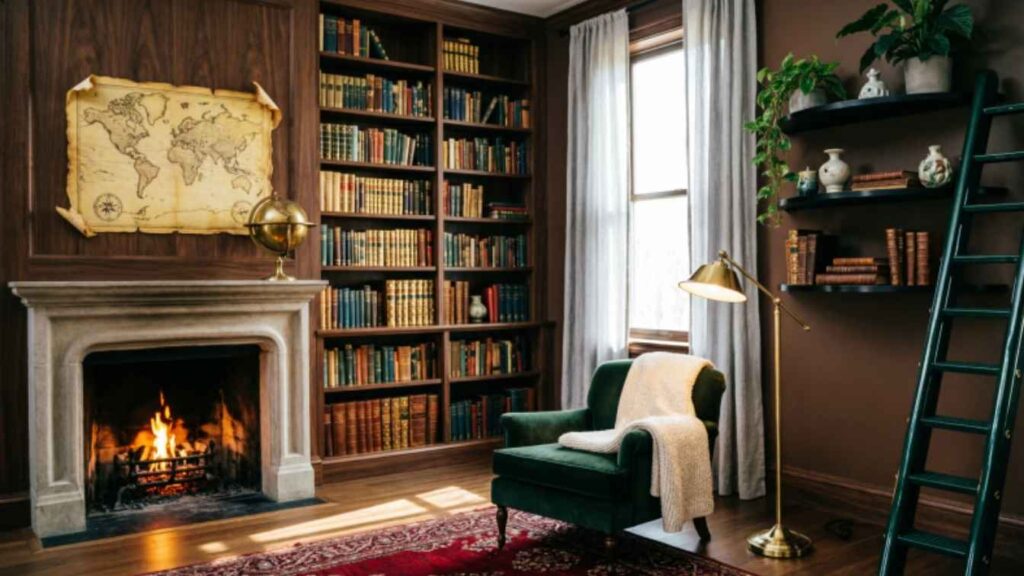
A home library room is no longer a luxury reserved for Victorian estates or academic households. Today, more homeowners are dedicating purposeful spaces to reading, studying, and curating personal book collections and the design world has responded with an extraordinary range of styles, layouts, and ideas to suit every budget and floor plan.
Whether you have an entire room to dedicate or just a spare wall, this guide delivers 27 actionable library room ideas grounded in design principles, real-world usage, and emerging 2026 trends. Each idea is explained with enough depth to help you make confident decisions not just to inspire, but to actually build your ideal reading space.
Floor-to-Ceiling Built-In Shelving
Classic · High Impact
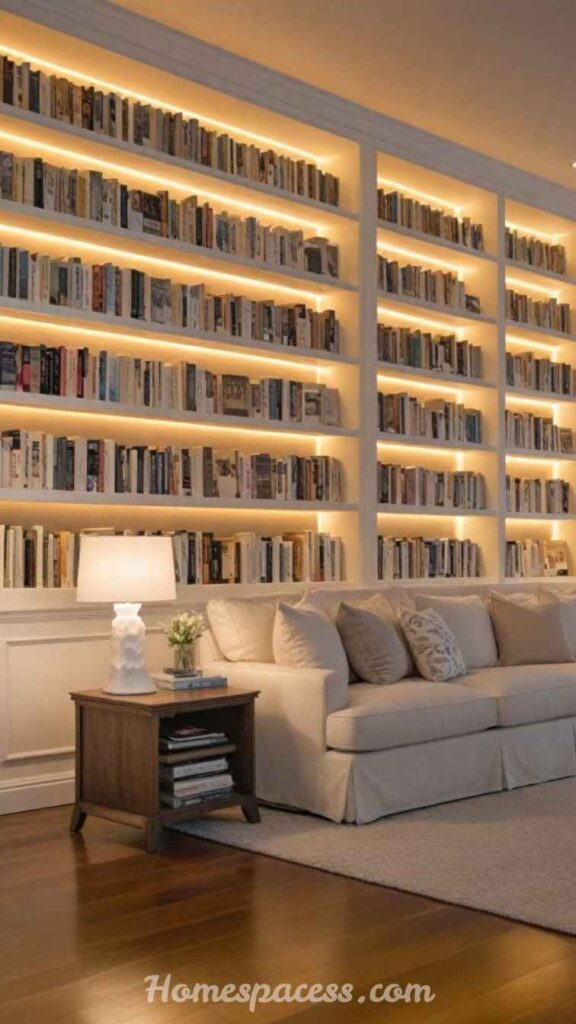
Nothing commands a room quite like built-in shelving that runs from floor to ceiling. This approach maximizes vertical storage, makes even a modest room feel grand, and adds considerable resale value to your home. Custom carpentry lets you integrate lighting, ladder tracks, decorative molding, and hidden base cabinets turning a plain wall into a full architectural feature that defines the entire room’s character.
For proportional balance, designers recommend keeping shelf depth between 10 and 12 inches for standard books, with shelves spaced roughly 12 inches apart and at least one deeper bay at 16 inches for oversized art books or displayed objects. Painting shelves and the wall behind them in the same dark tone (deep navy or forest green) creates a dramatic, cohesive backdrop that makes both books and decorative objects pop visually without requiring expensive materials.
Design Insight
Arrange books by color gradient and alternate between stacked-horizontal and vertical orientations. This technique, used widely in editorial interior photography, breaks visual monotony and signals intentionality transforming a functional storage wall into a curated visual composition.
Must Read: 20 Stunning Flower Garden Ideas to Transform Your Outdoor Space
The Reading Nook Alcove
Cozy · Space-Efficient
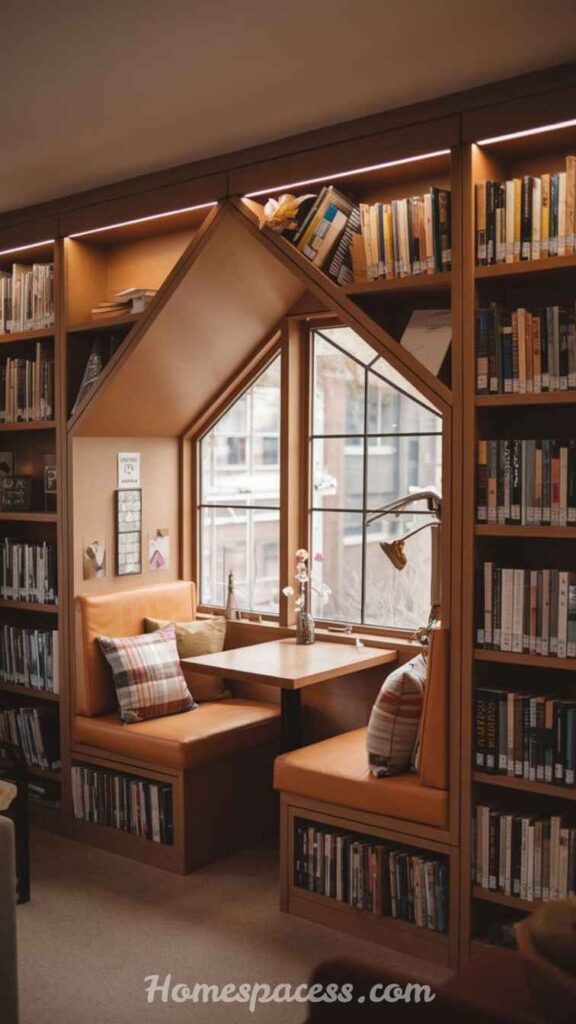
A reading nook transforms an awkward recess or underused corner into the most beloved spot in your home. Built into a wall alcove or bay window, these compact sanctuaries create genuine psychological separation from the rest of the room giving readers a precious sense of seclusion without requiring a separate dedicated space. Bench seating with hidden storage drawers beneath adds practical value to the romance without increasing footprint.
The key to a successful reading nook is layered comfort: a firm cushion base (at least 4 inches of high-density foam), tactile throw pillows, a dimmable reading light positioned at shoulder height, and a small side surface for a drink or bookmark. Surround three walls with low shelves and you have created a micro-library that punches well above its square footage and becomes the natural daily destination within the larger room.
Don’t Skip: BBQ Patio Ideas That Transform Your Outdoor Space
Dark Academia Aesthetic Library
Trending · Atmospheric

The dark academia interior style with its rich wood tones, aged leather, moody wall colors, and scholarly artifacts has moved far beyond a social media aesthetic into a legitimate design movement. In a library room, this translates to warm walnut or mahogany shelving, deep-toned walls in burgundy, hunter green, or charcoal, vintage oil paintings, globe collections, and antique reading lamps that cast amber pools of light across book spines and leather chair arms.
Textural contrast is the secret weapon of this style. Pair a worn leather Chesterfield chair with velvet drapes, a Persian rug underfoot, and raw linen throw cushions. Introduce brass hardware on cabinets and ladder tracks. Layer in genuine antiques or well-aged vintage pieces where possible the patina matters deeply, and it is what separates a curated dark academia library from a theatrical costume of one.
Expert Tip
Use Edison-style filament bulbs at 2200K color temperature in all light sources to achieve the warm amber tonality central to the dark academia mood. Crisp white LED lighting entirely undermines this aesthetic, regardless of how good the furniture quality is.
Read More: 26 Media Wall Ideas That Transform Any Living Space in 2026
Floating Wall Shelves for a Modern Library Look
Modern · Versatile
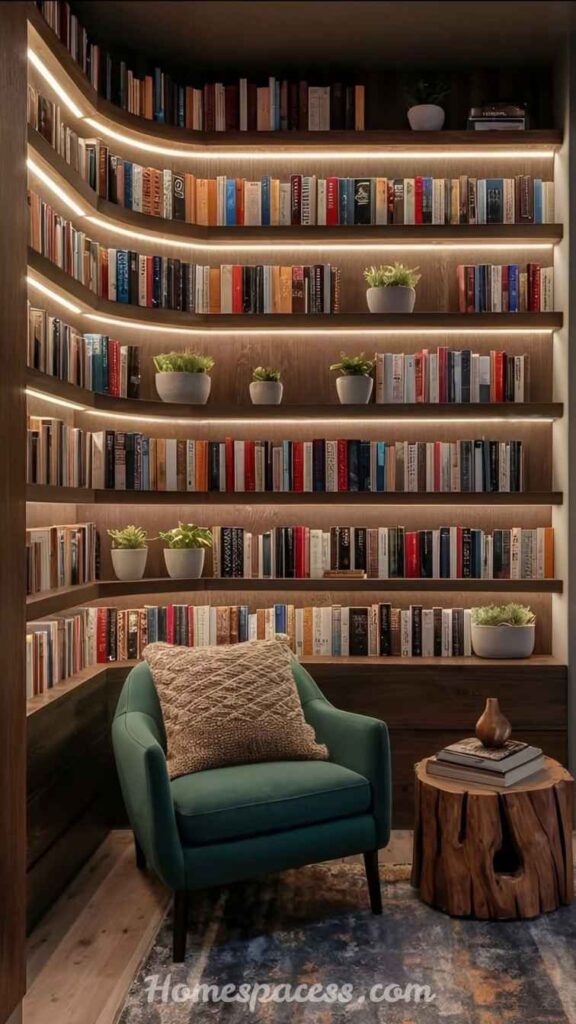
Floating shelves achieve something built-ins cannot: visual lightness. By appearing to emerge directly from the wall without visible supports, they create a clean, contemporary library aesthetic that suits smaller spaces exceptionally well. They are also far more budget-friendly than custom carpentry and allow easy reconfiguration as your book collection evolves and your curation priorities shift over time.
For a cohesive floating shelf library, vary the shelf lengths and stagger their positioning rather than aligning them in a rigid grid this creates a dynamic, gallery-like rhythm along the wall. Deep shelves at least 10 inches wide prevent books from leaning awkwardly, while concealed LED strip lighting along the underside of each shelf adds both ambient warmth and functional reading illumination in the evening hours.
Don’t Miss: 22 Living Room Decor Ideas That Transform Any Space
Rolling Library Ladder Shelving System
Statement Piece · Functional
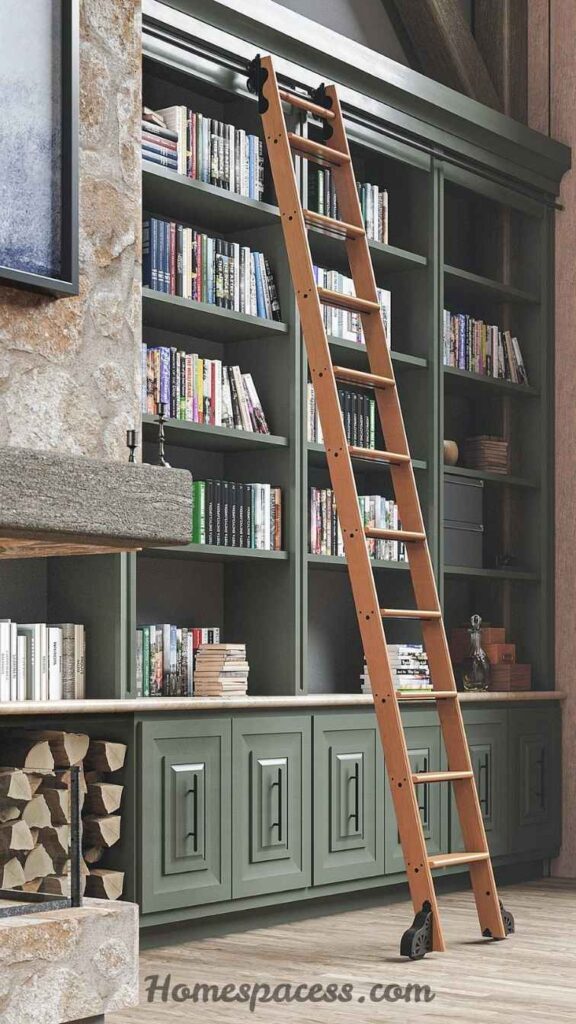
A rolling library ladder is both a practical storage solution and one of the most visually dramatic elements you can introduce into a home library room. Originally designed for the towering stacks of institutional libraries, the sliding ladder has become a coveted residential feature providing access to shelving heights above 8 feet while serving as a sculptural focal point when not in active use during the day.
The ladder rail can be installed on a single wall or engineered to turn a corner, allowing access to two adjacent shelving walls from a single track system. Brass hardware is the traditional choice, pairing beautifully with dark wood shelving. Matte black rails have surged in popularity for more contemporary, industrial-leaning library rooms. The critical structural requirement: shelving must be anchored into wall studs capable of bearing dynamic load from a climber at full extension.
Under-Stair Library Room
Space-Saving · Creative
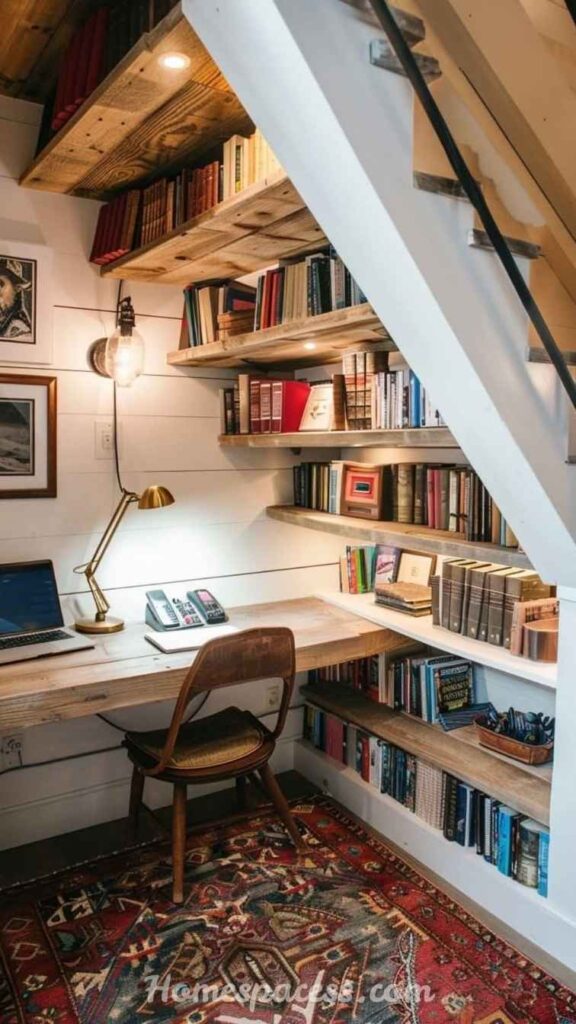
The triangular void beneath a staircase is one of the most underutilized spaces in any home and one of the most architecturally interesting for a compact library room idea. With custom shelving cut to follow the stair’s rake angle, you can house hundreds of books in a space that would otherwise become a cluttered storage closet. Add a small wingback chair tucked into the deepest section and a wall-mounted reading light, and it becomes a magical cave-like reading retreat that visitors instantly covet.
This concept works particularly well in homes with open-plan ground floors, where the under-stair area is visible from the main living space and benefits from social proximity. Use the same wood finish on the shelving as on the staircase itself for architectural continuity. Leave the front open rather than glazed to maintain the browsability and accessibility that makes a library feel genuinely alive rather than purely decorative.
Library Room with a Fireplace
Luxurious · Timeless
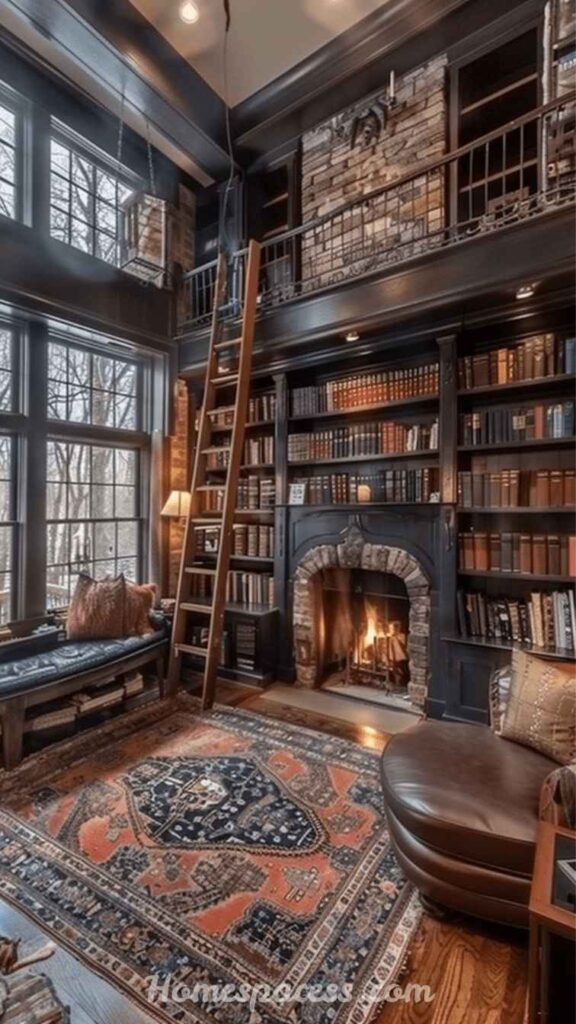
A fireplace is the single most powerful element you can pair with a home library. It anchors the room emotionally, creates an instant sense of warmth and refuge, and serves as the natural focal point around which seating and shelving can radiate. Flanking the fireplace breast with symmetrical built-in bookcases a classic Georgian configuration creates a visual composition of such completeness that the room feels perfectly resolved the moment you step through the door.
If a working fireplace is not feasible, high-quality electric fireplace inserts have improved dramatically in recent years, with convincing flame simulation and genuine radiant heat output. These can be integrated into a chimney-breast recess or a purpose-built joinery surround. The visual and psychological effect remains remarkably potent flickering light has a near-universal effect on creating the sense of sanctuary that a great library demands and deserves.
Minimalist Japandi Library Room
Serene · Refined
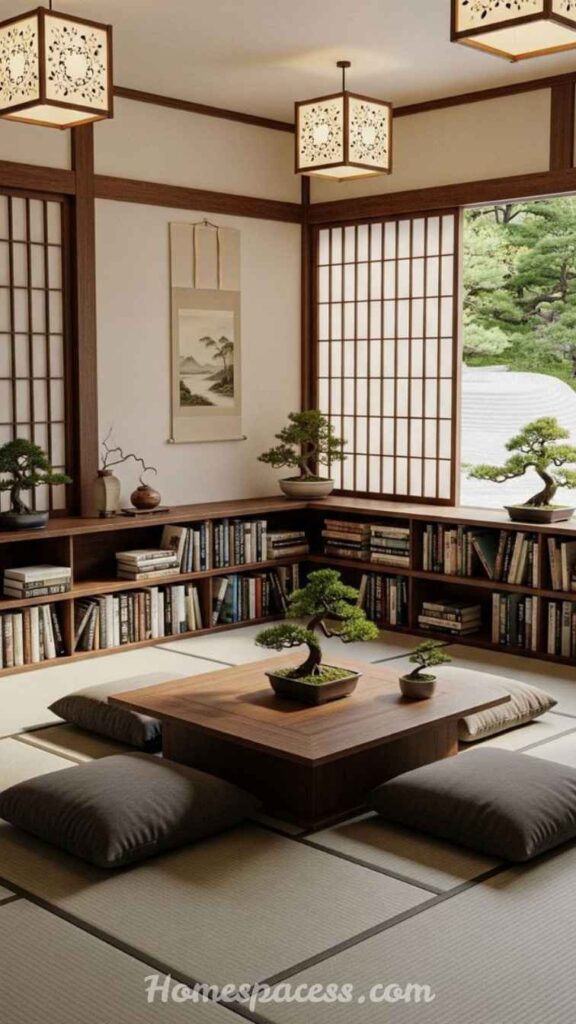
Japandi the design philosophy blending Japanese wabi-sabi with Scandinavian hygge translates beautifully into a home library concept. The aesthetic prizes intentional curation: only the books that genuinely matter, arranged with breathing space between them, accompanied by a single ceramic object, dried botanicals, or hand-thrown pottery. Nothing competes with the books, but nothing exists merely to fill space either. Every element has earned its presence through meaning or material quality.
In a Japandi library room, materials are primary: pale ash or whitened oak shelving, linen or undyed wool upholstery, tatami-influenced floor cushions, and shoji-screen room dividers. The color palette is deliberately narrow warm whites, muted sands, dusty sage, and charcoal. Task lighting is recessed or concealed, with a single handcrafted pendant or paper lantern providing ambient warmth. This style rewards those who own fewer, better books and resist the urge to fill every available surface.
Library Loft or Mezzanine Level
Architectural · Dramatic
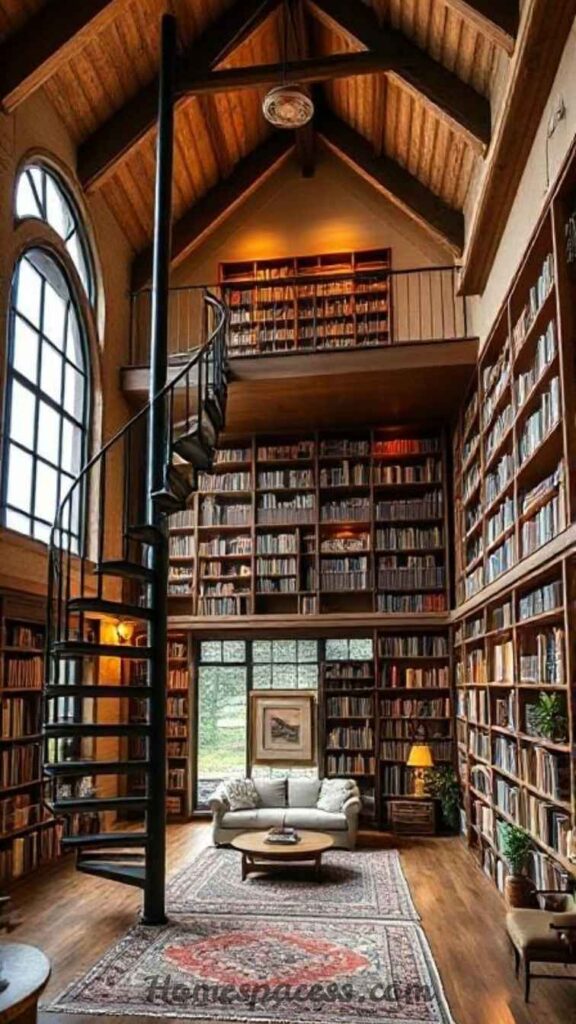
Rooms with double-height ceilings present a rare opportunity: an entire mezzanine level dedicated to books and quiet reading. Installing a cantilevered or steel-framed gallery level at mid-height creates vastly expanded book storage alongside an entirely separate experiential realm elevated, quieter, and separated from the activity of the floor below. Accessed by a ship’s ladder or open-tread staircase, the mezzanine library becomes the most coveted spot in the house.
Safety and structural engineering are the primary considerations. A mezzanine must be properly engineered for load-bearing capacity books are remarkably heavy, at approximately 20 to 30 kilograms per linear meter of fully loaded shelving. A structural engineer should assess the floor system before any library mezzanine is planned or constructed. Glass or perforated metal balustrades maintain a feeling of openness and preserve important sightlines across the double-height space below.
Dual-Purpose Home Office and Library
Practical · High-Function
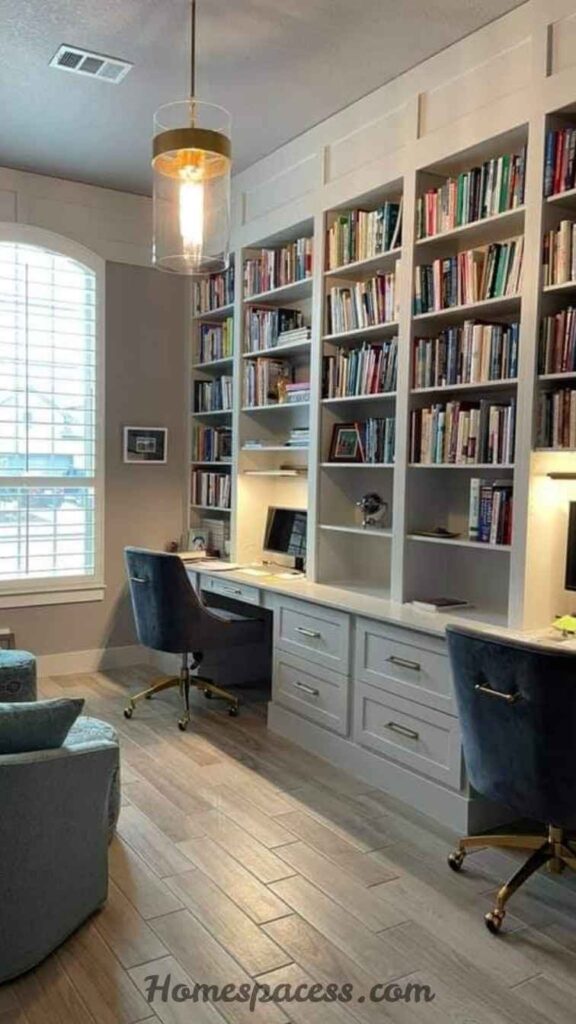
The normalization of remote work has made the hybrid home office library one of the most requested room types in residential design. Done well, the two functions reinforce each other: books signal intellectual seriousness in video calls, the library aesthetic elevates the workspace beyond a spare bedroom with a desk, and the physical presence of reference materials remains genuinely useful for knowledge workers, researchers, and creatives working from home daily.
The design challenge is preventing the room from feeling like two competing spaces jammed together. The solution is to anchor the desk directly into the shelving system integrated desk surfaces within built-in joinery unify both functions architecturally. Cable management is critical: a library’s visual calm is immediately undermined by exposed power cords. Invest in cable channels routed within the shelving itself, and position monitor screens away from the shelving backdrop during video calls to maintain the full library visual impact.
Video Call Strategy
Position your primary bookshelf directly behind your seated position for professional video calls. A well-curated library backdrop conveys credibility and intellectual depth an effect documented in remote work communication research that most home office designers overlook entirely.
More Detail: 20 Home Office Ideas to Boost Productivity in 2026
Children’s Library Room
Family · Developmental
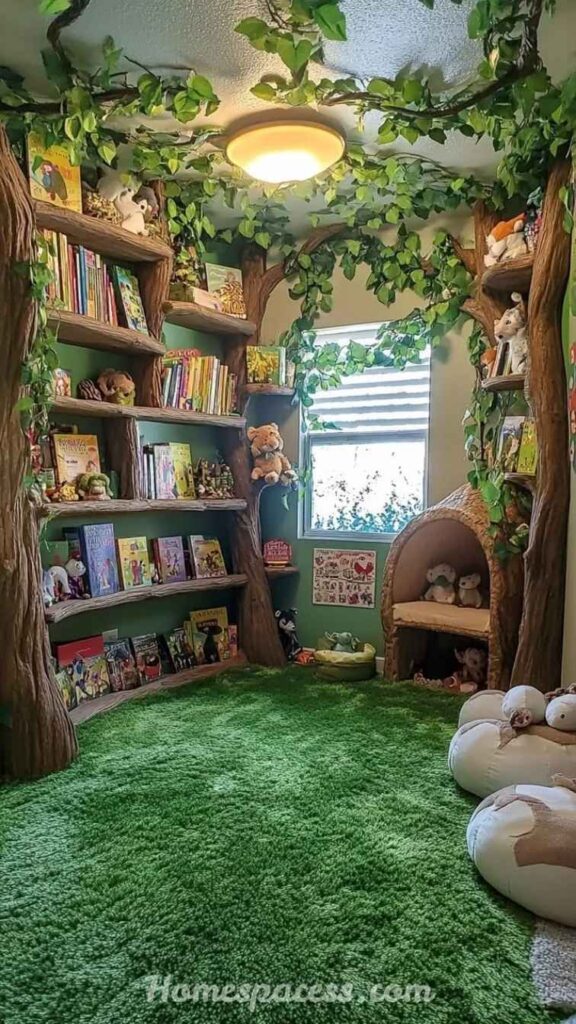
A dedicated children’s library room is one of the most developmentally significant investments a family can make in a home. Research in early childhood development consistently links access to a personal book collection with improved language acquisition, vocabulary depth, and long-term academic performance. The design should be entirely child-scale: low shelving at eye level, books displayed face-out rather than spine-out, and reading spaces built around child proportions floor cushions, bean bags, or a low platform reading area with side bolsters.
As children grow, the room should grow with them. Choose modular shelving that reconfigures as collections expand and children’s heights change over the years. Incorporate a growth chart directly into the shelving surround a detail that ties the library’s physical space to the child’s own developmental story. Chalkboard paint on one wall or inside a deep shelving cabinet provides a drawing and writing surface that expands the room’s daily utility well beyond reading hours alone.
Glass-Front Cabinet Library
Elegant · Protective
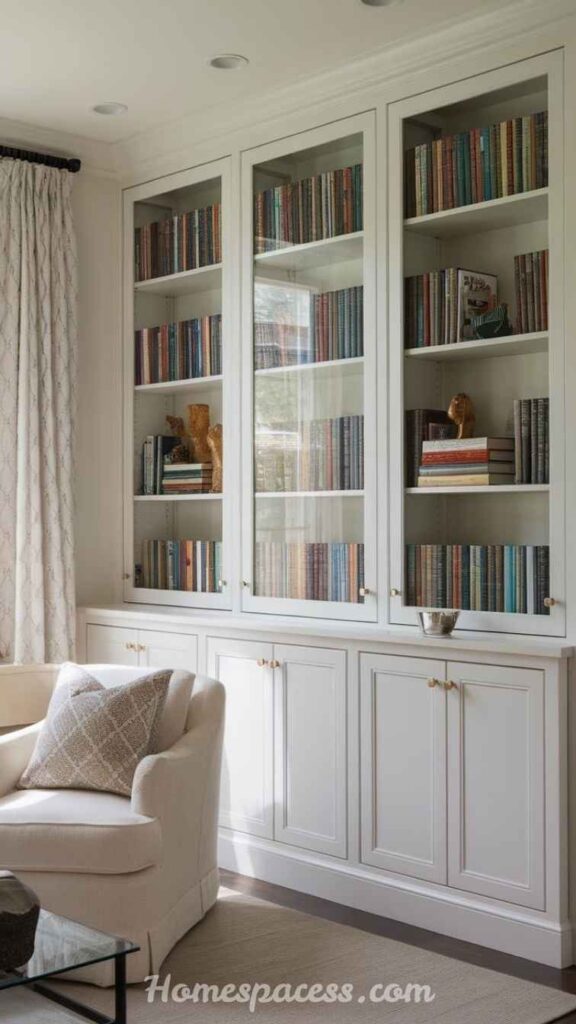
Glass-front bookcases solve a problem that open shelving cannot address: dust accumulation and UV degradation. For serious book collectors, rare first editions, or rooms with significant natural light exposure, glass-fronted cabinets protect the collection while maintaining full visibility of the books within. Historically associated with Georgian breakfront bookcases, this format has been refreshed by contemporary furniture makers into sleek, simple forms that suit modern interiors as effectively as traditional ones.
Wire glass or antique-glass panes with slight surface imperfections add warmth and visual interest to the cabinet face, while LED strip lighting installed inside creates a display-case effect that makes even ordinary books look extraordinary after dark. Brass, antique bronze, or unlacquered hardware on cabinet doors and bar pulls completes the archival, curatorial atmosphere that glass-front shelving naturally and elegantly evokes in any room.
Corner Library Wrap
Clever · Immersive
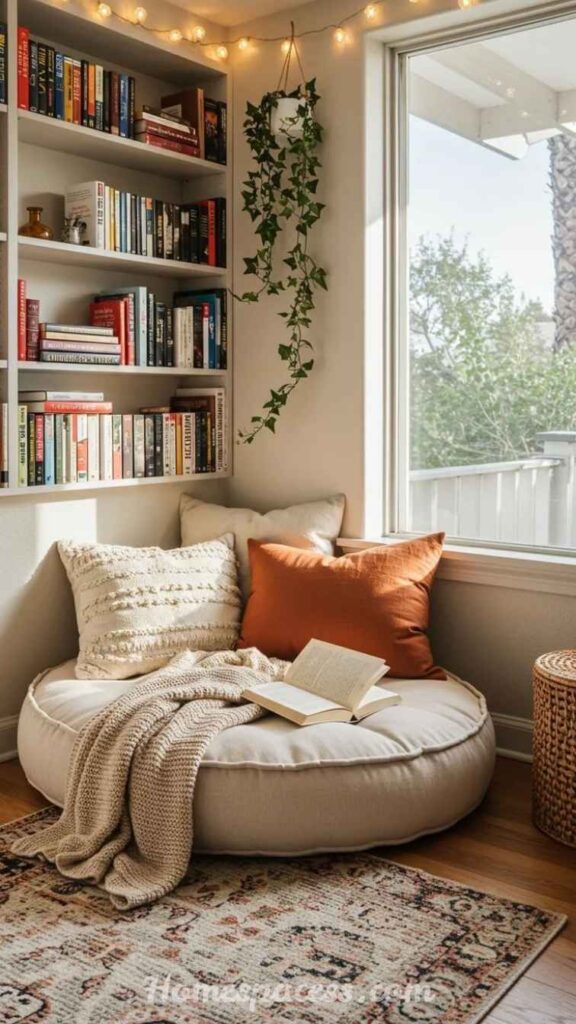
A library that turns a corner creates an enveloping experience not achievable with a single flat shelving wall. Corner-wrapping shelving immerses you in books from two directions simultaneously, making the room feel like you have stepped inside a library rather than simply placed one against a wall. Architecturally, it also activates the corner typically the weakest visual zone of any room turning a dead end into the most dynamic and interesting destination in the space.
The carpentry challenge is the corner junction itself, which requires precise miter cuts or a purpose-built bridging unit. Some designers treat the corner as an opportunity for a display alcove a small built-in niche with picture lighting above for an artwork, map, or sculptural object. This creates a satisfying visual hierarchy: books flanking on each side, focal piece centered in the corner, giving the entire composition a classical symmetry that rewards the eye from across the room.
Arched Doorway Library Entry
Architectural · Memorable
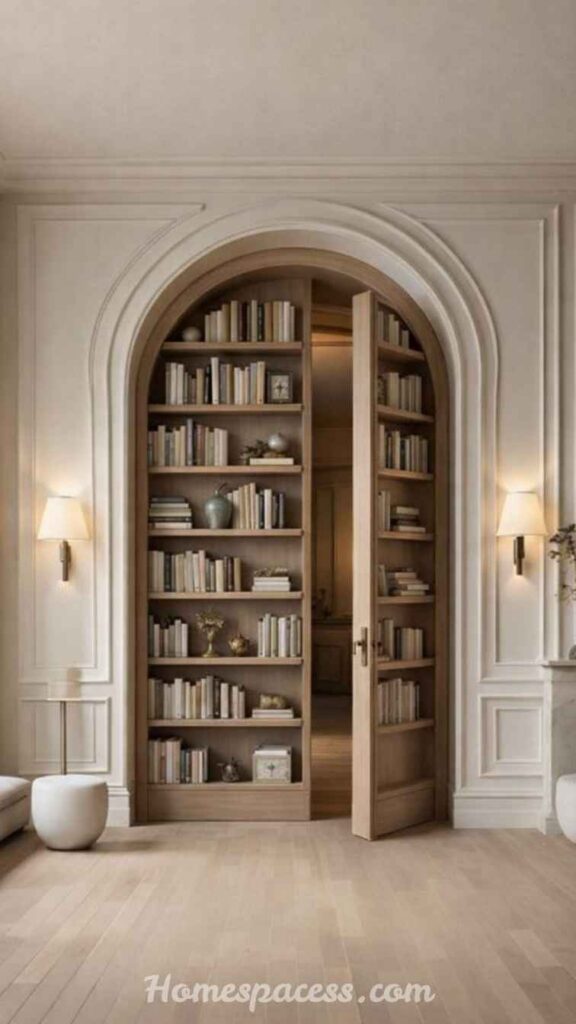
Few architectural details signal the transition into a special space as powerfully as an arch. Replacing a standard rectangular doorway with an arched opening into a home library immediately confers a sense of ceremony and arrival you are entering a dedicated realm of knowledge and quiet. In renovation contexts, this is achieved by removing the existing door frame and installing a curved plasterboard header, which is accessible work for a skilled plasterer with relatively modest material costs.
The arch can take a simple semicircular form or a more dramatic pointed Gothic shape, depending on the library’s interior aesthetic. For dark academia or traditional libraries, a rounded arch with plaster molding detail suits perfectly. For contemporary spaces, a pared-back full-height arch without any molding creates a clean but still architecturally distinct threshold. Book-lined walls beginning immediately inside the arch complete the sense of entering a purposefully curated world distinct from the rest of the house.
Library with Gallery Wall Integration
Personal · Layered
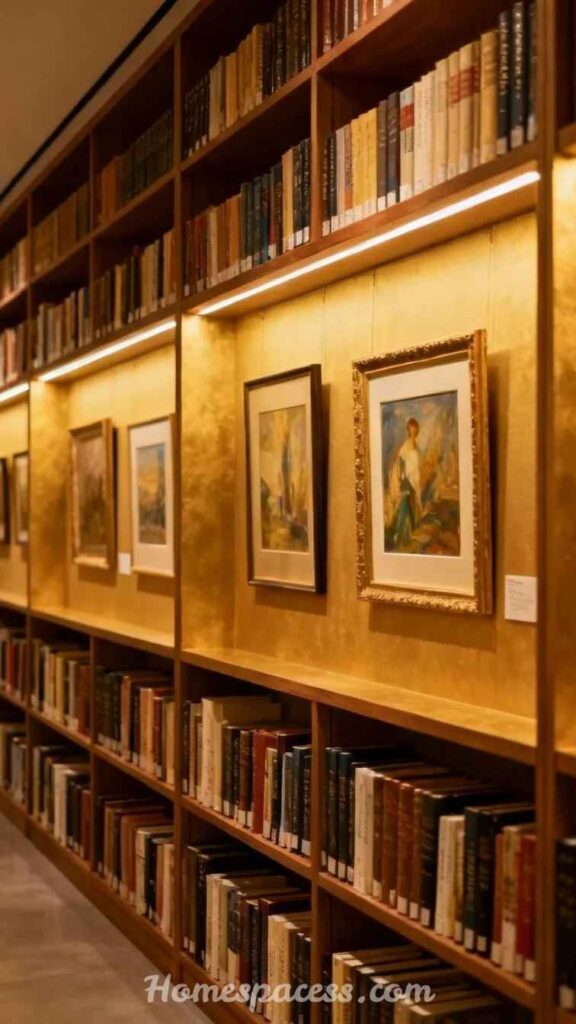
A gallery wall woven into a library room creates a deeply personal space that documents intellectual life alongside visual taste. Rather than treating books and artwork as competing interests, this approach integrates them: framed prints, photographs, maps, and original works nestle between shelving bays, creating a richly layered composition that rewards close inspection over time. The library becomes a comprehensive record of a life lived with genuine, wide-ranging curiosity.
The visual key is maintaining a consistent frame finish whether black, white, brass, or natural wood that unifies the gallery wall despite the diversity of images within it. Leave a deliberate breathing gap between shelf edges and frame edges so neither element crowds the other. Position shelving units to create natural vertical and horizontal frames within which gallery pieces sit, rather than scattering artwork randomly across whatever wall space the books have left available.
Library Room with Skylight or Dormer Natural Light
Luminous · Wellness-Focused
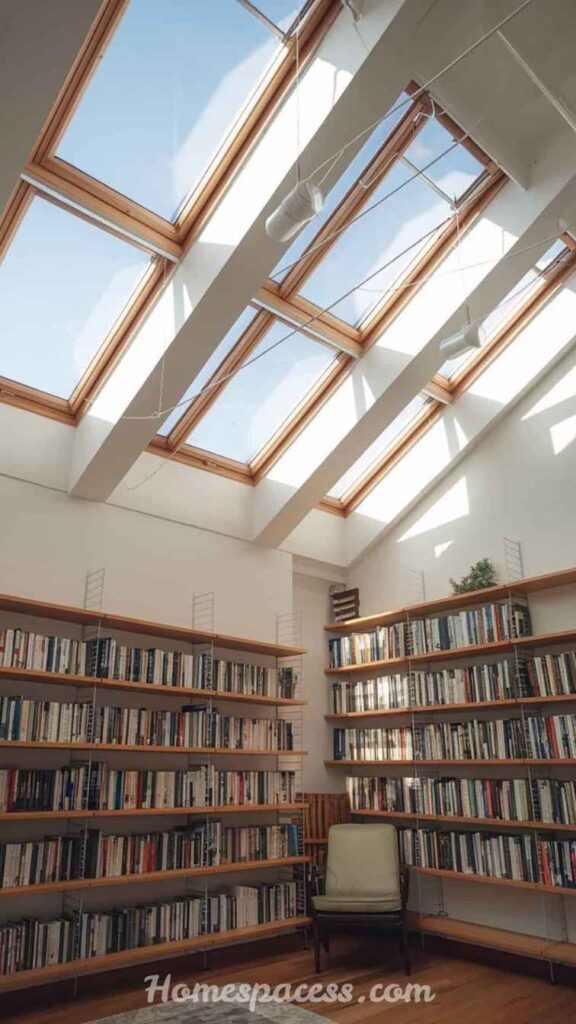
Light quality is the single most underestimated element in home library design. Most people focus intensely on what goes on the walls, yet the experience of reading is fundamentally shaped by the quality of light falling on the page. A skylight or dormer window delivers the most balanced, shadow-free natural light possible diffuse overhead daylight that illuminates the entire room evenly without the glare and contrast of direct south-facing windows at certain times of day.
In loft conversions or top-floor rooms, roof lights make library rooms extraordinarily light-filled throughout the day without sacrificing any wall space for book storage the ceiling becomes the light source. For rooms below the top floor, solar tube daylighting devices pipe natural light from the roof down through ceilings into otherwise windowless interior rooms. This technology transforms what would otherwise be a cave into a genuinely daylit reading space without any structural intervention beyond a roof penetration and ceiling fixture.
Converted Closet Library
Budget-Friendly · Ingenious
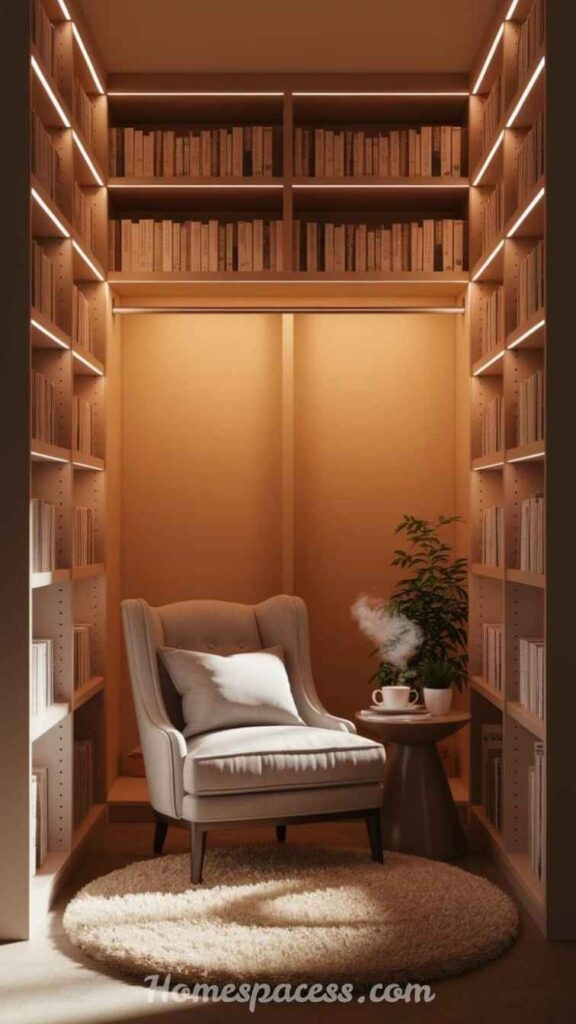
A walk-in closet or large wardrobe converted into a compact library room is one of the most cost-effective ways to create a dedicated reading space when no spare room is available. Remove the hanging rails, install floor-to-ceiling shelving across three walls, add a compact fold-down desk or reading seat, fit a dimmable pendant or picture light, and you have transformed dead storage space into a purposeful, intimate library alcove that costs a fraction of a room addition.
The intimacy of a closet-converted library is a genuine feature rather than a limitation. The enclosure creates that critical psychological separation from household noise and activity that open-plan living rarely provides. With the door closed or replaced with a fabric curtain for softer, more informal separation the closet library becomes a personal retreat: a cabinet of curiosity sitting within a bedroom or hallway without demanding a single additional square foot of your home’s floor plan.
Maximalist Color Library Room
Bold · Joyful
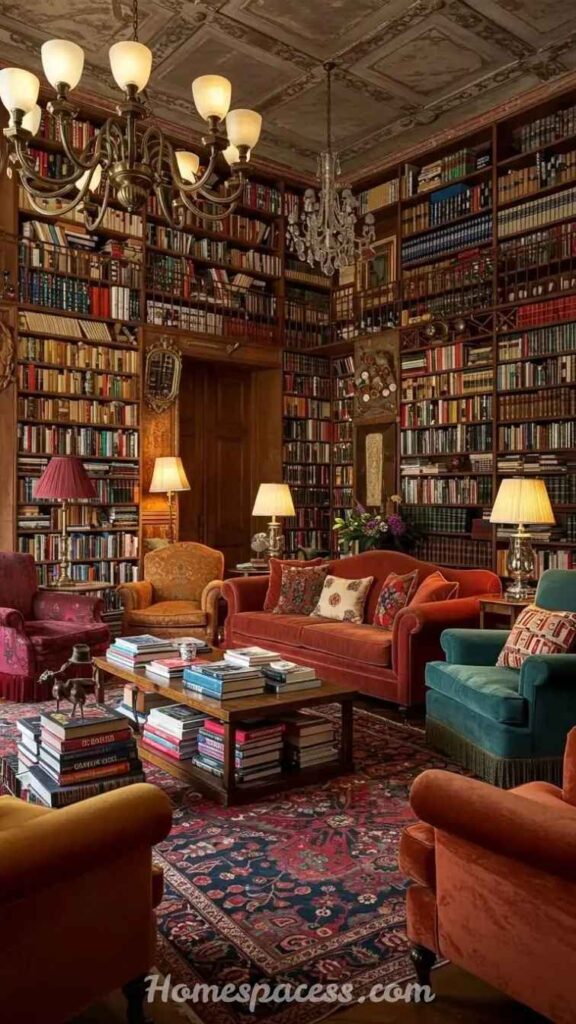
Maximalism in library design is experiencing a confident cultural resurgence. Where the previous decade pushed toward pale neutrals and spare minimalism, a growing design movement celebrates color, pattern, and accumulated personality. In a library room, this translates to jewel-toned walls in emerald, sapphire, or aged burgundy, mismatched but harmonious upholstery, layered rugs, and bookshelves used as much for display of collected objects as for book storage in the conventional sense.
The risk of maximalism is visual chaos; the reward is a room that feels irreplaceable and wholly alive. The discipline lies in repeating colors intentionally across the room: if you choose terracotta for chair upholstery, echo it in the book spines you choose to display face-out, in a small ceramic on a shelf, in a thread within the rug. Color repetition binds diverse elements into a composed whole transforming what could feel like busyness into the richer, more satisfying quality of genuine depth and accumulated character.
Smart Library with Technology Integration
Future-Ready · Intelligent
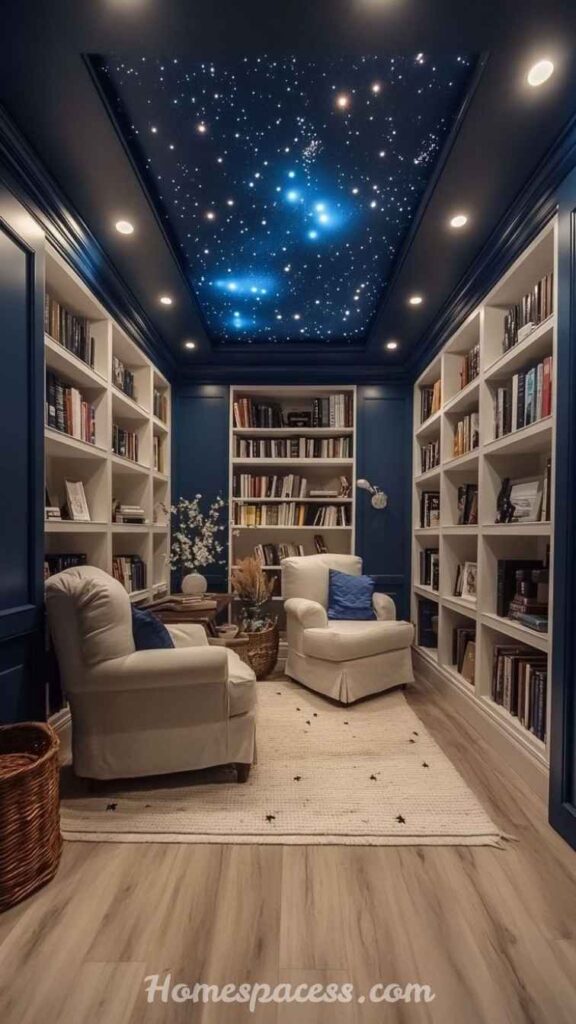
The smart home library of 2026 seamlessly integrates physical book culture with digital tools in ways that enhance rather than undermine the analog experience. Voice-controlled lighting scenes shift with a single command from bright task lighting for focused study to warm, dimmed ambient light for evening reading. Motorized blinds respond automatically to glare. Book cataloging apps that scan ISBN barcodes maintain complete digital inventories of physical collections searchable and sortable from any device in the household.
Wireless charging pads built discreetly into desk and side table surfaces keep reading devices powered without visible cables disrupting the library’s visual calm. Humidity and temperature monitoring ensures the stable environment that book preservation requires. At the cutting edge, AI-assisted reading tools are beginning to cross-reference physical book content with reading histories, surfacing connections between volumes in a personal collection that the owner might never independently discover the library becoming an actively intelligent research companion.
Biophilic Library Room with Living Plants
Wellness · Living Design
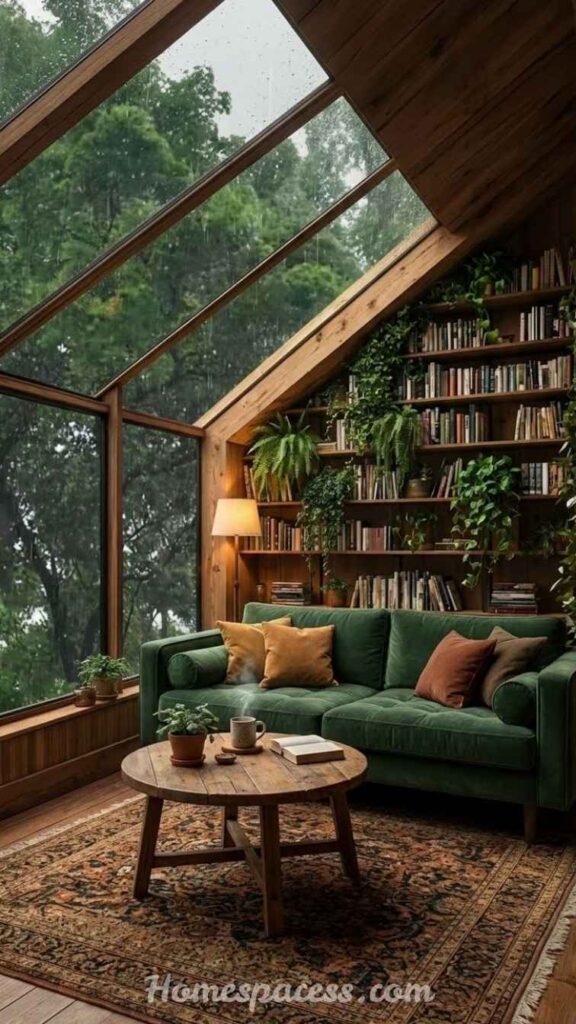
Biophilic design incorporating natural elements, especially living plants into a library room does more than add visual softness. Multiple peer-reviewed studies link the presence of plants in study environments with improved concentration, reduced cortisol levels, and measurably enhanced creative output. A library room is therefore one of the most scientifically justified places in the home to invest seriously in indoor planting as a functional design element rather than decorative afterthought.
Select plants that genuinely thrive in typical library conditions: moderate light levels and stable temperatures suit pothos, heartleaf philodendron, ZZ plant, and cast iron plant all resilient, architectural, and proven performers on or near bookshelves. A single large specimen such as a Monstera deliciosa or fiddle-leaf fig positioned beside shelving bays creates a dramatic living element without requiring intensive horticultural care. Trail varieties like string of pearls along upper shelf edges for a cascading effect that softens the hard geometry of the bookcase architecture.
Modular Bookcase System Library
Flexible · Scalable
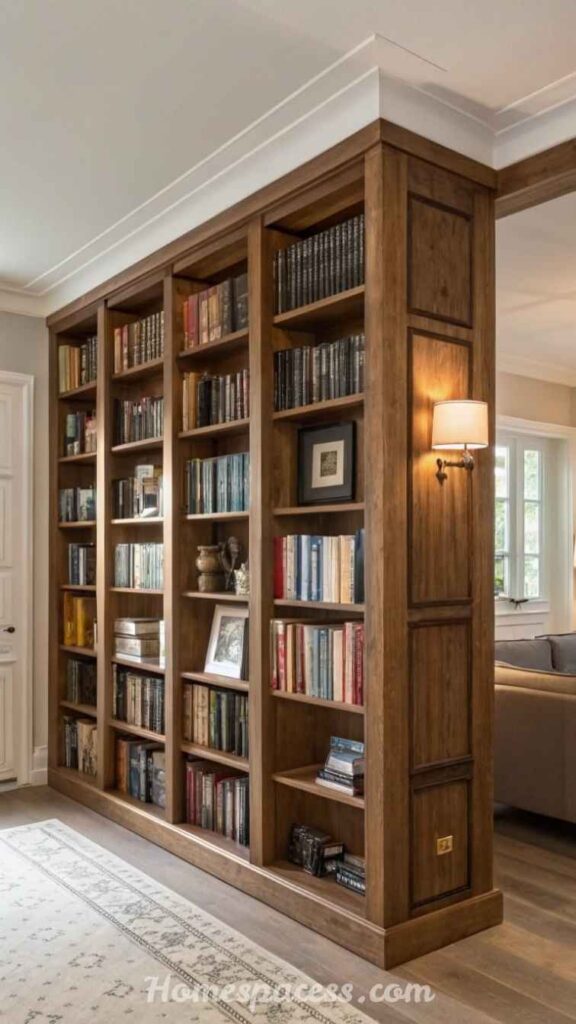
Modular bookcase systems sold as individual units that stack, combine, and reconfigure offer the flexibility that growing collections and changing lifestyles genuinely demand. Unlike fully custom built-ins, modular systems move with you when you relocate. Systems from String Furniture, VITSΠ606, and higher-end Ikea Billy configurations with premium aftermarket facades have made modular shelving capable of a genuinely premium library aesthetic without custom joinery pricing.
The design discipline modular systems demand is worth understanding clearly: they require deliberate planning of unit heights, depths, and column widths to avoid the slightly haphazard quality that off-the-shelf shelving can produce when assembled without a considered layout. Create a to-scale plan of the wall, select units that align at consistent heights across the run, and apply the same paint color to walls, unit backs, and visible side panels. This single step makes modular shelving look remarkably like custom joinery when viewed from across the room.
Vintage Map and Globe Library Room
Scholarly · Curated

The explorer’s library characterized by antique maps, vintage globes, specimen cases, and the accumulated artifacts of intellectual adventure positions books as part of a broader landscape of curiosity: the cartographic, the natural, the scientific. A large-format vintage map framed as a central artwork with book-lined shelving flanking on either side sets this tone powerfully and immediately signals the particular intellectual character of the library’s owner.
Vintage globes have become genuinely collectible, but high-quality reproductions are widely available and visually convincing at reasonable prices. A floor-standing globe on a wooden or brass stand positioned beside an armchair creates an immediately compelling scholarly vignette that anchors the room’s identity. Nest antique compasses, specimen trays, and leather-bound books of harmonious spine color together in display zones on shelves, and resist the urge to label or over-explain the collection. The explorer’s library should feel discovered, not staged for admiration.
Dedicated Reading Chair and Ottoman Zone
Comfort-First · Essential
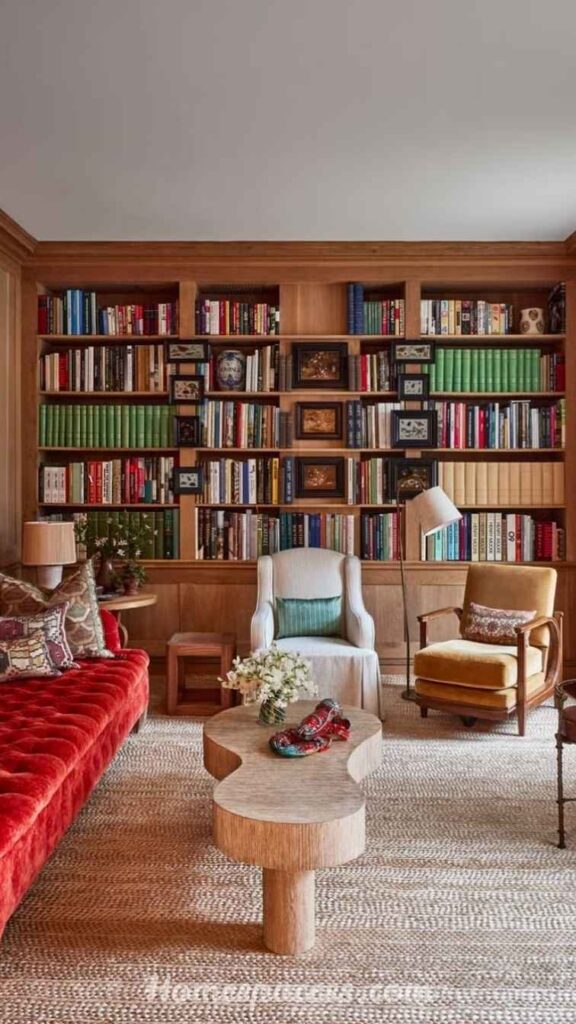
The reading chair is not a furnishing accessory to the library it is the library’s purpose made physical. Every great home library room is oriented around a primary seating position from which books can be seen, light falls correctly on the page, and the body can remain in comfortable, sustained reading posture for extended periods. Choosing this chair correctly is arguably more important than any other design decision about shelving configuration or room color palette.
For extended reading, lumbar support, armrest height, and seat depth matter clinically, not just aesthetically. The ideal reading chair has arms at the correct height to support forearms while holding a book without inducing neck strain, a seat depth that allows the lower back to contact the backrest fully without thigh-edge pressure, and a recline angle between 100 and 110 degrees. An ottoman at the correct elevation completes the ergonomic chain. Beauty matters enormously but the chair that looks perfect and causes back pain after twenty minutes is a design failure regardless of how good it photographs.
Ergonomic Note
Reading lamp positioning is as important as chair selection. Position the light source behind and above the shoulder never in front of or below the reader’s eye level to illuminate the page without glare and prevent the eye fatigue that cuts reading sessions short over time.
Narrow Hallway Library
Ingenious · Unexpected
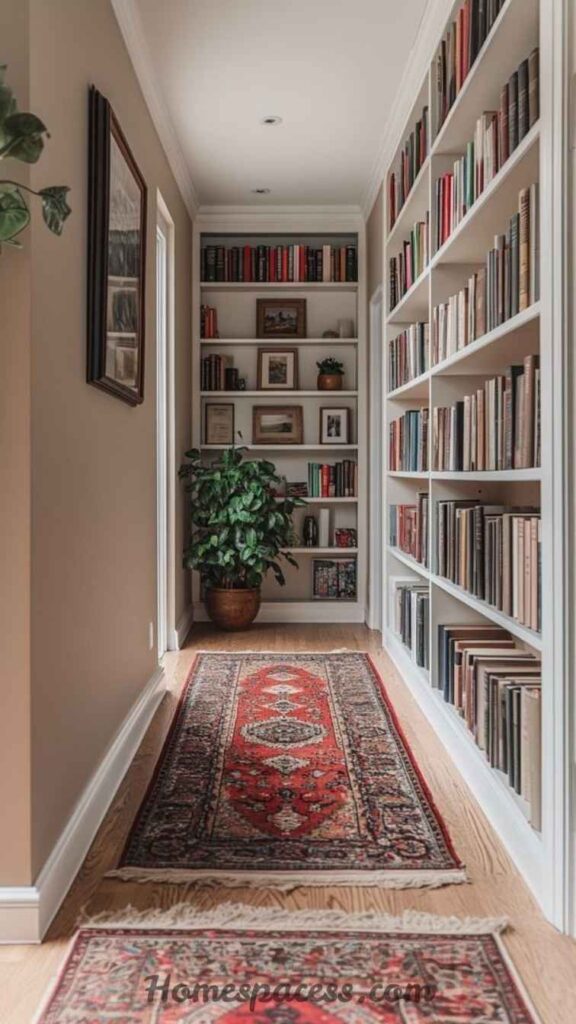
A wide hallway or corridor is one of the most underused spaces in a home and one of the best candidates for a library room transformation. Shelving installed along the full length of one or both hallway walls turns a circulation space into a browsable library passage every journey through the house becomes an opportunity to notice a book, remember a title, or pick up something unread. This idea appears in many celebrated private homes precisely because it makes purposeful use of space that serves no other function.
Hallway shelving should be shallower than conventional library shelving 8 inches is typically sufficient for most paperbacks and hardbacks to preserve comfortable passage width for occupants and visitors. Use the same wood finish or paint color as the hallway’s existing architectural elements to integrate the shelving visually rather than making it look retrofitted. A single runner rug along the floor and one or two small sconces installed at intervals complete the gallery-corridor library effect beautifully and at modest cost.
Attic Library Conversion
Hidden Gem · Transformative
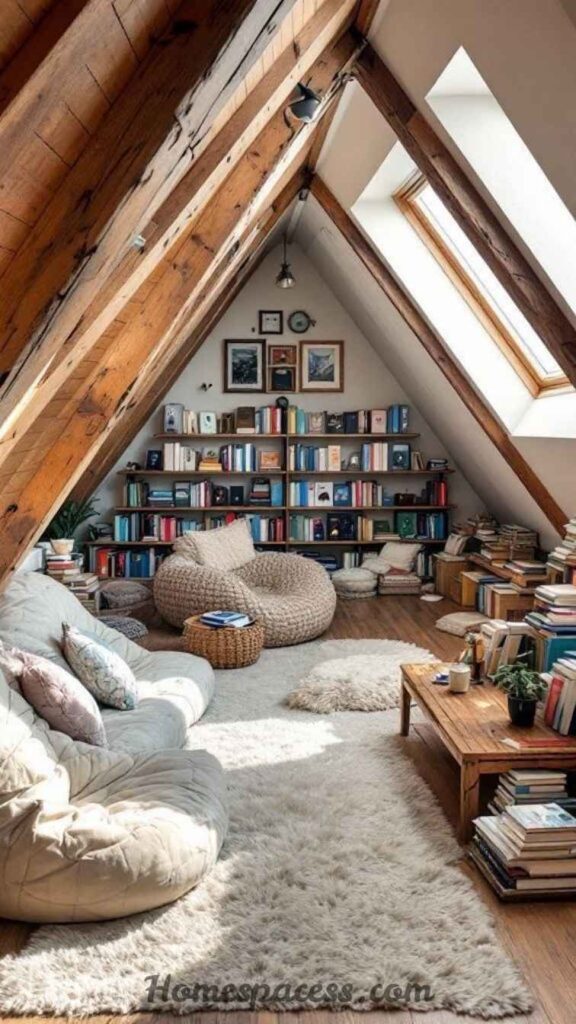
An attic conversion dedicated entirely to a library room is among the most transformative home improvement projects a homeowner can undertake. The sloping ceilings that can feel limiting in a bedroom context become a genuine design asset in a library: they lower the perceived ceiling height over seating areas, creating an intimate, nest-like quality ideal for long reading sessions. Built-in shelving can be designed to follow the pitch of the roof, with full-height sections at the ridge and angled shelf runs following the rafters down each side of the space.
Thermal and acoustic considerations are especially important in attic libraries. Proper insulation is essential both for comfort attics experience the largest temperature fluctuations of any room and for book preservation, since humidity variation and temperature extremes damage paper fibers and bindings over time. Spray foam or rigid insulation between rafters combined with a vapor barrier creates the stable microclimate that both occupants and book collections require. Dormer windows or roof skylights are non-negotiable for both sufficient daylight and adequate ventilation throughout the year.
Library Room with Window Seat
Classic · Inviting
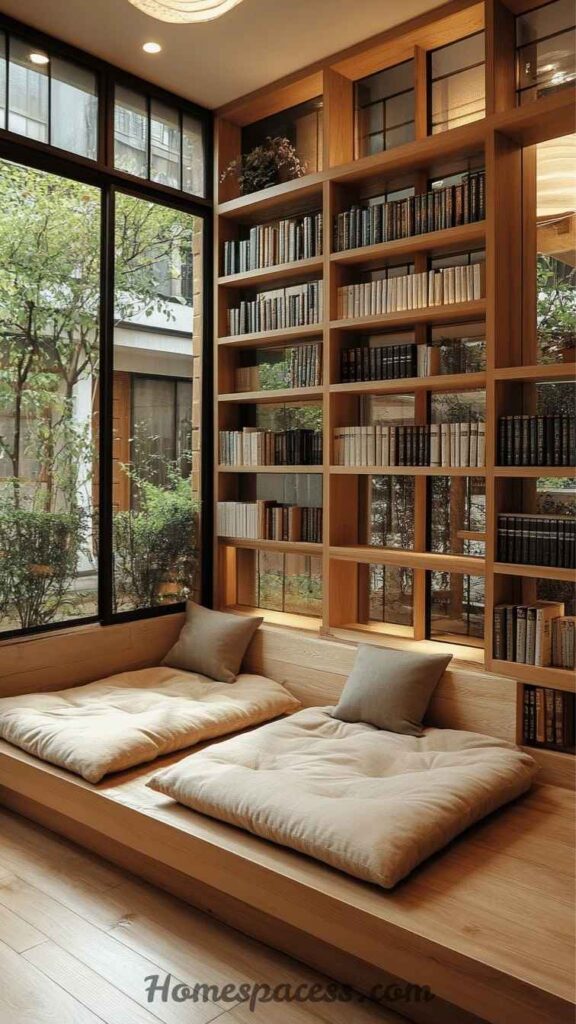
The window seat library is one of the oldest and most enduring domestic pleasures in architectural history window seat reading spaces appear in documented English homes as far back as the 17th century. Positioned to capture the best natural light in the room, flanked by shelving on either side, and padded generously for prolonged comfortable use, the window seat creates a perfect reading station that remains simultaneously connected to the outside world through glass, grounding the reader in season and time of day.
Window seats work best when built to the full width of the window bay rather than partially filling it, with seat height set between 17 and 19 inches the standard chair seat height that allows feet to rest flat on the floor. Storage drawers beneath the cushion are practical but require careful joinery detailing of the drawer face to avoid a furniture-stacked-on-furniture appearance. Box-pleated cushion covers in durable fabric such as herringbone, cotton canvas, or heavy linen age gracefully and clean easily in a space designed for daily, extended use through all seasons.
Secret Door Bookcase Library
Dramatic · Unforgettable
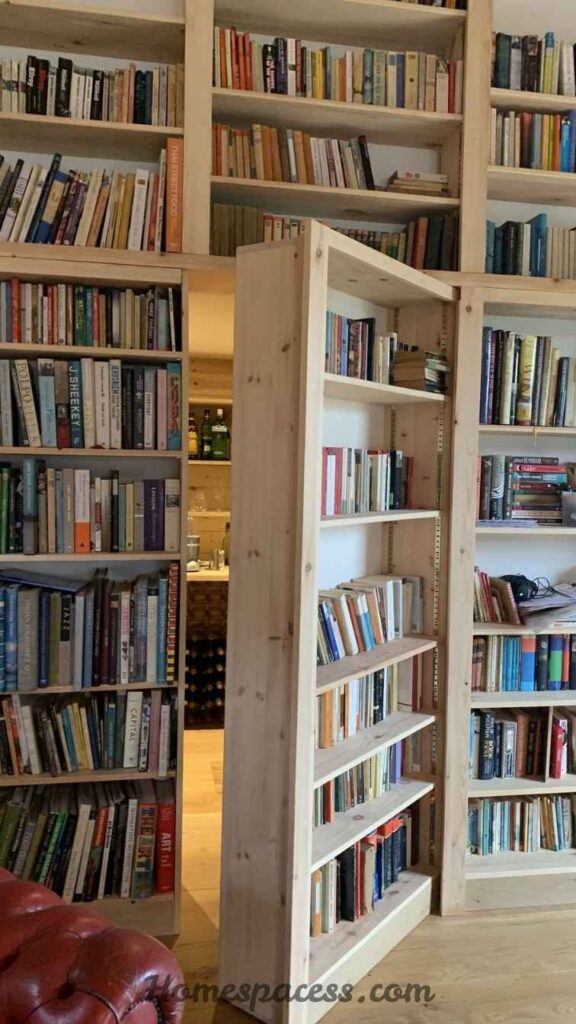
A bookcase that opens as a concealed door is the ultimate fantasy library element and a very real, engineerable design possibility in any home with sufficient planning. Disguised as a seamless section of the surrounding shelving, a hinged or pivot door conceals a passage to a home office, wine cellar, bedroom, or additional storage room. The mechanism is a serious joinery undertaking requiring precisely balanced hinges or pivot points capable of supporting the combined weight of the door structure plus the books displayed on its face.
Several specialist hardware companies produce bookcase door pivot systems engineered specifically for residential application, with mechanisms that handle loads up to 400 kilograms reliably. The critical design requirement is that the moving section of shelving must align perfectly with the static adjacent shelving in depth, height, and shelf position any gap, step, or material mismatch reveals the mechanism immediately and destroys the illusion. Books mounted on the door section should be lower-weight volumes, as heavy reference books on a pivoting door stress the hardware significantly and cause premature failure of the mechanism through repeated use over time.
Conclusion:
A home library room is more than a design project it is an act of self-definition. It declares what matters, preserves what has shaped you, and creates the physical conditions for what you might yet become. Whether you build a grand floor-to-ceiling masterpiece with a rolling ladder and fireplace, or simply transform a forgotten closet into a curated personal archive with excellent lighting, the act of dedicating intentional space in your home to books and reading is one of the most meaningful investments you can make in the quality of your daily life.
Use these 27 library room ideas not as a checklist to complete but as a palette to draw from intelligently. The best library room is always the one built around how you actually read, think, and live not the one that looks best in a photograph or on a mood board. Begin where you are, with what you have, and let the room evolve with your collection and your life over the years ahead.
Trend Analysis · 2026 and Beyond
Library Room Design Trends Defining 2026 and What’s Coming Next
The dominant trend reshaping library room ideas in 2026 is the deliberate rejection of digital-first living in favor of physical, tangible, accumulated spaces. As screen fatigue has become a widely acknowledged phenomenon, the home library is experiencing a genuine cultural renaissance that extends well beyond interior design circles. Publishers report sustained growth in physical book sales while furniture retailers show library and home office furniture as one of the fastest-growing categories in residential interiors. The library room is no longer nostalgic it is unambiguously aspirational for the educated consumer market.
Stylistically, the shift is toward what designers are calling “quiet luxury in the library” deeply considered, high-quality materials executed with practiced restraint. Bespoke joinery over flat-pack, natural materials over laminates and synthetics, warm incandescent-spectrum lighting over cool LEDs. The performative library designed primarily for social media photography is giving way to the genuinely functional one designed for hours of daily use. People are investing in libraries that work for reading, thinking, and creating, which changes design priorities profoundly.
Looking forward to 2027 through 2030, three emerging directions are worth watching. First, the integration of environmental monitoring humidity and temperature sensors that protect book collections and adjust climate control automatically throughout the year. Second, the audio library movement: vinyl record collections and high-fidelity listening areas are being integrated into library room concepts, creating multi-sensory sanctuaries that serve music and literature simultaneously. Third, the community micro-library model built as a shared extension of the home library accessible to neighbors which may influence urban residential library design significantly in the coming years.
Expert Insights · Real-World Optimization
Practical Tips for Designing a Library Room That Actually Works Daily
The most common complaint about home library rooms is that they become storage rooms with good intentions visually appealing from the doorway but practically awkward to use on a daily basis. The difference between a library that works and one that does not usually comes down to three factors that almost no design article discusses honestly: browsability, retrieval ease, and return friction. Browsability means seeing book spines clearly without bending, squinting, or moving other books. Retrieval ease means accessing any frequently-read book in under ten seconds. Return friction means how easy it actually is to put books back correctly if correct reshelving requires effort or decision-making, books will pile on horizontal surfaces within days and the library will feel messy despite being well-designed.
Zone by frequency, not genre
Keep books you are actively reading or plan to read at standing eye level. Archive completed books above head height. Genre organization is intuitive but frequency organization is practical and dramatically reduces daily retrieval friction.
Maintain 20% empty shelf capacity
A fully loaded bookcase looks satisfying in photographs but is a nightmare to browse and reshelve in daily use. Always maintain a buffer zone of empty space it allows your collection to grow naturally without requiring full reorganization every few months.
Test lighting before committing
Test the room with portable lamps before committing to any fixed lighting positions. The best placement for reading light is almost never where ceiling junction boxes were originally positioned during construction.
Use bookends as collection infrastructure
Bookends on partially filled shelves prevent book lean, which damages spines over time through sustained pressure. Choose bookends in metal or stone that coordinate with hardware finishes elsewhere in the room for visual consistency.
Sustainability and Long-Term Value
The Sustainability and Investment Case for a Home Library Room
A well-designed home library room is one of the most environmentally responsible spaces a homeowner can create. Physical books, when maintained in appropriate conditions, last for centuries a dramatically longer lifecycle than digital media infrastructure, which typically requires device replacement every three to five years alongside continuous energy consumption through server infrastructure. The embodied carbon in a solid timber bookcase, properly maintained, is effectively amortized over multiple generations of use. A library room built thoughtfully in 2026 should still be both beautiful and fully functional in 2086 with minimal intervention.
Material selection is where sustainability choices have the greatest impact. Reclaimed timber shelving salvaged from demolished buildings, old factories, or sustainably managed forests combines environmental responsibility with character that new machined timber cannot replicate. The patina and grain variation of reclaimed wood creates surfaces of genuine individuality. FSC-certified new timber is the baseline sustainable alternative where reclaimed material is unavailable or impractical. Water-based paints and stains have now largely matched the durability of solvent-based alternatives and are the clearly preferable choice for interior joinery environments where occupants spend extended daily time at close proximity.
From a property investment perspective, a custom home library consistently performs strongly in valuations. Estate agents note that distinctive architectural features particularly those signaling quality craftsmanship and intellectual character differentiate a home in ways that neutral, generic interiors simply cannot match in competitive markets. A thoughtfully designed library room with quality built-in joinery, bespoke lighting, and genuine architectural detail can return a disproportionate percentage of its total cost in added property value making it one of the highest return-on-investment home improvements available to owners planning to sell within a ten-year horizon.
Future Predictions · 2027–2032
The Future of Library Rooms: What Is Coming That Most Designers Currently Miss
The most significant future development in home library design is the convergence of physical book culture with AI-assisted knowledge management. Within five years, it is plausible that home library systems will integrate with AI reading assistants capable of cross-referencing a physical book’s content with an owner’s entire reading history, surfacing contextually relevant connections to other books in the collection that the reader would never independently discover. The library becomes not merely a storage system but an actively intelligent research and discovery companion enhancing rather than replacing the physical reading experience.
Acoustics will become a front-and-center consideration in library room design a factor almost entirely absent from current mainstream design coverage. As more people use home library rooms for podcasting, audio book recording, online tutoring, and focused deep work requiring sustained concentration, the acoustic properties of the space matter enormously. Most home libraries as currently designed are acoustically untreated and deliver significant echo and reverberation that undermines both recording quality and concentration. The next generation of library design will incorporate acoustic panels disguised as fabric wall treatments, book-filled shelving units (naturally absorptive surfaces), and specialized ceiling treatments designed to reduce acoustic reflection without institutional appearance.
Wellbeing-optimized library rooms will emerge as a specific, named design category within the next five years. Circadian lighting systems that shift color temperature throughout the day bright and blue-enriched in the morning to support alertness, progressively warmer through the afternoon to support natural melatonin production and wind-down will become standard in new library room installations rather than premium additions. Combined with air quality monitoring, biophilic design elements verified by environmental research, and ergonomic furniture selected by certified specialists, the home library of the early 2030s will be as attentive to physiological wellbeing as it is to aesthetic pleasure and intellectual function.
Common Mistakes and Overlooked Factors
Library Room Mistakes Most Homeowners Make (And How to Avoid Every One)
Even experienced interior design enthusiasts make predictable errors when planning a home library room errors almost never discussed in aspirational design content because they involve the unglamorous realities of daily use, book care, structural planning, and long-term collection management. Being forewarned about these specific mistakes can save considerable wasted expenditure and years of frustration with a space that photographs beautifully but consistently fails the test of actual daily inhabitation.
- Ignoring shelf load capacity Books are extraordinarily heavy a fully loaded meter of standard-depth shelving weighs 20 to 30 kilograms. Most decorative shelving sold for home use is rated for a fraction of that. Always verify weight ratings before purchasing any shelving system, and confirm that wall fixings penetrate structural studs or masonry not plasterboard alone. Shelf failure under full book load is both dangerous and highly destructive to the collection and room below.
- Placing books against exterior or damp walls An exterior wall that is not fully insulated and vapor-controlled will experience condensation during cold weather, promoting mold growth in books particularly those on bottom shelves where cold air pools. Maintain a minimum 25mm air gap between shelving and exterior walls, or fully insulate the wall cavity before any shelving installation proceeds.
- Underestimating the lighting budget Library room lighting is almost always the last budget item considered and the first cut when project costs overrun. This is a serious strategic error: lighting is experienced every single moment you occupy the room, while the shelving color is merely background. A well-considered lighting scheme with dimmable circuits and appropriate color temperature transforms a library more profoundly than any other single design decision. Budget at minimum 15 to 20 percent of total library room cost on lighting systems.
- Choosing aesthetics over ergonomics in seating The most visually striking reading chair is worthless if it causes physical discomfort after thirty minutes. Test any chair extensively before purchasing sitting in it for at least twenty minutes in the showroom and prioritize lumbar support, armrest height relative to your specific body dimensions, and seat depth above all aesthetic considerations. Reading sessions in an uncomfortable chair end at the first opportunity; in a comfortable one, they extend naturally for hours into the evening.
- Not planning for collection growth from the outset Most people significantly underestimate how quickly a book collection grows once a library room exists the dedicated space creates the books as much as the books create the need for the space. A room planned to full capacity at launch will be overflowing within three years of regular use. Build in at minimum 30 percent empty shelf capacity at the start, plan the shelving structure so additional units or levels can be added easily, and identify where collection overflow will go before it becomes an organizing crisis requiring complete library reorganization

Team Home Spacess shares simple, practical design ideas that work for real families. The team focuses on cozy décor, soft colors, and natural textures that make a space feel truly lived-in. From everyday decorating tips to creative home projects, Team Home Spacess is dedicated to helping readers create warm, comfortable, and inviting spaces with a fresh and personal touch.