

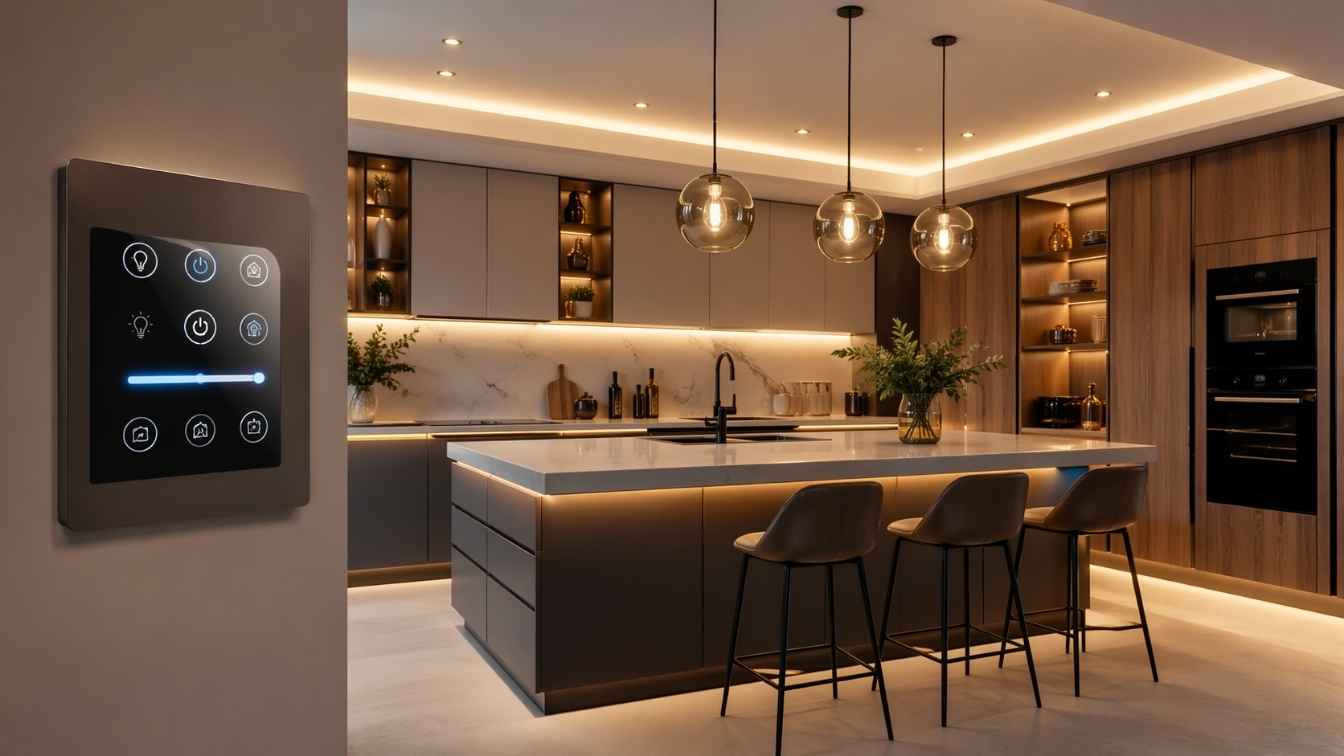
Most kitchens are under-lit, over-glared, or both. The right kitchen lighting ideas don’t just brighten a room they reshape how you cook, eat, and feel in your own home every single day.
Poor kitchen lighting is one of the most overlooked design problems in modern homes. You could have premium countertops and high-end appliances, but if your lighting is wrong, the entire space feels dull, unsafe, and tiring to work in. Shadows on your cutting board, washed-out colors on your food, and eye strain after evening cooking sessions are all signs of a lighting problem not a kitchen problem.
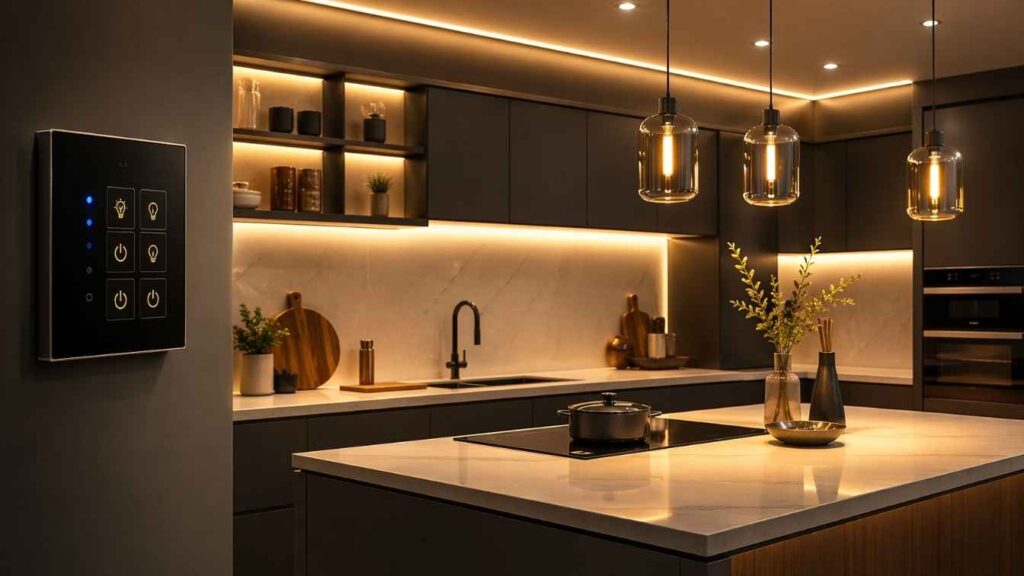
The good news is Strategic kitchen lighting ideas can completely transform your space without a full renovation. Whether you’re upgrading a small apartment kitchen or redesigning a large open-plan layout, the right combination of light layers, fixtures, and smart controls will make your kitchen feel larger, safer, and significantly more enjoyable. This guide goes beyond the basics covering the six most impactful kitchen lighting ideas along with trend analysis, sustainability insights, and common mistakes most homeowners never consider.
Layered Ambient Lighting
The Foundation Every Kitchen Needs
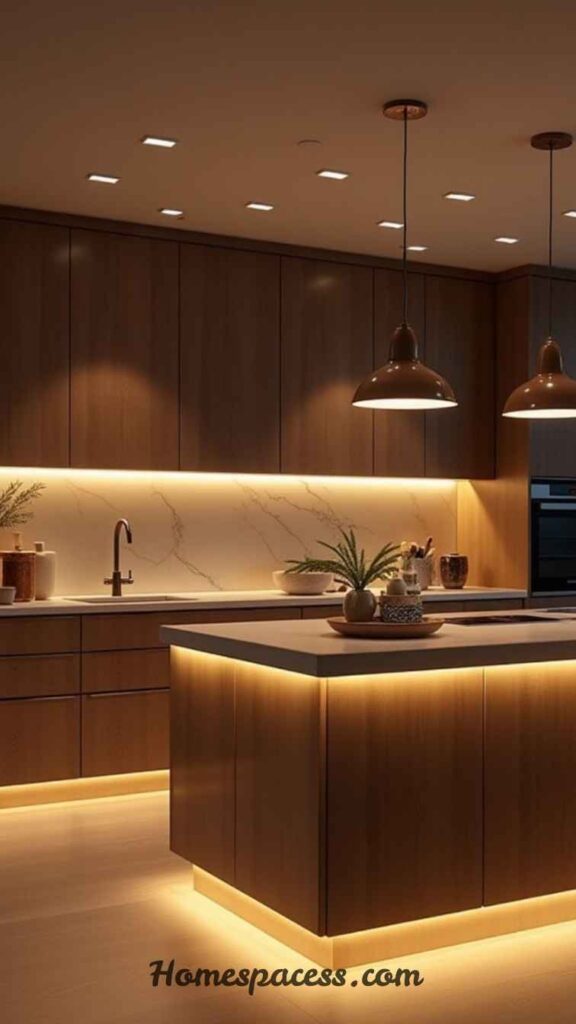
Ambient lighting is your kitchen’s base layer the general illumination that makes the entire space visible and safe. Most homeowners stop here, installing a single flush-mount ceiling fixture and calling it done. However, a single overhead light creates harsh shadows and uneven brightness, especially in larger kitchens. The smarter approach is to layer multiple ambient sources: recessed downlights spaced evenly across the ceiling, combined with a central pendant or chandelier for visual warmth.
What most articles don’t mention is the importance of color temperature in ambient lighting. For kitchens, the sweet spot is between 2,700K and 3,000K warm enough to feel inviting but bright enough for food preparation. Going above 4,000K (cool white) makes kitchens feel clinical and makes food look less appealing. Imagine prepping a dinner party with everything bathed in a cold blue-white glow it kills the mood immediately, even if the food is excellent.
EXPERT INSIGHT
Interior lighting designers recommend a minimum of 50 lumens per square foot for kitchen ambient lighting. A 200 sq ft kitchen needs at least 10,000 lumens total from all combined sources most homeowners install fixtures that deliver only 30–40% of that.
Also Read: Kitchen Nook Ideas: Transform Dead Corners Into Cozy, Functional Spaces
Under-Cabinet Task Lighting
The Single Biggest Upgrade for Working Cooks
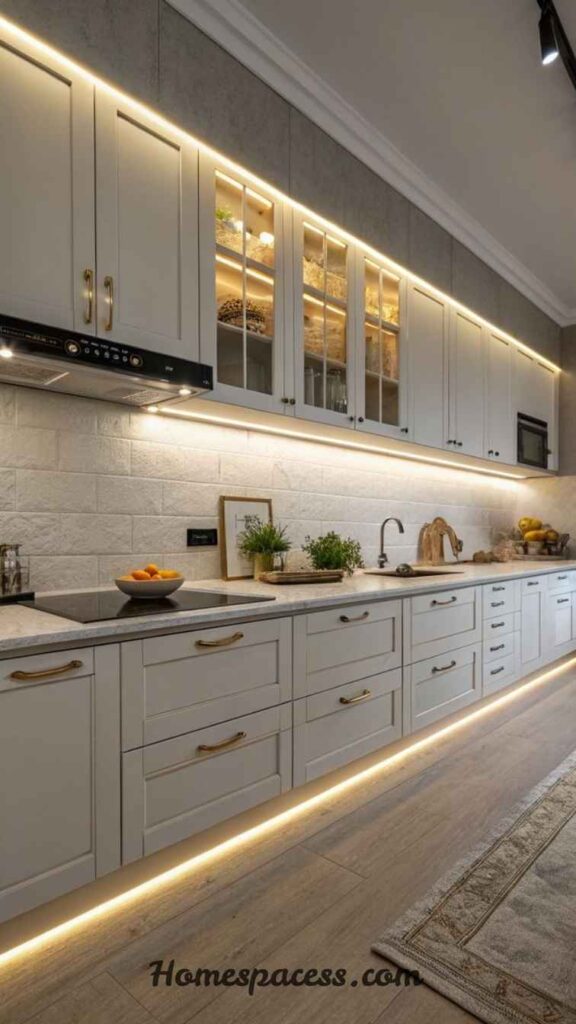
Under-cabinet lighting is arguably the most practical kitchen lighting idea available, yet it remains installed in fewer than 30% of home kitchens. The reason is simple: it’s often added after the kitchen is finished and feels like an afterthought. But for anyone who cooks regularly, under-cabinet LED strips or puck lights eliminate the single most dangerous lighting problem in kitchens your own shadow falling directly on your workspace. When overhead light is behind you, you’re cutting, chopping, and slicing in your own shadow.
Modern LED tape lights have made this upgrade surprisingly affordable and DIY-friendly. The key detail most guides skip is choosing the right IP (Ingress Protection) rating. Kitchen environments involve steam, grease, and splashes, so under-cabinet lights should have a minimum IP44 rating. Additionally, lights mounted too far forward on the cabinet underside wash the backsplash, while lights mounted too far back create a hotspot on the counter edge. The ideal position is roughly one-third of the way in from the front of the cabinet.
Read More: Living Room Curtain Ideas for a Cozy and Modern Home Look
Pendant Lights Over Islands and Peninsulas
Style Meets Function
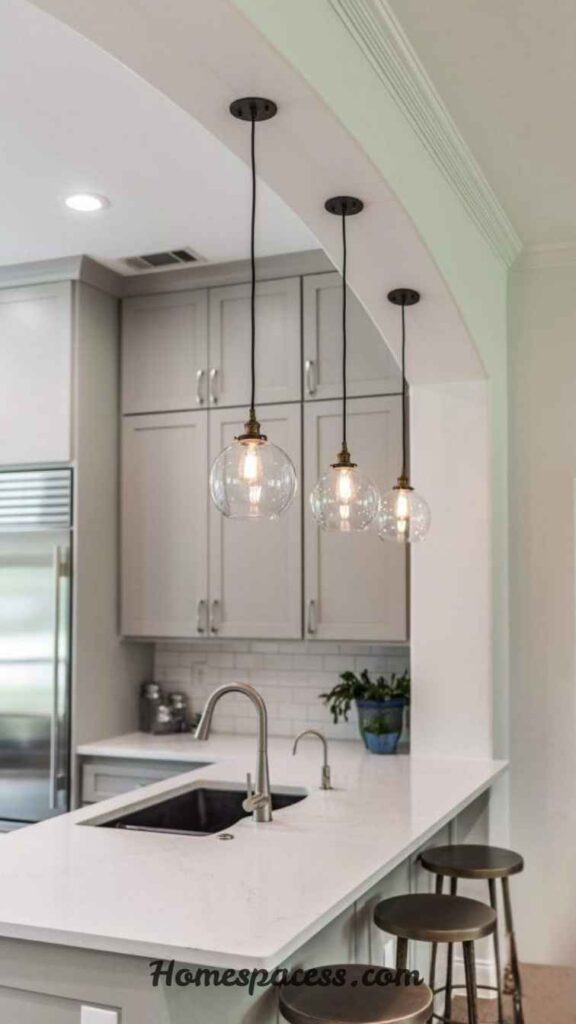
Pendant lights above a kitchen island or peninsula serve a dual purpose: they provide focused task lighting for prep work and casual dining, and they act as a design statement that anchors the entire room. However, getting pendant placement wrong is extremely common. Pendants hung too high lose their functional impact and visual weight. Hung too low, they interrupt sightlines and feel oppressive. The standard rule is 30–36 inches between the countertop surface and the bottom of the pendant though this adjusts for ceiling height above 9 feet.
For islands longer than 5 feet, using two or three pendants creates better light distribution than a single large fixture. Spacing matters here: pendants should be evenly distributed with at least 24 inches between them. A commonly overlooked tip is to choose pendants with dimmer compatibility from the start most homeowners add dimmers as an afterthought and discover their existing fixtures don’t support them. Dimmable pendant lighting above an island lets the same space shift from bright prep zone to intimate dining atmosphere.
“The island pendant is the jewelry of the kitchen. Get the scale right, and everything else falls into place.” Common principle in interior design practice
Must Read: Gaming Desk Ideas: Stylish and Functional Setups for Every Budget
Recessed Lighting Grids
Achieving Even, Shadow-Free Kitchen Illumination
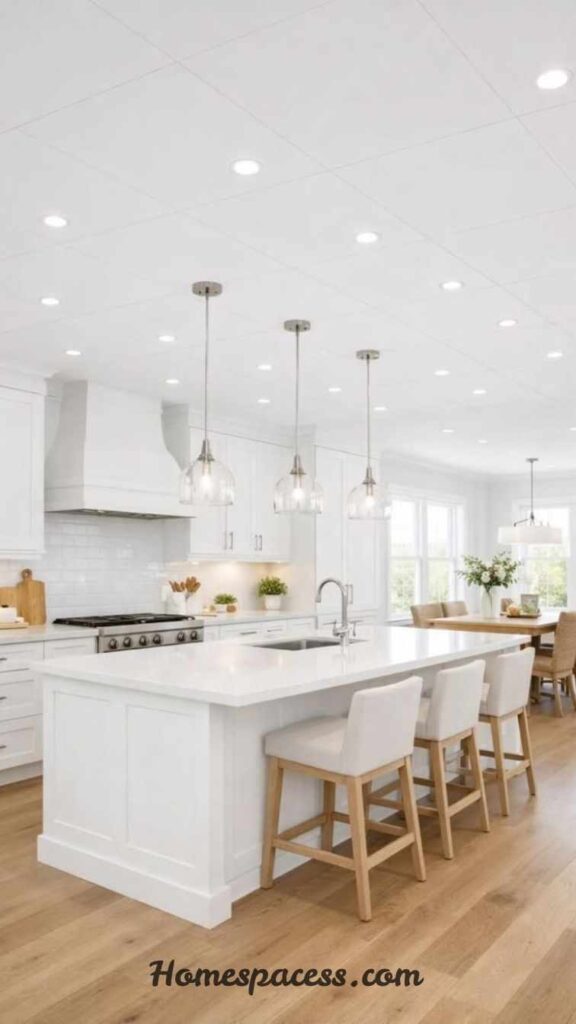
Recessed lighting, also called downlights or can lights, is the workhorse of modern kitchen illumination. A properly designed recessed lighting grid eliminates dead zones and dark corners that single-point lighting inevitably creates. The industry standard for spacing recessed lights is one-half the ceiling height so in a kitchen with 9-foot ceilings, downlights should be placed every 4.5 feet in a grid pattern. Most DIY installations space them too far apart, leaving bright pools of light separated by dim patches.
What separates a professional installation from a basic one is the beam angle. Standard recessed lights often come with 40–60 degree beam angles, which creates soft, broad illumination ideal for ambient layers. However, over specific workstations like the range or prep sink, switching to a 25-degree narrow beam provides more focused task light without installing additional fixtures. Retrofit LED recessed lights have made upgrades significantly easier, with many models fitting directly into existing housing without rewiring.
🔦 Beam Angle Guide
Use 60° for general ambient. Use 25–35° directly above counters and prep zones for focused task light.
📐 Spacing Formula
Ceiling height ÷ 2 = spacing distance. In a 9ft ceiling kitchen, place downlights every 4.5 feet.
🌡️ Color Temp Sweet Spot
2,700K–3,000K for warm, inviting kitchens. Avoid cool white above 4,000K it dulls food colors.
🔌 Retrofit First
Retrofit LED inserts fit most existing can housings. No rewiring needed just swap, twist, and done.
Smart Kitchen Lighting Systems
Automation, Scenes, and Energy Intelligence
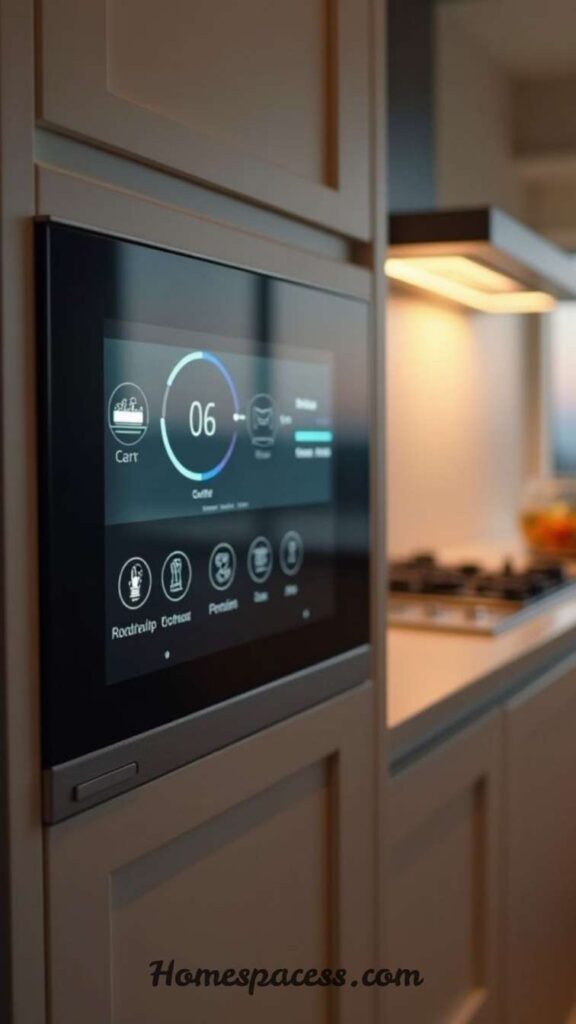
Smart lighting systems have moved from luxury novelty to genuinely practical kitchen tools. Modern systems from brands like Philips Hue, LIFX, and Lutron Caséta allow you to create pre-programmed “scenes” morning mode might activate bright cool-white task lighting for breakfast prep, while evening mode dims everything to a warm amber for dinner. The real value isn’t the novelty of voice control; it’s the behavioral shift that happens when lighting automatically adapts to context rather than requiring manual adjustment.
From a practical standpoint, smart kitchen lighting also offers granular control over energy consumption. With scheduling features, lights in rarely-used pantry areas can automatically switch off after a few minutes. Motion sensors integrated with smart systems eliminate the classic problem of leaving kitchen lights on overnight. For larger families, scene presets reduce the friction of adjusting lighting for different cooking tasks an important detail when you’re in the middle of managing multiple pots on the stove and can’t reach a dimmer switch.
Don’t Skip: Creative Camper Interior Ideas to Make Your RV Feel Like a Dream Home
Accent and Decorative Lighting
Adding Depth, Drama, and Visual Interest
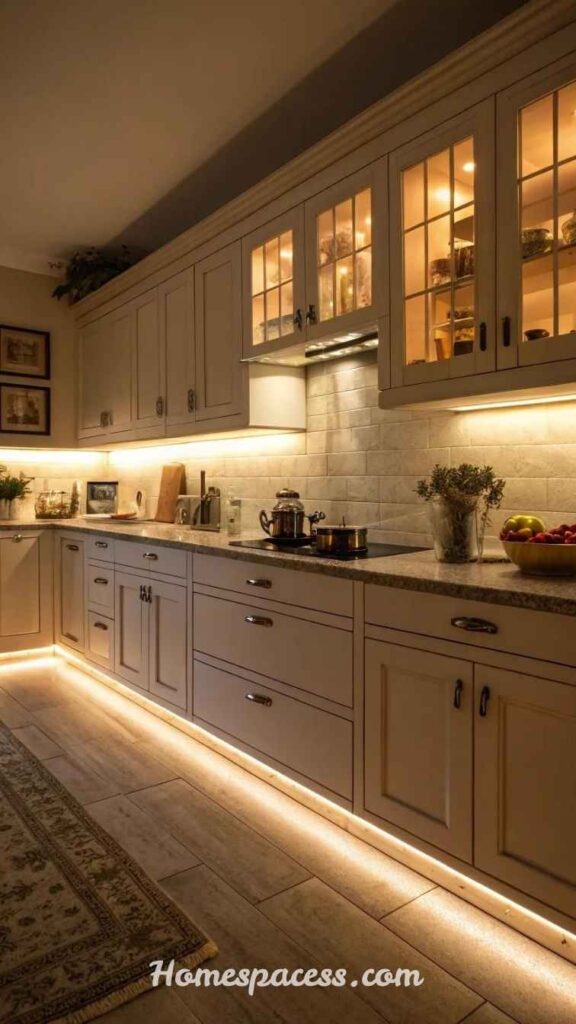
Accent lighting is the finishing layer most kitchen designs completely skip and it’s the layer that separates a well-lit kitchen from a truly beautiful one. Toe-kick lighting (LED strips at the base of lower cabinets) creates a floating-island effect that dramatically changes the visual weight of cabinetry. Interior cabinet lighting with glass-front doors showcases dishware while adding warm ambient glow. Display shelf lighting above the range hood highlights architectural features or decorative objects.
The strategic purpose of accent lighting is to add perceived depth to flat surfaces. Kitchens with purely overhead lighting tend to look two-dimensional bright and functional, but not visually interesting. Adding backlighting behind a frosted-glass tile backsplash, or warm LED strips inside open shelving, creates layered visual planes that make even modest kitchens feel designed and considered. This technique is widely used in high-end restaurant kitchens for exactly this reason it makes the space feel intentional.
Don’t Miss: Modern Dining Room Ideas That Instantly Elevate Your Home Style
Conclusion
The best kitchen lighting ideas share one common principle: layers work better than single solutions. Combining ambient, task, accent, and smart controls creates a kitchen that performs beautifully for every activity, from early morning prep to late-evening entertaining. Whether you start with under-cabinet strips or invest in a full smart lighting system, every upgrade compounds making your kitchen more functional, more beautiful, and more energy-efficient with each change.
Don’t wait for a full renovation to improve your lighting. Even one strategic change swapping in dimmable LEDs, adding under-cabinet strips, or installing smart switches will make a noticeable difference from day one.
Trend Analysis
Kitchen Lighting Trends in 2026 and Beyond
The kitchen lighting landscape has shifted substantially over the past two years. Tunable white lighting systems that dynamically shift color temperature throughout the day to match natural daylight cycles has moved from commercial applications into residential kitchens at accessible price points. This “circadian lighting” approach supports natural sleep rhythms by warming kitchen light after sunset, reducing the alertness-disrupting effect of cool blue-spectrum light during evening cooking.
Meanwhile, the aesthetic trend is moving away from the all-matte-black fixture dominance of the early 2020s toward warmer metallic finishes: brushed brass, antique bronze, and aged gold are appearing in both high-end and budget kitchen fixtures. Sustainable material sourcing is also influencing fixture design, with recycled aluminum and low-VOC finishes becoming marketing differentiators reflecting broader consumer awareness about product lifecycle.
| Trend | Status | Practical Impact |
| Tunable White / Circadian Lighting | Hot Now | Improves sleep quality; reduces evening eye strain |
| Warm Metallic Finishes (Brass, Bronze) | Hot Now | Replacing matte black; warmer visual tone |
| AI-Driven Scene Learning | Rising | Lights learn your patterns and adapt automatically |
| LiDAR-Based Occupancy Sensing | Coming 2027 | Room-level presence detection without cameras |
| Integrated Fixture + Ventilation Units | Rising | Combined range hood + lighting systems save space |
| Recyclable / Modular Fixtures | Rising | Components replaced individually vs. whole-unit replacement |
Practical Expert Tips Most Homeowners Never Consider
Professional lighting designers use a technique called “lighting zoning” that most residential installations completely ignore. Rather than wiring all kitchen lights to a single circuit and switch, zoning divides the kitchen into functional areas prep zone, dining zone, ambient zone each independently controlled. This allows the kitchen to serve completely different purposes within the same footprint: bright and energetic for morning prep, warm and dim for evening gatherings.
Another underused strategy is controlling fixture placement relative to cabinet door swing. Recessed lights placed directly above upper cabinet doors create glare whenever the cabinet is open a minor but persistent annoyance. Moving downlights 6–8 inches toward the room center eliminates this. Similarly, kitchen designers recommend avoiding symmetrical light placement centered on the room as a whole; instead, lights should be centered on work zones centered over the prep counter, centered over the range, centered over the sink.
EXPERT INSIGHT
A common professional rule: always install more switching circuits than you think you need. Adding a dimmer circuit costs very little during installation but retrofitting one into a finished kitchen can cost 5–10x more. Plan for flexibility from the start.
Sustainability
Sustainability, Energy Efficiency, and Long-Term Value in Kitchen Lighting
Kitchen lighting accounts for a disproportionately large share of household energy use because kitchens tend to be occupied for longer, more intensive periods than other rooms. Switching an entire kitchen from halogen or incandescent fixtures to LED equivalents typically reduces lighting energy use by 70–80%. For an average-sized kitchen running 4–5 hours daily, that translates to roughly £40–£70 annual savings (or $50–$90 USD) modest individually, but significant over a 15–20 year fixture lifespan.
- 💡 LED Lifespan Advantage: Quality LED fixtures rated at 50,000 hours will last 25+ years under typical kitchen use eliminating hundreds of bulb replacements and the associated waste.
- 🌱 Lumen Efficiency Ratings: Look for fixtures with at least 100 lumens-per-watt efficiency. Top-tier LED drivers now reach 140–160 lm/W roughly 10x more efficient than the halogen bulbs they replace.
- ♻️ Modular Fixture Design: Choose fixtures with replaceable LED modules rather than integrated arrays. When the LED eventually fails, you replace only the module not the entire fixture and its embedded materials.
- ⚡ Smart Scheduling as Energy Tool: Smart lighting systems that auto-dim after 10pm and shut off unoccupied zones reduce wasted electricity without any behavior change required from the household.
Future Innovations
Future Innovations: What’s Coming to Kitchen Lighting by 2028
The most significant shift on the horizon for kitchen lighting is the convergence of lighting systems with broader home AI platforms. Rather than controlling lights via manual apps or voice commands, next-generation systems will use behavioral prediction learning that you start coffee at 6:45 AM and pre-activating the appropriate lighting scene before you reach the kitchen. Early versions of this AI-driven approach already exist in platforms like Google Home and Amazon Alexa, but the predictive intelligence will become substantially more accurate over the next 2–3 years.
OLEDs (Organic Light Emitting Diodes) are also entering the residential lighting market in a practical way. Unlike LED panels, OLEDs are diffuse, thin, and flexible enabling lighting surfaces that are nearly invisible when off and glow without visible point sources. Imagine a kitchen ceiling that appears as a smooth white surface during the day and transforms into a glowing ambient field at night, with no visible fixtures or trim. OLED kitchen panels are currently in the $800–$2,000 range for early adopters but are expected to reach mainstream pricing within 4–5 years.
2026–2027
AI Scene Learning
Lighting platforms predict and activate scenes based on behavioral patterns no app required.
2027
LiDAR Occupancy
Radar-based presence sensors detect people and zones without cameras, improving privacy.
2027–2028
OLED Panel Ceilings
Thin, seamless glow surfaces replace traditional fixtures in premium kitchen designs.
2028+
Integrated Spectral Control
Lights optimized for food photography and visual quality matching exact color rendering to task type.
Common Mistakes
Common Kitchen Lighting Mistakes That Undermine Even Beautiful Kitchens
Even well-intentioned kitchen renovations repeatedly make the same preventable lighting errors. Many of these mistakes aren’t visible in a showroom or in daytime photos they only become apparent when you’re actually cooking dinner at 7 PM with inadequate light over the stove. Understanding these pitfalls before installation is far easier than correcting them afterward.
- Single overhead light syndrome: One central fixture cannot adequately illuminate a full kitchen. It creates shadows in every corner and across every work surface. Always plan for multiple zones and light sources.
- Ignoring the range hood as a light source: Most range hoods include built-in lights rated for high-temperature cooking environments. These are not cosmetic they are functional task lights for the most dangerous cooking zone. Never leave them unplugged or on dim settings during cooking.
- Skipping dimmer switches: Fixed-brightness kitchen lighting removes all flexibility. Installing dimmer switches costs $20–$40 per switch and provides years of flexible control. Nearly all LED fixtures support dimming with the correct dimmer model.
- Mismatching color temperatures across fixtures: Mixing a 2,700K pendant with 5,000K recessed lights creates a visually incoherent, uncomfortable space. All kitchen fixtures should be within 200–300K of each other.
- Placing recessed lights directly against walls: Downlights within 12–18 inches of a wall create “scallop shadows” curved shadow patterns that look unprofessional and poorly lit. Keep recessed fixtures at least 24 inches from wall surfaces.
- Buying fixtures before selecting dimmers: Many LED fixtures are not compatible with all dimmer brands. Verify compatibility before purchasing manufacturers publish approved dimmer lists for their LED products.

Team Home Spacess shares simple, practical design ideas that work for real families. The team focuses on cozy décor, soft colors, and natural textures that make a space feel truly lived-in. From everyday decorating tips to creative home projects, Team Home Spacess is dedicated to helping readers create warm, comfortable, and inviting spaces with a fresh and personal touch.