


Your living room curtains are quietly failing you. They might block light well enough, but if they’re not chosen strategically, they could be making your ceilings feel lower, your space feel smaller, and your carefully picked furniture look disconnected. The right living room curtain ideas don’t just decorate a window they define the entire emotional tone of the room.

In 2026, interior designers are rethinking curtains not as an afterthought but as an architectural element. This guide goes beyond color and fabric. You’ll discover how to use curtains to manipulate perceived space, how to layer them for year-round function, which emerging styles are dominating interiors right now, and which classic mistakes even experienced decorators still make. Whether you’re starting from scratch or refreshing a room that almost works, this guide will help you make curtain decisions you won’t second-guess.
Floor-to-Ceiling Curtains
The Easiest Way to Make Any Room Feel Grand
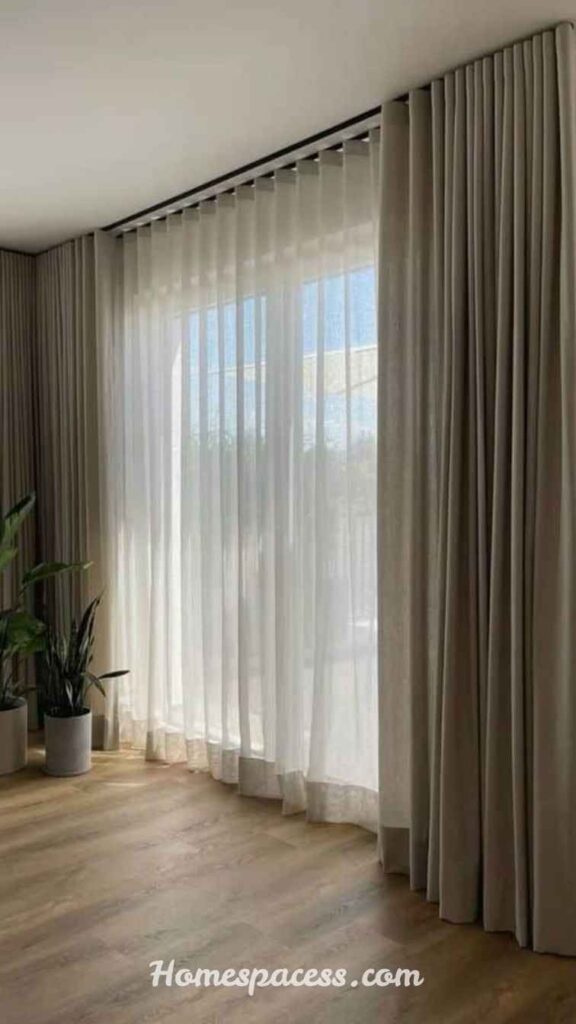
If there is one living room curtain idea that interior designers recommend above almost everything else, it is this: hang your curtains as high as possible and let them fall all the way to the floor. When curtain rods are mounted just a few inches below the ceiling regardless of where the actual window ends the eye travels upward and reads the room as taller. It is a perceptual trick that costs almost nothing extra but creates an effect that renovations cannot always achieve.
This approach works especially well in rooms with standard 8- or 9-foot ceilings that feel a little compressed. A good rule of thumb is to position the rod 4 to 6 inches above the window frame, but in rooms where the gap between the window top and ceiling is small, mount it directly at the ceiling. Use curtain panels that are at least 108 inches long, or have them custom-hemmed so they just graze the floor with about a half-inch gap enough to avoid dragging but close enough to look intentional.
A curtain that starts at the ceiling and ends at the floor is not just window dressing it is the architectural equivalent of adding a foot to your room’s height.’ Interior Design Principle
For fabric, heavyweight options like linen-cotton blends, silk look-alikes, or interlined panels drape beautifully from this height without appearing flimsy. Avoid lightweight polyester when going floor-to-ceiling; it tends to billow awkwardly and lacks the structured fall that makes this look so refined. The color can match the wall for a seamless tone-on-tone effect, or provide a contrasting anchor to ground the vertical line visually.
Must Read: Kitchen Nook Ideas: Transform Dead Corners Into Cozy, Functional Spaces
Sheer Layered Curtains
Light, Privacy, and Versatility in One
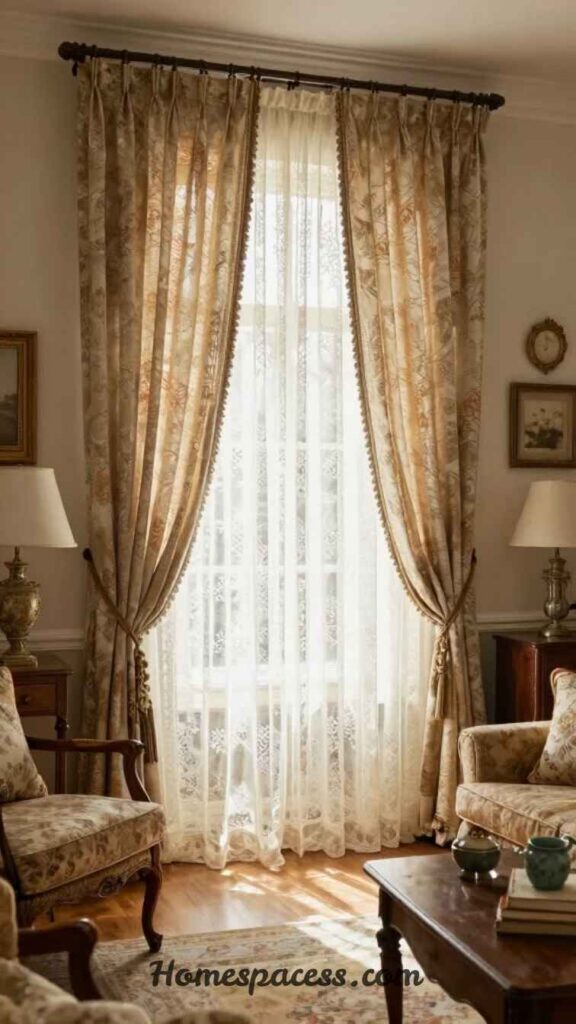
Layering curtains pairing a sheer panel close to the glass with a heavier drape on the outside is one of the most practical and visually sophisticated living room curtain ideas available. The sheer layer filters harsh afternoon light into a soft, diffused glow while still providing daytime privacy. The outer drape, when drawn, provides complete darkness and insulation. Together, they give you full control over light and mood at any hour.
The most common layering mistake is using two rods of the same size, which creates an awkward overlap. Instead, use a double curtain rod system the inner rod sits 3 to 4 inches closer to the glass, and both rods extend generously beyond the window frame (8 to 12 inches on each side). This ensures that when both layers are open, they stack neatly to the sides without blocking daylight. Sheer linens in white, ecru, or pale sage work well for the inner layer, while the outer panel can introduce texture, color, or pattern.
Designer Insight
In south-facing living rooms, layered sheers can reduce solar heat gain by up to 30% compared to a single opaque curtain all while keeping the room brighter and more welcoming during the day.
Layered curtains also allow you to refresh your room’s look seasonally without replacing everything. Swap the outer drape from a warm wool blend in winter to a breezy cotton voile in summer, while keeping your sheer panels constant. This modularity makes the initial investment in a good double rod system well worth it over time.
Read More: Creative Camper Interior Ideas to Make Your RV Feel Like a Dream Home
Earthy Linen Curtains
The Calm, Natural Look Designers Keep Returning To
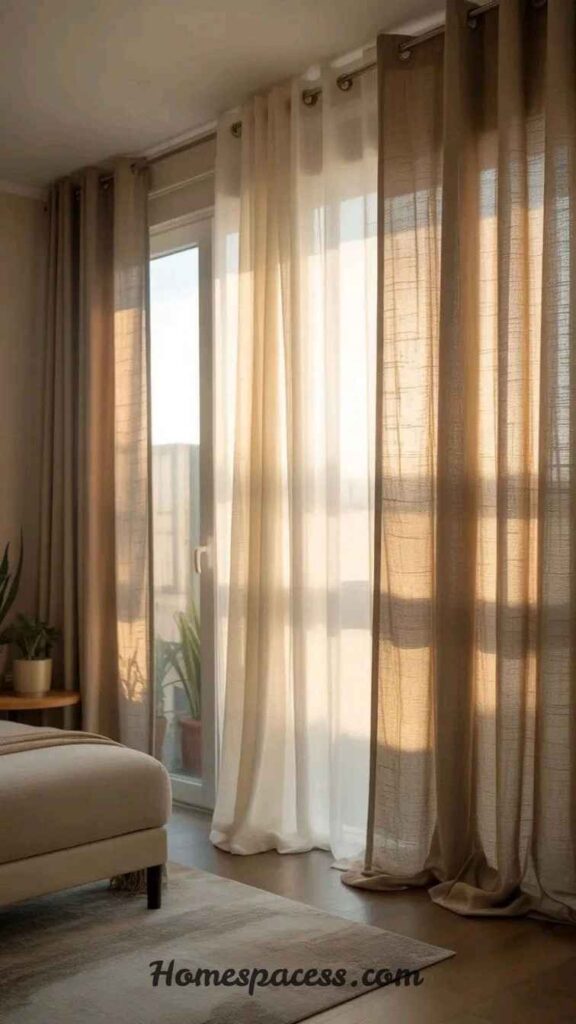
Linen curtains have become the defining textile of contemporary living rooms and for very good reason. Their natural slubby texture catches light differently throughout the day, creating a surface that feels alive rather than flat. Unlike polyester alternatives that look shiny and cheap in photographs, genuine linen has a matte depth that photographs beautifully and ages gracefully. It wrinkles, yes but those wrinkles read as organic and intentional, not unkempt.
Earthy tones in linen think warm oat, dusty terracotta, dried sage, clay, or undyed natural pair effortlessly with the organic material palettes dominating 2026 interiors. Stone floors, jute rugs, raw wood furniture, and ceramic accessories all find a natural ally in linen drapes. The key is to lean into the tonal palette rather than fight it: choose linen curtains that are one or two shades lighter or darker than your largest wall, rather than defaulting to stark white, which can feel clinical against warm organic surfaces.
From a practical standpoint, linen curtains improve with washing they soften and relax while maintaining their structure. Pre-washing before hanging is essential to avoid unexpected shrinkage later. For best results, hang them slightly damp and let them dry in place so gravity sets the fall naturally. This small step creates a custom-draped look without paying for custom curtains.
Don’t Miss: Modern Dining Room Ideas That Instantly Elevate Your Home Style
Velvet Curtains
Where Warmth, Drama, and Acoustic Comfort Meet
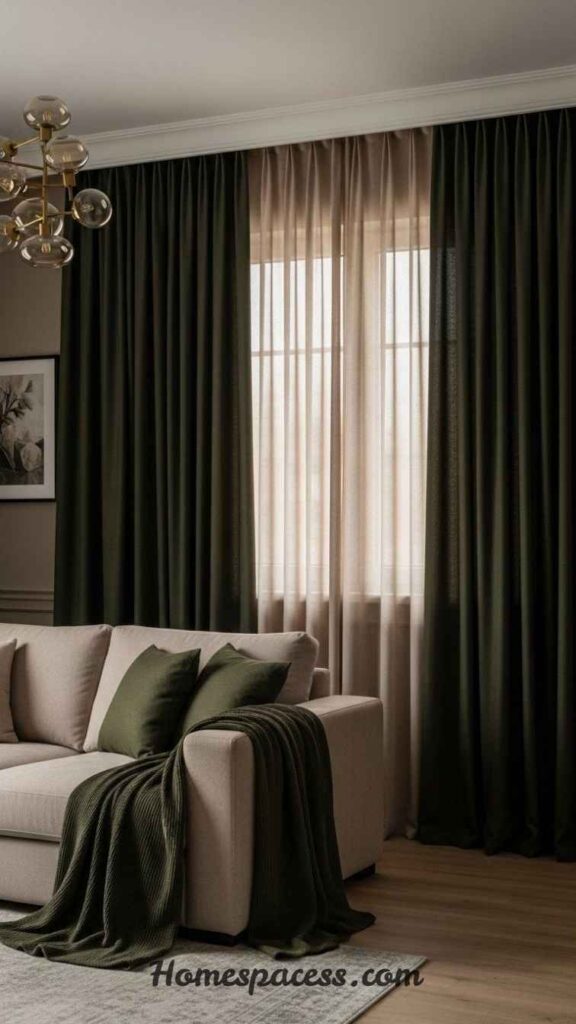
Velvet curtains are experiencing a sustained revival not as an opulent throwback, but as a genuinely functional choice for modern living rooms that need warmth and sound absorption. Velvet’s dense pile construction provides exceptional insulation, reduces echo in open-plan spaces, and blocks light more completely than almost any other fabric. In living rooms used for TV watching or music listening, velvet curtains are an underrated acoustic upgrade.
Contemporary velvet curtains work best in jewel tones deep forest green, midnight navy, burgundy, or rich charcoal but the new generation of designers is also exploring muted, dusty versions: sage velvet, blush velvet, and pale stone velvet that feel luxurious without overwhelming a room. These quieter colors allow velvet’s texture to do the visual work while keeping the palette sophisticated rather than theatrical. Pair with simple matte hardware (brass, black iron, or brushed nickel) to avoid over-decorating.
🎯
Velvet Care Tip
Always hang velvet so the pile runs downward. Brushing upward creates visible light-catching ridges that look like damage.
🔊
Acoustic Benefit
Lined velvet panels can reduce mid-frequency sound reverberation by 15–25% a meaningful improvement in open-plan rooms.
🌡️
Insulation Value
Interlined velvet curtains function as an effective thermal barrier, keeping living rooms warmer in winter and cooler in summer.
One often-overlooked detail with velvet: the heading style matters enormously. Pencil pleat headings create a dense, traditional gather that emphasizes velvet’s richness. Pinch pleat or eyelet headings give a cleaner, more contemporary result. Avoid tab-top headings with velvet the weight of the fabric causes the loops to distort over time, making the curtain hang unevenly.
Also Read: Home Bar Ideas That Make Entertaining at Home More Fun
Patterned Curtains
Making a Statement Without Repainting the Whole Room
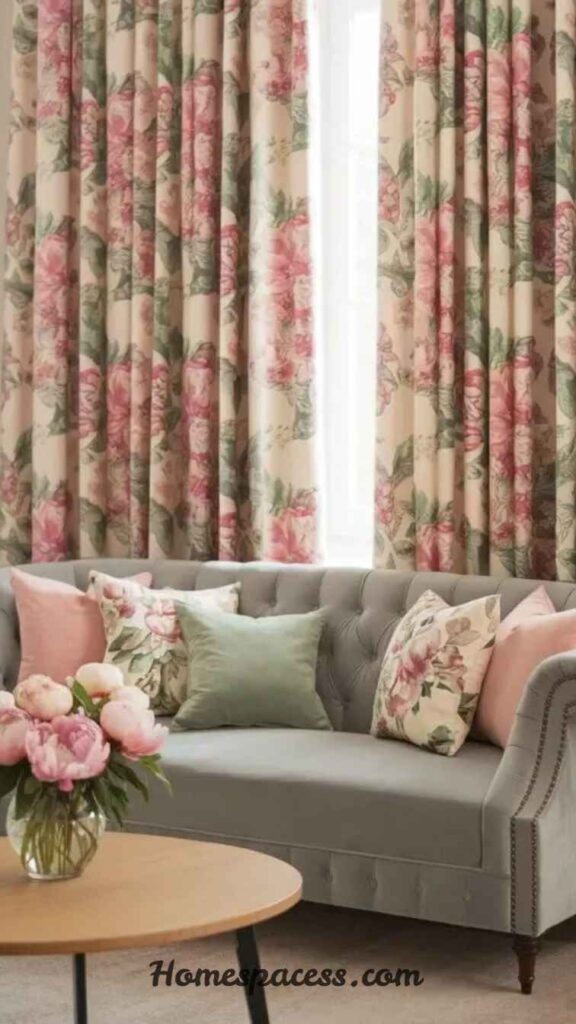
A well-chosen patterned curtain is one of the most cost-effective ways to introduce personality, color, and visual rhythm into a living room that feels safe but flat. The key distinction that most guides miss is this: patterns on curtains read differently than patterns on walls or cushions. Because curtains are vertical and often gathered or pleated, busy patterns compress and stretch with the fabric a pattern that looks overwhelming on a flat swatch may look beautiful when pleated, and vice versa.
Botanical prints, abstract geometric weaves, stripes, and tonal block prints are all strong choices for 2026 living rooms. Stripes are particularly strategic vertical stripes reinforce the height-extending effect we discussed earlier, while horizontal stripes can be used deliberately in low-ceilinged rooms to make them feel cozier and more human-scaled. Large-scale botanical patterns work best in rooms where other surfaces (walls, rugs, upholstery) are relatively neutral, giving the curtain room to breathe and become the room’s focal anchor.
The most common mistake with patterned curtains is ordering without considering pattern repeat. If your panel requires multiple fabric widths stitched together, the pattern must be matched at every seam and this requires purchasing significantly more fabric than the panel dimensions suggest. A professional curtain maker will calculate this automatically, but if you’re ordering ready-made or semi-custom, always check whether the pattern repeat is included in the sizing. Mismatched patterns at seams undermine even the most beautiful fabric.
Conclusion
The best living room curtain ideas are those chosen with intention for how they manage light, how they shape the perception of space, and how they contribute to the room’s emotional atmosphere over years, not just weeks. From floor-to-ceiling sheers that open a room to the sky, to richly layered velvet that makes a living room feel like a sanctuary, every choice carries more consequence than it first appears.
Invest in quality fabric, proper lining, substantial hardware, and correct proportions. These fundamentals outperform trends every single time. And as smart home technology and sustainable materials continue to evolve, your curtain decisions will increasingly influence your home’s energy performance and daily comfort in measurable ways.
Start with one idea that resonates most with your room’s needs whether that’s adding height with longer panels or replacing synthetic fabric with honest linen and build from there. Small, well-executed changes in window treatment create some of the most noticeable transformations in any living room.
Trend Analysis
2026 Living Room Curtain Trends And Where They’re Heading Next
The dominant story in living room curtain ideas for 2026 is the move away from decoration-for-decoration’s-sake toward intentional functionality. Curtains are increasingly being chosen for their thermal performance, acoustic properties, and circadian light management not just their visual appeal. This shift is being driven by a generation of homeowners who understand that their home environment directly affects health, sleep quality, and energy costs.
What’s Trending Right Now
Tonal dressing where curtains, walls, and key furnishings share the same color family in varying shades is the defining aesthetic of 2026. It creates an immersive, enveloping feeling that resonates with the growing desire for living rooms that feel like genuine retreats. Alongside this, undyed and naturally pigmented textiles are gaining momentum: raw Belgian linen, undyed organic cotton, and hemp-cotton blends that carry the subtle irregularity of natural dyeing processes.
Simultaneously, curved and arched window treatments are having a moment as arched windows return to new construction and renovation. Flexible curtain tracks that follow curved architecture previously custom-only are becoming more accessible through specialist retailers. Expect this niche to grow significantly as architectural windows become more popular in residential design.
Where the Trend Is Going
Looking toward 2027 and 2028, the integration of biophilic design principles into curtain choices will deepen. This means not just natural materials but also curtain systems designed to sync with natural light cycles gradually transitioning from sheers in the morning to light-filtering mid-layers in the afternoon to blackout in the evening, either manually or through smart home automation. The curtain as a passive tool is slowly becoming an active participant in the home’s daily rhythm.
Expert Insights
Practical Tips Designers Use That Most Guides Never Mention
The width calculation almost everyone gets wrong: For curtains to look full and luxurious when closed, each panel should be 1.5 to 2.5 times the width of the space it needs to cover. This means for a 60-inch-wide window, you need panels with a total width of 90 to 150 inches. Most people buy one standard panel per side and wonder why their curtains look thin and sad when drawn. Fullness is the single biggest difference between curtains that look expensive and curtains that don’t.
‘Width is what separates a curtain from a drape. A drape is just a curtain with enough fabric to have a genuine sense of gravity and presence.’
Hardware before fabric, always. Most homeowners choose their fabric first, then buy rods and end up with hardware that fights the curtain. Professional designers start with the rod: its finish, diameter, and bracket spacing determine how the curtain hangs and how the room is framed. A 1.25-inch diameter rod reads as architectural and substantial. A thin 0.75-inch rod looks temporary. Choose hardware that can support 20% more weight than your fabric requires curtains are heavier than they look, and undersized rods bow and sag over time.
The Overlooked Role of Lining
Lined curtains hang better, last longer, protect fabric from UV degradation, and provide meaningful insulation. Yet many people skip lining to save money and end up replacing curtains far sooner. A basic cotton lining adds structure and weight that makes any fabric drape more beautifully. Interlining (a layer of soft padding between face fabric and lining) elevates the result further: it gives even lightweight fabrics the appearance and fall of premium heavy curtains. For living rooms that receive direct sunlight, UV-protective lining is an investment that pays for itself in fabric longevity alone.
📐
Width Rule
Total curtain width = window width × 2. Never less than 1.5×. This single rule prevents 80% of ‘cheap curtain’ problems.
🔩
Rod Placement
Extend rods 8–12 inches beyond each side of the window. When open, curtains stack off the glass, maximizing natural light.
🧵
Always Line
Lined curtains last 2–3× longer than unlined ones. For south-facing rooms, UV-block lining is non-negotiable.
✂️
Hem Last
Hang curtains for 48 hours before hemming. Fabric relaxes and drops slightly after installation, especially linen and silk.
Sustainability & Value
Choosing Curtains for Long-Term Value, Not Just Style
The most sustainable curtain is the one you don’t replace. This sounds obvious, but it has a profound implication for how you choose living room curtain ideas: prioritize classic cuts, neutral or tonal colors, and high-quality natural fabrics over trend-led fast-furnishing options. A well-made linen or wool curtain in a timeless color can outlast three cycles of trend-driven decorating and will only improve visually as it ages and softens.
Material Choices That Last
From an environmental standpoint, natural fibers outperform synthetics significantly at end-of-life. Linen, cotton, wool, and silk are biodegradable; polyester and acrylic are not. Beyond disposal, natural fibers also regulate humidity better in living spaces linen, in particular, naturally absorbs and releases moisture, contributing to a more comfortable indoor environment without mechanical intervention. Organic certification (GOTS-certified linen or cotton) provides assurance that the supply chain meets rigorous environmental and social standards.
From an energy perspective, well-chosen curtains meaningfully reduce heating and cooling costs. Studies from the Energy Saving Trust suggest that heavy, lined curtains drawn at dusk can reduce heat loss through windows by up to 40% compared to uncovered glass. In climates with cold winters or very hot summers, this translates to real financial savings that compound over the lifespan of the curtain. When you factor in these energy savings, a premium lined curtain can be significantly more economical than a cheap replacement every few years.
The Cost-Per-Year Framework
Rather than comparing the sticker price of curtains, calculate cost-per-year: divide the total price by the expected lifespan in years. A £400 / $500 pair of well-made linen curtains lasting 15 years costs roughly £27 / $33 per year. A £80 / $100 pair of fast-furnishing polyester panels replaced every 3–4 years costs £20–27 / $25–33 per year almost identical, but with far more waste, more installation effort, and less visual quality throughout. This reframing changes the economics of quality dramatically.
Future Innovations
The Next Generation of Living Room Window Treatments
The curtain industry is quietly undergoing a technological transformation. Smart motorized curtain systems once the exclusive province of luxury hotels and high-end residential projects are becoming genuinely affordable for mainstream homeowners. Systems like those using Matter-compatible smart home protocols now allow curtains to open and close automatically based on time of day, room temperature, sunlight intensity, or voice command. For living rooms with east-facing windows, this means curtains that automatically filter morning glare without requiring manual adjustment every day.
Phase-Change and Thermochromic Textiles
On the material innovation frontier, phase-change curtain fabrics are moving from laboratory to limited commercial availability. These fabrics contain microencapsulated materials that absorb heat when the room warms and release it when it cools functioning as passive thermal regulators. While currently expensive, the technology is on a cost-reduction curve comparable to early smart thermostat technology. By 2028–2030, phase-change lining is likely to be available as a premium upgrade option from mainstream curtain manufacturers.
Meanwhile, electrochromic and thermochromic window films which change opacity in response to electrical charge or temperature are beginning to blur the line between curtains and window treatments altogether. These technologies don’t replace fabric curtains for their acoustic, aesthetic, and insulative value, but they may reshape how we think about layering light control in living rooms. The future of window treatment is almost certainly a system film, sheer, and drape working in concert rather than any single solution.
Forward-Looking Insight
By 2030, analysts predict that over 35% of new residential curtain installations in smart-home-enabled properties will include some form of automated light management, up from under 8% in 2024. Early adoption now means avoiding more expensive retrofitting later.
Common Mistakes
The Curtain Mistakes Even Design-Savvy Homeowners Make
Understanding great living room curtain ideas means nothing if the execution is flawed. The most pervasive mistake remains hanging curtains too low and too narrow this single error makes rooms feel shorter, windows feel smaller, and the entire decorating investment feel underwhelming. We’ve covered the solution: high rods, wide extensions, long panels. But there are several other mistakes that are less discussed and equally damaging.
Mistake: Matching Curtains to the Sofa Instead of the Room
Many homeowners pick curtain colors to match or complement their sofa. This sounds logical but often creates a fragmented room where one corner coordinates while the rest doesn’t. Instead, anchor curtain color to the largest fixed surface in the room the wall color, the floor, or a large area rug. The sofa can then work within this framework rather than competing with the curtain for dominance. Curtains that relate to the architectural shell of the room always feel more intentional than those that relate to a single piece of furniture.
Mistake: Choosing Fabric Weight Without Considering the Rod
Heavy velvet or interlined panels require robust rods with center supports without them, the rod bows under the weight, causing curtains to gather toward the middle rather than hanging straight. This is a surprisingly common outcome for homeowners who invest in premium fabric but use standard lightweight rods. Before purchasing heavy curtains, verify that your rod system is rated for the weight and that center brackets are installed at intervals no greater than 48 inches.
Common Oversight
Dry-clean-only curtains in a household with children, pets, or cooking smells become a maintenance burden that many homeowners underestimate. Always check cleaning requirements before buying and prefer washable fabrics for high-traffic, high-use living rooms.
Mistake: Ignoring the Return
The ‘return’ is the portion of the curtain that wraps around from the front of the rod bracket back to the wall. Without a proper return, light leaks in along the sides of drawn curtains the same problem you see in hotel rooms where curtains never fully close. For blackout curtains or rooms where full darkness is needed, specify curtains with a deep return and ensure your brackets position the rod far enough from the wall to allow the fabric to wrap back. This small detail separates professionally installed curtains from well-intentioned DIY results.

Team Home Spacess shares simple, practical design ideas that work for real families. The team focuses on cozy décor, soft colors, and natural textures that make a space feel truly lived-in. From everyday decorating tips to creative home projects, Team Home Spacess is dedicated to helping readers create warm, comfortable, and inviting spaces with a fresh and personal touch.