

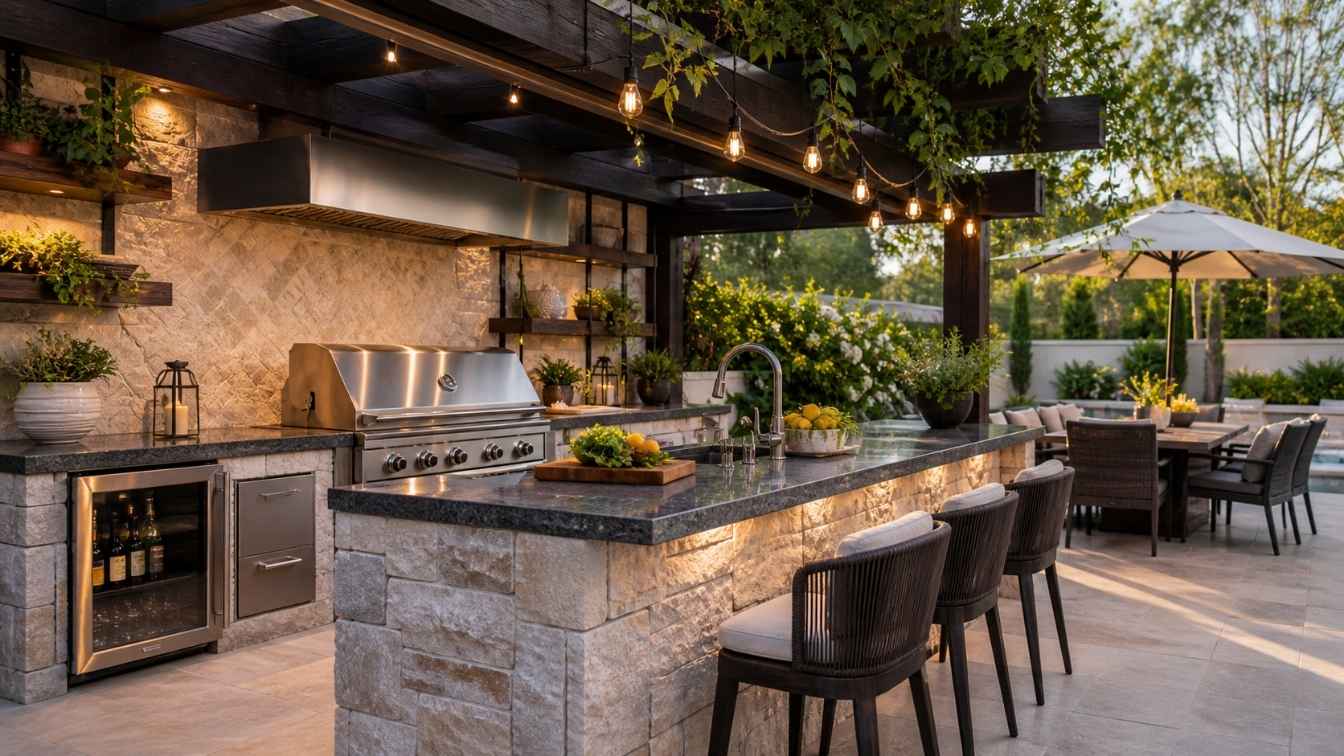
Most people settle for a portable grill and call it done. Here’s why a well-planned outdoor kitchen is the highest-return upgrade you can make to your home and how to build one that actually works.
You’ve probably hosted a summer barbecue where you spent more time running back and forth to the indoor kitchen than actually enjoying your guests. Every trip inside breaks the flow and reminds you that your backyard isn’t quite the entertaining space it could be.
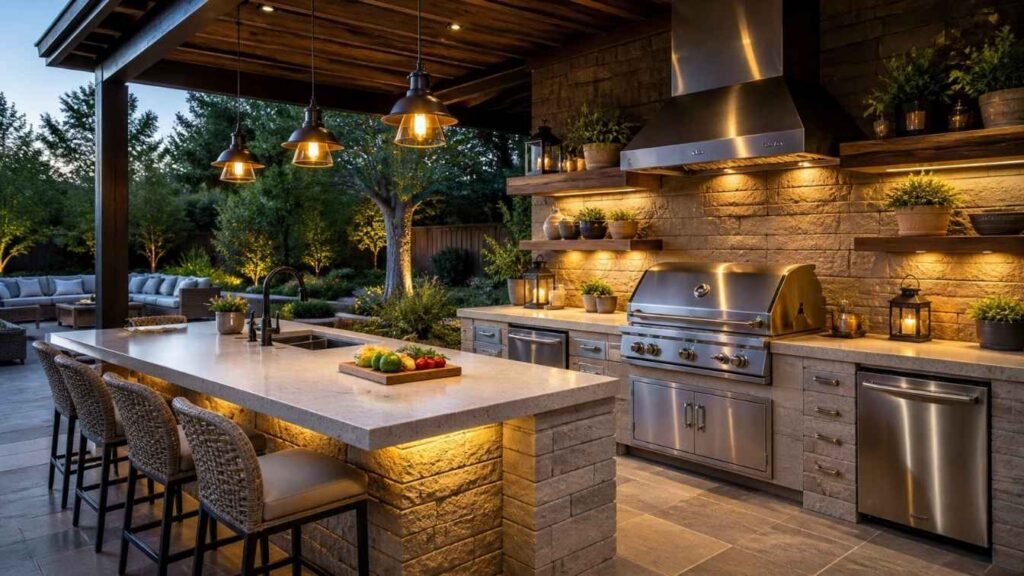
A well-designed outdoor kitchen doesn’t just solve that problem. It changes how you live. From weeknight grilling to weekend dinner parties, the right outdoor cooking setup adds real value, genuine convenience, and thousands of dollars to your home’s resale price. This guide covers eight outdoor kitchen ideas worth building not just pinning.
$10K
Average outdoor kitchen cost (entry-level)
100–200%
Typical ROI on outdoor kitchen investment
67%
Homebuyers say outdoor living space is a priority
3x
More time spent outdoors with a dedicated cook space
Built-In Grill Station With Counter Seating
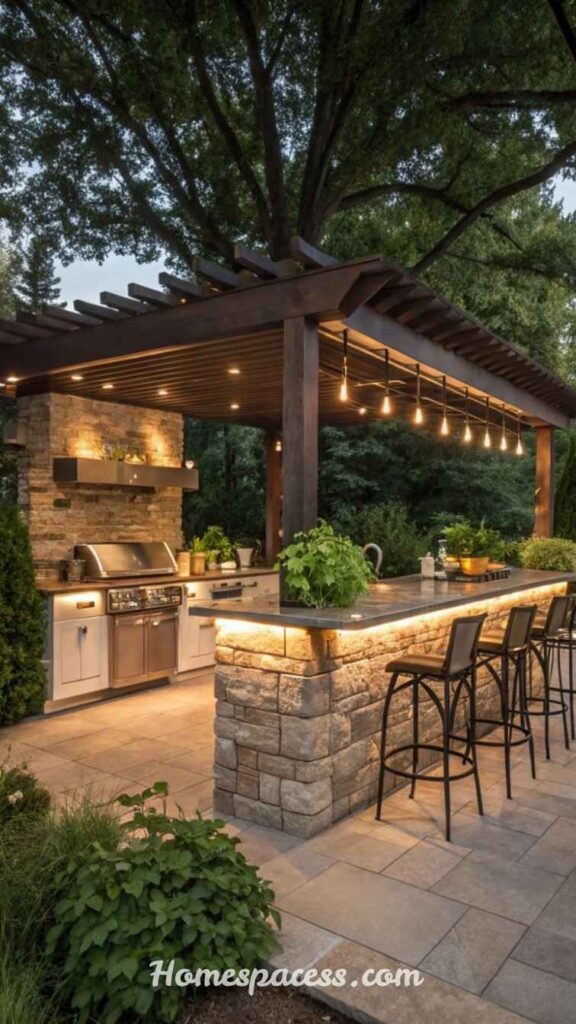
A built-in grill station is the cornerstone of most outdoor kitchens and for good reason. Unlike a freestanding grill that you move around seasonally, a built-in unit is permanent, flush-mounted, and connected to a natural gas or propane line. This means no more tank swaps, no more rolling the grill into the garage when it rains. You get a cooking surface that behaves exactly like your indoor range, just bigger and better suited to high-heat cooking.
The real magic happens when you add counter seating on one side of the grill station. A 12-inch overhang on a stone or concrete countertop creates a casual bar-style setup where guests can perch on stools, hold a drink, and actually talk to whoever’s cooking. This single design choice eliminates the “chef isolation problem” where the cook is stuck facing a wall while everyone else socializes. It’s a subtle but transformative shift in how outdoor entertaining actually feels.
Material choice here matters more than most guides admit. Polished granite looks beautiful in photos but can get uncomfortably hot in direct afternoon sun. Quartzite, concrete, and porcelain slab countertops handle heat, UV exposure, and moisture much better over a 10–15 year horizon. Choose a material rated for outdoor use, not just a material that looks good at the tile showroom.
Pro Tip
Orient your grill so the prevailing wind blows smoke away from your seating area. In most of the US, prevailing winds blow from the west so a south-facing grill with west-side seating keeps guests comfortable even during long cooks.
Must Read: Baby Room Ideas That Make Small Nurseries Look Bigger and Brighter
L-Shaped Layout With a Built-In Pizza Oven
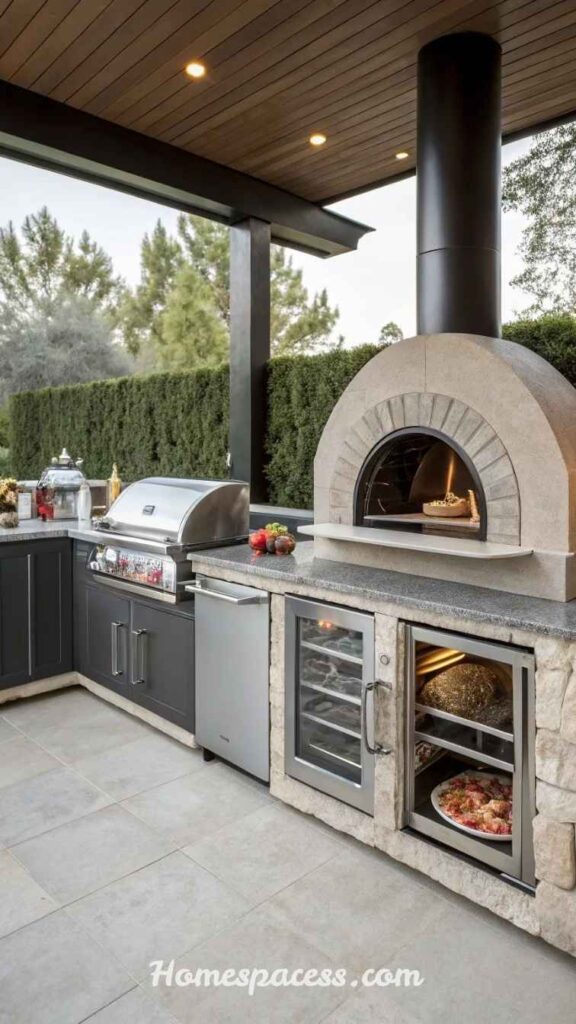
An L-shaped outdoor kitchen configuration is the most versatile layout for mid-size patios because it creates a natural flow between the cooking zone, prep area, and serving space without requiring a sprawling footprint. One arm of the L houses the grill and side burner; the other arm becomes prep and storage. The corner can anchor a pizza oven, a smoker, or a large sink, depending on your cooking priorities.
Built-in wood-fired pizza ovens have moved from “luxury add-on” to mainstream feature over the past three years, and for good reason. A properly built masonry oven reaches 700–900°F, which means Neapolitan-style pizza in 90 seconds, perfectly roasted vegetables, and even fresh-baked bread. Gas-powered pizza ovens like those from Fontana or Alfa are an excellent alternative if you want faster heat-up times and less maintenance than a wood-burning unit.
One detail most guides skip: pizza ovens need a foundation capable of supporting significant weight. A standard residential concrete patio slab (4 inches thick) is often insufficient for a masonry pizza oven that can weigh 1,500–3,000 lbs. Always have a structural engineer or experienced contractor assess your slab before committing to a heavy masonry installation. Skipping this step is one of the most expensive mistakes in outdoor kitchen projects.
Read More: Outdoor Patio Ideas That Turn Any Backyard Into a Relaxing Escape
Compact Galley-Style Outdoor Kitchen for Small Spaces
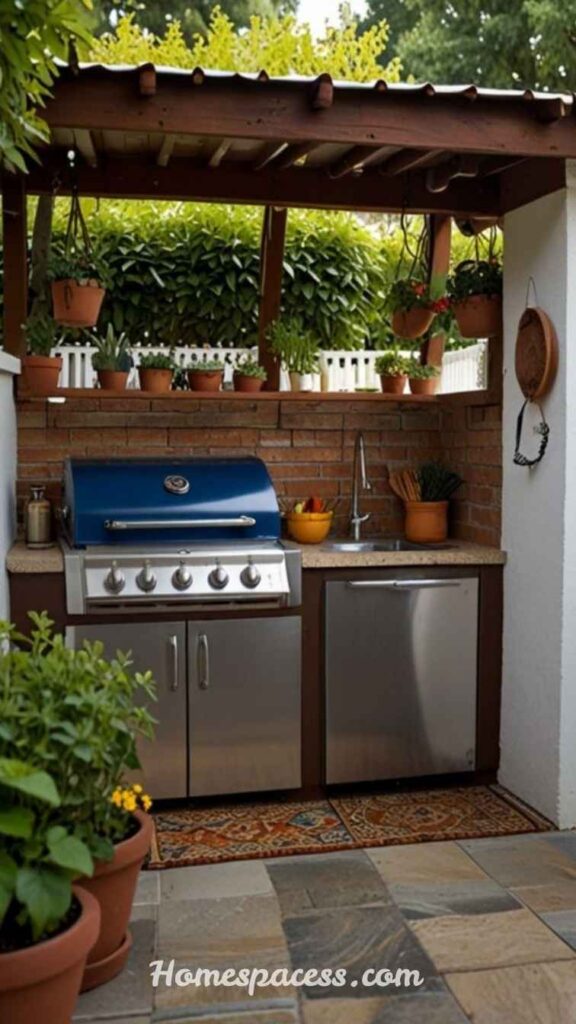
Small patios, narrow backyards, and condo terraces often get dismissed as “not big enough” for a real outdoor kitchen. That’s a missed opportunity. A galley-style layout two parallel countertops facing each other, or a single straight run of 8–12 feet can deliver full outdoor kitchen functionality in remarkably tight spaces. The key is ruthless prioritization: a two-burner grill instead of four, a compact undercounter fridge instead of a full bar setup, and a fold-down prep shelf instead of a fixed countertop extension.
For urban environments and smaller homes, modular outdoor kitchen systems from brands like Coyote, Modular Outdoor Kitchen (MOK), and NatureKast have made this category far more accessible. These systems use pre-fabricated stainless or weather-resistant cabinet frames that you can configure to your exact footprint. Installation is DIY-friendly compared to custom masonry, and they’re significantly more affordable often coming in at $3,000–$6,000 for a complete galley setup versus $15,000+ for a custom stone build.
One underrated design choice for compact outdoor kitchens: vertical storage. Install a tall pegboard or slotted stainless rail on the wall behind the cooking surface to hang tools, spices, and small accessories. It keeps countertops clear, makes the space feel more professional, and eliminates the clutter that makes small outdoor kitchens feel cramped.
Don’t Skip: Wall Painting Ideas That Make Your Home Feel Warm and Inviting
Poolside Outdoor Kitchen With a Swim-Up Bar
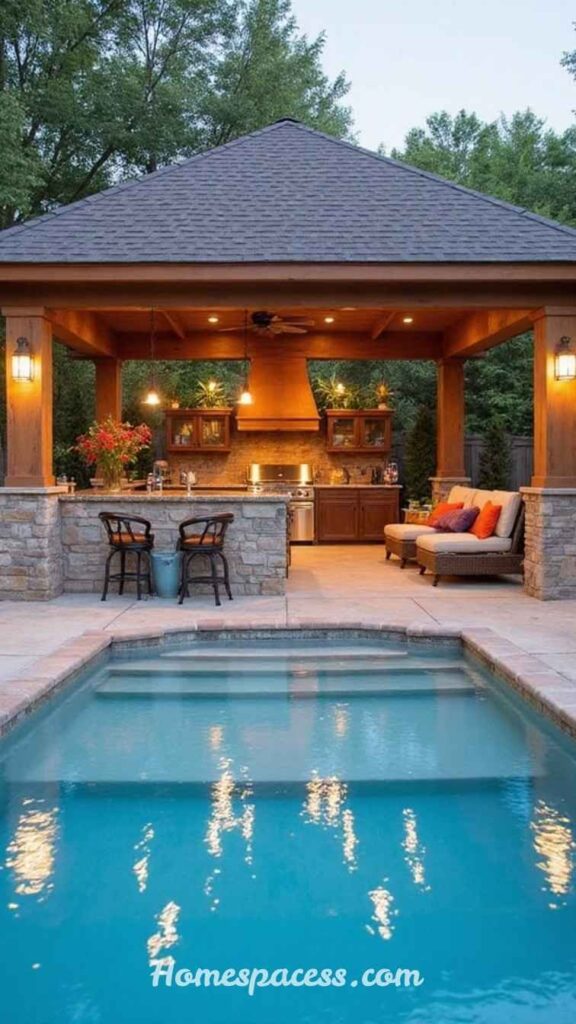
If you’re fortunate enough to have a pool, integrating your outdoor kitchen into the pool zone is one of the highest-return design decisions you can make. A poolside outdoor kitchen doesn’t mean putting a grill next to the water it means designing a cohesive zone where cooking, serving, and swimming all flow together. The swim-up bar concept, long associated with resort pools, is now appearing in residential backyards thanks to better waterproofing technology, more durable outdoor cabinetry, and weather-resistant bar equipment.
A properly designed poolside outdoor kitchen places the grill and cooking appliances slightly upwind and away from the pool edge typically 6–10 feet minimum to prevent grease and smoke from contaminating the water. The bar and serving area faces the pool, allowing a bartender or cook to hand drinks and food directly to guests in the water. Submerged bar stools built into the pool ledge complete the resort experience without requiring a major structural overhaul to your existing pool.
Water and electricity are dangerous together, and this is a space where cutting corners is genuinely hazardous. All electrical outlets in a poolside kitchen must be GFCI-protected and rated for wet locations, and local codes typically require them to be at least 5–10 feet from the water’s edge. Always pull permits for poolside electrical work and hire a licensed electrician. The cost of doing it correctly is trivial compared to the risk of not doing so.
Pro Tip
Install a small, under-counter ice maker dedicated to the outdoor kitchen. A 50-lb daily capacity unit from Scotsman or U-Line keeps you from the endless indoor-to-outdoor ice bucket relay that characterizes every summer party without one.
Covered Outdoor Kitchen Under a Pergola or Pavilion
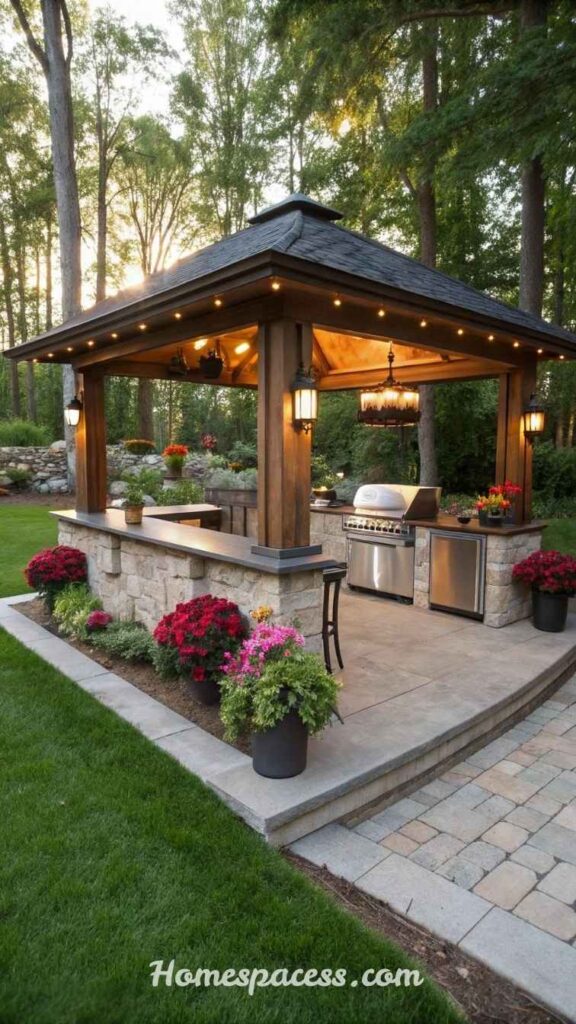
An uncovered outdoor kitchen is a fair-weather friend. Rain, intense sun, and wind limit when you can use it and accelerate wear on your equipment. Covering your outdoor kitchen whether with an attached pergola, a freestanding pavilion, or a full roofed structure is perhaps the single best investment you can make to maximize how often you actually use the space. A covered outdoor kitchen extends your season by months and transforms “we can’t use it today” into “we can always use it.”
The covering structure you choose should match both your aesthetic and your climate. In rainy climates, a fully waterproof roof with proper drainage is essential louvered pergolas with adjustable aluminum slats, like those from Pergola Kits USA or StruXure, offer the best of both worlds: open sky when you want it, weather protection when you need it. In hot, sunny climates, shade fabric, retractable canopies, or a solid patio cover prevents your cooking surfaces from superheating and makes the workspace comfortable even in peak summer heat.
Ventilation is a critical and frequently overlooked issue with covered outdoor kitchens. Grills and pizza ovens produce large volumes of smoke and carbon monoxide. An enclosed or semi-enclosed cooking area without adequate airflow is a genuine safety hazard. Any covered outdoor kitchen should have at least two open sides, or a commercial-grade exhaust hood rated for outdoor use. Residential indoor range hoods are not designed for outdoor grill BTU output and will fail quickly if misapplied.
Also Read: Simple Garden Decor Ideas for a Clean and Modern Outdoor Style
Entertainment-First Outdoor Kitchen With an Outdoor Bar
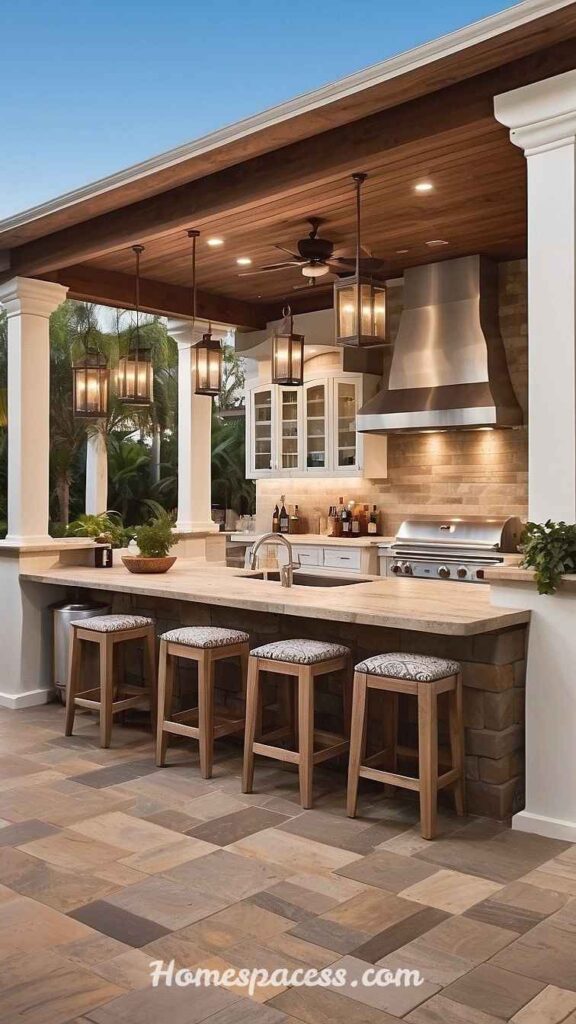
Not every outdoor kitchen is primarily about cooking. For households that entertain frequently, the priority might be hospitality over culinary output a beautifully stocked outdoor bar, ample seating, and ambient lighting that creates an experience rather than just a place to make food. This “entertainment-first” outdoor kitchen approach prioritizes the guest experience and treats cooking as one element within a larger social ecosystem.
The outdoor bar is the centerpiece of this design. A dedicated bar counter with an undercounter refrigerator, a kegerator or wine cooler, a built-in blender station, and generous overhead storage makes it possible to entertain 20+ guests without setting foot inside. Add a beverage sink with hot and cold water, and you have essentially a full service bar capable of handling any event. Outdoor-rated bar stools in a material like powder-coated aluminum or teak handle weather beautifully and can stay outdoors year-round in most climates.
Lighting deserves particular attention in entertainment-focused outdoor kitchens. Task lighting above the grill and prep areas is essential for safe cooking after dark. Ambient string lights, LED strip lighting under countertop edges, and pathway lighting create the atmosphere that makes guests want to linger. Smart outdoor lighting systems like those from Lutron Caséta or Philips Hue Outdoor allow you to adjust the entire zone’s mood with a single scene preset, shifting from “grilling mode” bright task light to “dinner party” warm ambient in seconds.
Luxury Outdoor Kitchen With Full Appliance Suite
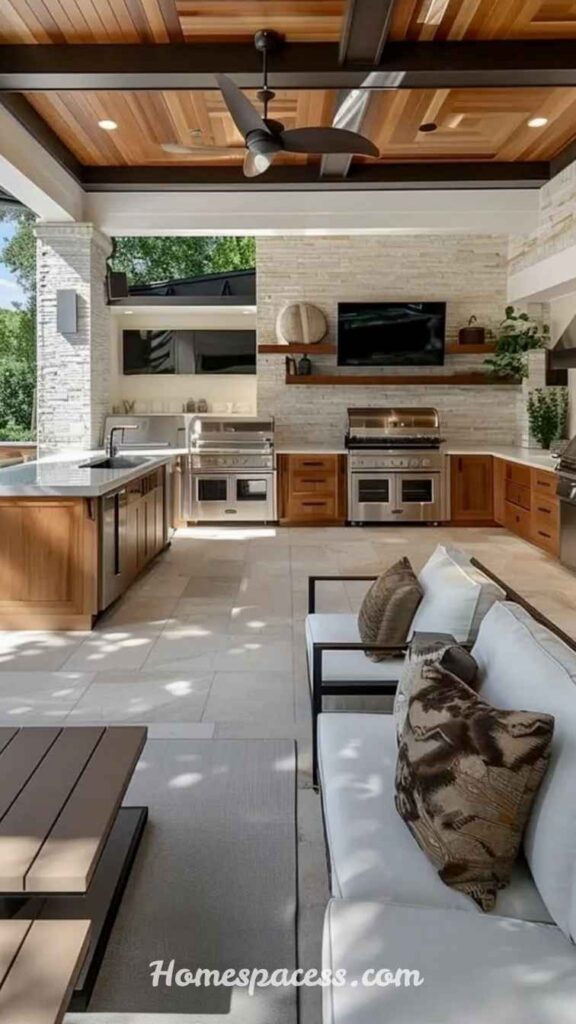
For those planning a full-scale outdoor living room, the luxury outdoor kitchen brings every indoor cooking convenience outside commercial-grade grills, warming drawers, outdoor-rated dishwashers, refrigerator drawers, ice makers, outdoor pizza ovens, rotisserie attachments, and even outdoor-rated TVs built into the cabinetry. This isn’t about excess; it’s about eliminating every reason to go inside, creating an outdoor environment so capable and comfortable that it becomes your primary living space for eight months of the year.
The appliance brands worth specifying at this tier are notably different from what you find at big-box home improvement stores. For grills, Kalamazoo Outdoor Gourmet, Hestan, and Twin Eagles are the standard for professional-grade outdoor cooking. For refrigeration, U-Line and Perlick build outdoor-rated units with insulation and compressor systems designed for temperature swings and high ambient heat that would kill a residential indoor refrigerator in two summers. The price premium is real but so is the longevity difference.
Whole-outdoor kitchen integration with smart home systems is now mainstream at this price tier. Voice-controlled lighting, automated shade and louvered roof systems, outdoor audio with in-ceiling or in-wall rated speakers, and even outdoor-rated tablet mounts for recipe display and media control can all be integrated into a single control interface. The practical value isn’t gimmick-level being able to raise a shade, turn on music, and turn on the grill from inside before your guests arrive changes how you use the space day to day.
Conclusion
A well-designed outdoor kitchen is one of the few home investments that genuinely improves how you live day to day not just how your home appraises. From compact galley setups for urban terraces to luxury appliance suites built under custom pergolas, there’s an outdoor kitchen idea that works for nearly every backyard, every budget, and every cooking style.
The key is treating your outdoor kitchen with the same planning rigor you’d apply to an indoor kitchen renovation: assess your infrastructure first, choose materials rated for outdoor use, plan your workflow before your layout, and build with long-term durability in mind rather than just short-term aesthetics.
Trend Analysis
Outdoor Kitchen Trends in 2026 and Beyond
The outdoor kitchen category has undergone a notable shift in the past two years. The pandemic-era surge in backyard investment has matured from impulsive DIY projects into thoughtful, design-led outdoor living spaces that homeowners are treating with the same seriousness as kitchen renovations. Several trends are currently reshaping how outdoor kitchens are designed, built, and used.
Rising Now
Louvered pergola roofs
Motorized adjustable-slat roofs that open and close on demand protecting from rain, controlling sun and shade, and extending the usable season significantly.
Rising Now
Outdoor kitchen pods
Self-contained, prefabricated outdoor kitchen units that arrive fully plumbed and wired no masonry required, plug-in-ready in a weekend.
Emerging
Electric induction outdoors
High-BTU outdoor induction cooktops are eliminating gas dependency, especially in California and states with stricter outdoor gas regulations.
Emerging
Multi-fuel cooking systems
Single cooking platforms that switch between gas, charcoal, and wood delivering the versatility of three appliances in one footprint.
Future
Solar-integrated outdoor kitchens
Off-grid outdoor kitchens powered by rooftop solar arrays feeding battery storage eliminating utility connections entirely and enabling more remote placement.
Future
AI-assisted cooking appliances
Smart grills and smokers with built-in computer vision that monitor cook progress, adjust temperature autonomously, and alert you to doneness via app.
One trend the mainstream media has been slow to cover: the rapid increase in outdoor kitchen regulations at the municipality level. Several US cities and counties particularly in Southern California and parts of Florida have introduced restrictions on gas-burning outdoor appliances due to air quality and wildfire risk. If you’re planning a gas-heavy outdoor kitchen build, confirm local permit requirements before committing to a layout that may be non-compliant within five years of construction.
Expert Insights
What Professionals Know That Most Guides Miss
After speaking with landscape architects, outdoor kitchen contractors, and culinary professionals, several consistent insights emerge that rarely appear in mainstream outdoor kitchen content. These aren’t about choosing between granite and quartz they’re about the systemic decisions that determine whether an outdoor kitchen is truly functional or just an expensive showpiece.
Size the plumbing before you size the grill
Most homeowners start planning an outdoor kitchen by choosing the grill. Professionals start by assessing the plumbing and gas infrastructure. Running a dedicated gas line for a high-BTU grill, pizza oven, and side burner simultaneously requires a significantly larger gas line than most homes have running to the backyard. Having a plumber and gas professional assess your existing service before finalizing your appliance list prevents the expensive surprise of discovering mid-build that your gas supply is insufficient for your planned setup.
Drainage is the most expensive afterthought
Outdoor kitchens produce water from rain, from rinsing, from sink use, and from melting ice. Without adequate drainage planned from the start, water pools on countertops, around cabinet bases, and on the patio surface, accelerating rot, corrosion, and concrete spalling. A 1–2% slope on countertops toward a recessed channel, proper grading of the patio surface, and a drain connected to the home’s storm water system should be designed in from day one, not bolted on after the fact.
Invest in the frame; save on the finish
The internal structure of an outdoor kitchen island typically steel studs, cement board, or masonry block determines long-term durability far more than the exterior finish material. Many homeowners over-invest in expensive tile or stone facades while using lower-grade structural materials that allow moisture intrusion, rusting, and eventually structural failure. The professional approach is the inverse: build the frame from the most durable material your budget allows (welded steel or concrete masonry), then apply a finish that meets your aesthetic goals.
Sustainability, Long-Term Value
Strategic Thinking
The most future-proof outdoor kitchens are designed with material durability, energy efficiency, and adaptability in mind. This isn’t just an environmental consideration it’s a financial one. An outdoor kitchen built from truly weather-resistant materials with quality appliances will outperform a cheaper build over a 20-year horizon by a factor that far exceeds the upfront cost differential.
Material longevity deserves a straightforward analysis. Stainless steel cabinetry (304 or 316 grade for coastal environments) outlasts powder-coated aluminum, which outlasts wood, which outlasts most polymer composites in high-UV environments. Concrete and masonry countertops in sealed, properly maintained condition last essentially indefinitely. Porcelain tile is excellent in freeze-thaw resistant grades (PEI 4 or 5) and terrible when cheaper grades crack through their first winter. Specify materials by their outdoor durability ratings, not by how they look in the showroom.
From an energy perspective, induction cooktops are now compelling for outdoor kitchens in mild climates. They use significantly less energy than gas equivalents (70–74% efficiency vs. 40% for gas), produce no open flame reducing fire risk on covered patios, and critically generate far less ambient heat in the cooking zone, making them more comfortable to cook over during summer. Pairing an outdoor kitchen with solar generation and battery storage further reduces operating costs and makes the space genuinely self-sufficient for lower-wattage appliances.
Future Predictions
How Outdoor Kitchens Will Evolve Through 2030
Several converging trends suggest that outdoor kitchens in 2030 will look meaningfully different from what we’re building today. The most significant shift will likely be the decoupling of outdoor kitchens from gas infrastructure. As electrification accelerates driven by both climate policy and the improving performance of induction and electric heating technology outdoor kitchens will increasingly run on electricity rather than gas. This shift will also enable more flexible placement, since running an electrical circuit is significantly cheaper and simpler than trenching a gas line across a large yard.
Smart appliance integration will move from premium add-on to baseline expectation within five years. Grills that automatically maintain target temperatures, smokers that send push notifications when your brisket hits 195°F, and refrigeration that alerts you when inventory runs low are already on the market from brands like Traeger, Meater, and Weber. By 2028, these features will be standard on mid-range appliances, not just luxury units. The outdoor kitchen of the near future will be nearly as connected as a smart home interior.
Prefabrication and modular systems will continue disrupting the custom masonry model. Just as kitchen cabinetry shifted from carpenter-built to factory-built in the 1980s, outdoor kitchen structures are following the same trajectory. Factory-fabricated welded steel frames with pre-plumbed sink cavities, pre-wired electrical runs, and precision-fit appliance cutouts reduce on-site labor dramatically, improve quality consistency, and make outdoor kitchen installation accessible to a much broader market. Expect the premium custom masonry outdoor kitchen to become a niche luxury product rather than the default high-end option within a decade.
Common Mistakes
Homeowners Make With Outdoor Kitchens
Outdoor kitchen projects go wrong in predictable ways. Understanding these failure modes before you begin can save you from costly redesigns, permit issues, and disappointment with a space that looked great on paper but doesn’t function in real life.
- Underestimating the electrical load: Refrigerators, ice makers, lighting, and powered tools on a single 15-amp circuit trip breakers constantly. Plan for dedicated 20-amp circuits for each major appliance and a sub-panel if your run exceeds 50 feet.
- Using indoor materials outdoors: Regular granite, most ceramic tiles, indoor-rated stainless appliances, and standard wood stains fail quickly when exposed to freeze-thaw cycles, UV, and humidity. Always specify outdoor-rated materials.
- Building without permits: Unpermitted outdoor kitchens with gas and electrical connections can create significant liability, complicate home sales, and require expensive demolition if discovered. Pull permits the process is more straightforward than most fear.
- Skipping the workflow analysis: Placing the trash pull-out on the opposite end from the grill, or the prep area behind the cook rather than beside it, creates friction on every single use. Map your actual cooking workflow before fixing any layout.
- No weather protection for appliances: Even “outdoor-rated” appliances benefit from appliance covers during prolonged off-seasons and a covered structure overhead. UV and moisture degrade seals, electronics, and finishes faster than most warranties acknowledge.

Team Home Spacess shares simple, practical design ideas that work for real families. The team focuses on cozy décor, soft colors, and natural textures that make a space feel truly lived-in. From everyday decorating tips to creative home projects, Team Home Spacess is dedicated to helping readers create warm, comfortable, and inviting spaces with a fresh and personal touch.