

High-Impact Systems: Heat Pumps, Plumbing, and Electrical Modernization
Modernizing your home’s core systems goes beyond simple replacements; it involves strategic upgrades that work in concert to deliver superior comfort and efficiency. This holistic approach often includes advanced inverter technology, seamless system integration, precise load calculation, and robust operational reliability. When considering significant home improvements, such as enhancing your HVAC heating and cooling infrastructure, look at the bigger picture. A reputable service provider can guide you through these complex decisions, ensuring your upgrades are not only effective but also qualify for available incentives.
Core Residential HVAC and Plumbing Upgrades for Maximum Efficiency
At the forefront of residential energy efficiency are variable-speed heat pumps and hybrid heat pump water heaters. Unlike traditional systems that cycle on and off, variable-speed heat pumps utilize inverter technology to continuously adjust their output, maintaining consistent temperatures with minimal energy consumption. This makes them highly efficient, especially in cold climates, where they can extract heat from ambient air even when temperatures drop significantly. The coefficient of performance (COP) for these units can be remarkably high, meaning they produce several units of heat energy for every unit of electrical energy consumed.
For water heating, hybrid heat pump water heaters (HPWHs) offer a substantial upgrade over conventional electric resistance or gas models. They operate by moving heat from the surrounding air into the water tank, consuming significantly less electricity—up to 60% less than traditional electric heaters. This heat extraction process is an excellent example of how modern plumbing solutions are integrating energy-saving technologies.
Transitioning away from fossil-fuel-dependent systems like gas furnaces and water heaters towards these electric alternatives is a key step in whole-home electrification.
Smart Electrical Panels and Load Management
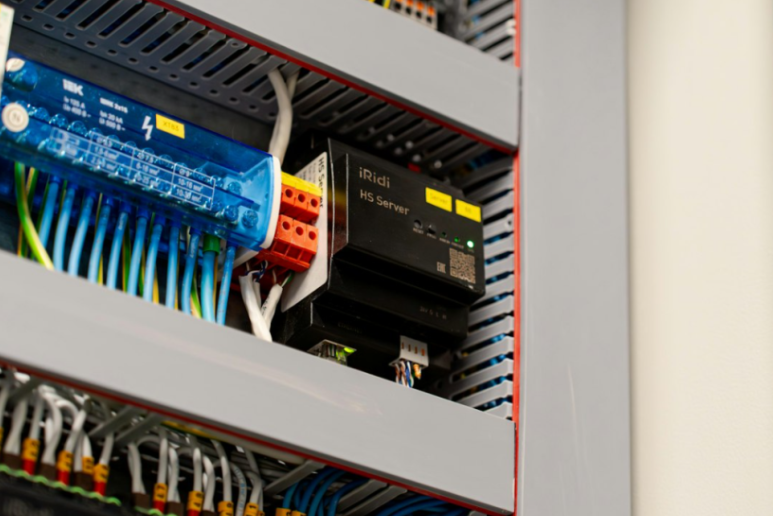
The backbone of a fully electrified, energy-efficient home is a robust and intelligent electrical system. Smart electrical panels, such as those offered by SPAN, act as the “brain of the home,” providing real-time circuit monitoring and dynamic load balancing. These panels allow homeowners to track energy consumption circuit-by-circuit via a smartphone app, gaining unprecedented control and insight into their energy use.
Many older homes have 100-amp electrical service, which can be insufficient for the demands of modern electric appliances like heat pumps, heat pump water heaters, and induction ranges. Upgrading to a 200-amp service is often a prerequisite for whole-home electrification. Smart panels not only manage these increased loads but also offer advanced features like automatic overload protection and remote control, ensuring both safety and optimal energy flow. For instance, an induction cooktop, a popular choice for its efficiency and precise control, can draw a significant amount of power, often necessitating a panel upgrade to accommodate it alongside other high-demand appliances.
Integrating Envelope Sealing and Ductwork Redesign
The efficiency of even the most advanced HVAC system is profoundly impacted by the home’s thermal envelope and ductwork. Before sizing a new heat pump, it is crucial to conduct a comprehensive energy audit, including Manual J load calculations, to accurately determine the home’s heating and cooling needs. This calculation helps prevent oversizing, which can lead to inefficient operation and higher costs.
Furthermore, the ductwork itself plays a critical role. Many older homes have leaky, undersized, or poorly insulated ducts, especially those made of R-4 flexible material. A full ductwork redesign, guided by Manual D design principles, ensures that conditioned air is delivered efficiently throughout the home. Upgrading to R-8 insulated ductwork and meticulously sealing all joints with mastic can dramatically reduce energy loss. Improving envelope tightness through insulation and air sealing can reduce the required heat pump capacity by 15-25% in typical leaky older homes, directly lowering equipment costs and enhancing overall system performance. These foundational improvements are often eligible for additional rebates, making them a smart first step in any comprehensive upgrade plan.
Financial Incentives for Residential HVAC and Plumbing Upgrades
The financial landscape for home energy upgrades has never been more favorable. Homeowners can now unlock substantial savings through a strategic layering of rebates and incentives, significantly improving the financial ROI of their investments. These programs, spanning federal, state, and local levels, are designed to encourage the adoption of high-efficiency plumbing and HVAC solutions. Understanding how to navigate these opportunities is key to maximizing your benefits.
Income Thresholds and HEEHRA Rebate Caps
One of the most impactful federal programs, the Home Energy Efficient Rebates Act (HEEHRA), offers significant point-of-sale discounts for qualifying upgrades. Eligibility for the largest rebate tiers is often determined by Area Median Income (AMI). For instance, households under 80% AMI can qualify for the full HEEHRA tier, which provides up to $14,000 per household across all eligible appliances. This includes specific per-appliance caps such as $8,000 for a heat pump, $1,750 for a heat pump water heater, $840 for an induction range, $4,000 for an electrical panel upgrade, and $1,600 for insulation. For households between 80% and 150% AMI, the rebate amounts are typically capped at 50% of the project cost, up to the same per-appliance maximums. These income-based thresholds are crucial for low-to-moderate income homeowners to access deep savings, making electrification more accessible.
Utility Programs and Layered Incentive Stacking
Beyond federal incentives, local utility programs and state initiatives offer additional layers of savings. These can include utility tariffs, municipal bonuses, and gas-displacement incentives. The key is understanding how to stack these various programs.
For example, a homeowner in Santa Clara, California, received up to $13,000 back from Silicon Valley Power (SVP) for a full home energy upgrade. This included a smart electrical panel, heat pump water heater, and an inverter heat pump system. Similarly, a Milpitas homeowner captured $4,500 in rebates by replacing a gas furnace and AC with a Daikin heat pump, including a $2,000 gas-furnace-replacement rebate from Silicon Valley Clean Energy (SVCE) and a ‘Go Electric, Milpitas!’ city bonus.
In Colorado, Xcel Energy’s 2026 residential electrification tariff pays $3,200 for a qualifying cold-climate heat pump, $800 for an ENERGY STAR heat pump water heater, $500 for electrical panel upgrades, and up to $600 for insulation. The Colorado state tax credit further adds a 10% credit up to $1,500, calculated against the net-of-HEEHRA-and-utility-rebate cost. Manufacturer rebates, like the $1,000 Daikin contractor rebate secured by a Los Feliz, CA homeowner for a whole-home heat pump conversion, can also be layered on top, significantly reducing the net out-of-pocket cost. The sequencing of these applications—often applying for federal HEEHRA concurrently with signing a contract, then utility and manufacturer rebates, and finally state tax credits—is vital for maximizing total savings.
Whole-Home Electrification Cost and Payback Analysis
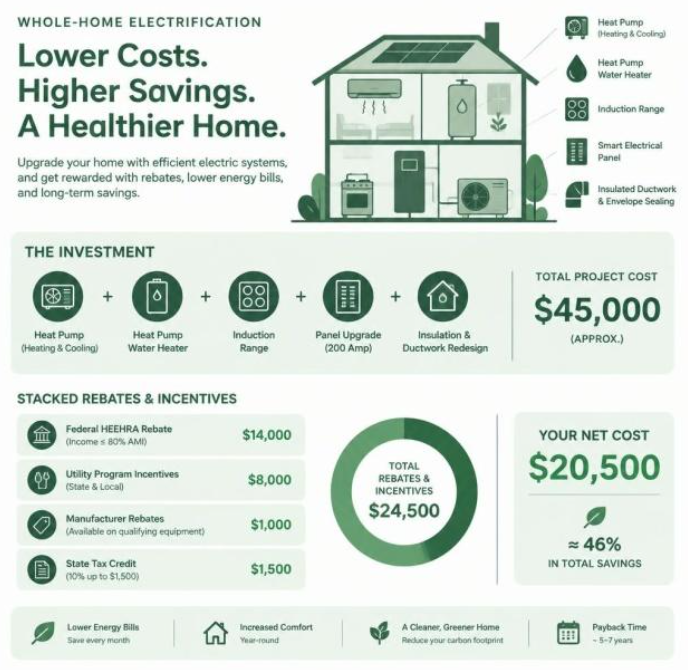
Let’s consider a hypothetical case study from Denver, Colorado, in September 2026, for a $45,000 full electrification bundle (heat pump, heat pump water heater, induction range, panel upgrade, and insulation) for a homeowner at 70% AMI. This scenario illustrates the power of stacked rebates:
Item Pre-Rebate Cost (Approx.) Rebate Source Rebate Amount (Approx.) Whole-Home Electrification Bundle $45,000 Heat Pump (w/ installation) $20,000 HEEHRA, Xcel, Mfg. $8,000 (HEEHRA) + $3,200 (Xcel) + $1,000 (Mfg) = $12,200 Heat Pump Water Heater $5,000 HEEHRA, Xcel $1,750 (HEEHRA) + $800 (Xcel) = $2,550 Induction Range $3,000 HEEHRA $840 (HEEHRA) = $840 Electrical Panel Upgrade $7,000 HEEHRA, Xcel $4,000 (HEEHRA) + $500 (Xcel) = $4,500 Insulation & Air Sealing $5,000 HEEHRA, Xcel $1,600 (HEEHRA) + $600 (Xcel) = $2,200 Subtotal Rebates $22,290 Colorado State Tax Credit State $1,500 (10% of remaining $22,710, capped at $1,500) Total Rebates & Credits $23,790 Net Out-of-Pocket Cost $21,210 Note: The actual rebate amounts and eligibility can vary based on specific equipment, income, and program availability. This table is illustrative based on the provided statistics.
In this scenario, the total rebates and credits reduce the homeowner’s out-of-pocket cost from $45,000 to approximately $21,210. The financial benefits extend beyond upfront savings. A Denver homeowner’s annual operating cost dropped from approximately $2,400 (gas furnace + AC + gas water heater + gas range) to about $1,450 per year (heat pump + HPWH + induction), saving roughly $950 annually. This translates to a quick payback period on the net investment. Furthermore, Denver market data from 2025 appraisals shows a 3-5% premium on fully electrified homes, adding $18,000-$31,000 of incremental appraised value on a $620,000 home, turning an upgrade into a significant asset.
Strategic Implementation and System Maintenance
Successfully navigating residential HVAC and plumbing upgrades requires careful planning, quality assurance, and a commitment to long-term durability. From initial project sequencing to ongoing performance testing, each step is crucial for maximizing efficiency and protecting your investment.
Planning Timeline and Contractor Selection for Residential HVAC and Plumbing Upgrades
The first step in any major upgrade is to select a qualified contractor. This is paramount for ensuring proper installation and securing rebates. Look for contractors who possess specific certifications and are part of recognized program networks.
Here’s a list of essential contractor qualifications and documentation requirements:
- Trade Licensing: Ensure the contractor holds all necessary state and local trade licenses (e.g., HVAC, plumbing, electrical).
- Program Participation: Verify they are participating contractors in relevant rebate programs (e.g., Home Performance Contractor Network members for BC Hydro/FortisBC, Xcel Energy participating contractors).
- Certifications: Look for certifications like Colorado-HPIT (Heat Pump Installer Training) for heat pump installations, NATE (North American Technician Excellence) for HVAC technicians, or others relevant to your region.
- Quality Installation Standards: Confirm they adhere to industry best practices and quality installation standards, such as those promoted by ENERGY STAR or NEEP (Northeast Energy Efficiency Partnerships).
- HERS Testing: For comprehensive projects, especially in California, ensure they can facilitate Home Energy Rating System (HERS) testing for duct sealing and overall energy performance.
- Permit Acquisition: The contractor should handle all necessary permit applications with local authorities.
- Documentation: They should provide clear, itemized invoices with GST numbers, AHRI (Air-Conditioning, Heating, and Refrigeration Institute) certificates for equipment, and proof of equipment specifications for rebate submissions.
- Warranty Information: Obtain full warranty details for both equipment and labor.
Choosing a contractor who understands the intricacies of rebate programs and can provide all required documentation is critical for a smooth process.

Essential Long-Term Maintenance and Calibration
Once your new high-efficiency systems are installed, proper maintenance is key to extending their lifespan, preserving efficiency, and protecting your rebate eligibility.
- Airflow Optimization: Regular checks for proper airflow are vital, especially for heat pumps. Restricted airflow can significantly reduce efficiency and strain the system.
- Filter Maintenance: For HVAC systems, replacing filters every 1-3 months (or more frequently if you have pets or allergies) is non-negotiable. Dirty filters impede airflow and reduce efficiency.
- Refrigerant Charge: An incorrect refrigerant charge can severely impact a heat pump’s performance. Annual professional checks should include verifying the refrigerant levels.
- Electrical Calibration: For smart panels and other electrical components, periodic checks ensure all connections are secure and the system is operating within specifications.
- Annual Tune-ups: Schedule professional annual tune-ups for both your HVAC and heat pump water heater. This allows technicians to clean coils, check electrical components, lubricate moving parts, and identify potential issues before they become costly repairs.
- Space Clearance: Ensure outdoor heat pump units and indoor water heaters have adequate clearance for optimal operation and service access.
- Warranty Protection: Adhering to manufacturer-recommended maintenance schedules is often a condition of your warranty. Keep detailed records of all service.
Proactive maintenance not only saves money on energy bills and repairs but also ensures your systems continue to perform at their peak efficiency for years to come.
Frequently Asked Questions About Home Systems
As homeowners increasingly consider home energy improvements, several common questions arise regarding system lifespan, rebate eligibility, and the impact of various upgrades.
What is the difference between replacing a gas furnace with a heat pump versus a standard AC?
Replacing a gas furnace with a heat pump is a significant upgrade that offers year-round conditioning from a single unit. A heat pump provides both highly efficient heating in winter and cooling in summer, eliminating the need for separate heating and cooling systems. This contrasts sharply with a standard AC replacement, which only addresses cooling and leaves the gas furnace in place for heating.
Opting for a heat pump allows for the decommissioning of your gas line, reducing your home’s reliance on fossil fuels and potentially eliminating monthly gas service charges. Heat pumps, particularly cold-climate models, are designed for seasonal efficiency across a wide range of temperatures. They often qualify for substantial incentives (federal, state, and utility) that are not available for like-for-like AC replacements, as they represent a transition to a more sustainable, all-electric heating solution. Some homeowners might opt for a “dual-fuel” system, pairing a heat pump with a high-efficiency gas furnace for backup in extreme cold, but the trend is towards full electrification.
How do home insulation improvements affect heat pump sizing?
Home insulation improvements, along with air sealing, significantly impact the sizing and efficiency of a new heat pump system. By creating a better thermal envelope, insulation reduces the home’s heating and cooling load. This means a smaller capacity heat pump can effectively condition the space.
For example, improving envelope performance can reduce the required heat pump capacity by 15-25% in typical older homes. A smaller unit often translates to lower upfront equipment costs. More importantly, a correctly sized heat pump in a well-insulated home will operate more efficiently, avoiding short-cycling (where the system turns on and off too frequently) and maintaining more consistent indoor temperatures. This leads to greater comfort and lower energy bills. Furthermore, insulation and duct sealing upgrades often qualify for their own rebates, further enhancing the overall financial benefit of a holistic home energy upgrade.
What certifications must a contractor hold to secure energy rebates?
To secure energy rebates for HVAC and plumbing upgrades, contractors typically need to hold specific certifications and be registered with the relevant rebate programs. While requirements can vary by state and utility, common qualifications include:
- State or Local Trade Licenses: HVAC, plumbing, and electrical licenses are fundamental for all installation work.
- Program-Specific Registrations: Many utility and state rebate programs require contractors to be registered as “participating contractors” or members of specific networks (e.g., Home Performance Contractor Network).
- Manufacturer Certifications: For certain brands or high-efficiency equipment, manufacturers may require their products to be installed by factory-trained and certified technicians.
- Industry Certifications: Certifications like NATE (North American Technician Excellence) for HVAC technicians or specific heat pump installer training (e.g., Colorado-HPIT) demonstrate a commitment to quality and expertise.
- Quality Installation (QI) Standards: Some programs mandate adherence to ENERGY STAR Quality Installation guidelines or similar standards.
- Proof of Insurance and Bonding: Essential for consumer protection and often a prerequisite for program participation.
Always verify your chosen contractor’s credentials and their status with the specific rebate programs you intend to utilize. This due diligence ensures that your installation meets all technical and administrative requirements for incentive qualification.
Conclusion
Embracing residential HVAC and plumbing upgrades, particularly those focused on electrification, represents a powerful step towards a more comfortable, efficient, and sustainable home. From the immediate benefits of consistent indoor temperatures and lower utility bills to the long-term advantages of increased property value and reduced environmental impact, these investments offer a compelling return.
By strategically combining high-efficiency heat pumps, smart electrical panels, and integrated plumbing solutions with foundational improvements like insulation and duct sealing, homeowners can achieve holistic retrofits that enhance home comfort and contribute to grid resilience. The landscape of financial incentives, including federal HEEHRA rebates, state tax credits, and diverse utility programs, makes these upgrades more accessible than ever in September 2026. Understanding how to navigate these layered savings, coupled with selecting qualified contractors and committing to essential maintenance, ensures a smart, sustainable investment with significant lifecycle savings.

Team Home Spacess shares simple, practical design ideas that work for real families. The team focuses on cozy décor, soft colors, and natural textures that make a space feel truly lived-in. From everyday decorating tips to creative home projects, Team Home Spacess is dedicated to helping readers create warm, comfortable, and inviting spaces with a fresh and personal touch.