

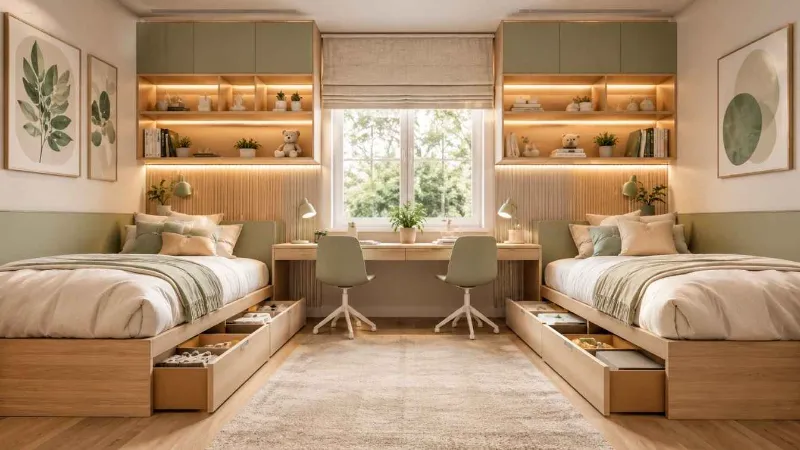
Twin bedrooms are among the most challenging spaces to design well. Whether you’re outfitting a shared kids’ room, a guest bedroom, or a small apartment, fitting two sleeping zones into one room without making it feel like a dorm or a furniture warehouse is a real design problem. Most people default to symmetry and call it a day but that approach wastes precious space, kills personality, and ignores the unique needs of each occupant.
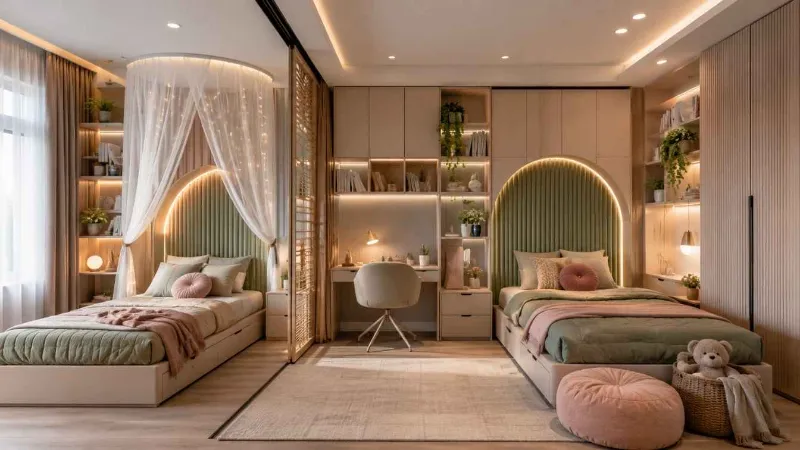
This guide goes beyond the basics. You’ll find 12 twin bedroom ideas rooted in real-world interior design strategy, current 2026 trends, and practical insight that most decorating articles skip entirely. Whether you’re designing for two children, two adults, or a flexible guest room, these ideas will help you create a twin bedroom that’s both beautifully functional and distinctly yours.
Built-In Bunk Beds with Individual Storage Zones
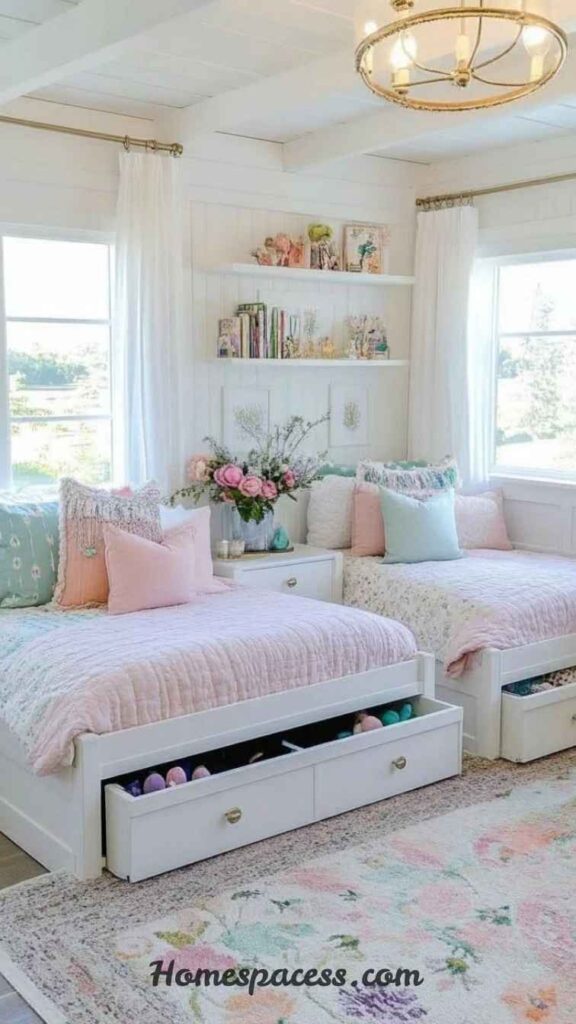
Bunk beds have evolved far beyond their basic wooden-ladder origins. In 2026, built-in bunk systems with integrated shelving, drawers, and even study nooks are redefining what’s possible in a twin bedroom. By going vertical, you free up floor space that can be used for play, movement, or a shared workspace a critical advantage in smaller rooms.
The smartest designs assign each occupant their own dedicated storage zone directly attached to their sleeping space. Upper bunk residents get overhead cubbies and a built-in reading light; lower bunk users get under-bed drawers and a curtained privacy nook. This “micro-territory” approach gives each person a sense of ownership without requiring extra square footage.
For families with growing children, investing in a high-quality built-in bunk system pays dividends for years. Unlike freestanding furniture, built-ins can be customized as kids’ needs change converting the lower bunk to a desk station during teen years, for example, without redesigning the entire room.
Must Read: Trendy Funky Bathroom Ideas for a Cool and Modern Bathroom Makeover
L-Shaped Twin Bed Layout for Visual Balance
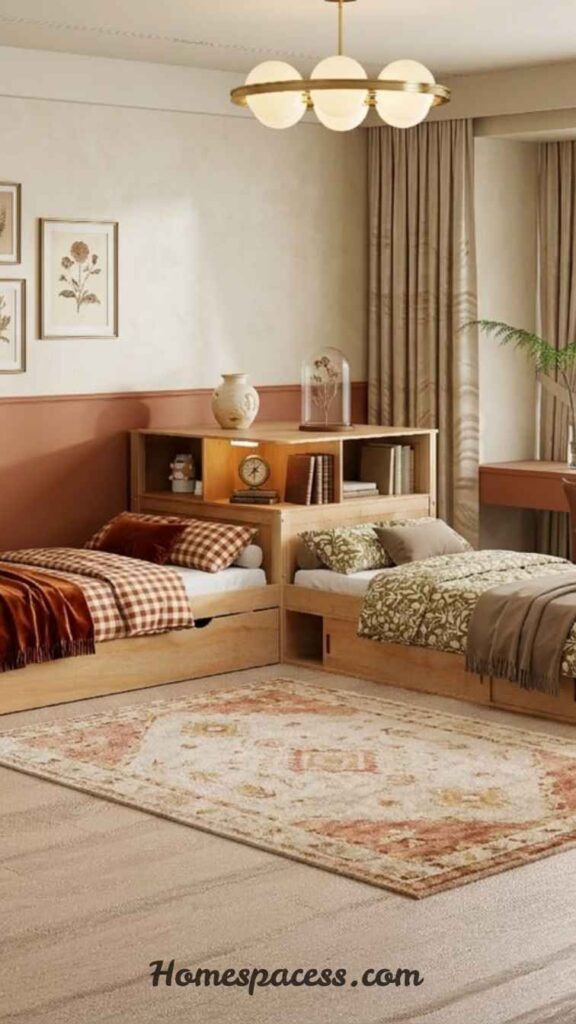
Placing twin beds at a right angle forming an L-shape is one of the most underused twin bedroom arrangements. Instead of two parallel beds that make a room feel like a hospital ward, an L-shaped layout creates visual dynamism and makes better use of corner space that typically goes to waste.
This layout works especially well in square-shaped rooms where a traditional parallel arrangement would leave awkward gaps along the walls. The corner junction can be used for a shared nightstand, a small bookshelf, or even a vertical plant stand that adds life to the room without consuming floor space.
An L-shaped setup also works well for non-sibling roommates who want a sense of spatial separation. Pairing this layout with a low room divider like an open-back bookshelf creates distinct zones without building a wall, making the room feel larger while still maintaining privacy.
Read More: Girly Room Ideas on a Budget for a Trendy and Elegant Space
Loft Beds with Functional Under-Bed Space
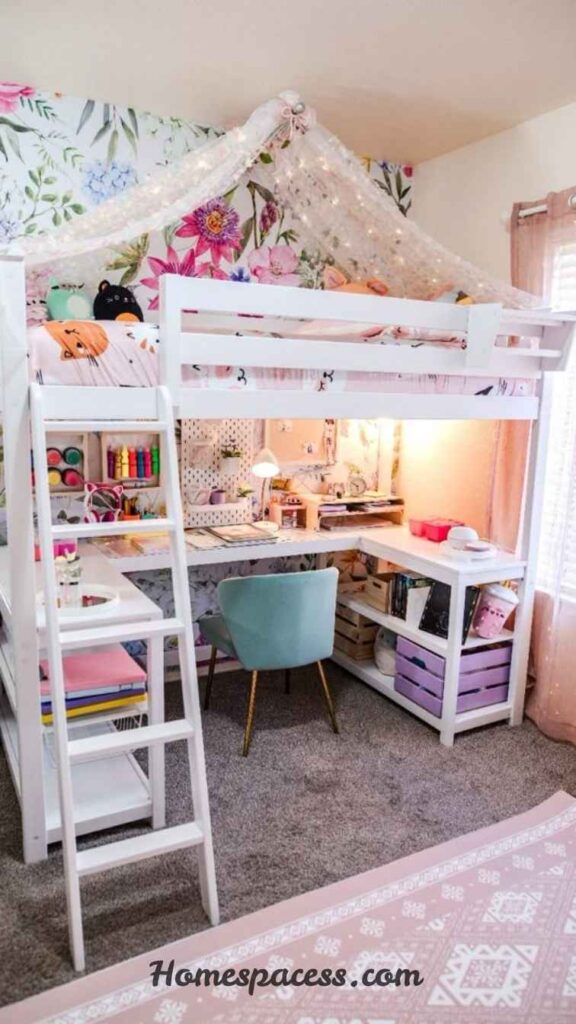
Loft beds raise the sleeping surface to near-ceiling height, converting the floor area beneath into fully usable living space. In a twin bedroom, two loft beds allow each occupant to have a personalized under-bed zone one could feature a study desk, the other a reading corner or mini wardrobe.
This idea is especially transformative in rooms under 150 square feet where storage and study space feel impossible to accommodate. With a loft bed, you’re essentially stacking two functions into the vertical footprint of one. For teenagers and college-aged occupants, this configuration dramatically increases room functionality without increasing room size.
The key design consideration is ceiling height. Loft beds require at least 9-foot ceilings for comfortable headroom both above and below. If your ceiling is lower, opt for mid-loft options raised about 4.5 to 5 feet which still provide meaningful under-bed utility without feeling cramped.
Read More: Balcony Privacy Ideas for Cozy Living: Make Your Balcony More Private and Stylish
Symmetrical Twin Bedroom Design with a Bold Focal Wall
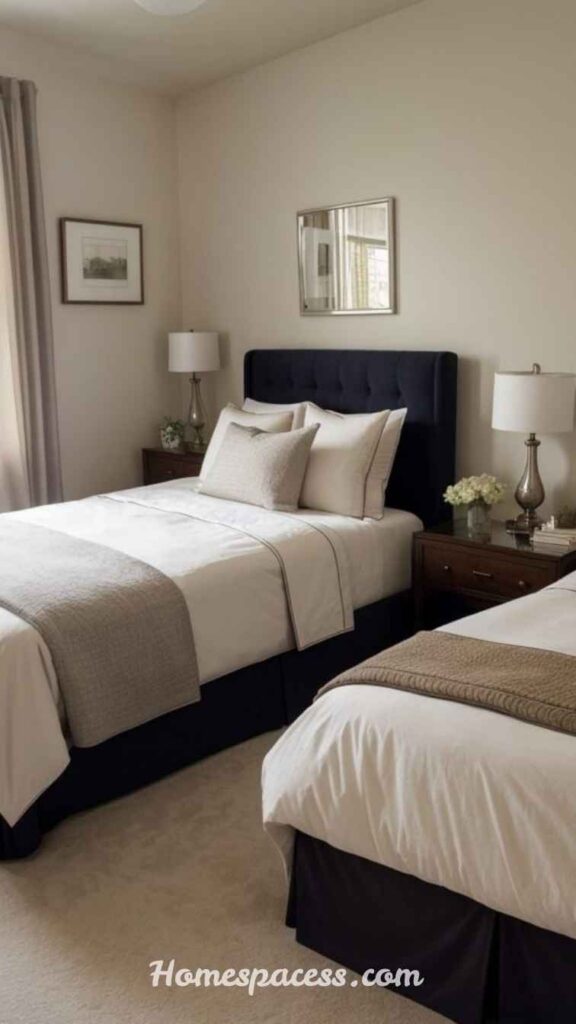
Symmetry, when done with intention, creates a deeply satisfying sense of order and in a twin bedroom, it signals fairness. Placing identical twin beds on either side of a shared focal wall gives the room a hotel-suite quality that feels elegant rather than institutional.
The focal wall is where this idea separates itself from generic “matching beds” advice. Instead of plain paint, consider a large-scale geometric wallpaper, a dramatic panel of limewash plaster, or a floor-to-ceiling gallery wall of framed prints. This central feature draws the eye inward and makes each bed feel like a “wing” of something intentional rather than two pieces of furniture stuffed side by side.
Symmetric layouts also simplify purchasing decisions you need just one set of matching linens, one pair of nightstands, and one lighting fixture on each side. However, the real skill is injecting enough individual personality through pillows, artwork, or accent colors to keep each side from feeling like a copy-paste error.
Don’t Miss: Modern Family Room Ideas for Relaxing and Entertaining Guests
Color-Coded Zones for Individual Identity
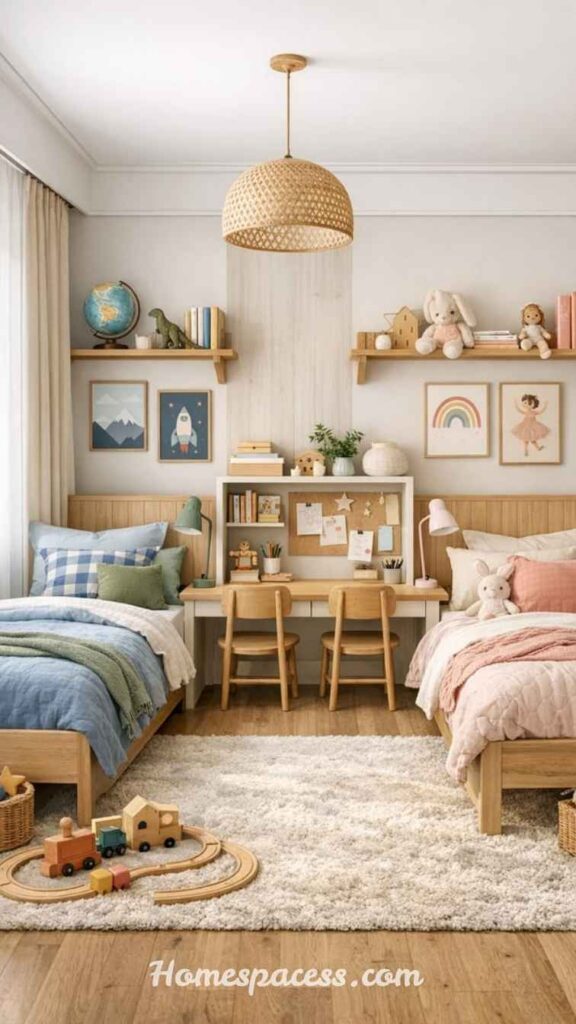
One of the most overlooked twin bedroom strategies is using color to give each occupant a defined territory. Rather than painting the entire room one color, assign each bed zone a distinct accent color matching it to bedding, wall panels, or curtains while keeping a neutral foundation (white, grey, or beige) throughout the room.
For example, one side might feature navy blue accents with geometric bedding, while the other uses sage green with botanical prints. The shared areas flooring, ceiling, and main wall remain neutral to unify the space visually. This approach is particularly effective for siblings with different personalities who want their room to feel like “theirs” rather than a compromise.
Color-coded zones also simplify room management. When everything belonging to one person is in their color zone, tidying becomes more intuitive. Interior designers working with young children’s rooms often use this strategy to encourage independence and reduce ownership conflicts a practical payoff that goes far beyond aesthetics.
Murphy Beds for Multi-Functional Twin Spaces
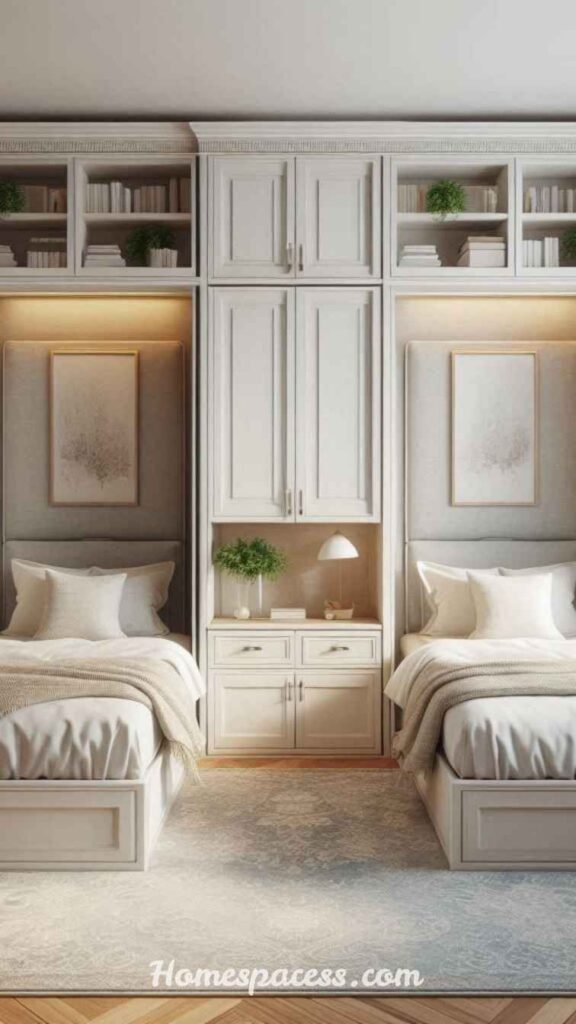
If the room needs to double as a guest room, home office, or playroom during the day, wall-mounted Murphy beds are a game-changing solution. Two Murphy beds installed on opposite or adjacent walls fold flat when not in use, reclaiming the entire floor for other activities.
Modern Murphy bed systems have shed their bulky, awkward reputation. Today’s designs integrate seamlessly into custom cabinetry, often including fold-out desks, sofa sections, or wardrobe panels that look like a standard wall unit when the bed is stored. This makes the room presentable and fully functional during daytime hours without the visual clutter of two exposed beds.
The investment is higher upfront compared to standard twin beds, but the ROI is significant for smaller homes or apartments where every room must serve multiple purposes. For Airbnb hosts or families who occasionally host guests, a Murphy-bed twin setup transforms a single room into a versatile, always-guest-ready space.
Canopy Beds to Create a Dreamy, Layered Twin Setup
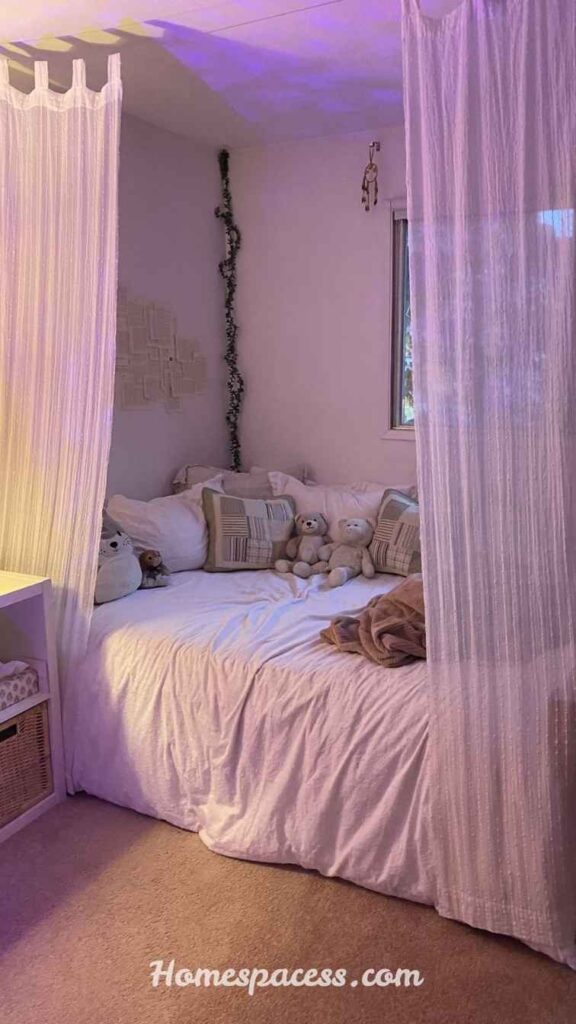
Canopy frames over twin beds introduce height, texture, and a strong sense of enclosure that makes each bed feel like a private sanctuary even in a shared room. Lightweight canopy structures can be DIY’d with tension rods and sheer curtains for under $100, or sourced as purpose-built frames for a more polished look.
The design power of canopies lies in their ability to visually segment a shared room without adding walls or partitions. With sheer fabric panels drawn around each bed at night, occupants get meaningful privacy and a cozy, enveloped sleeping experience that significantly improves sleep quality especially important for children with different sleep schedules.
For a cohesive twin bedroom look, use the same canopy frame style on both beds but differentiate the fabrics one in white muslin, one in soft blush linen, for example. Pair with warm-toned string lights draped over each canopy frame for an ambiance that feels intentional, Pinterest-worthy, and genuinely comfortable.
Under-Bed Storage Systems That Replace Traditional Dressers
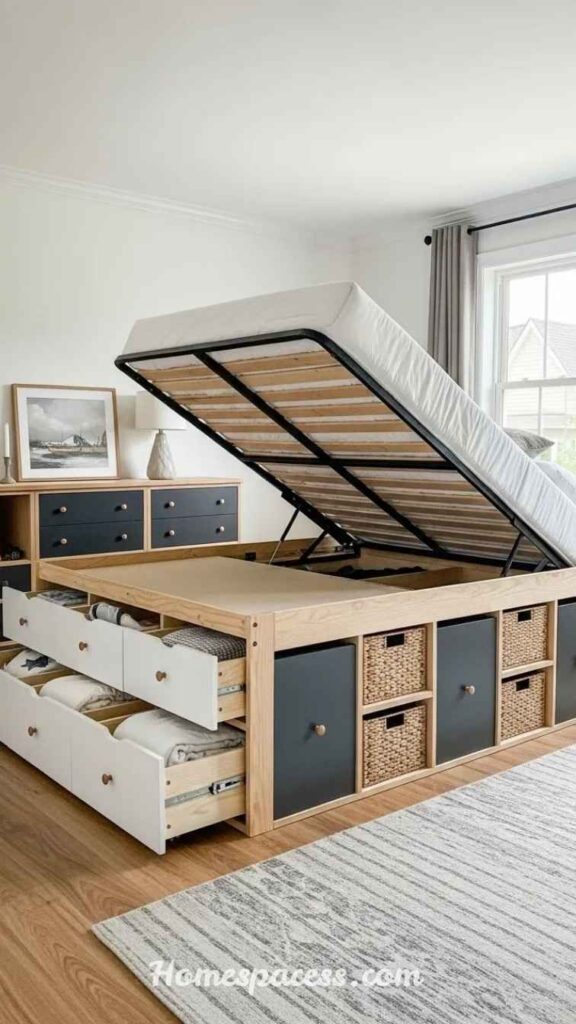
In a twin bedroom, two beds already consume significant floor space adding two full dressers often makes the room feel impossibly crowded. A smarter approach is to eliminate dressers entirely and rely on high-quality under-bed storage systems paired with a single shared wardrobe or built-in closet.
Low-profile bed frames with built-in drawer systems typically offering three to four large drawers per bed provide substantial clothing and linen storage without occupying any additional wall space. For rooms with standard bed frames, deep rolling storage bins or vacuum storage bags under each bed accomplish the same goal at a fraction of the cost.
This approach also encourages minimalism by limiting how much each occupant can accumulate a meaningful benefit in children’s rooms where toy and clothing overflow is a constant challenge. Combining under-bed storage with a slim floating shelf above each headboard provides accessible storage for books, devices, and small items without encroaching on floor or wall space.
Sliding Room Dividers for Privacy Without Permanent Walls
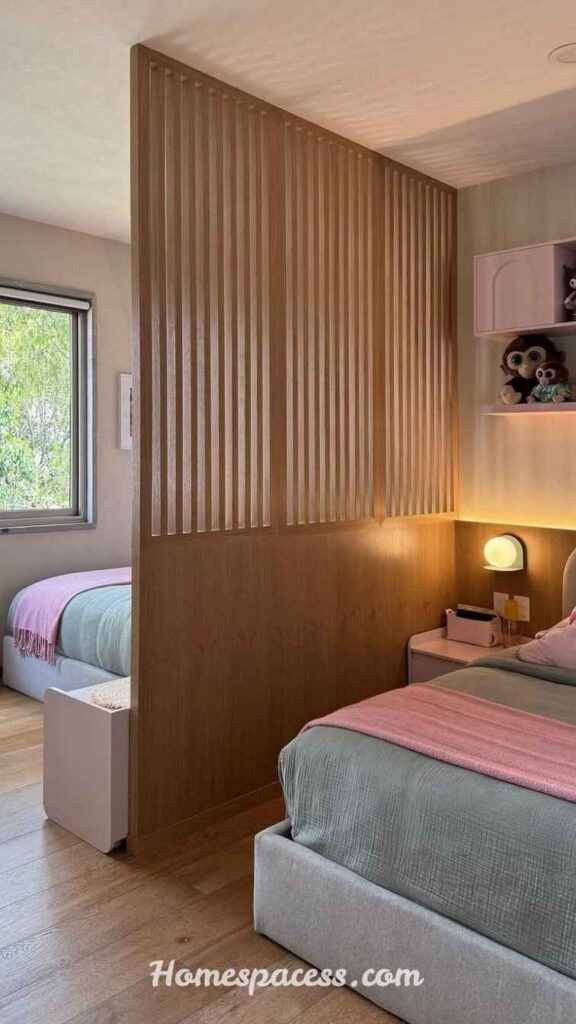
Siblings sharing a room often reach an age typically around 8 to 10 years old where privacy becomes a genuine need rather than a preference. Installing a ceiling-mounted sliding panel or folding partition system allows the room to function as one open space during the day and two distinct private zones at night or during homework time.
Unlike traditional room dividers, ceiling-track sliding panels don’t eat into floor space and can be fully retracted when not needed. Materials range from frosted glass (for light transmission) to solid wood panels (for sound dampening) to fabric-covered frames (for warmth and aesthetics). Each material choice carries different implications for acoustics, light, and visual weight choices worth thinking through carefully.
For renters or families who can’t commit to structural changes, freestanding bookshelves arranged back-to-back serve a similar purpose while adding storage. Place them perpendicular to the longer wall, centered between the two beds, and you create a natural corridor between the sleeping zones while keeping the room’s openness intact.
Floating Shelves as Personalized Display and Storage Walls
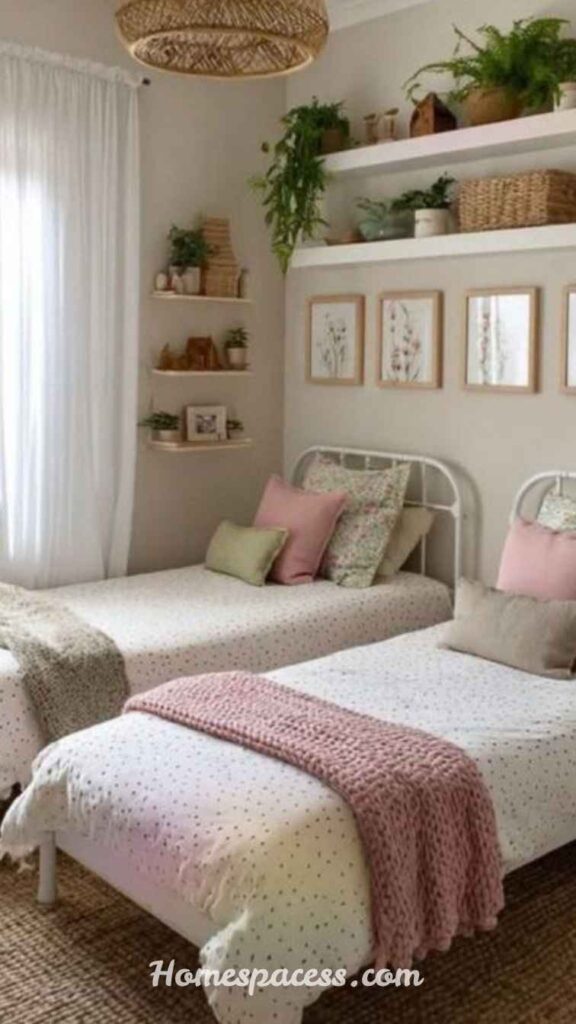
Rather than relying on bulky bedside tables, floating shelves installed above each headboard create a personalized mini-wall for each occupant one that holds books, a lamp, a small plant, a phone charger, and whatever objects reflect that person’s personality.
This design decision has a significant visual impact: the wall becomes an expression of identity, making each side of the room feel distinctly inhabited rather than generically furnished. For children’s rooms, rotating seasonal artwork or school projects on these shelves keeps the room feeling fresh and personally meaningful throughout the year.
From a space perspective, floating shelves add substantial storage capacity without consuming any floor footprint. In smaller twin bedrooms under 120 square feet this trade-off is critical. Pair each shelf with a swing-arm or clip-on reading light to eliminate the need for a bedside table lamp altogether, keeping nightstand surfaces clear and uncluttered.
Neutral Base + Bold Textile Strategy for a Grown-Up Twin Room
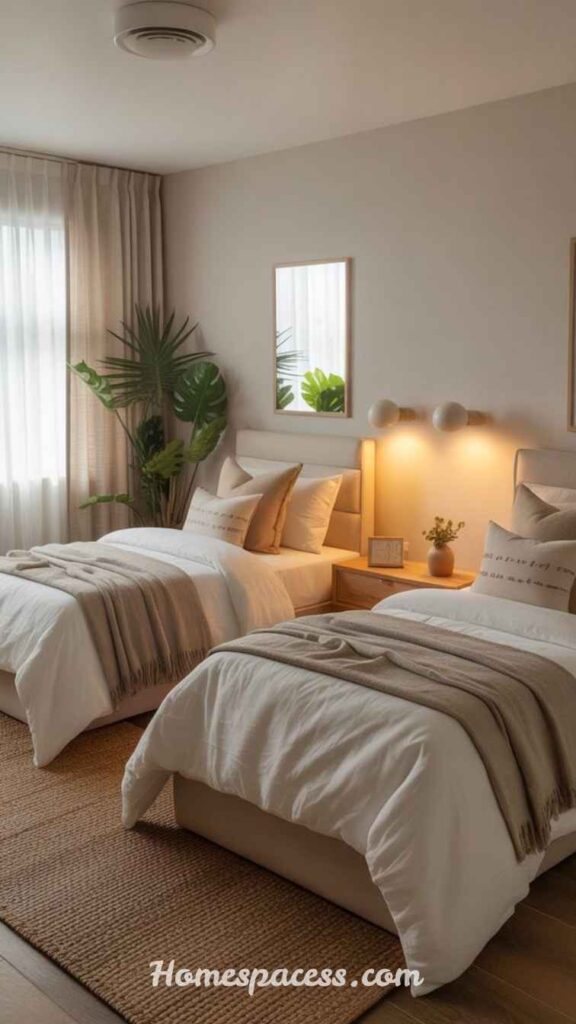
Adult twin bedrooms whether for guest rooms or shared living situations often struggle with feeling either too juvenile or too sterile. The solution lies in a specific design formula: start with a neutral, sophisticated base (think warm greige walls, natural wood floors, and white ceiling) and layer in personality exclusively through textiles.
Bold throw pillows, richly textured duvet covers, patterned curtains, and layered area rugs carry the visual weight of the room without overwhelming the space. This approach also makes updates easy and affordable swapping textiles seasonally costs a fraction of repainting or replacing furniture, and dramatically changes the room’s entire mood.
The key distinction from generic “neutral room” advice is the intentional pairing of texture contrasts: smooth linen against chunky knit throws, flat woven rugs against velvet cushions, matte walls against glossy ceramic accent pieces. These contrasts create depth and interest that keep the eye moving throughout the space, making the room feel curated rather than default.
Smart Bedroom Technology Integration for Twin Setups
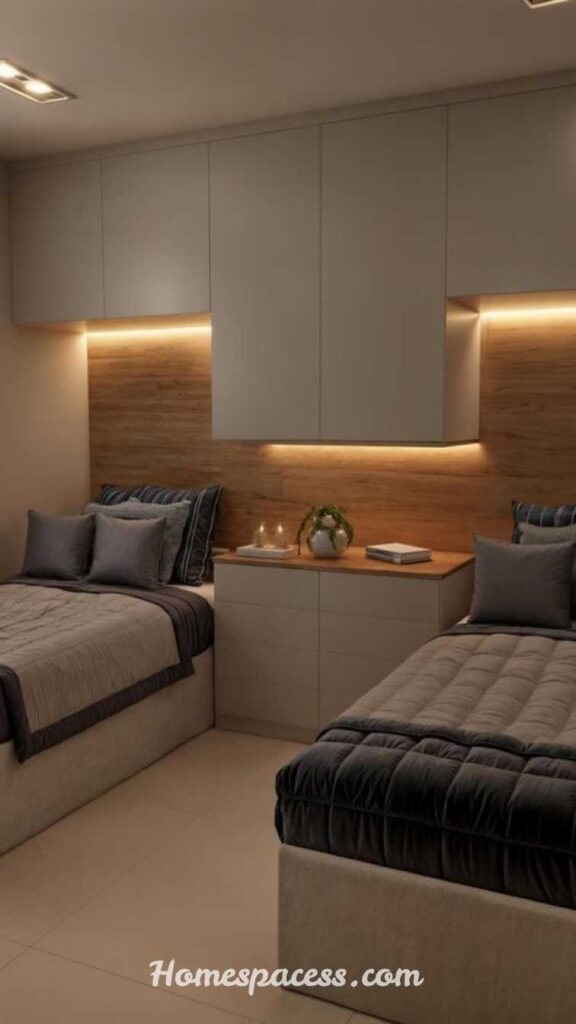
Modern twin bedrooms benefit enormously from thoughtful smart home integration, especially when two people share a space but have different schedules, light preferences, or sleep habits. Individual smart lighting systems such as Philips Hue or LIFX bulbs controlled via app allow each occupant to set their own wake-up light routine, reading brightness, and bedtime wind-down sequence without affecting their roommate.
White noise machines or smart speakers with individual sleep sound settings address the sound conflict issue that many shared-room occupants face. Paired with blackout curtains on each bed’s canopy frame, these technologies create acoustically and visually independent sleep zones within the same physical room a solution that significantly improves sleep quality for both occupants.
Looking ahead, integrated smart panels embedded in headboards or nightstand surfaces showing weather, calendar reminders, or ambient visualization are moving from concept to consumer reality. Designing twin bedrooms now with built-in USB charging panels, cable management systems, and smart hub placement ensures the room stays functional as this technology matures over the next 3 to 5 years.
Conclusion
Twin Bedroom Ideas can help you create a smart and cozy shared space. With simple design, you can save space and keep the room organized. Use light colors, smart storage, and matching furniture. This makes the room look clean and beautiful. Small changes can bring big comfort and style.
These Twin Bedroom Ideas also focus on comfort and personal style. You can add soft bedding, wall decor, and shared lighting. It helps both users feel happy in the room. A well-planned space makes daily life easy and relaxing. Try simple updates to make your twin bedroom more functional and modern.
Trend Analycsis
The dominant trend in 2026 twin bedroom design is “biophilic layering” the intentional introduction of natural materials, textures, and living elements into shared sleeping spaces. Rattan bed frames, linen bedding, wooden shelving, and potted trailing plants are appearing in twin setups across age groups, driven by growing awareness of how natural environments improve sleep quality and reduce stress hormones.
A second major trend is the move away from matching sets. Rather than buying a “twin bedroom furniture package” from a single manufacturer, design-forward homeowners are mixing vintage pieces with modern frames, pairing secondhand wardrobes with new built-in storage, and sourcing beds from different makers that share only a general aesthetic. This approach produces more interesting, personalized rooms and avoids the “showroom floor” feel that matching sets often create.
Looking ahead to 2026 and 2027, the next wave of twin bedroom design will be shaped by modularity. Furniture systems that can reconfigure from bunk to loft to two separate beds without tools or professional installation are already in development by brands like IKEA’s concept labs and smaller DTC furniture startups. Expect “transformable bedroom systems” to become a mainstream product category within the next two years, fundamentally changing how parents and designers approach twin room planning.
Expert Insights and Practical Optimization Tips
Experienced interior designers working with twin bedrooms consistently emphasize one often-ignored principle: the room works best when you design the shared center first, not the individual beds. Most people start by placing two beds against opposing walls and then figure out what to do with the middle but the opposite approach produces better results. Designing the central shared zone (a rug, a table, a divider, a play area) first naturally informs where and how the beds should be positioned.
Another insight from professional designers is the importance of ceiling height utilization. Most twin bedrooms waste the vertical space above 6 feet entirely. Even in rooms where loft beds aren’t practical, adding crown molding, ceiling-height curtain rods, or tall LED light strips draws the eye upward and makes the room feel significantly larger a psychological trick that costs very little but has outsized visual impact.
From a real-world usage perspective, the most functional twin bedrooms are also the easiest to clean. Designers recommend minimizing the number of furniture legs touching the floor opting for wall-mounted or floating pieces wherever possible to simplify vacuuming and prevent the “furniture graveyard” of dust that accumulates beneath standard pieces. In shared rooms, where tidying responsibilities are often contested, reducing friction around cleaning has genuine quality-of-life benefits.
Sustainability and Long-Term Value
The most sustainable twin bedroom is one designed to evolve rather than be replaced. Choosing solid wood furniture over MDF particleboard even at higher upfront cost typically results in pieces that last 20 to 30 years rather than 5 to 7. Solid wood can be repainted, refinished, and repurposed as life circumstances change, offering genuine long-term value that flat-pack alternatives simply can’t match.
From an environmental perspective, the twin bedroom offers a meaningful opportunity to reduce consumption by buying used. The secondhand furniture market particularly platforms like Facebook Marketplace, Chairish, and local estate sales regularly offers solid wood twin beds, vintage wardrobes, and quality nightstands at 20 to 40% of retail cost. Pairing secondhand structural pieces with new, high-quality mattresses and linens is arguably the optimal sustainable strategy: prioritize quality where it touches your body, and prioritize sustainability everywhere else.
Long-term value also comes from designing for adaptability. A loft bed that converts to a standard bed, a bunk system with removable top bunk, or twin beds with interchangeable headboard panels can serve a room’s occupants from childhood through young adulthood without requiring furniture replacement. Designing this flexibility into the room from the start rather than retrofitting it later saves significant money and reduces waste over a 10 to 15 year horizon
Future Innovations
Transforming Twin Bedroom Design
The twin bedroom of 2030 will likely look significantly different from what we design today, driven by three converging innovations. First, smart mattress technology currently available in early-adopter form from brands like Eight Sleep will become mainstream, with mattresses that automatically adjust temperature, firmness, and elevation for each sleeper independently. In a twin bedroom context, this means two occupants can have fully personalized sleep environments within the same room without any manual adjustment.
Second, spatial computing interfaces exemplified by Apple Vision Pro and its successors will allow each twin bedroom occupant to have a fully personalized visual environment overlaid onto their physical space. One person might fall asleep watching a virtual starfield; the other might have a soft forest scene. These private, headset-enabled environments eliminate many of the light and sound conflicts inherent in shared bedrooms, potentially reshaping how we think about bedroom design entirely.
Third, advanced acoustic materials already used in recording studios and high-end offices are becoming available in consumer-friendly formats. Acoustic panels embedded in headboards, sound-absorbing fabric wallcoverings, and micro-perforated ceiling tiles will allow twin bedrooms to achieve meaningful sound separation without physical partitions. Expect these materials to enter the mainstream home furnishing market within 5 years, making the “one snores, one doesn’t” problem far more solvable than it is today.
Common Mistakes
Twin Bedroom Design (And How to Avoid Them)
Treating both occupants identically when they’re not. The instinct toward perfect symmetry is understandable, but it often produces a room that serves neither person optimally. If one occupant reads before bed and the other doesn’t, only one side needs a dedicated reading light. If one person needs more clothing storage, their side should have more drawers. Customizing each zone to its occupant’s actual habits rather than mirroring everything produces a far more livable room.
Underestimating the impact of noise. Most twin bedroom design articles focus entirely on visual organization and storage, almost completely ignoring acoustics. Yet noise is one of the primary sources of conflict in shared bedrooms, particularly when occupants have different sleep schedules. Simple interventions a white noise machine, acoustic curtains, a bookshelf filled with books (books are excellent sound absorbers) positioned between beds can dramatically reduce noise-related tension and improve sleep quality for both occupants.
Buying furniture that fits the room today, not five years from now. Twin bedrooms for children require the most forethought on this point. A room designed perfectly for two 6-year-olds will likely need a complete overhaul by age 10 if adaptability wasn’t built into the original design. Whenever possible, choose furniture with adjustable configurations, neutral colors that can grow with the occupants, and storage systems that can be repurposed as needs change. The extra planning investment at the design stage pays enormous dividends in the years that follow.

Team Home Spacess shares simple, practical design ideas that work for real families. The team focuses on cozy décor, soft colors, and natural textures that make a space feel truly lived-in. From everyday decorating tips to creative home projects, Team Home Spacess is dedicated to helping readers create warm, comfortable, and inviting spaces with a fresh and personal touch.