

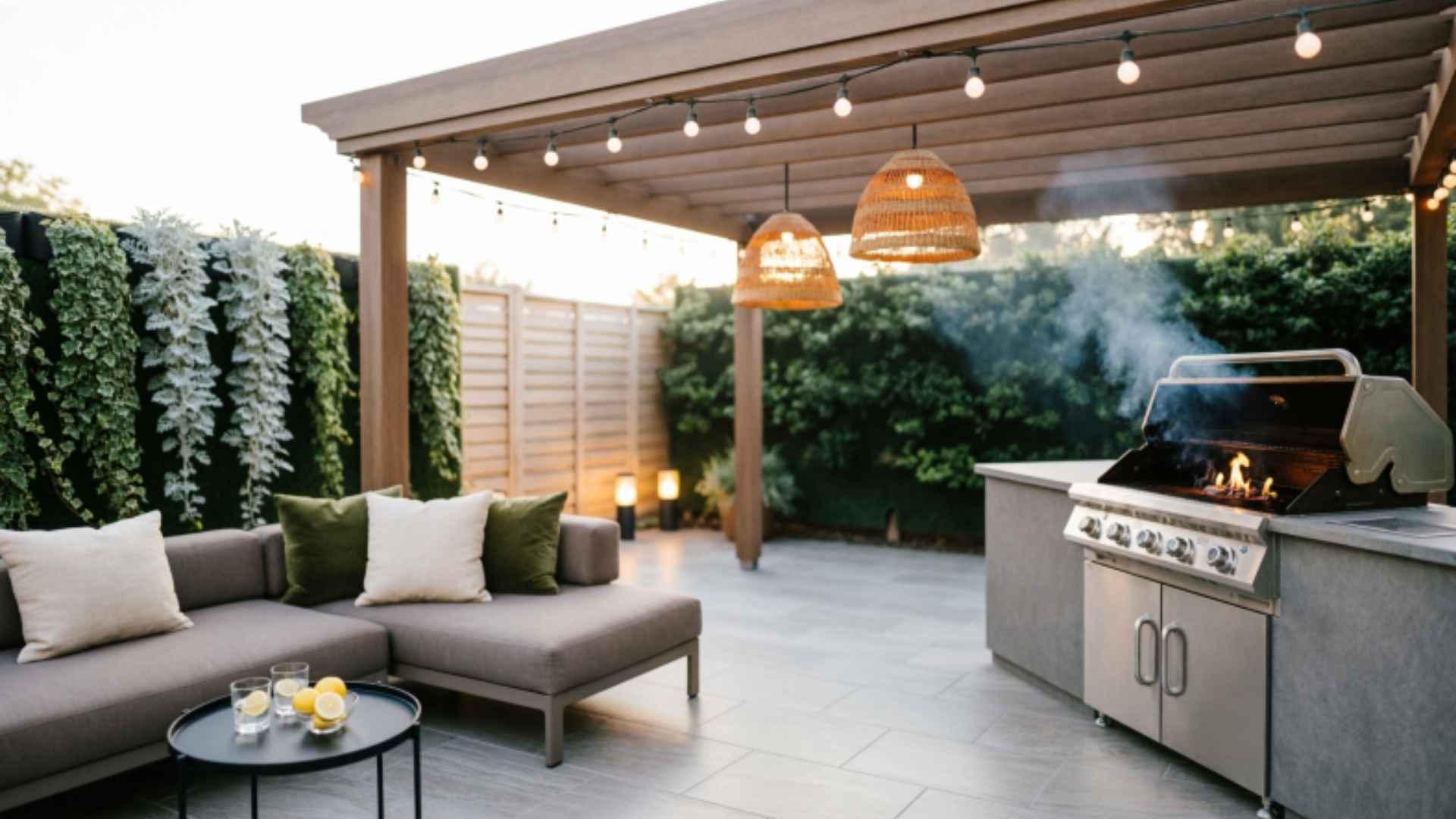
A BBQ patio is no longer just a concrete slab with a grill. In 2026, it’s an extension of your home a carefully designed outdoor living room, entertainment hub, and culinary space rolled into one.
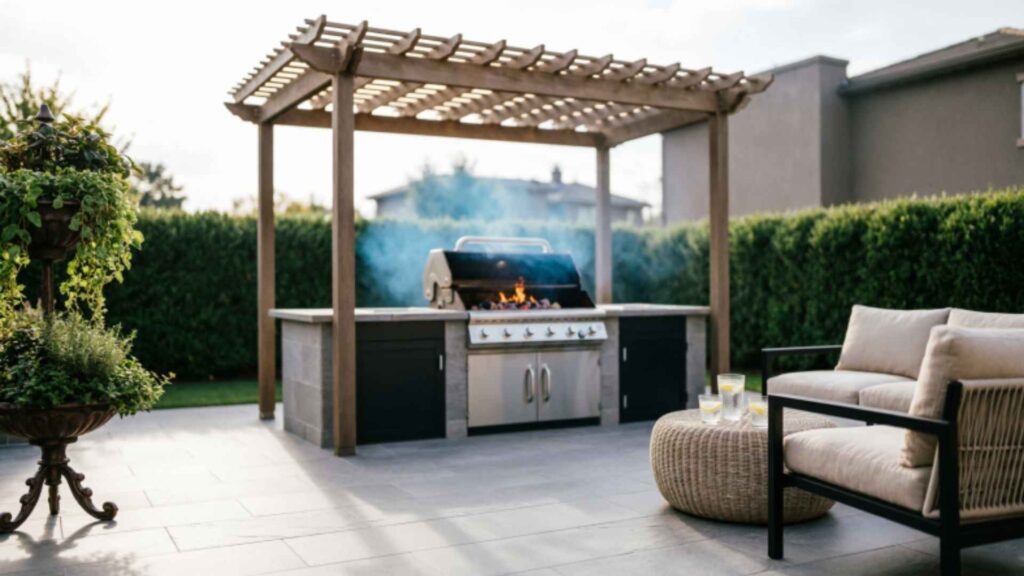
Whether you’re working with a modest apartment balcony or a sprawling suburban backyard, the right BBQ patio design can dramatically increase your home’s value, your quality of life, and your hosting confidence.
This guide goes beyond the generic advice you’ll find elsewhere. We’ve compiled 29 actionable BBQ patio ideas with real design thinking, material guidance, and cost context plus advanced sections covering trends, sustainability, expert insights, and the mistakes most homeowners make that cost them thousands later. Let’s build something worth gathering around.
67%
of buyers pay more for outdoor living spaces
$8K
avg. ROI boost from a well-designed patio
3×
more time spent outdoors post-pandemic
29
ideas covered in this guide
Layout & Structural Foundation Ideas
The Defined Zone Patio
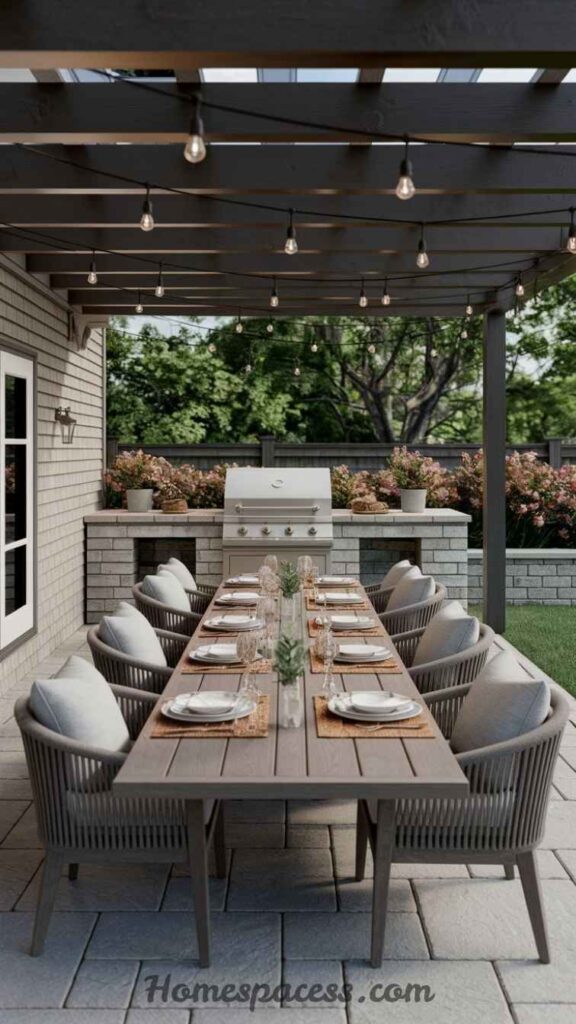
The biggest mistake most BBQ patios make is lacking definition everything bleeds into everything else. A defined zone patio uses intentional boundaries: a pergola overhead, a low retaining wall on one side, and a change in ground material to separate the grilling area from the dining zone. This spatial hierarchy tells guests exactly where to gather and where not to stand while you’re cooking.
The most effective version of this idea uses three distinct zones: the hot zone (grill + prep counter), the cool zone (dining table, 8–10 feet away), and the social zone (lounge chairs, fire pit). This layout mirrors how professional outdoor hospitality spaces are designed it’s not accidental that restaurant patios feel more intentional than most backyard setups.
Pro Insight:
Position your grill so prevailing wind carries smoke away from the dining area. Check your local wind pattern before laying any foundation this one variable determines the entire layout logic.
Must Read: 26 Media Wall Ideas That Transform Any Living Space in 2026
L-Shaped Outdoor Kitchen Layout
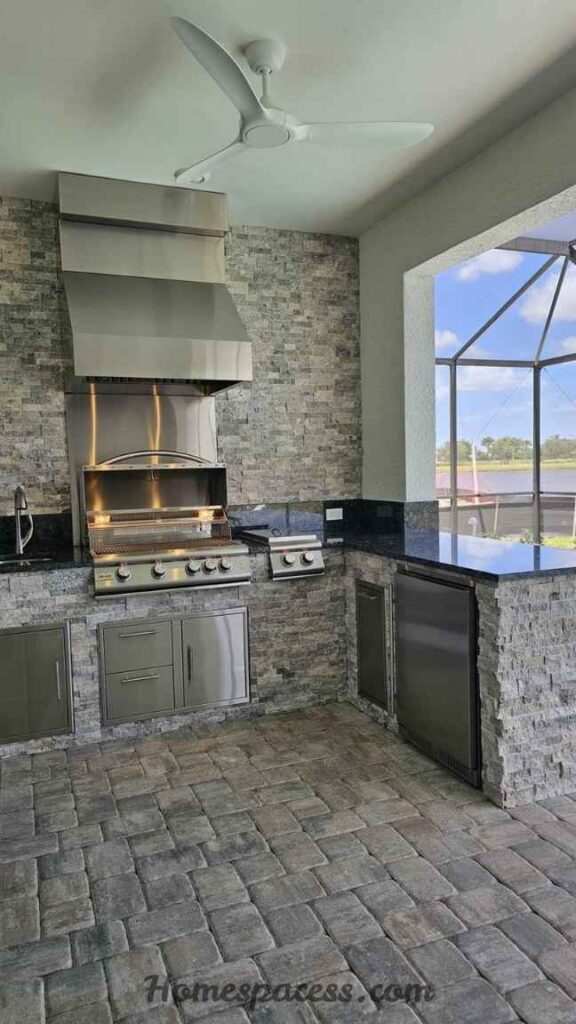
An L-shaped layout is the gold standard for BBQ patios because it mirrors the classic indoor kitchen work triangle while adapting it to an open-air environment. One arm of the L houses your grill, smoker, and prep surface; the other arm becomes your bar counter, mini-fridge, and storage. The corner naturally creates a social hub where guests can interact with the chef without crowding the cooking space.
For a mid-range budget, you can build a functional L-shaped setup using modular outdoor kitchen units from brands like Napoleon or Cal Flame, which drop into a pre-built frame of concrete blocks and stucco. This approach saves 30–40% versus custom masonry while still looking polished. The key is choosing a consistent material palette mixing stone, wood, and tile without a unifying color throws the whole design off.
Don’t Skip: 22 Living Room Decor Ideas That Transform Any Space
Raised Deck BBQ Platform
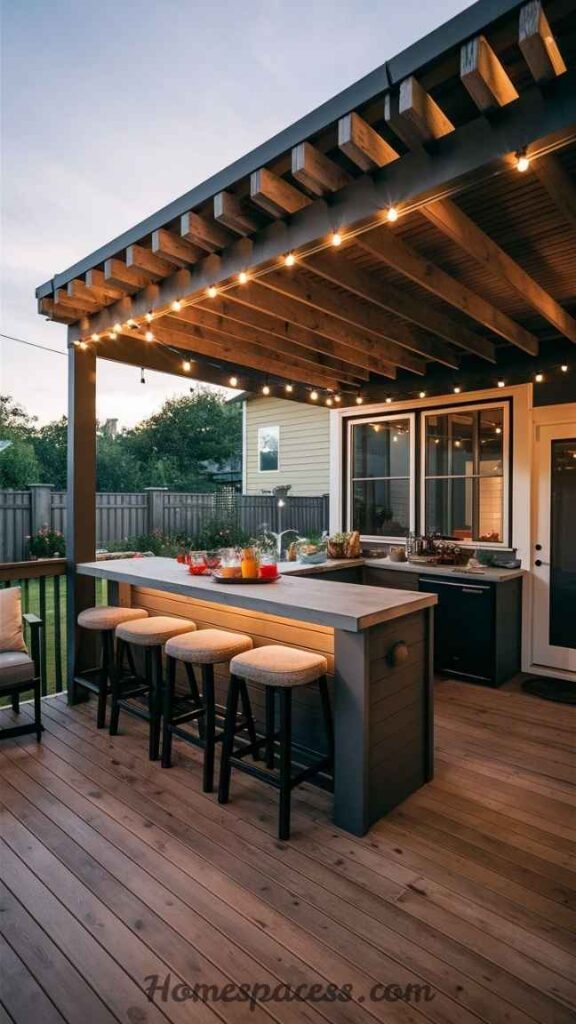
If your backyard is sloped or you want to create a dramatic focal point, a raised deck BBQ platform is one of the highest-impact investments you can make. Built from composite decking or pressure-treated hardwood, a raised platform elevates the entire grilling experience literally and figuratively. The elevation also improves airflow around the grill, reduces ground-level moisture damage, and gives the space a resort-like quality.
One often-overlooked benefit: the space beneath the deck becomes natural storage for firewood, propane tanks, or outdoor furniture covers. Plan access panels into the deck design from the start retrofitting them later is awkward and expensive. Composite decking brands like Trex or Timber Tech now offer 25-year fade warranties, making them a smarter long-term choice than natural wood for most climates.
Read More: 15 Baby Nursery Ideas That Are Beautiful, Safe & Built to Grow With Your Child
Sunken Patio Conversation Pit
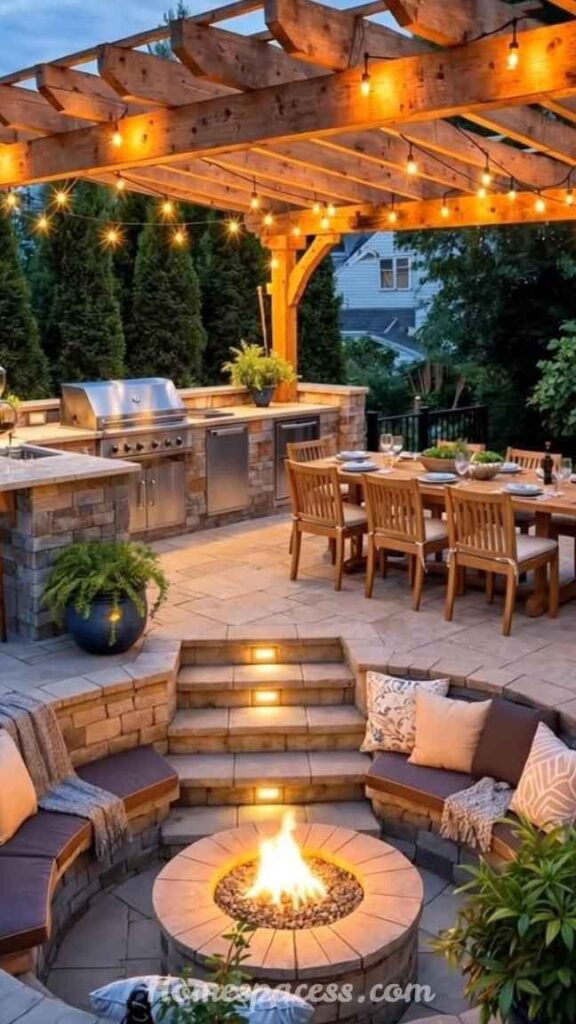
A sunken patio dug 18–24 inches below grade creates a naturally wind-sheltered, intimate gathering space that feels completely separate from the rest of the yard. Combine it with a central fire pit or low table grill and you’ve built one of the most socially magnetic BBQ setups possible. Guests instinctively gravitate toward the pit the slightly lower perspective makes the space feel cozy and protected, not unlike the appeal of a cave or fireside corner in a rustic cabin.
The engineering challenge is drainage. A sunken pit must have a French drain system or perforated pipe running beneath the concrete pad, or you’ll be bailing water after every rain. Budget for proper drainage from day one it typically adds $500–1,200 to the project but prevents catastrophic moisture problems. Line the retaining walls with natural stone rather than poured concrete for a more organic, timeless look.
Don’t Miss: 24 Bedroom Interior Ideas That Actually Work in Real Homes
Pavilion-Covered BBQ Station
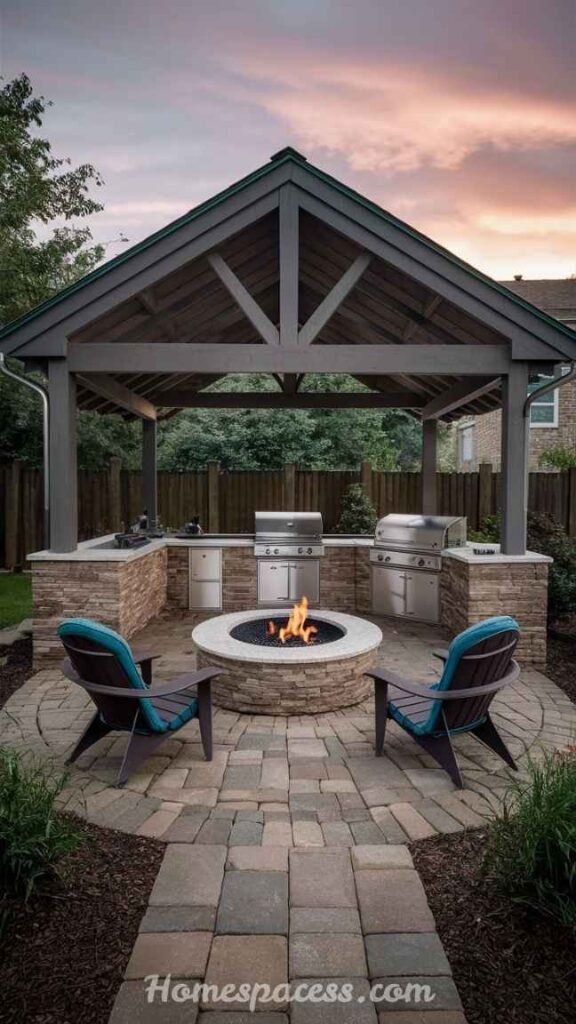
A dedicated pavilion not just a pergola gives your BBQ area real weatherproofing with a solid roof, making it usable in light rain and providing genuine shade in summer heat. This turns your outdoor cooking space from a seasonal amenity into an almost year-round room. Cedar and redwood are traditional choices, but steel-frame pavilions with metal roofing have surged in popularity for their industrial-chic aesthetic and superior longevity.
The critical design decision is ventilation. A fully enclosed pavilion roof above a grill can trap carbon monoxide, so at minimum you need open sides and preferably a built-in range hood vented through the roof. Outdoor-rated range hoods from brands like Proline or Zline are designed for this application and start around $400 a necessary investment when adding any solid roof structure over a built-in grill.
Safety Note:
Never use a gas grill directly under a fully enclosed structure without proper ventilation. Local building codes often require a minimum clearance of 8 feet overhead and open sides for covered grill stations.
Grill Setup & Cooking Station Ideas
Built-In Gas Grill Island
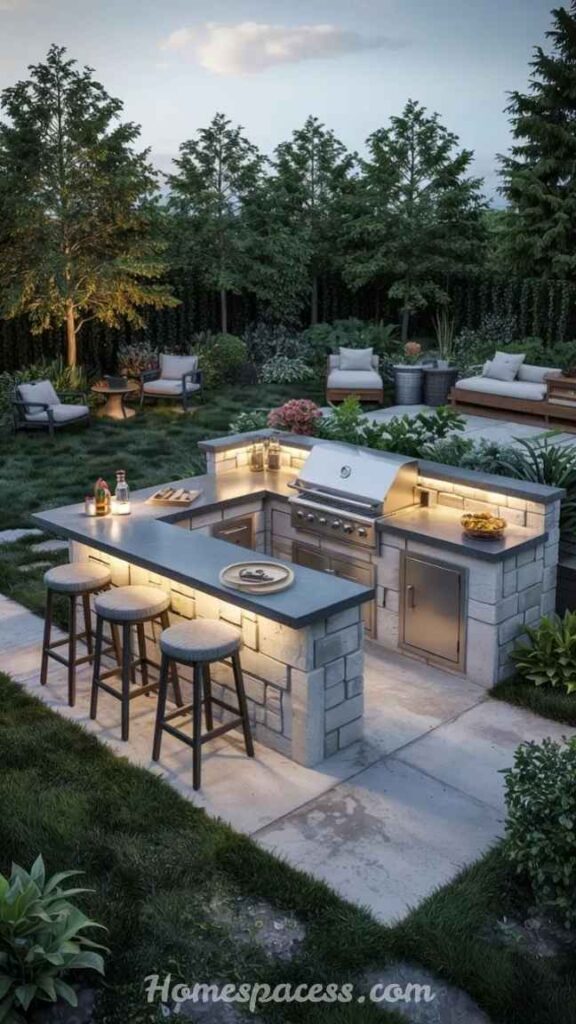
A built-in gas grill island is the most popular upgrade in outdoor kitchens, and for good reason it removes the awkward mobility of a freestanding grill, creates architectural permanence, and allows for seamless counter space integration. The island frame is typically built from cinder blocks or steel studs, skinned with concrete board, and finished with stone, tile, or stucco. Inside, you can integrate a grill, side burners, drawers, and a mini-fridge in a single cohesive unit.
The hidden complexity is the gas line. Running a dedicated natural gas line from your home to the island requires a licensed plumber in most jurisdictions and adds $300–800 to the project. However, it eliminates the tank-swapping hassle of propane permanently a quality-of-life upgrade that most built-in grill owners say they wish they’d made years earlier. If you’re building from scratch, always run natural gas and a waterproof electrical conduit simultaneously, even if you don’t need the electrical immediately.
Offset Smoker Corner Station
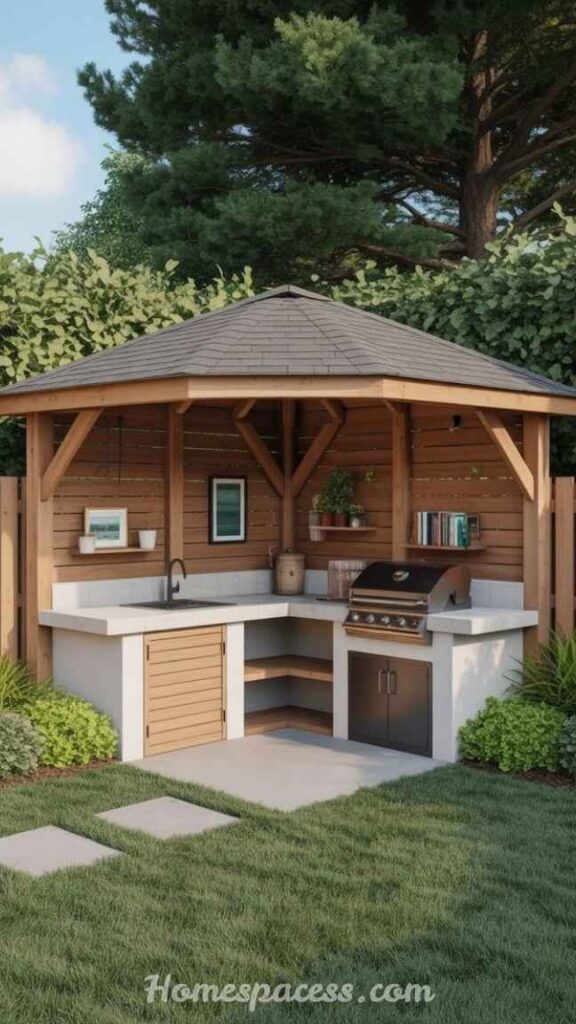
Offset smokers the kind with a separate firebox that feeds smoke into a longer cooking chamber produce the most authentic low-and-slow BBQ results. Designing a dedicated corner for an offset smoker involves more than just “a place to put it.” The station should include a built-in firewood storage rack (keep 2–3 hours of wood easily accessible), a prep shelf for rubs and injections, and a heat-resistant surface for resting meat.
The smoke management piece is what most people miss. An offset smoker positioned poorly can fill your entire patio with smoke within minutes. Ideally, it should be at the downwind edge of your patio, with the firebox opening facing away from the dining area. Some dedicated BBQ patios use a low cinder block wall as a smoke buffer it sounds excessive but completely transforms the comfort level of guests nearby during a long cook.
Wood-Fired Pizza Oven & Grill Combo
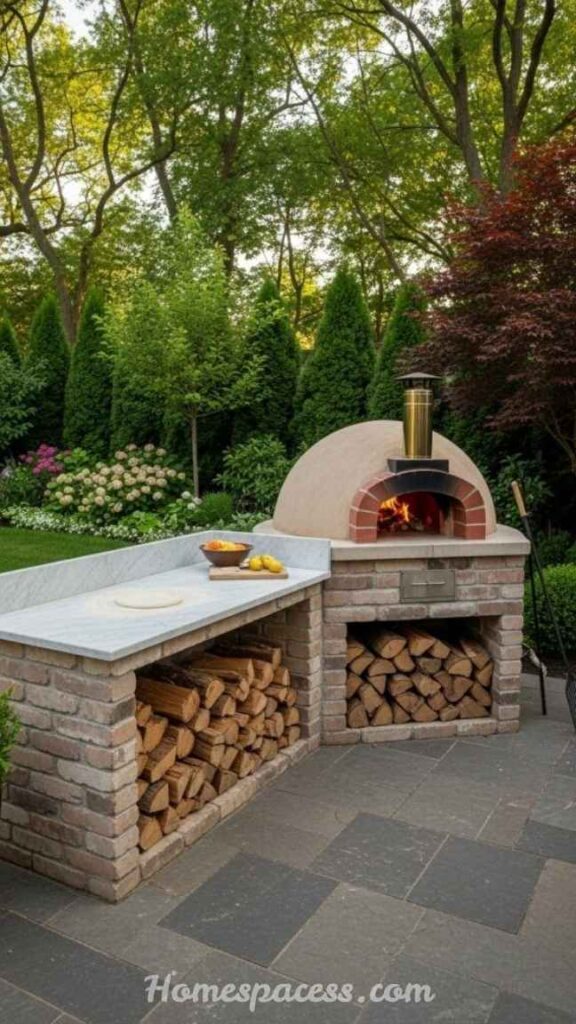
A wood-fired oven paired with a grill station has become the ultimate dual-cooking setup for outdoor entertainers. The oven reaches 700–900°F for pizza in 90 seconds, or can be dialed back to 400°F for slow-roasting chicken or lamb. Brands like Forno Bravo and Alfa Forni make modular oven kits designed to integrate with masonry kitchen builds. The combination of the oven’s visual drama the dancing flame visible through the opening and the grill’s everyday functionality creates a space that guests photograph every single time.
The practical consideration most people skip is curing time. A new masonry wood-fired oven must be gradually cured over 5–7 sessions of progressively larger fires to drive out moisture and prevent cracking. Starting too hot too soon is the #1 reason new oven owners crack their investment in the first week. Follow the manufacturer’s curing schedule precisely it’s not optional.
Kamado Grill Niche Station
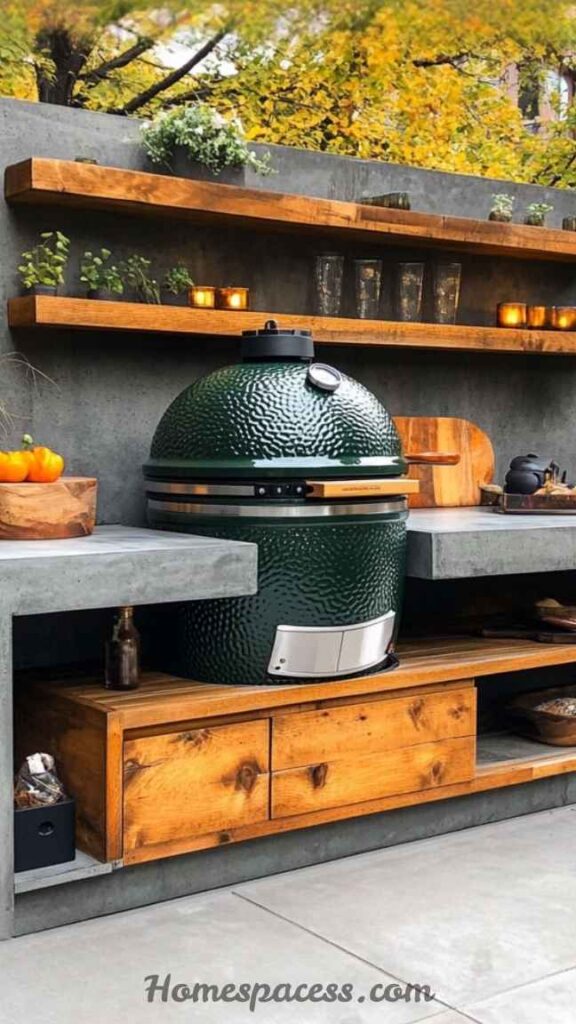
Kamado grills like the Big Green Egg or Kamado Joe are ceramic, egg-shaped cookers that function as smokers, grills, and ovens in one unit. Building a dedicated niche station for a kamado typically a table-style frame with an opening sized to the dome keeps it at the perfect working height, integrates it into the patio’s design language, and protects the base from ground moisture. The ceramic body is durable but heavy, so the station needs a proper concrete or paver foundation.
One underrated kamado patio concept is the “kamado corner” two units side by side, one set at smoking temperature (225°F) and one at grilling heat (500°F+). This lets you simultaneously smoke brisket and sear steaks, handling the full spectrum of BBQ in one session. Serious outdoor cooks who entertain regularly find this dual-kamado setup more versatile than any single piece of cooking equipment.
Charcoal Grill & Ash Management Station
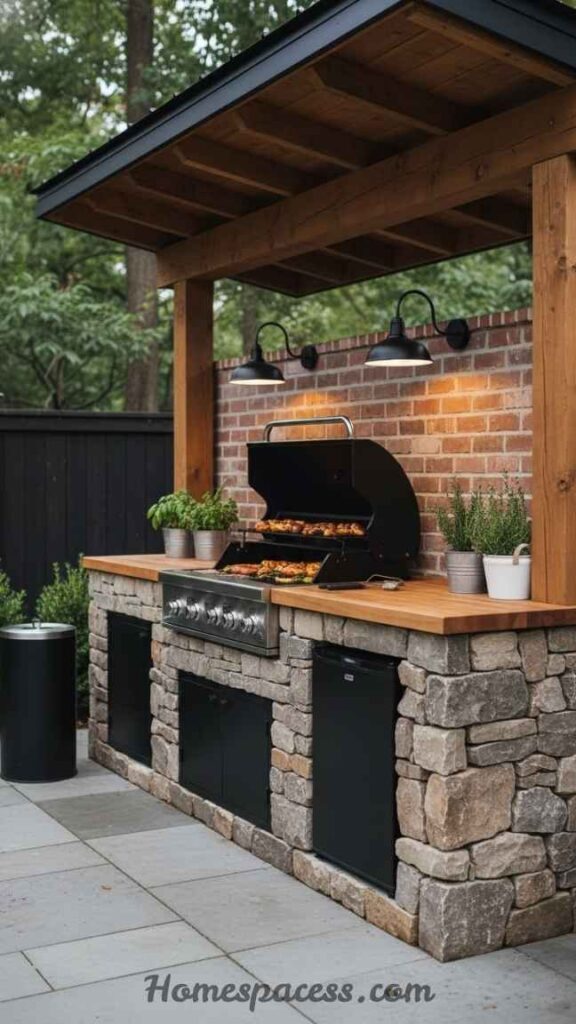
Charcoal grilling produces superior flavor but requires ash management and most patios handle this terribly. A dedicated charcoal station should include a built-in charcoal storage drawer (keeps briquettes dry), a stainless steel ash catcher mounted beneath the grill, and a lidded metal ash disposal bucket secured nearby. This system keeps the prep area clean and prevents the grey-dust mess that makes charcoal grilling feel laborious.
The paving choice around a charcoal station matters significantly. Concrete and natural stone are safe. Composite decking is not stray embers can cause surface damage or, in rare cases, ignition. If your deck is composite and you love charcoal, invest in a large concrete paver “landing pad” beneath and around the grill area. It’s a $150 fix that prevents a $15,000 deck replacement.
Flooring, Surfaces & Material Ideas
Large-Format Porcelain Paver Patio
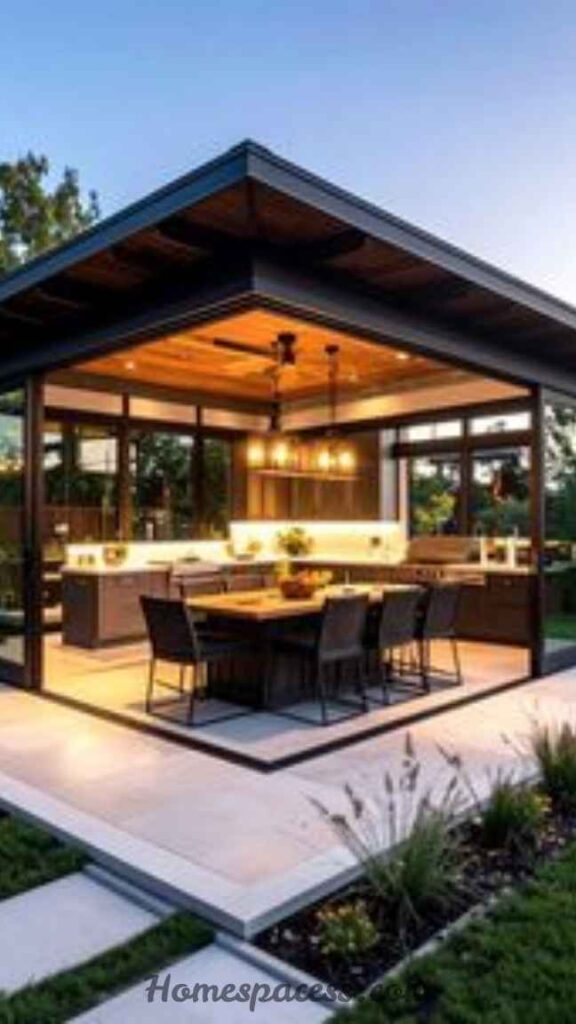
Large-format porcelain pavers (24″×24″ or even 24″×48″) have disrupted the outdoor flooring market in the past five years. They look indistinguishable from natural stone, require virtually no maintenance, don’t need sealing, resist staining from grease and marinades, and can handle freeze-thaw cycles without cracking. For a BBQ patio specifically, these properties are invaluable you’ll spill things, drop things, and drag things across this surface constantly.
The installation detail that separates amateur from professional results is the joint width. Large-format pavers look best with very narrow joints (1/8″ to 1/4″), which gives a nearly seamless appearance. Wider joints visually “chop” the surface and reduce the premium feel. Have your installer use a suction cup lift tool and laser level these tiles are too heavy and too precise a material to lay by eye.
Stamped Concrete with Integrated Patterns
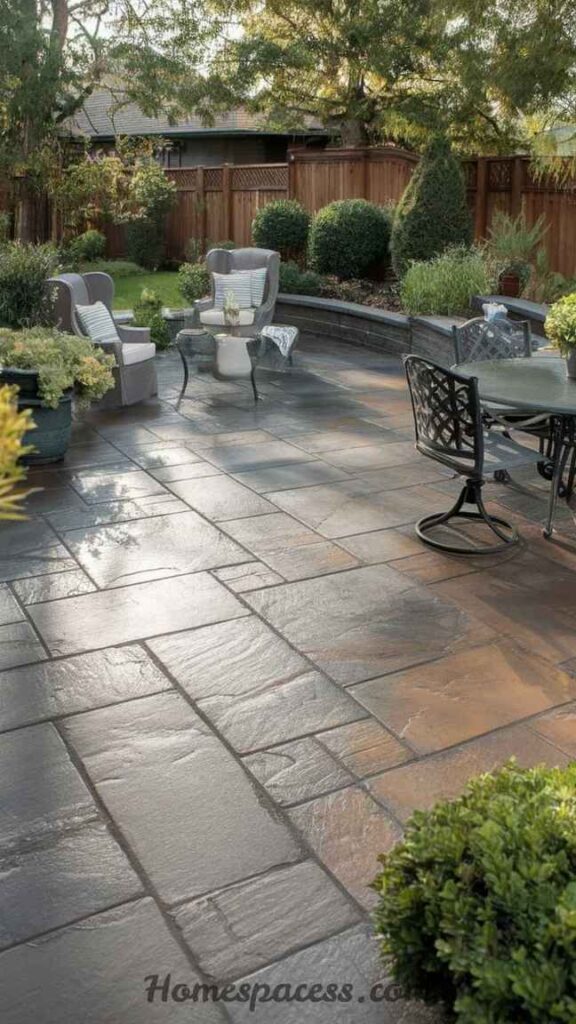
Stamped concrete can convincingly replicate slate, flagstone, brick, or wood plank textures at roughly 50–70% of the cost of natural materials. For BBQ patios, the seamless, poured nature of concrete is a practical advantage no gaps for grease to penetrate, no individual pavers to shift underfoot while you’re carrying a hot grill pan. A well-done stamped concrete job with integral color (pigment mixed into the pour) rather than surface-applied stain will maintain its appearance for 15–20 years with periodic resealing.
The critical investment is in the base preparation. Stamped concrete fails prematurely when poured on inadequate base material. Require 4″ of compacted crushed stone base minimum, with reinforcing mesh or rebar in the concrete itself. A slab poured over poorly compacted soil will crack within 2–3 years, regardless of how beautiful the surface pattern is. Get the base right and your concrete will outlast almost anything else.
Natural Flagstone Patio with Mortar Joints
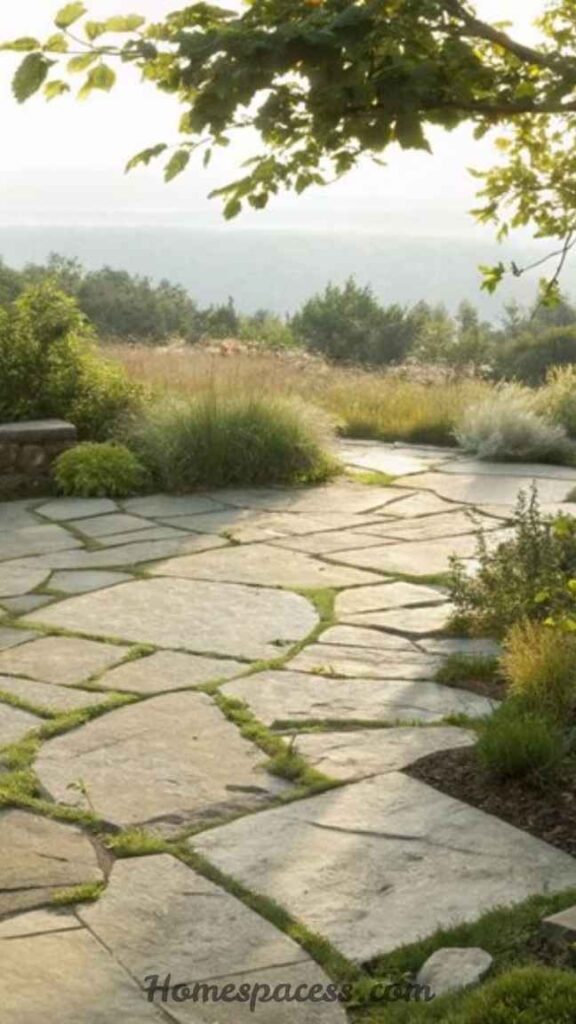
Irregular-cut natural flagstone (bluestone, travertine, slate, or limestone) gives a BBQ patio an authentic, organic character that no manufactured product fully replicates. The color variation and texture irregularity is the point it connects the space to the natural landscape. Mortar-set flagstone (versus dry-laid) is the right choice for a BBQ patio because the solid base eliminates any shifting or wobble that would make maneuvering a heavy grill dangerous.
The material selection depends on your climate. Travertine is gorgeous but absorbs water and can spall in hard-freeze climates. Bluestone is durable everywhere and ages beautifully. Limestone is soft and can stain from acidic marinades. Slate splits cleanly but can become slippery when wet. For most climates and BBQ use, thermal-finish bluestone is the gold standard the textured surface remains grippy even in rain.
Composite Decking BBQ Area with Fire-Safe Zone
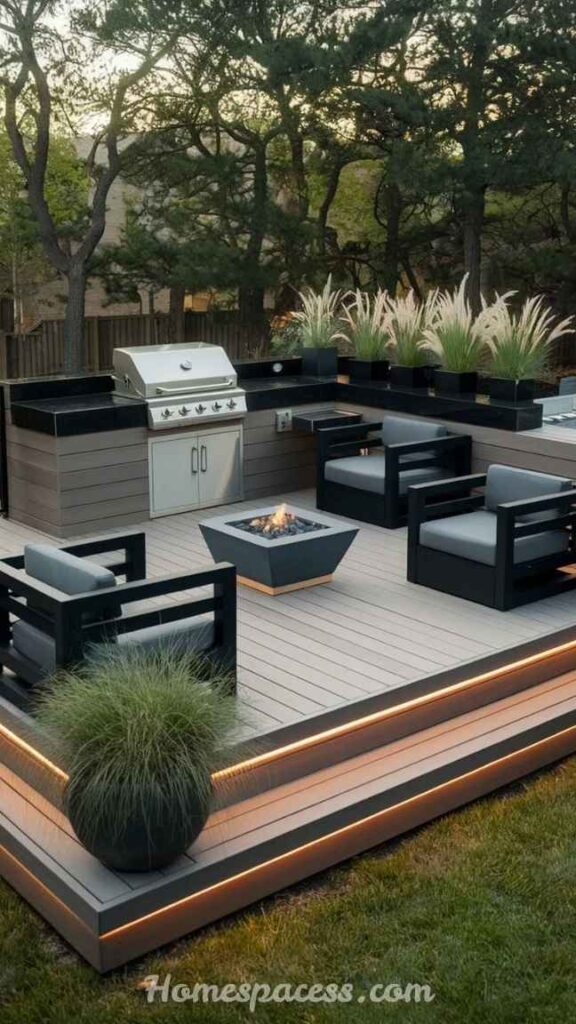
Modern composite decking (Trex, Fiberon, TimberTech) offers extraordinary longevity with minimal maintenance, but it requires one modification for BBQ use: a fire-safe zone beneath and immediately around any grill. The most elegant solution is a flush-set porcelain tile or natural stone pad integrated into the decking, sized at minimum 36″×36″ but ideally 48″×48″. This creates a visual focal point, protects the deck from heat and sparks, and doesn’t require the visual disruption of a separate mat.
This integrated approach is something very few deck designers suggest, but it solves the #1 liability of composite decking near grills while actually improving the design. Choose a stone that contrasts subtly with the decking color for grey composite, warm beige travertine creates a beautiful tension. For brown composite, charcoal slate reads as a sophisticated continuation of the palette.
Shade, Shelter & Overhead Structure Ideas
Pergola with Adjustable Shade Sail
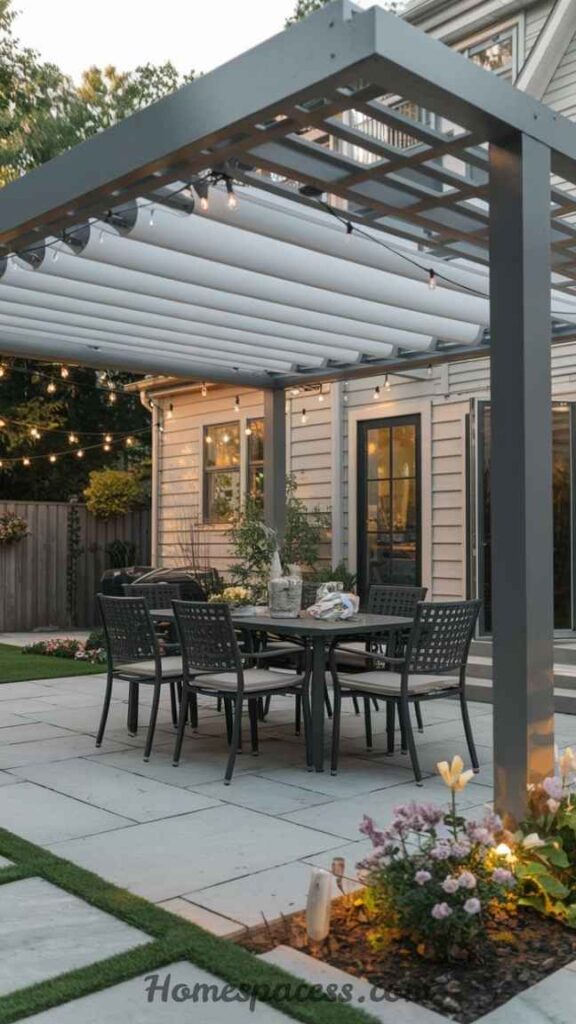
A pergola gives structure without full enclosure, but its open lattice top provides only partial shade at best. The smart upgrade is to pair the pergola frame with a retractable shade sail or slatted shade panels that can be adjusted based on sun angle and season. Modern shade sail systems from brands like Coolaroo or Shademaxx attach to integrated anchor points on the pergola posts and can be removed in minutes before a storm.
The overlooked design detail: the shade structure should cover the dining zone, not the grill zone. You want to grill in open air for ventilation while guests eat in comfort. A pergola positioned directly over the grill creates smoke management problems. Position the structure so its shadow falls primarily over the dining and lounging area, with the grill station at the edge or just outside the footprint.
Outdoor Motorized Louvered Roof System
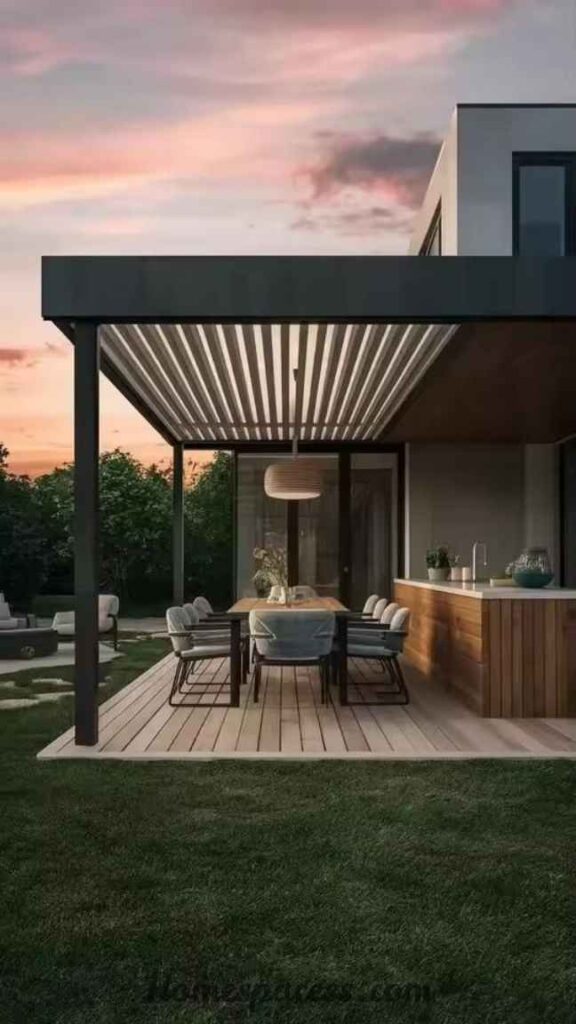
Motorized louvered roofs articulating aluminum slats that open and close at the touch of a button have moved from luxury hotel territory into the mid-range residential market. Brands like Equinox and StruXure now offer systems starting around $8,000–15,000 installed. The slats rotate from fully open (maximizing airflow) to fully closed (waterproof rain barrier), with infinite positions in between. For BBQ entertaining, this means you can cook and dine in rain, full sun, or anything in between without rescheduling.
Integrated lighting, speakers, and heating elements can all be embedded into the louvered system’s structural channels. This creates a genuinely all-weather outdoor room one where you can host a dinner party in November in most U.S. climates. Homeowners consistently report this as the single highest-satisfaction outdoor investment they’ve made, often recovering 70–80% of the cost in home value.
Living Green Wall as Wind & Privacy Screen
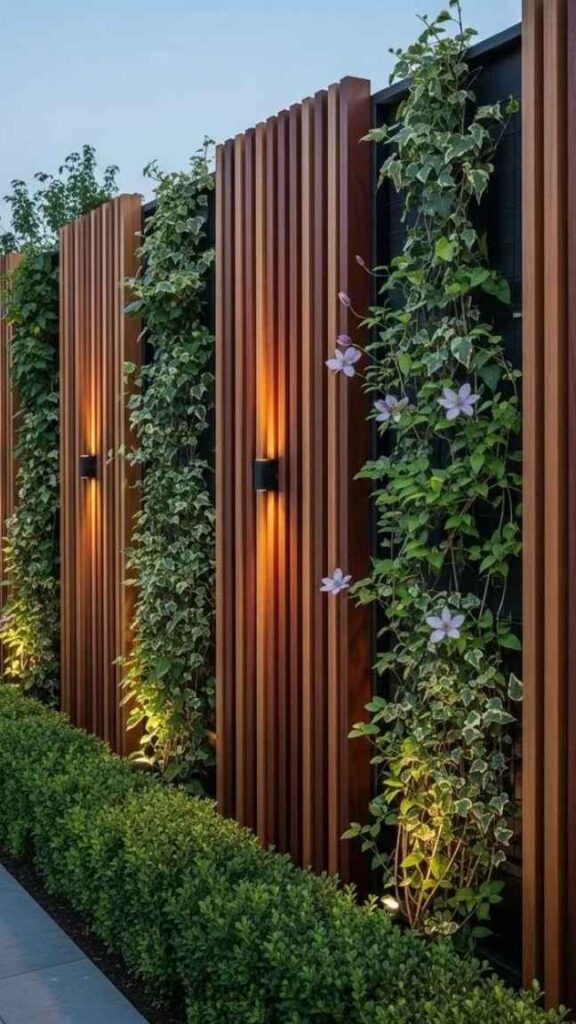
A living green wall a modular panel system planted with succulents, ferns, herbs, or trailing plants solves three BBQ patio problems simultaneously: privacy from neighbors, wind buffering for your cooking flame, and visual beauty. Vertical garden systems from Woolly Pocket or Flora felt are designed for outdoor use, with drip irrigation integrated into the panel structure. For a BBQ patio, plant a portion with culinary herbs rosemary, thyme, oregano so guests can snip fresh ingredients directly into their food.
The practical note: a living wall needs a waterproof backing membrane if it’s against a fence or wall, and a drip irrigation timer if you want it to survive summer heat without daily watering. The investment in automation pays off immediately. An unirrigated living wall becomes a dead wall within two weeks of summer neglect plan the water system first, plants second.
Lighting, Ambiance & Evening Atmosphere Ideas
Layered Lighting Design for Evening BBQs
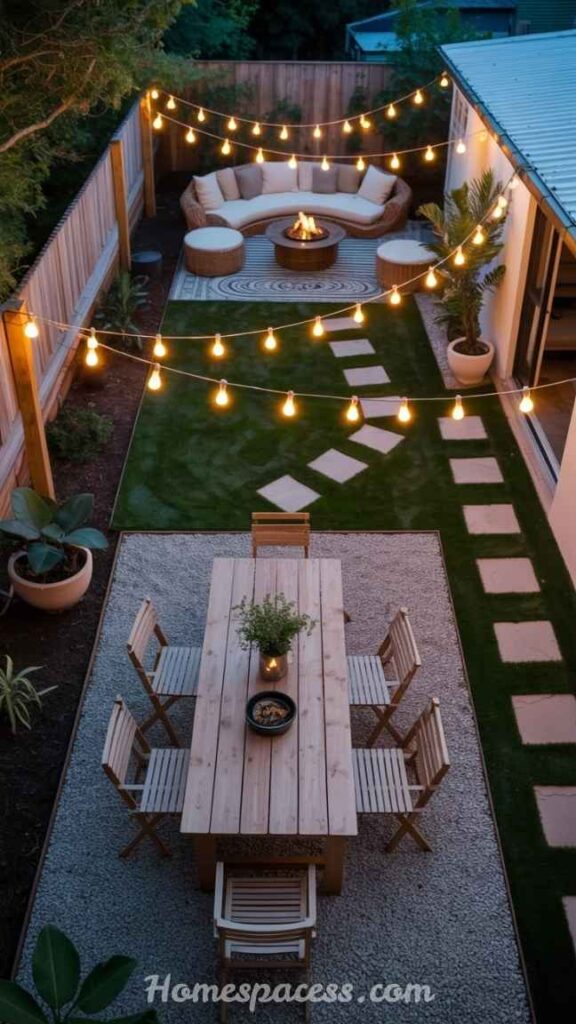
Most BBQ patios have one kind of light: a single overhead fixture. Professional lighting designers use three layers ambient (overall illumination), task (bright light over the grill and prep areas), and accent (uplighting, string lights, candles) and the difference is transformative. Ambient light comes from a central pendant or string light canopy. Task lighting, critically, needs to be 300+ lumens focused specifically on the grill surface so you can see the internal meat color accurately at dusk.
The most impactful low-cost lighting upgrade for any BBQ patio is café-style string lights hung in a grid pattern overhead. Use 48-foot strands with 2-inch Edison-style or globe bulbs, hung at 8–9 feet height with a zigzag pattern from a central hook to perimeter anchors. The warm 2200K color temperature creates a flattering, festive atmosphere that immediately elevates any patio from functional to memorable. Smart-plug integration lets you set them on timers or dim them from your phone.
Gas Fire Pit as Centerpiece
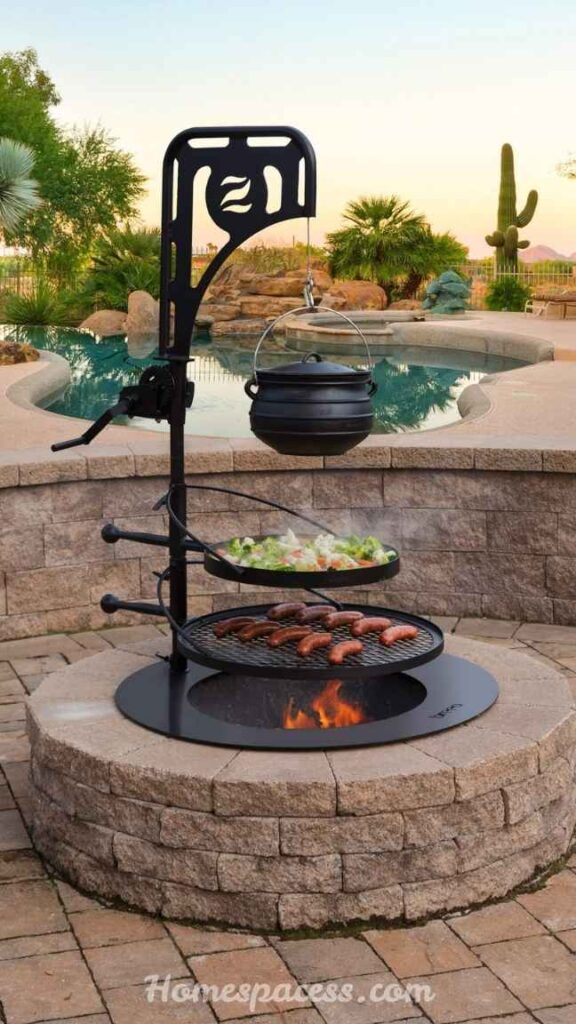
A gas fire pit does double duty as both a functional heat source and the visual anchor of your patio. Unlike wood-burning fire pits that produce unpredictable smoke and require ash management, gas fire pits ignite with a switch, produce clean flames, and shut off instantly. Linear “ribbon burner” designs with black lava rock or glass fire media read as design-forward; round bowl designs with ceramic logs feel more traditional and cozy.
Placement is everything. A fire pit at the center of a conversation seating arrangement should be low enough (16–18″ table height or lower) that it doesn’t obstruct sight lines. Oversized fire pits placed at 30″ table height feel like campfires dramatic but not conversational. For a BBQ patio where you want to extend the evening after dinner, a low fire table surrounded by deep lounge chairs is the most socially successful configuration.
Landscape Uplighting & Path Integration
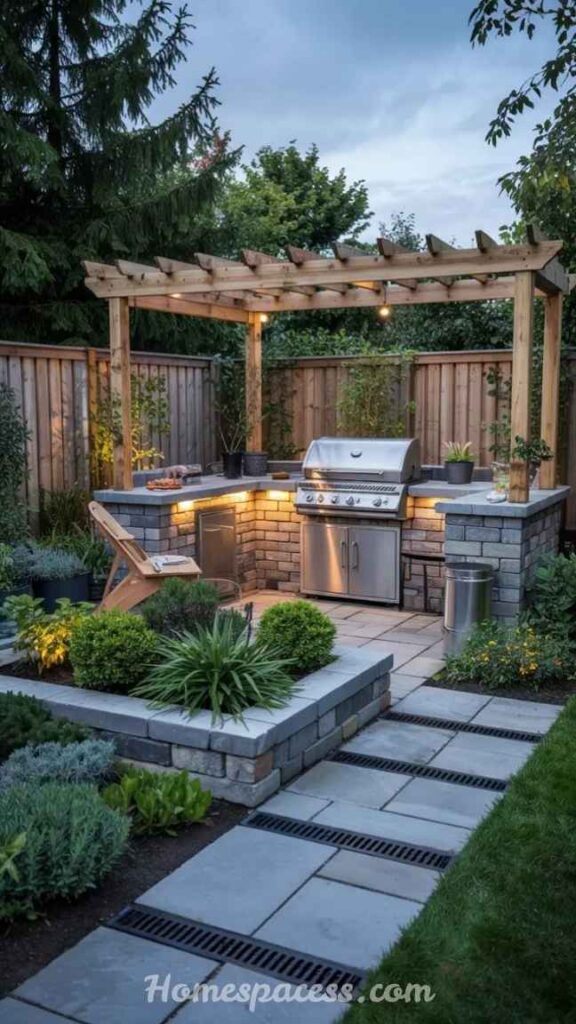
Landscape uplighting transforms the perimeter of your BBQ patio after dark, illuminating trees, shrubs, and architectural features that frame the space. In-ground or stake-mounted LED spotlights (4–8 watts) aimed upward into trees create dappled, canopy-light effects that no string light can replicate. Combined with low path lighting guiding guests from the house to the patio, the effect is a cinematic outdoor room rather than a lit concrete slab.
Smart landscape lighting systems (Kichler’s Smart Outdoor System or VOLT Lighting’s Wi-Fi controllers) allow scene programming “dinner mode” might set string lights at 60% and uplights at 100%, while “party mode” bumps everything to max. These systems run on standard 12V landscape wire, making DIY installation realistic for most homeowners. The transformer plugs into a standard outdoor outlet and controls the entire system via an app.
Outdoor Kitchen, Bar & Serving Ideas
Outdoor Refrigerator & Beverage Center Station
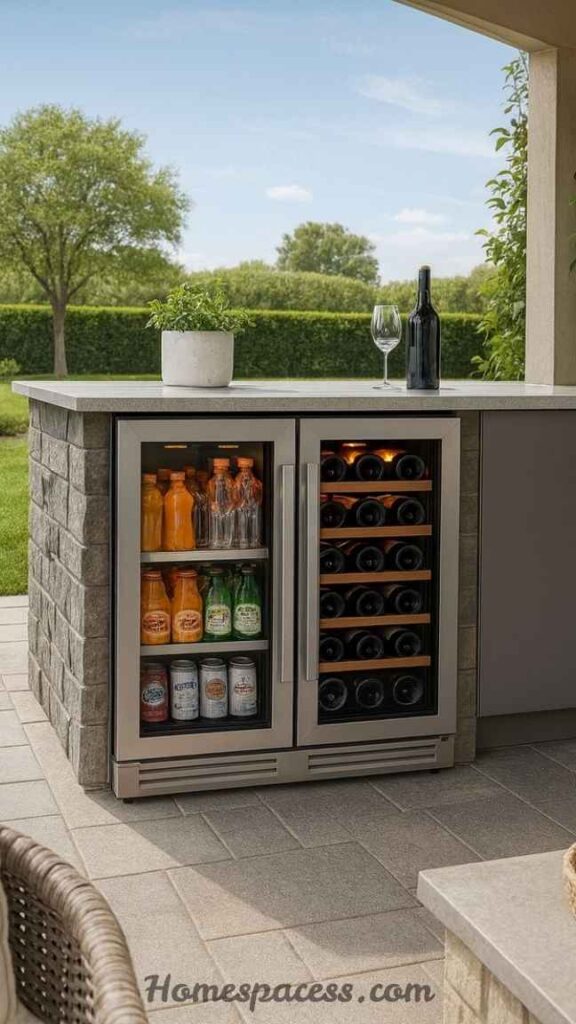
An outdoor-rated refrigerator under your BBQ island eliminates the constant trips inside for drinks, marinade, and condiments that fragment the hosting experience. Outdoor refrigerators are built to withstand temperature extremes, humidity, and UV exposure that destroy indoor units within a season. Brands like Coyote, Perlick, and True make 24″ wide undercounter units that fit standard kitchen base cabinet openings and can store 60+ cans plus condiments.
The beverage center concept a dedicated section of the outdoor kitchen with a refrigerator, ice bin, bottle opener, and glassware storage keeps guests self-sufficient and out of the cook’s way. A 36″–48″ bar-height counter section on the guest-facing side of the kitchen island becomes the natural congregation point, allowing social interaction with the chef while maintaining a clear division between the cooking zone and the gathering zone.
Outdoor Sink with Hot & Cold Water
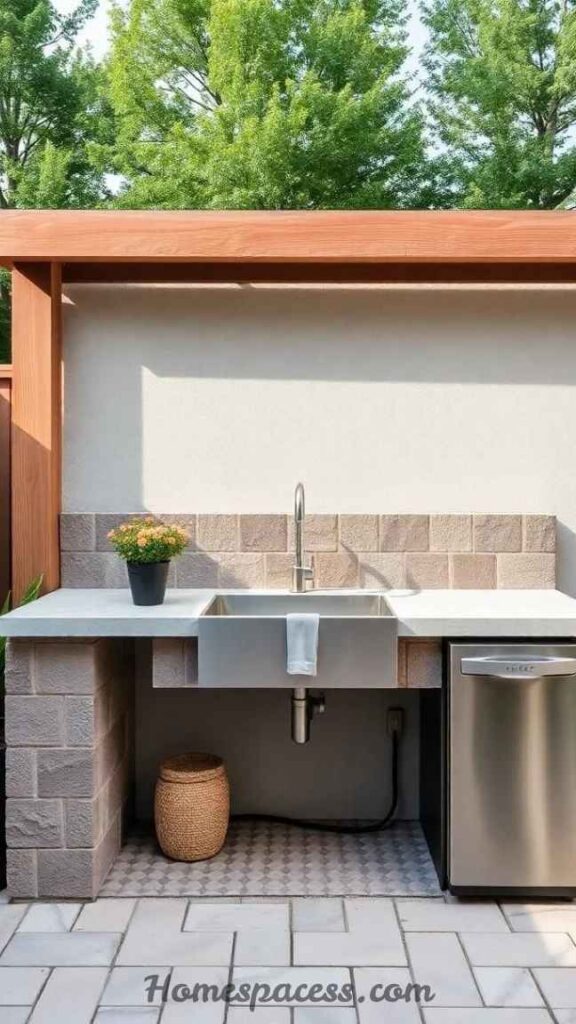
An outdoor sink is arguably the most underrated element of a serious BBQ patio. Washing hands between handling raw meat and touching surfaces, rinsing vegetables, cleaning tools, and cleaning up without going inside these quality-of-life benefits become immediately obvious the first time you use an outdoor sink. For a permanent outdoor sink, you need both a water supply line and a drain that connects to the home’s drainage system this requires a plumber but is far less complex than it sounds.
A hot water supply to the outdoor sink dramatically improves grease cleanup and is achievable by running an insulated supply line from the home’s hot water system. Alternatively, an on-demand tankless point-of-use heater can be mounted inside the outdoor kitchen cabinet and connected to a cold water line only providing hot water without a long run from the house. This $200–400 tankless unit solution is what most professional outdoor kitchen builders now specify for mid-range projects.
Expert Tip:
Run a 1″ conduit sleeve alongside all plumbing it costs almost nothing when done during initial construction and gives you a pathway for future electrical or smart home wiring without digging up your patio.
Built-In Outdoor Pizza/Side Burner Station
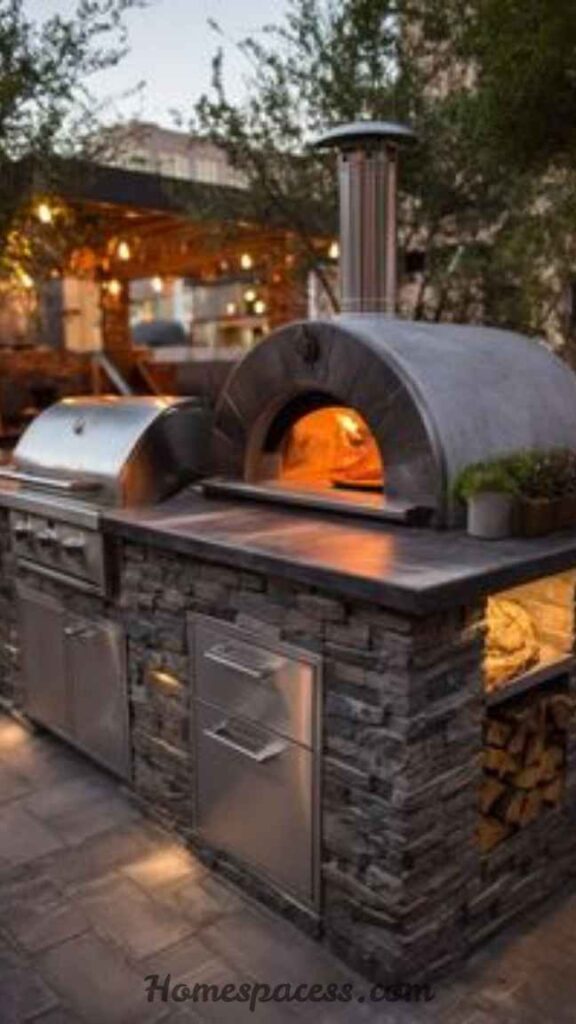
A side burner station adjacent to the main grill expands your outdoor cooking capability from one-dimensional to multi-course. A high-BTU side burner (15,000+ BTU) can boil a large pot of corn, reduce a pan sauce, or sauté sides simultaneously with the grill eliminating the indoor kitchen entirely for summer meals. Many built-in outdoor kitchen manufacturers offer two or three-burner side stations designed to integrate seamlessly with their grill lines.
The practical detail most people miss: outdoor cooking at high heat in wind creates flame instability and uneven cooking. Specify a wind guard around any outdoor burner station most quality outdoor cooktop units include one, but verify before purchasing. A burner without a wind guard in a breezy yard is frustrating to cook on and can pose a safety risk if flames are pushed horizontally.
Seating, Dining & Social Space Ideas
Concrete Dining Table with Built-In Ice Bucket
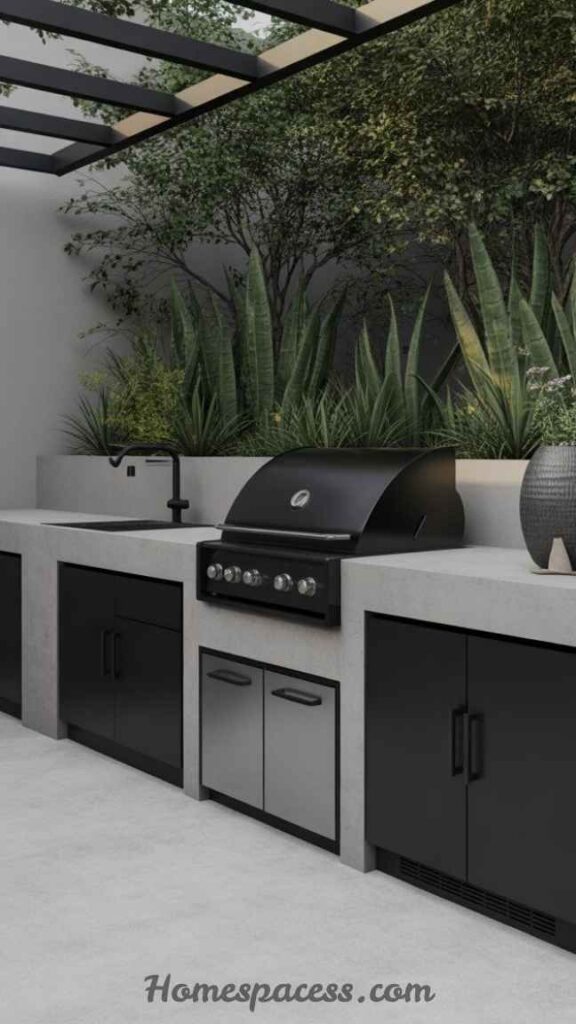
A cast concrete outdoor dining table is one of the most visually striking and functionally superior choices for a serious BBQ patio. Concrete’s thermal mass keeps the surface cool to the touch even in direct sun, resists staining when sealed properly, and can be cast in any shape or size to fit your exact space. The advanced version includes a router cut into the center or end of the table, finished with stainless steel trim, that serves as a built-in ice bucket or planter. It’s a conversation piece that also has genuine utility at every outdoor meal.
DIY concrete table casting is achievable for a competent weekend builder the mold is melamine-coated plywood, and the mix is standard bagged concrete with fiber reinforcement. However, a 6-person concrete table weighs 300–500 lbs and will never move once placed. Choose its location with the sun angle at 6–8 PM (your likely dining time) in mind, and ensure there’s no overhead obstruction before the pour.
Mixed-Height Seating Zone
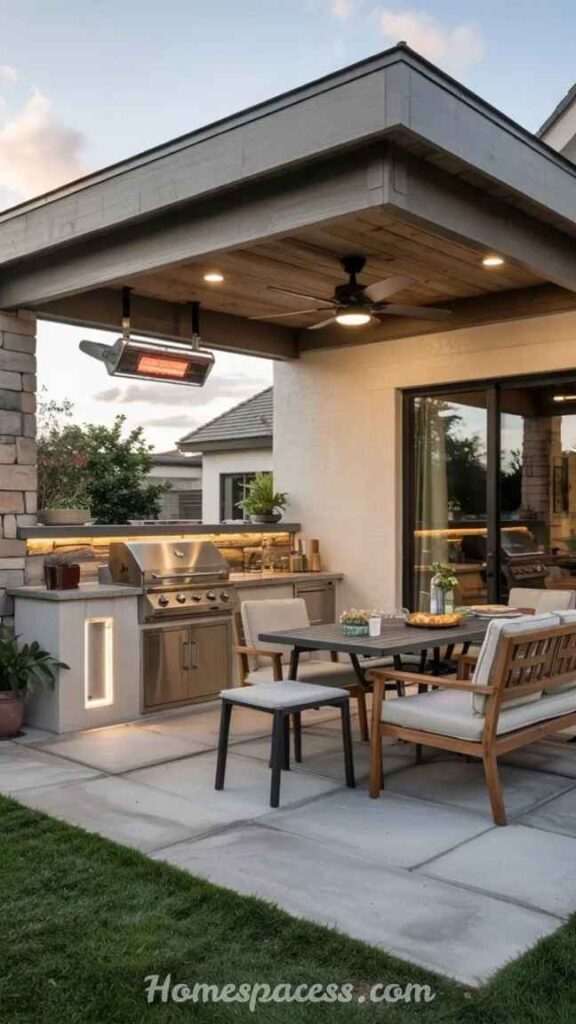
The most socially dynamic BBQ patios combine multiple seating heights rather than a single uniform setup. Counter-height stools at the grill island (28–30″ height) let guests interact with the cook; standard dining table height (29–30″ table, 18″ seat) for the main meal; and low lounge chairs (seat height 14–16″) around the fire pit for post-dinner relaxation. Each height creates a different social energy counter stools feel casual and animated, dining chairs focused and convivial, lounge chairs intimate and relaxed.
The spatial planning requirement is that each zone needs adequate clearance: 36″ minimum behind dining chairs for passage, 18″ between counter stools for comfort, and 48″ between lounge chairs and fire pit for safety. Sketch your layout with these clearances marked before buying a single piece of furniture. Most patio furniture-buying regrets come from not accounting for real-space circulation needs.
Outdoor Day Bed & Lounge Corner
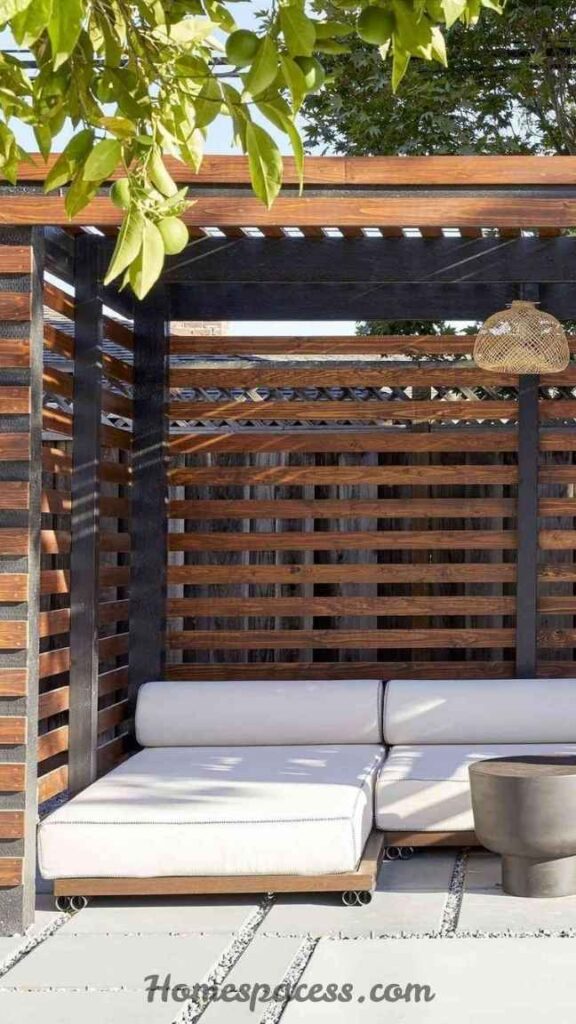
A dedicated lounge corner with an oversized outdoor daybed or deep sectional extends the usability of your BBQ patio beyond the meal itself. After dinner, guests naturally want to shift from upright dining posture to relaxed conversation and a well-positioned lounge area keeps the party outdoors rather than migrating inside. All-weather sectional sofas from brands like Poly wood, Brown Jordan, or Janus et Cie are built for permanent outdoor installation and maintain their comfort and appearance for years without the indoor-outdoor fabric rot that plagues budget options.
The daybed concept specifically a deep platform with weather-resistant cushions and a canopy or shade structure above creates a resort-like destination corner that communicates “this patio is serious.” Size it for at least two people lying fully flat, and position it at the edge of the patio with a view back toward the house or garden. It becomes the natural photography spot at every gathering
Water Features, Plants & Nature Integration
Pondless Waterfall Feature as Background Sound
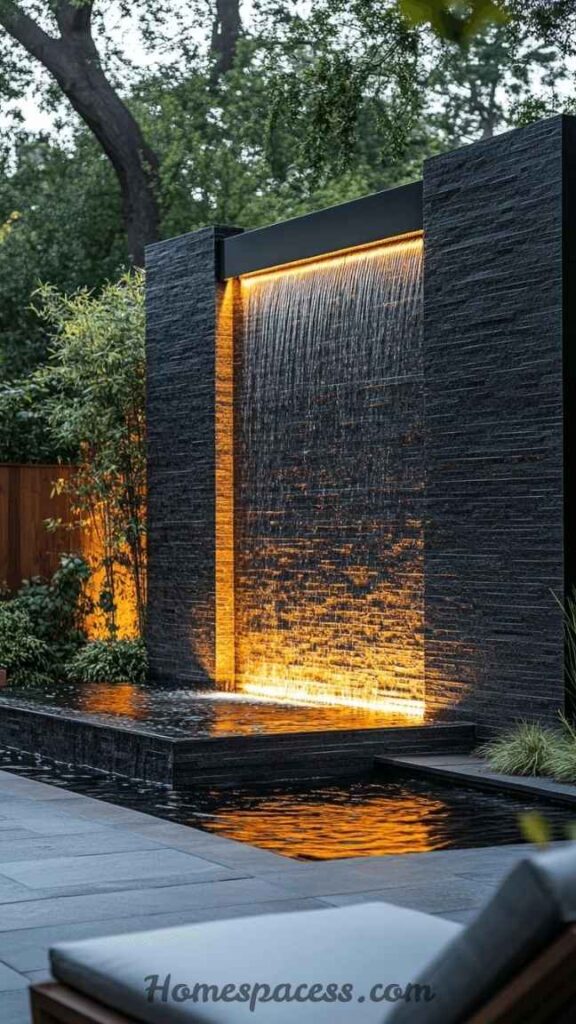
A pondless waterfall system a recirculating pump buried in a gravel reservoir, feeding water up to a spillway of stacked stone adds the sound of running water to your BBQ patio without the maintenance of a full pond. The acoustic effect of water sound is well-documented: it masks ambient street noise, lowers perceived stress levels among guests, and creates a sensory richness that transforms a functional patio into an experiential retreat. It’s the acoustic equivalent of background music, but organic.
The system is remarkably low-maintenance a good pump and filter requires cleaning only 1–2 times per year. Size the spillway to the patio: a small 2–3 foot waterfall is appropriate for a 400 sq ft patio. A waterfall that’s too large for the space becomes overwhelmingly loud rather than soothing. Position it at the perimeter furthest from the grill so splashing water never interferes with your cooking surface.
Raised Herb Garden Adjacent to Cooking Station
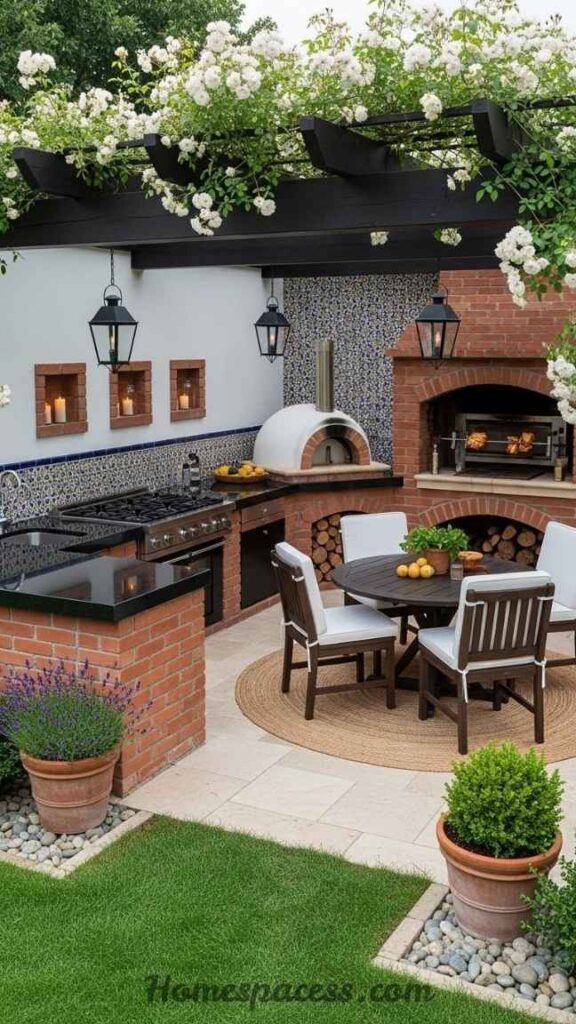
A raised planter bed positioned within arm’s reach of the grill planted with rosemary, thyme, basil, oregano, chives, and mint transforms BBQ cooking from a purely mechanical exercise into something more sensory and intuitive. The ability to snip fresh herbs directly onto a steak coming off the grill, or fold fresh mint into a cocktail while you cook, creates moments of genuine culinary pleasure that any BBQ guest will notice and remember.
For a built-in look, construct the planter from the same stone or concrete block as your outdoor kitchen. A 24″ wide × 12″ deep planter box at counter height (36″) is ergonomically ideal for both gardening and cooking harvest. Line it with a root barrier membrane to prevent vine roots from cracking the masonry, and install a drip irrigation emitter for each major herb variety different herbs have very different water needs that hand-watering doesn’t handle efficiently.
Outdoor Speaker & Smart Home Integration
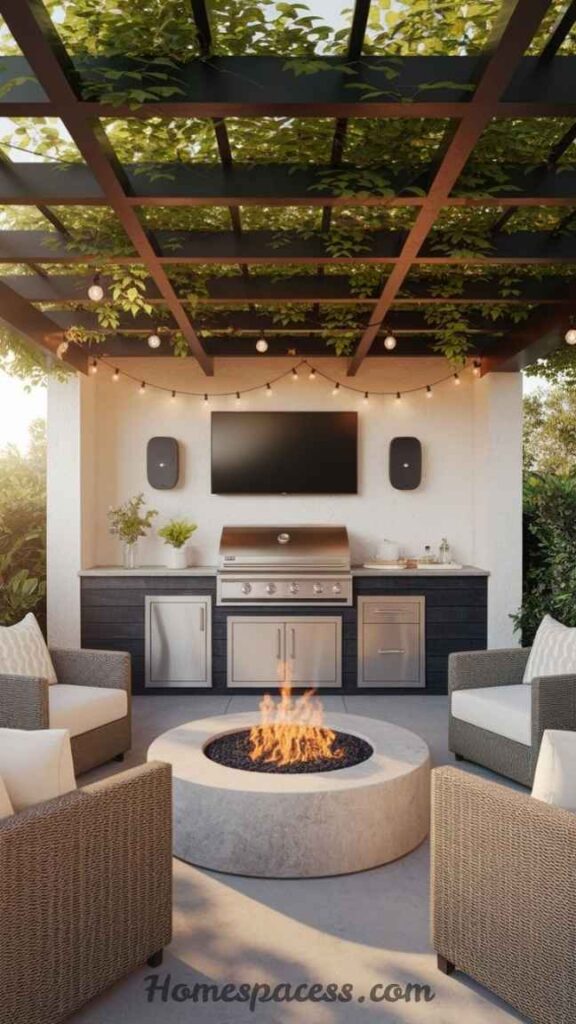
The final element that separates a great BBQ patio from an extraordinary one is seamless audio. Buried landscape speakers (Sonance Garden Series, Klipsch AW Series) deliver 360° sound that appears to come from everywhere and nowhere versus a Bluetooth speaker that everyone can see and that sounds thin at outdoor volumes. A four-speaker burial around the patio perimeter, connected to an amplifier housed in a weatherproof enclosure inside the kitchen island, delivers audiophile-quality sound at a system cost of $600–1,500.
Smart home integration connecting the audio, lighting, louvered roof, gas fire pit, and any heating elements to a single platform like Control4, Savant, or even a well-configured Apple HomeKit or Google Home system lets you trigger “BBQ Mode” from your phone that simultaneously lights the grill area, starts the string lights, ignites the fire pit, and starts your playlist. The theatrics of this moment alone consistently impress guests. It’s the digital equivalent of a curtain rising on your stage.
Final Idea Insight:
The most memorable BBQ patios don’t compete with restaurants they’re better than restaurants, because they’re deeply personal. Every material choice, every plant, every speaker and lightbulb is a decision you made. Design for the evenings you actually want to have, not the ones in a catalog.
Conclusion
Building or upgrading a BBQ patio is one of the most rewarding home improvement projects you can undertake. Unlike interior renovations, the results are immediately visible, immediately usable, and immediately social. You don’t have to implement all 29 ideas at once in fact, the best outdoor spaces evolve over time as you understand how you actually use the space.
Start with the foundation: get your layout right, choose your materials thoughtfully, and plan your utilities (gas, water, electrical) before anything is built. These invisible systems determine everything that comes later. Then add the personality the plants, the lighting, the furniture, the speakers over time. A patio built this way feels earned, layered, and genuinely yours.
The most important metric isn’t cost or curb appeal. It’s how often people stay. If guests are lingering on your patio long after dinner is done, talking and refilling their glasses and not wanting to leave that’s a great BBQ patio.
2026 Trend Analysis
BBQ Patio Trends in 2026 and Where They’re Going
The most dominant trend reshaping BBQ patio design in 2026 is the “indoor-outdoor blur” the deliberate dissolution of the boundary between interior living space and exterior entertaining space. This manifests in large sliding or folding glass walls that open fully, matching flooring materials used both inside and outside, and outdoor kitchens that mirror the aesthetic language of the home’s interior kitchen exactly. What used to be an “outdoor space” is now literally another room, with all the permanence and design intention that implies.
A second major trend is the shift from gas to hybrid and multi-fuel cooking setups. The “forever grill” concept a single built-in unit that can switch between charcoal, wood pellet, and gas depending on the cook’s intent has gained significant traction. Brands like Kalamazoo Outdoor Gourmet, Twin Eagles, and Weber’s Summit line now offer hybrid systems that appeal to both the flavor-focused charcoal purist and the convenience-oriented weeknight griller. This versatility trend reflects a broader cultural reassessment of outdoor cooking as a skilled practice, not just a weekend convenience.
The third trend worth tracking: sustainability-forward materials. Reclaimed wood, recycled composite decking, and locally sourced stone have moved from niche to mainstream as homeowners increasingly factor environmental impact into renovation decisions. Permeable paving patio surfaces designed to allow rainwater infiltration rather than runoff is being adopted at accelerating rates in response to local storm water regulations. By 2027–2028, permeable paving is expected to be required by code in several major U.S. municipalities for new outdoor hardscape installations over 500 square feet.
Expert Insights
Practical Expert Insights Most BBQ Patio Guides Ignore
The single piece of advice that separates experienced outdoor kitchen designers from beginners is the concept of “the working triangle” adapted for outdoor use. In indoor kitchen design, the work triangle connects the sink, stove, and refrigerator in an efficient relationship. Outdoors, this becomes the triangle between the grill, the prep surface, and the serving area. When these three zones are within 4–6 feet of each other, cooking efficiency increases dramatically and the physical strain of hosting large parties decreases noticeably. Get this triangle wrong and no amount of beautiful materials or expensive appliances will make the space feel intuitive to cook in.
The second insight that most homeowners discover too late: outdoor furniture should be chosen for its weight, not just its appearance. Lightweight aluminum furniture looks fine in a showroom but becomes projectile hazards in any wind event. Specify furniture that weighs 15+ lbs per piece for seating and 40+ lbs for tables, or plan for a dedicated furniture storage strategy for storm days. The best outdoor furniture for BBQ patios is heavy enough to stay put in wind, made of material that doesn’t scratch moving grills or carts across it, and designed with no fabric elements that require seasonal removal and storage.
A third expert insight rarely discussed: electrical planning for a BBQ patio is almost always underestimated. Most homeowners plan for one outdoor outlet; professional outdoor kitchen designers specify six to eight: one for the refrigerator, one for the landscape lighting transformer, one for the outdoor TV, one for the audio amplifier, one for a cocktail blender station, and two spare for phone charging and plugin appliances. Each of these should be on a dedicated GFCI circuit. Running conduit for all eight circuits before the patio slab is poured costs a fraction of what it costs to core-drill and retrofit later plan for the kitchen you aspire to, not just the one you can afford today.
Sustainability & Long-Term Value
Building a Sustainable BBQ Patio That Holds Its Value
The most durable BBQ patio investment decisions are ones that consider lifecycle cost rather than purchase price. Concrete pavers at $8/sq ft installed will likely need replacement or significant maintenance within 15 years. Porcelain pavers at $14/sq ft installed will outlast the house. Cheap stainless steel grill grates at 304 grade will rust within 3–5 years in coastal or humid climates; 316 marine-grade stainless holds indefinitely. These material-grade distinctions, invisible to the eye at installation, create dramatically different long-term cost curves. The 75% of homeowners who choose on purchase price alone invariably spend more over a 10-year period than the 25% who specified quality from day one.
Sustainability in the ecological sense increasingly intersects with patio design in meaningful ways. Native plant landscaping around the patio perimeter eliminates irrigation needs once established, reduces chemical inputs, and supports local pollinator populations. A permeable paver system can reduce storm water runoff by 90% compared to a solid concrete slab. Pellet grills produce fewer emissions than charcoal; natural gas produces fewer than propane; induction outdoor cooking (increasingly viable as the technology matures) produces essentially zero combustion emissions. These choices compound an eco-conscious patio design made in 2026 will be not just ahead of social expectations but ahead of incoming regulatory requirements.
From a home value perspective, well-designed outdoor kitchens consistently return 60–80% of their cost at resale in most markets, with full outdoor rooms in sun-belt markets returning 100%+ in recent comparable sales analyses. The key qualifier is “well-designed” a poorly executed outdoor kitchen with undersized appliances, builder-grade materials, and dysfunctional layout can actually detract from perceived home value by communicating that the seller cut corners on the property. Invest in professional landscape architecture consultation at minimum most firms offer design-only services for $500–1,500 that can save multiples of that in execution mistakes.
Future Innovations
The Future of BBQ Patios Innovations Arriving by 2028
The outdoor cooking equipment space is on the verge of a smart appliance revolution that mirrors what happened to indoor kitchens over the past decade. AI-assisted grill controllers that monitor meat temperature, ambient temperature, wind speed, and fuel level simultaneously adjusting burner output automatically to maintain target cooking conditions are already available in early form from brands like Traeger’s D2 system and Weber’s Connect Hub. By 2027–2028, fully autonomous outdoor cooking will be commercially available: you place protein on the grill, set a target internal temperature via app, and the system handles everything else, alerting you when the meal is ready. The implications for casual entertaining are significant hosting will genuinely require less skill while producing more consistent results.
Materials science will bring two important innovations to patio surfaces and structures by the late 2020s: self-cleaning concrete treatments (titanium dioxide photocatalytic coatings that break down organic stains on contact with UV light) and structural aerogel insulation panels for outdoor kitchen cabinet walls that maintain consistent internal temperatures in extreme heat or cold with minimal energy input. Both technologies exist in commercial applications today and are migrating toward the residential market. Early adopters who specify infrastructure for these upgrades now smooth concrete surfaces, pre-run electrical in cabinet walls will be able to retrofit them at much lower cost than those who must modify existing structures.
The most transformative near-future innovation may be the integration of outdoor living spaces with home energy systems. As residential solar + battery storage becomes mainstream, the outdoor kitchen becomes a natural node in the home energy network: smart appliances that shift high-draw cooking tasks to peak solar production windows, EV charging integration with an outdoor outlet, and outdoor battery backup stations that can power critical systems during grid outages. The BBQ patio of 2030 will not just be a culinary and social space it will be a functional component of a smart, energy-resilient home ecosystem.
Common Mistakes
8 BBQ Patio Mistakes That Cost Homeowners the Most
After analyzing hundreds of BBQ patio projects, the same costly mistakes appear repeatedly. Here are the eight most impactful and how to avoid them.
- Skipping the drainage plan. Water accumulation beneath or around your patio causes frost heave, slab cracking, and foundation damage. Every patio needs a minimum 1% slope away from the house, plus subsurface drainage in clay-heavy soils.
- Undersizing the patio area. The most common regret: building too small. Once furniture, grill, and guests are in the space, a patio that seemed adequate on paper feels crowded in practice. Add 25% to whatever size you think you need.
- Placing the grill near the house wall. Minimum 10 feet clearance from any combustible structure is required by most codes and 15 feet is the professionally recommended standard. Heat, grease, and smoke damage to siding are cumulative and expensive.
- Choosing furniture before finalizing layout. Furniture purchased before the patio is built never quite fits right. Layout first, furniture second always.
- Using interior-rated electrical components outdoors. Standard electrical boxes, outlets, and switches will fail and pose shock hazards outdoors. Every outdoor electrical element must be rated WR (weather resistant) and GFCI protected.
- No gas shutoff accessible from the dining area. Building code and basic safety practice require a readily accessible gas shutoff. Don’t put it inside the cabinet under the grill put it on the exterior face of the kitchen island where any adult can reach it instantly.
- Overlooking sun angle at design time. A patio that’s in beautiful shade at 10 AM can be in brutal direct sun at 5 PM precisely when you’re hosting. Use a sun tracking app (Sun Seeker, SunCalc) to model shadow patterns at your planned entertaining times before choosing a location or shade structure.
- Not sealing natural stone or concrete. An unsealed concrete or natural stone patio absorbs every grease drip, wine spill, and tannin stain permanently. Seal all porous surfaces within 30 days of installation and reseal every 2–3 years depending on traffic and UV exposure.
The overlooked factor:
Most BBQ patio mistakes aren’t design failures they’re sequencing failures. The right decision made at the wrong stage of construction costs 3–10× more than the same decision made at the right stage. Plan exhaustively before you break ground, and the build itself becomes almost straightforward.

Team Home Spacess shares simple, practical design ideas that work for real families. The team focuses on cozy décor, soft colors, and natural textures that make a space feel truly lived-in. From everyday decorating tips to creative home projects, Team Home Spacess is dedicated to helping readers create warm, comfortable, and inviting spaces with a fresh and personal touch.