


Table of Contents
- Start With Safety Before Cost
- Signs a Furnace May Need Repair
- Signs Replacement May Be the Better Choice
- Use a Repair-Cost Test, Not a Single Rule
- Check Age and Repair History
- Look Beyond the Furnace Itself
- What to Ask a Heating Technician
- Repair or Replace: A Simple Decision Guide
- Plan Before the Next Cold Snap
A furnace problem can turn stressful quickly during a Toronto winter, whether you live in a downtown condo, an older east-end semi, or a detached home in North York. The lowest immediate price is not always the lowest cost over the next few heating seasons. Before approving work, determine whether the issue is a contained repair or evidence that the system is becoming unreliable, inefficient, or unsafe.
For homeowners weighing that next step, furnace repair in Toronto through Enbridge Sustain is a resource focused on diagnosing residential heating problems and connecting local homeowners with licensed heating technicians. Its Toronto service information covers inspection, testing, repair options, and clear repair quotes, which can be particularly useful when a furnace issue affects homes from the city core to neighborhoods such as Birch Cliff.
Start With Safety Before Cost
Do not begin with a price comparison if there may be a combustion, gas, electrical, or carbon monoxide concern. Leave the home and call emergency services from outside if a carbon monoxide alarm sounds, if people feel symptoms such as dizziness or nausea, or if there is a suspected gas leak. Do not restart the furnace to “see if it works.”
Burning smells, smoke, repeated tripping of electrical controls, and unusual exhaust-related odors also deserve prompt professional attention. Homeowners should not open sealed combustion sections or attempt gas line, wiring, ignition, or heat exchanger repairs. Ontario homeowners can review provincial carbon monoxide safety guidance, including the importance of ensuring alarms are working and keeping exterior furnace vents clear of snow and debris.
Signs a Furnace May Need Repair
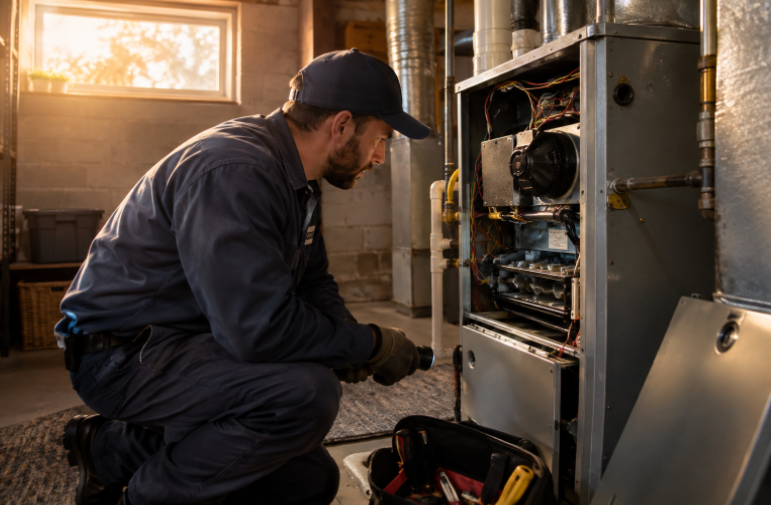
One fault does not automatically mean a furnace needs replacement. A qualified technician may be able to correct a specific issue and restore normal operation, particularly when the equipment is relatively new and has otherwise been dependable.
Ask for a written diagnosis that identifies the failed part, the likely cause, and the recommended repair. A symptom such as cold air or frequent cycling can have several possible causes, so a diagnosis is more useful than a guess based on the symptom alone.
- A thermostat that is not reading or communicating correctly.
- A dirty, blocked, or incorrectly fitted air filter.
- A worn igniter or a dirty flame sensor.
- Weak airflow caused by a blower motor, capacitor, or control problem.
- Short cycling, where the furnace starts and stops more often than expected.
- A failed switch, sensor, or other serviceable component.
Signs Replacement May Be the Better Choice
Replacement becomes a more reasonable conversation when the furnace has repeated breakdowns, unreliable starts, loud operation, steadily worsening comfort, or repair needs involving major components. A cracked heat exchanger or a serious combustion-related problem can alter the decision because safe operation must come first.
Age is relevant, but it is not a verdict in itself. A well-maintained older furnace may still have useful service life, while a newer furnace that was improperly installed or neglected can develop problems sooner. Consider age alongside maintenance records, parts availability, repair history, warranty coverage, energy use, and the expected life of the proposed repair.
Use a Repair-Cost Test, Not a Single Rule
Compare the complete repair quote with an estimate for a suitable replacement system. Include labor, diagnostic fees, parts, warranties, installation work, and any necessary changes to venting, electrical connections, controls, or ductwork. A repair that appears inexpensive can be less appealing if several other aging components are likely to require attention soon.
Conversely, a major repair may still be the sensible choice when the furnace is newer, the fault is isolated, replacement parts are readily available, and the rest of the system is in good condition. When a major component fails, request both options in writing and compare how each choice addresses the issue.
Check Age and Repair History
Find the model and serial number on the furnace data plate, typically located inside or near the cabinet. Record the installation date if known, then list every service visit from the last two or three heating seasons. Frequent calls for different components can indicate declining reliability even when no single invoice seems overwhelming.
This record also makes it easier to ask informed questions. Note whether the same issue keeps returning, whether repairs were covered by warranty, and whether the home has experienced persistent comfort problems after service.
Look Beyond the Furnace Itself
A furnace is only one part of a home heating system. Cold bedrooms, weak airflow, and high heating bills can also be related to duct leakage, blocked vents, insufficient return air, insulation gaps, air leaks, or an incorrectly sized system. Replacing the furnace without investigating these conditions may leave the original comfort problem unresolved.
Quick Home Comfort Check
- Confirm that supply vents are open and not blocked by furniture or rugs.
- Check that return-air grilles are not obstructed.
- Inspect or replace the filter according to the equipment manufacturer’s instructions.
- Notice whether the same rooms are consistently colder than the rest of the home.
- Consider whether the thermostat is near a drafty area, a sunny window, a kitchen heat source, or an exterior door.
Regular filter attention supports airflow and system performance. Natural Resources Canada advises homeowners to inspect and clean or replace furnace filters according to the furnace type and manufacturer instructions as part of central heating and cooling maintenance.
What to Ask a Heating Technician
- What caused the failure, and what testing supports that diagnosis?
- Is there a safety concern that requires the furnace to remain off?
- How long is the repaired component expected to last?
- Are replacement parts still available and covered by warranty?
- What is the full repair cost, including labor and diagnostic charges?
- What would a comparable replacement cost, including installation?
- Will a replacement suit the home’s ductwork and heating requirements?
- What warranty applies to each option?
Repair or Replace: A Simple Decision Guide
- Newer furnace, one isolated fault: Repair is often worth considering because much of the system’s service life may remain.
- Older furnace, repeated repairs: Compare replacement options before committing more money to a pattern of breakdowns.
- Safety or combustion concern: Stop using the system and seek professional assessment before making a cost decision.
- Repair estimate close to replacement cost: Review reliability, warranty, efficiency, and installation scope for both choices.
- Uneven heat without a clear furnace fault: Investigate airflow, ductwork, insulation, and thermostat placement.
Plan Before the Next Cold Snap
Schedule seasonal service before heavy winter demand, keep exterior exhaust areas clear, and save written estimates with your furnace records. The best repair-or-replace decision is based on evidence rather than pressure. A straightforward repair can be the right answer for a dependable system, while repeated failures or a serious safety issue may justify replacement to protect comfort, budget, and household safety.

Team Home Spacess shares simple, practical design ideas that work for real families. The team focuses on cozy décor, soft colors, and natural textures that make a space feel truly lived-in. From everyday decorating tips to creative home projects, Team Home Spacess is dedicated to helping readers create warm, comfortable, and inviting spaces with a fresh and personal touch.