

By a commercial property maintenance industry contributor.
A fresh tag on a commercial building isn’t just an annoyance; it’s a costly problem. Your first reaction is to get it gone, fast. But a rushed, incorrect removal can cause more expensive damage than the paint itself. This can lead to chipped brick, etched glass, or a permanent “ghost” of the tag that shows through new paint. The wrong approach turns a surface problem into a structural one.
The challenge is that every situation is different. The spray paint used for a quick tag is not the same as the thick enamel used in a larger piece. An absorbent surface like sandstone or brick will soak up paint colors, while a sealed metal panel is a different problem to solve. Knowing these differences is the first step to avoiding costly mistakes. For property managers, getting a clear check of the materials involved is key before any work begins. The full scope of commercial graffiti cleaning denver depends on this first assessment.
The cost of labor is another big part of professional services. According to the U.S. Bureau of Labor Statistics, the average hourly pay for building and grounds cleaning workers in the Denver area was $20.25 in May 2023. This is part of a larger pattern where average wages in the metro area are higher than the national average. This detail affects the final price of any skilled service.
Quick answer: Proper graffiti removal is a skilled job, not just a cleaning task. The right method depends on the type of paint and how much the surface material absorbs it. Using the wrong technique can cause permanent damage. Local labor costs, which are higher than the national average, are a big part of professional service pricing.
What’s inside
- How Do Denver’s Labor Costs Affect Project Pricing?
- What Questions Should I Ask Before Approving a Removal Quote?
- Why Can’t You Just Paint Over It?
- Frequently Asked Questions
- Protecting the Asset, Not Just Cleaning the Stain
How Do Denver’s Labor Costs Affect Project Pricing?
Local labor rates are a main reason for project costs. The final price must cover the higher-than-average wages needed to keep skilled workers in the metro area. This isn’t just about one person’s paycheck; it reflects the entire local economy. It has a direct impact on the budget for any commercial property maintenance task, including graffiti removal.
The economy in the Denver area sets the stage for service pricing. Data from the U.S. Bureau of Labor Statistics shows that the average hourly wage for all jobs in the Denver-Aurora-Lakewood area was $36.50 in May 2023. This is much higher than the national average of $31.48. This higher pay affects every industry, but it is especially true for skilled jobs where experience is needed to get results without causing property damage.
A worker’s wage is only the starting point. A professional quote for graffiti removal combines this direct labor cost with other business costs. These include liability insurance to protect your property, workers’ compensation, the cost of special tools, and supplies like blasting materials or chemical removers. Also, proper training and safety certifications are a big and ongoing expense for any good company. These business costs go up as wages go up.
When looking at a bid, ask how the hourly rate is made up. A contractor’s total hourly rate, which includes all business costs and profit, is often several times the worker’s direct pay. A company that cannot explain this is a warning sign. The price reflects the entire support system needed to do the work safely and correctly.
Understanding this cost structure helps you compare quotes better. A much lower price may look good, but it often means they are cutting corners in important areas. The contractor might not have enough insurance, use untrained workers, or rely on low-quality tools that could damage your property. Paying a price that reflects local wages is not just about covering paychecks; it’s paying to avoid bigger problems and making sure the job is done right the first time.
What Questions Should I Ask Before Approving a Removal Quote?
You should ask for a detailed explanation of the removal method and why it is right for the damaged surface. A professional’s value is not in blasting paint away, but in knowing how to do it without damaging your property. The first conversation should be about protecting your building, not just about the price.
A key sign of an experienced worker is the suggestion for a test patch. Before starting the full cleaning, they should offer to test their method on a small, hidden spot. This lets both of you confirm the process works and won’t cause fading, etching, or other permanent damage. If a contractor is not willing to do a test, it is a big warning sign.
Understanding the options is also important. Different surfaces need different techniques. Using the same method for everything leads to expensive damage.
| Removal Method | Best For | Key Risk |
|---|---|---|
| Pressure Washing | Smooth, strong, non-absorbent surfaces like sealed concrete or metal. Works for newer, less-stuck paints. | Can push paint deeper into absorbent materials like brick or wood. High pressure can damage soft stone or strip protective coatings. |
| Chemical Solvents | Delicate surfaces where scraping or blasting isn’t an option. Good for breaking down certain paints on historic materials. | Can leave chemical stains or “ghost” marks if not fully rinsed. Must be contained carefully to protect the environment. |
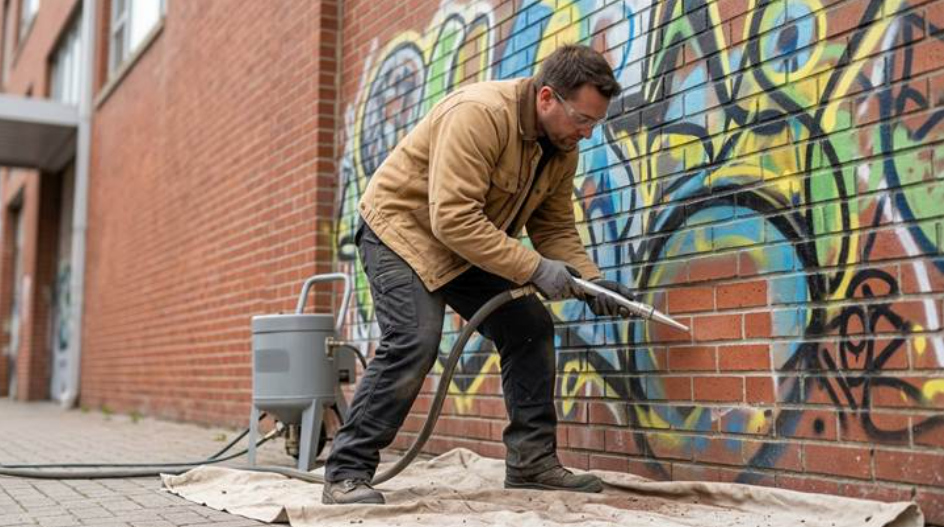
| Media Blasting | Tough surfaces like steel or thick concrete. Uses materials like sand or glass beads to wear the paint away. | Very damaging to soft materials like brick, wood, or limestone. Can remove the hard outer surface of old brick, making it wear out faster. |
The risk of using the wrong blasting method on brick or stone is very high. According to the National Park Service’s Technical Preservation Services, rough methods like sandblasting can strip the smooth, fired outer surface of brick. That leaves a rough face that erodes, holds dirt, and is harder to clean the next time. Always ask a contractor to explain their choice of blasting material and pressure settings for your specific type of brick or stone.
Finally, check their insurance and safety rules. Ask for a current insurance certificate that covers both general liability and workers’ compensation. You should also ask about their safety plan for the job site. How will they manage public access during the work? How will they contain runoff or dust? A professional company will have clear, written answers to these questions.
Why Can’t You Just Paint Over It?
Painting over graffiti often fails because chemicals in the new paint soften the old paint. This causes the tag to leak through the new paint. The result is a faint but permanent “ghost” of the original image, which wastes the time and paint spent on the cover-up. A real fix requires fixing the real chemical problem, not just covering it up.
Most paints have three main parts: pigment for color, a binder that acts like glue, and a solvent that keeps it liquid. When graffiti is sprayed, the solvent evaporates, leaving the color and binder stuck to the surface. When you apply a new layer of paint, you add fresh solvents. These chemicals can soften the graffiti’s binder. This allows the strong colors from the tag to move up into the new paint layer as it dries. Reds and blacks are especially known for bleeding through.
The strange part is that the act of “fixing” the problem makes it reappear. The new paint’s chemicals act like a key, releasing the old paint’s colors and pulling them to the surface. This is why a quick coat of standard primer or matching paint almost never works by itself.
To prevent this, you must create a solid seal between the old and new layers. This requires a special primer that blocks stains, often one that is shellac-based or alcohol-based. These primers dry into a solid layer that physically seals the graffiti. The chemicals in the top paint can’t get through this seal to soften the tag underneath. Without this specific type of primer, you are just mixing the problem into the solution.
Even with a perfect chemical block, a physical outline can remain. The edges of the spray paint are slightly thicker than the wall around them. This difference in texture, called “telegraphing,” can still be seen under the new paint, especially in certain light. For a perfectly smooth repair, the texture must be sanded to be smooth before priming and painting. On absorbent materials like brick or concrete, where the color has soaked into the surface, painting over usually doesn’t work for long. The color must be removed first.
Frequently Asked Questions
How much does it cost to clean graffiti? Pricing is usually based on the square footage, but most professional services have a minimum charge for sending a team and their tools. The final cost depends on a few things: the type of surface (absorbent brick is harder than smooth metal), the type of paint used, and how hard it is to reach the area. A detailed quote should break down these factors.
Can a pressure washer remove all types of graffiti? No, and using one the wrong way is a common cause of permanent damage. While it works on strong, sealed surfaces, high-pressure water can push paint colors deeper into absorbent materials like brick, concrete, or wood. It can also cause spalling, which is the chipping or flaking of the surface, especially on older or softer stone.
What is “ghosting” and can it be prevented? Ghosting is the faint shadow of graffiti that remains after cleaning. It happens when paint colors have soaked deep into a surface. To prevent it, you need a removal method that pulls the color out, not just cleans the surface. If ghosting can’t be avoided, a specialist may use special stains that match the brick or stone to blend the area.
Are there environmentally friendly graffiti removal options? Yes, several methods are better for the environment. Media blasting with natural materials that break down, like crushed walnut shells or baking soda, is one option. Another is dry ice blasting, which uses frozen carbon dioxide pellets that turn directly into a gas on impact. This process leaves no leftover mess or water runoff to clean up.
How quickly should graffiti be removed from a commercial property? Most property managers and city rules aim for removal within 24 to 48 hours. This quick response does two things. First, it doesn’t give the vandal the attention they want, which discourages them from doing it again. Second, it makes removal easier, as the paint has not had weeks to fully dry and bond to the surface.
How do anti-graffiti coatings work? These protective coatings create a barrier between the building and the paint. There are two main types. Sacrificial coatings are a clear layer that is removed along with the graffiti using low-pressure hot water; then the coating is reapplied. Non-sacrificial coatings create a permanent, slick surface that paint can’t stick to, so it can be wiped off easily without damaging the coating.
Protecting the Asset, Not Just Cleaning the Stain
Responding to graffiti is more than a simple cleaning task; it is about protecting your property. The immediate problem is the unwanted paint, but the bigger risk is permanent damage from the wrong removal method. A low bid that results in chipped brick, etched glass, or a permanent chemical stain is not a good deal. It turns a temporary problem into a major, expensive repair.
The most important step happens before any equipment is turned on. It is the first check, the test patch, and the clear explanation of why a specific method was chosen for your building’s specific surfaces. The right approach puts the long-term health of the surface first, over the short-term removal of the paint. By focusing on a contractor’s technical knowledge and their plan to prevent damage, you are not just buying a cleaning service. You are investing in protecting your property’s value.
About the author
The insights in this article come from the specialists at Lightning Mobile. For more than 40 years, the company has served Denver’s businesses and industrial companies with complete property maintenance services. Their expertise ranges from skilled surface cleaning, such as graffiti removal and sandblasting, to mobile welding and site services. They partner with property management firms and construction companies to solve complex maintenance needs while making sure to protect the buildings they work on.

Team Home Spacess shares simple, practical design ideas that work for real families. The team focuses on cozy décor, soft colors, and natural textures that make a space feel truly lived-in. From everyday decorating tips to creative home projects, Team Home Spacess is dedicated to helping readers create warm, comfortable, and inviting spaces with a fresh and personal touch.