

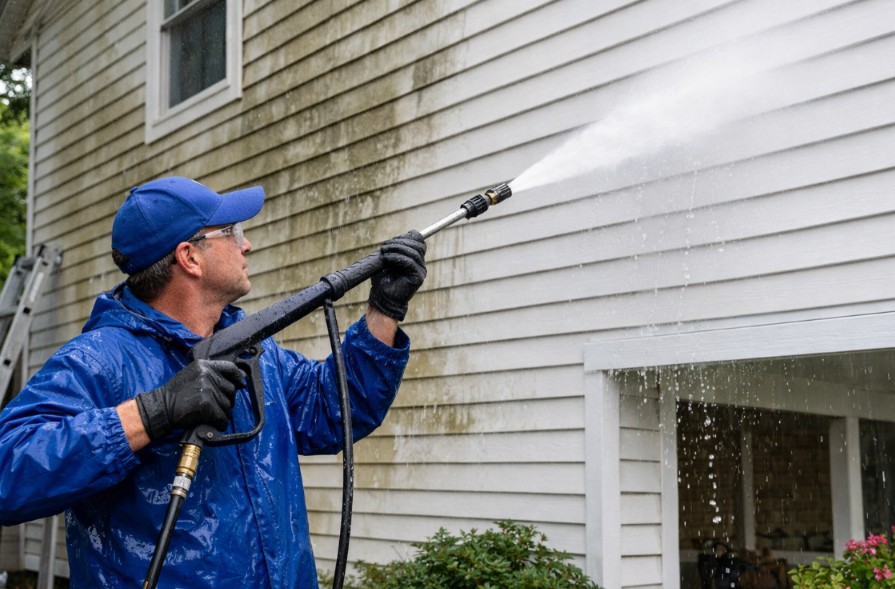
Last summer, a homeowner in Vaucluse hired a pressure washing crew off a local Facebook group. The quote was fast. The price was low. The crew arrived with a single machine, dialed to full pressure, and worked through the entire property in four hours. By the time they packed up, the century-old sandstone stairs at the front entry looked “clean” at a glance. Two weeks later, the owner noticed the stone surface had turned chalky white in patches. The texture was rougher than before. A stonemason later confirmed what the pressure had done: it had stripped the outer skin of the sandstone, opened the pores, and accelerated the exact biological regrowth the homeowner was trying to fix. The repair bill was three times the original cleaning cost. The full story of how this keeps happening, and why the exterior cleaning industry lets it, is at https://theprestigestandard.com.au/.
This is not a rare story in Sydney. It plays out across the Eastern Suburbs, the North Shore, and the Northern Beaches every single season. And the financial stakes have never been higher. The Australian Bureau of Statistics puts the mean NSW dwelling value above $1.2 million in 2025, the highest in the country. When a cleaning error strips a sandstone facade, etches a limestone pool coping, or forces water into a rendered wall, that is not a cosmetic inconvenience. It is damage to an asset worth seven figures.
Sydney’s Climate Is Making the Problem Worse
Here is something the exterior cleaning industry does not advertise: the warmer Sydney gets, the more biological growth attacks your facade, and the more tempting it becomes to blast harder. The Bureau of Meteorology confirmed that 2024 was Australia’s second-warmest year on record. Warmer, humid, coastal conditions are the ideal environment for mould, algae, lichen, and moss. They colonise render, sandstone, limestone, roof tiles, and glass faster than they did a decade ago.
So owners call a cleaner. The cleaner shows up with a pressure washer on full bore. The organic growth disappears visually. What also disappears, in some cases, is the stone surface itself. Sandstone is a soft, porous material. Its outer skin, called the case hardening, is the natural protective layer that formed over decades of weathering. High-pressure water strips that skin in minutes. Once it is gone, the stone absorbs water, salt, and spores at a dramatically faster rate. The growth comes back harder. The stone stays damaged permanently.
Limestone is similarly unforgiving. It reacts to acidic chemistry. Some operators still use acid-based cleaners to shift organic staining. On limestone, that is the equivalent of dissolving the surface you are trying to protect. The etching is immediate, the texture change is permanent, and no amount of sealing fixes a chemically eroded surface.
Render is the other casualty. Sydney’s older homes, particularly federation and interwar properties, carry render that is at adhesion limits. High-pressure water does not just clean it. It forces moisture behind the paint film, lifts the bond, and causes delamination that shows up weeks after the cleaner has been paid and left.
The Stormwater Problem Nobody Warns You About
There is a second failure mode that is almost never discussed on exterior cleaning websites: where does the dirty water actually go?
When a pressure washer runs on a driveway, a sandstone retaining wall, or a tiled pool surround, the wastewater carries detergents, sediment, mould spores, paint residue, hydrocarbons, and biocides. If that water is not physically contained and collected at the work face, it flows into the stormwater drain at the kerb. Sydney’s stormwater drains do not go to treatment infrastructure. They drain directly to the harbour and to coastal beaches.
This is not a theoretical concern. The NSW Government’s State of the Beaches reports, published annually through NSW Beachwatch, consistently identify stormwater pollution as a major driver of degraded swimming water quality in harbour and estuarine areas. And in 2024, the NSW EPA strengthened enforcement powers and increased penalties for pollution offences under its updated regulatory framework. Uncontrolled wash-down run-off from residential or strata cleaning is the kind of event those penalties are designed to address.
Councils including Woollahra, Waverley, Randwick, Mosman, Ku-ring-gai, and Northern Beaches have their own specific prohibitions on wash water entering the stormwater system. Most homeowners have no idea this obligation exists. Most exterior cleaning operators do not mention it. Some actively ignore it, because proper containment and collection add time and equipment to the job, which cuts the margin on a cheap quote.
The homeowner who books the cheapest crew does not just risk a damaged surface. They risk contributing to a stormwater compliance breach on their own property. The responsibility for what leaves your site does not vanish because someone else was holding the pressure wand.
Matching the Method to the Surface: What Professional Practice Actually Looks Like
The core failure in the exterior cleaning market is simple: most operators apply one method to every surface. A single pressure washer, a single chemical, one PSI setting, everything done in a day. It is fast. It looks clean on the day. The problems emerge over the weeks and months that follow.
Surface-matched cleaning works differently. The method is selected based on what the surface actually is, not what will get the job done quickest.
Sandstone and limestone require low-pressure or zero-pressure application. The cleaning agent does the work, not the mechanical force. The chemistry must be pH-neutral or mildly alkaline. Acid etches carbonate stone. High pressure erodes the matrix. Rinse pressure must be controlled to prevent water ingress into mortar joints. This is not over-engineering. This is basic conservation practice applied to residential exteriors.
Render and painted masonry need soft washing: low-pressure delivery of chemistry that kills mould and algae at a biological level, without mechanical force that tests the adhesion of old paint films. Any operator worth hiring will spot-test render before committing to a full clean.
Concrete driveways and pool surrounds are genuinely suitable for pressure cleaning, but the execution matters. Hot-water rotary surface cleaners distribute pressure evenly across the full cleaning head. They eliminate the zebra striping that results from wand cleaning, and they achieve effective results at lower PSI than a single wand requires. Run-off containment is still mandatory regardless of surface type.
Glass balustrades and coastal facades accumulate mineral deposits from salt spray and hard water. Pure-water or deionized water systems remove those deposits without detergent residue and without the micro-scratching that abrasive cleaning compounds or direct high-pressure application cause on glass.
The practical point is this: a professional exterior cleaner should be able to tell you, before they start, exactly what pressure and chemistry they are using on each surface and why. If they cannot, that is a direct signal about what will happen to your property.
Contractor Liability: The Risk That Lands on You
The working-at-heights dimension of exterior cleaning is almost never discussed in the booking conversation. It should be one of the first things confirmed.
Safe Work Australia’s 2024 key statistics recorded 200 worker fatalities in 2023 and nearly 139,000 serious workers’ compensation claims filed in 2022 to 2023. Exterior house cleaning routinely involves ladders, multi-storey access, sloped driveways, rooftops, and balconies. When an uninsured or improperly trained worker is injured on your property, the liability consequences do not automatically fall only on the contractor. Property owners and strata managers who engage operators without adequate insurance and training have genuine exposure.
Five things to verify before any exterior cleaning contractor starts work:
- Public liability insurance at an adequate level, confirmed in writing before commencement. For strata and commercial work, $20 million is the industry benchmark.
- Workers’ compensation insurance covering all technicians on-site. The absence of this shifts incident liability in ways most homeowners have never considered.
- Named, background-checked technicians, not anonymous labor-hire or unverified subcontractors. Anonymous operators on high-value occupied properties is an unacceptable risk profile, full stop.
- A written guarantee that covers the cleaning outcome. Verbal assurances are not enforceable. A written re-clean commitment within a defined period is the benchmark.
- A specific run-off containment protocol they can describe without hesitation. If the answer is vague, the drains are probably getting it.
Five Questions That Separate Professionals From the Rest
Ask these before any crew arrives on your property. The quality of the answers tells you everything you need to know.
“What PSI and chemistry will you use on this specific surface, and why?” A qualified operator answers immediately and specifically. A generic operator quotes a single setting for everything.
“How do you contain and dispose of run-off water on this job?” A specific protocol is the only acceptable answer. Any hesitation or vague reassurance is a red flag.
“Can you send your public liability and workers’ compensation certificate of currency before the job starts?” Non-negotiable for any strata, heritage, or high-value property. Any reluctance here tells you what you need to know.
“Who will be on-site, and have they been police-checked?” Relevant for any occupied home, strata building, or property with vulnerable residents. Named technicians with background checks are not a premium feature. They are a basic professional standard.
“What is your guarantee if the result does not meet the agreed standard?” A written seven-day re-clean commitment is the floor. If the answer is verbal, it is not a guarantee. It is a conversation that will be hard to have after the invoice is paid.
Sydney’s exterior cleaning market is full of operators who are fast, cheap, and unspecific. The evidence for what that costs, in damaged stone, stormwater breaches, and contractor liability, is now well documented. With NSW property values at record highs, EPA enforcement tightening, and warming conditions accelerating biological growth every season, the approach of choosing the cheapest crew with the biggest pressure washer is simply not a rational option for a property worth over a million dollars. The method matters. The chemistry matters. The compliance documentation matters. And the guarantee needs to be in writing before the first technician walks through the gate.

Team Home Spacess shares simple, practical design ideas that work for real families. The team focuses on cozy décor, soft colors, and natural textures that make a space feel truly lived-in. From everyday decorating tips to creative home projects, Team Home Spacess is dedicated to helping readers create warm, comfortable, and inviting spaces with a fresh and personal touch.