

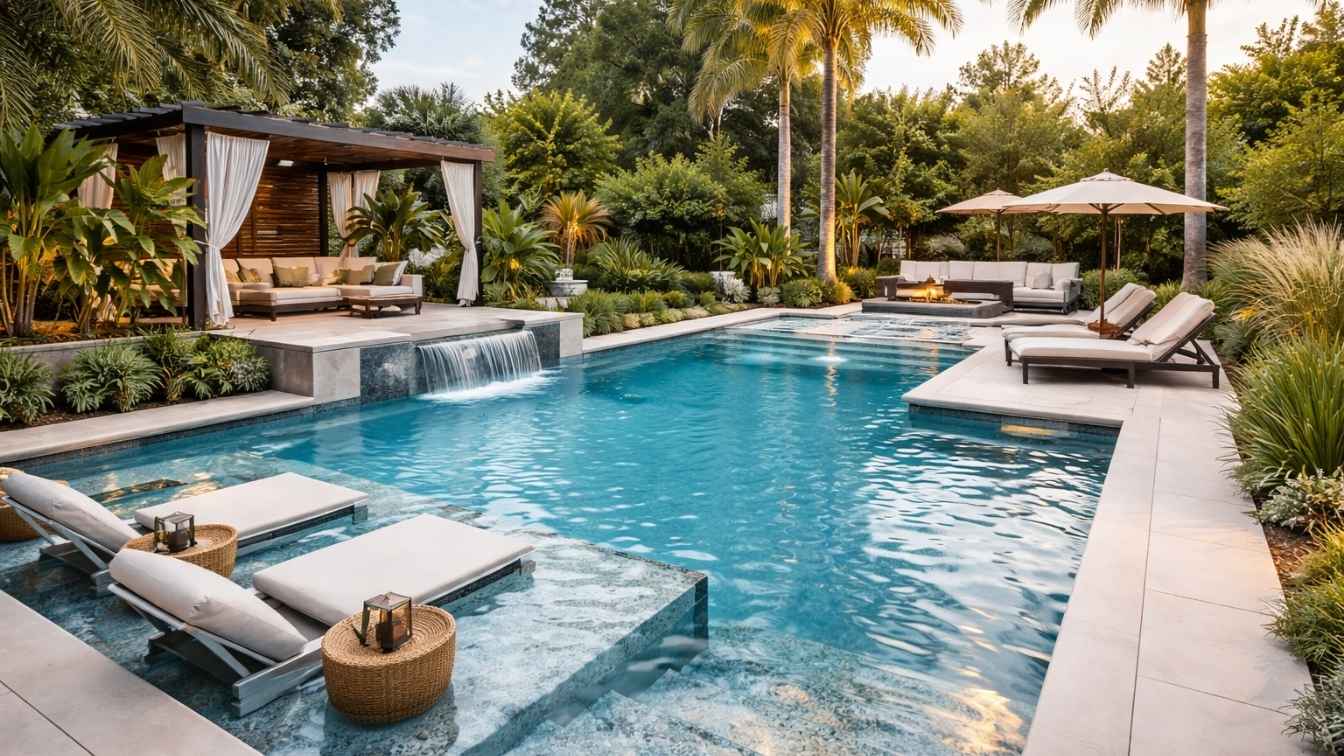
You want a swimming pool that looks beautiful in photos and feels even better in real life but with hundreds of options online, most homeowners end up choosing a design that’s either forgettable or financially regrettable. The truth is, the right swimming pool design doesn’t just add a place to swim. It changes how you use your entire outdoor space.
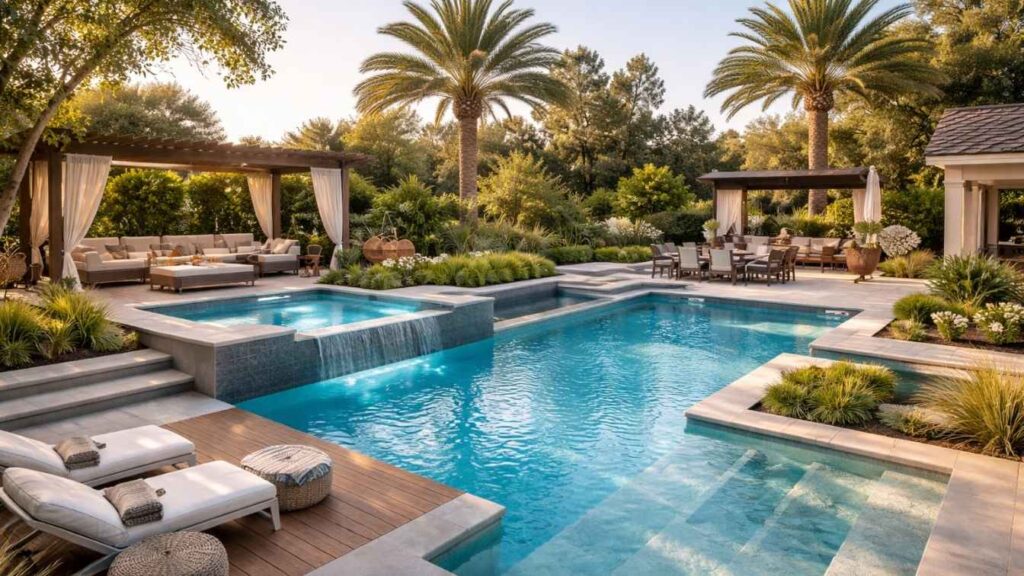
This guide covers 9 carefully chosen swimming pool design ideas, from sleek infinity edges to nature-inspired lagoon pools each with real-world insights on cost, maintenance, and long-term value. Whether you have a small urban yard or a sprawling estate lot, there’s a design here that fits your lifestyle and budget.
$22K
Average pool adds to US home resale value
67%
Buyers prefer homes with outdoor water features
30%
Water savings with modern eco-pool systems
Infinity Edge Pools:
The Art of the Vanishing Horizon
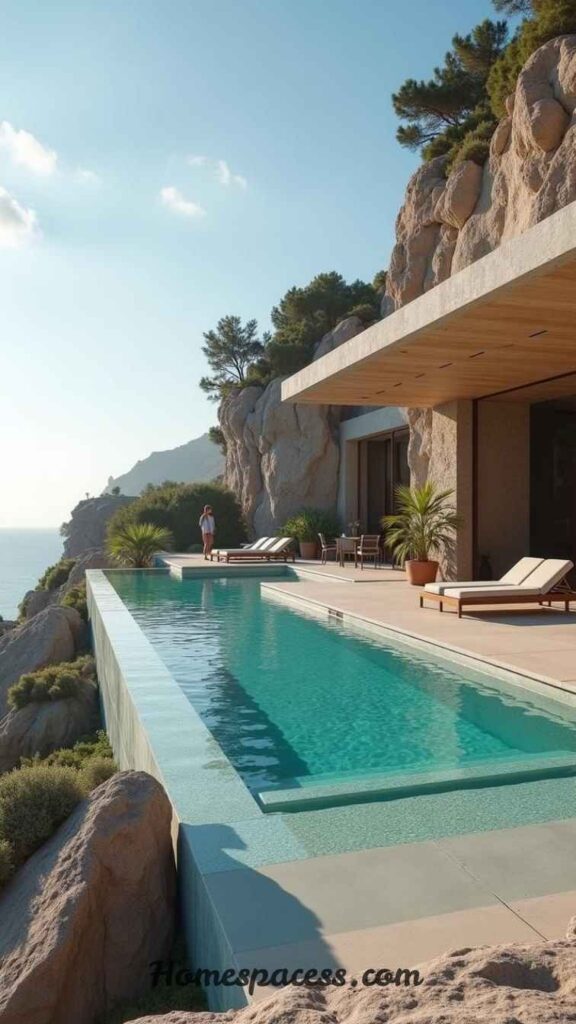
Few swimming pool designs command attention like an infinity edge pool, also called a vanishing-edge or negative-edge pool. The concept is deceptively clever: one or more walls of the pool end at a precise elevation, causing the water to flow over the edge and collect in a catch basin below, then recirculate back. From the swimmer’s vantage point, the water appears to seamlessly merge with the sky, ocean, or landscape beyond an optical illusion that never loses its drama.
What most guides don’t mention is that the success of an infinity pool is entirely dependent on site selection. The pool only works visually when it’s positioned above a meaningful view a valley, cityscape, ocean, or even a well-landscaped lower garden. Constructing an infinity edge on flat terrain or facing a fence produces no visual payoff and adds substantial cost for zero wow factor. For this reason, hillside lots and elevated terraces are the ideal candidates.
Expert Insight:
The catch basin for an infinity pool typically requires a volume equal to 10–15% of the main pool’s capacity to safely collect overflow during heavy use. Undersized catch basins are the #1 cause of mechanical failure in DIY infinity pool projects.
From a materials standpoint, dark interior finishes midnight blue glass tile, charcoal plaster, or black granite dramatically enhance the mirror-like effect and make the water appear deeper and more reflective. Pairing this with recessed LED lighting transforms the pool at night into something truly extraordinary. Budget realistically: infinity pools typically cost 20–35% more than a standard pool of equivalent size, but they also return the highest resale premium of any pool style.
Must Read: Sun Room Ideas That Turn Dead Space Into Your Home’s Best Room
Natural Swimming Pools:
Where Biology Replaces Chemicals
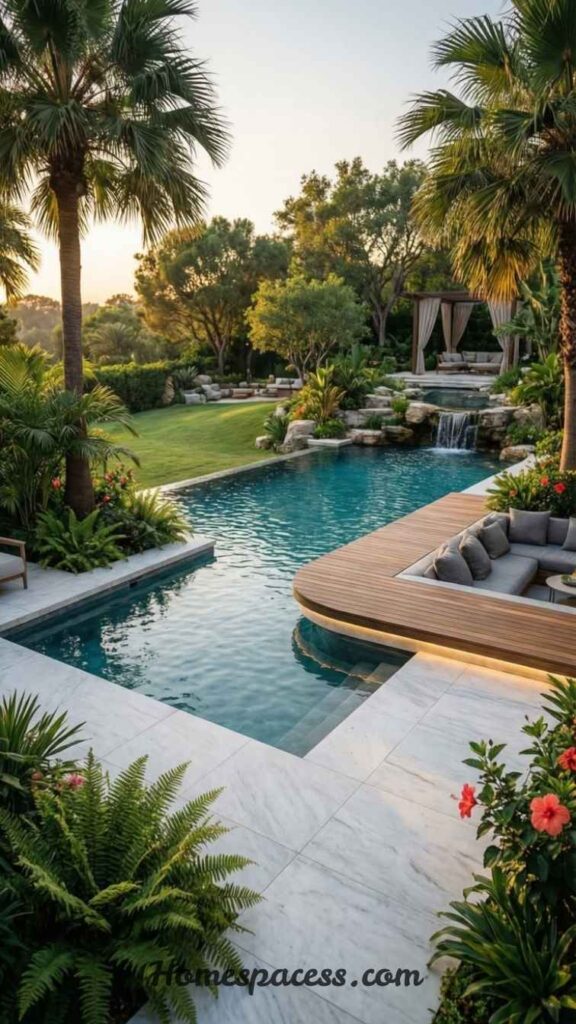
A natural swimming pool sometimes called a biopool or swimming pond uses aquatic plants and gravel bio-filters instead of chlorine or salt to maintain clean, swimmable water. The pool is divided into two zones: the swimming zone (typically lined with a rubber membrane) and the regeneration zone (a planted, shallow area filled with water-purifying plants like cattails, water iris, and submerged oxygenators). Water circulates continuously between both, emerging naturally filtered and clear.
These designs originated in Austria and Germany in the 1980s and have been rapidly gaining traction in the United States and UK as homeowners become more aware of chlorine’s long-term skin and health implications. For families with children or those with sensitive skin conditions, the appeal is significant. However, natural pools require a larger total footprint typically the regeneration zone needs to equal at least 50% of the swimming area making them better suited to generous outdoor spaces.
What Competitors Miss About Natural Pools:
Natural pools actually require more upfront design expertise than conventional pools, not less. The ecosystem needs to be balanced from day one: too few plants and the water turns green; too many and circulation is compromised. Working with a qualified aquatic ecologist during the design phase not just a landscape contractor is the single biggest predictor of success.
Maintenance is also misunderstood. Natural pools don’t require zero maintenance they require different maintenance. Regular plant pruning, debris removal from the regeneration zone, and seasonal inspections are essential. But there are no chemicals to store, no chlorine odour, and running costs are typically 30–50% lower than conventional pools.
Don’t Skip: Entryway Decor Ideas: Transform Your First Impression Into a Lasting Statement
Geometric Modern Pool Designs:
Precision as Aesthetic
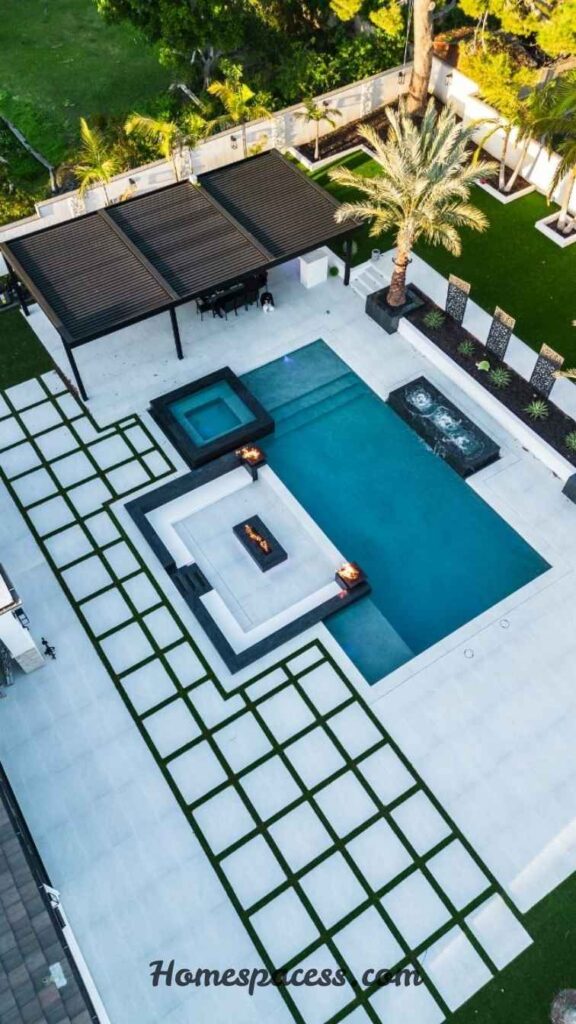
Geometric pool designs clean rectangles, L-shapes, T-shapes, and multi-level configurations remain the dominant choice in contemporary architecture for good reason. They integrate seamlessly with modern home design, they’re easier to cover with automatic covers (which reduce both heating costs and evaporation), and their straight edges make tile work, coping, and water feature integration more predictable and cost-efficient.
The real design conversation in 2026 is about what happens *around* the geometric pool, not just its shape. Sun shelves also called tanning ledges have become nearly standard, a shallow 9-to-12-inch platform at one end where lounge chairs can sit in the water. Integrated spa spillovers, linear fire features running along the pool’s long edge, and frameless glass fencing (which preserves sightlines without visual interruption) are the details that elevate a simple rectangle into a luxury outdoor living room.
For urban lots where space is constrained, the L-shaped pool is an underrated champion. One arm of the L can serve as the lap swimming zone while the perpendicular section becomes a shallow lounging and play area two functional zones in one design, without sacrificing the clean geometric language.
Read More: 20 Stunning Door Painting Ideas That Actually Transform your Home
Lap Pools & Fitness Pools:
Performance Meets Elegance
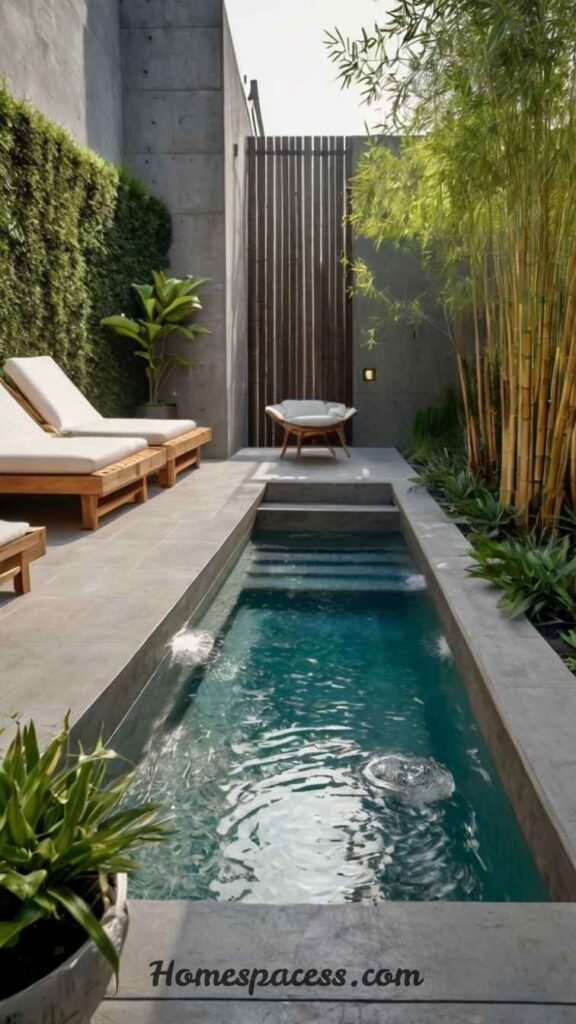
A lap pool is purpose-built for swimming laps typically long, narrow, and deep enough to allow flip turns. The standard dimensions for serious swimmers are at least 40 feet long, 8–10 feet wide, and 4.5–5 feet deep throughout. What has changed in recent years is their aesthetic integration: the era of the purely utilitarian lap pool is over. Today’s fitness pools incorporate the same premium finishes, lighting systems, and landscape integration as resort pools.
For homeowners who want performance swimming but don’t have the space for a full-length lap pool, the swim spa and counter-current system have become compelling alternatives. These compact units sometimes just 14–17 feet long generate an adjustable current that allows open-water-style swimming in place. While the swimming sensation differs from a traditional lap pool, the cardiovascular benefit is genuine. Many high-performance swim spas now include resistance bands, underwater treadmills, and hydrotherapy jets, blurring the line between pool and fitness equipment.
Design Tip
Place the lap pool parallel to the longest axis of your property to maximize perceived and actual length. A 50-foot lap pool running the full depth of a lot feels dramatically more generous than the same pool running across its width.
Don’t Miss: 25 Home Decor Ideas That Actually Transform Your Space
Plunge Pools & Cocktail Pools:
Maximum Impact, Minimum Space
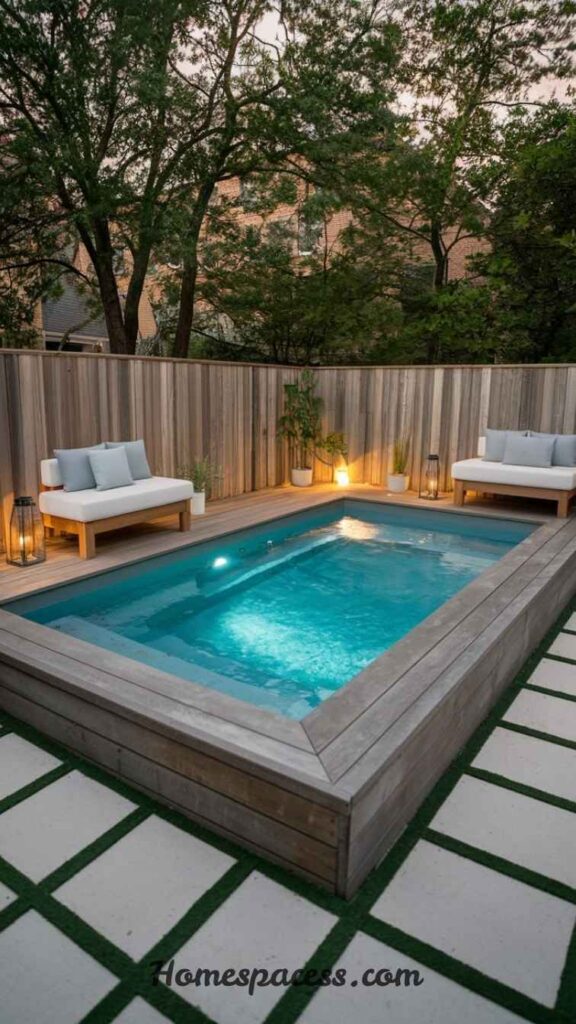
The plunge pool compact, deep, and designed for cooling off rather than swimming laps has emerged as one of the fastest-growing segments in residential pool design, driven entirely by urban density and the explosion of smaller lot developments. A typical plunge pool ranges from 6 to 12 feet wide and 10 to 22 feet long, with depths often reaching 5 to 6 feet deeper than most standard pools because the therapeutic benefit (and the drama) comes from the depth, not the surface area.
The closely related “cocktail pool” is slightly shallower and wider typically designed for social use rather than exercise or cold therapy. Think 8-by-12 feet with a built-in bench seat, a small sun shelf, and often a connected spa or hot tub. For apartment rooftops, courtyard gardens, and narrow urban backyards, the cocktail pool delivers the lifestyle value of a full pool at roughly 40–60% of the cost. Installation is also significantly faster, often completing in 6–10 weeks compared to 3–6 months for larger builds.
Cold Plunge: The Wellness Trend Reshaping Pool Design
The biohacking and longevity movement has supercharged interest in dedicated cold plunge pools, kept at a consistent 50–59°F (10–15°C). These are now being designed as permanent outdoor features rather than portable tubs, using medical-grade chillers and high-flow circulation. When paired with an adjacent hot tub or sauna, the “contrast therapy” circuit has become a serious wellness amenity that high-end homeowners are budgeting specifically for.
From a design perspective, the contrast therapy setup cold plunge, hot spa, and sauna in close proximity creates a natural outdoor wellness hub that benefits from thoughtful orientation, privacy screening, and flooring materials that are safe for wet, rapid transitions between temperatures.
Rooftop & Terrace Pool Designs:
Urban Elevation
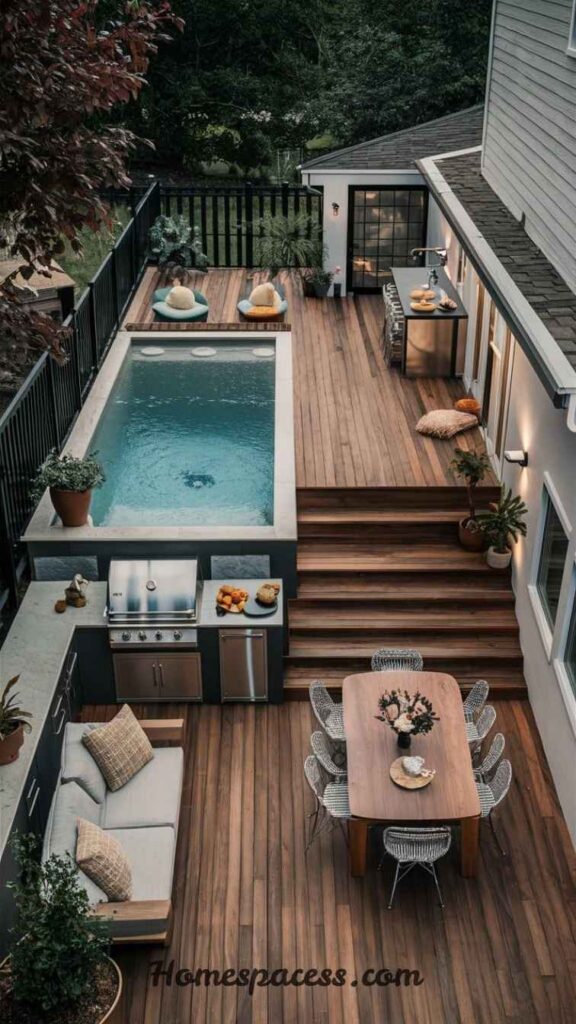
Rooftop pools represent the pinnacle of urban luxury and engineering complexity. Unlike ground-level installations, every design decision for a rooftop pool must account for structural load water weighs approximately 8.3 pounds per gallon, and a modest 12-by-24-foot pool holds roughly 14,000 gallons, adding over 58 tonnes of distributed weight. This demands a thorough structural engineering assessment before any design work begins, not after.
The most spectacular rooftop pool designs use transparent acrylic or ultra-clear glass panels on at least one side, creating the now-iconic “glass-bottom pool” effect seen in luxury hotels. This technique, while visually extraordinary, requires panels engineered to withstand the full hydrostatic pressure of the water column a specialized and premium product that significantly adds to the project cost. For private residences, even a 1-meter-wide glass panel can create the illusion of the full effect at a fraction of the cost of a fully glazed end wall.
Rooftop pools also require careful attention to wind, sun exposure, and drainage. In most urban settings, they benefit from wind-breaking screens or privacy walls that double as shade structures and help retain heat a practical necessity that can also become a stunning architectural feature if well-designed.
Indoor Swimming Pool Designs:
Year-Round Luxury
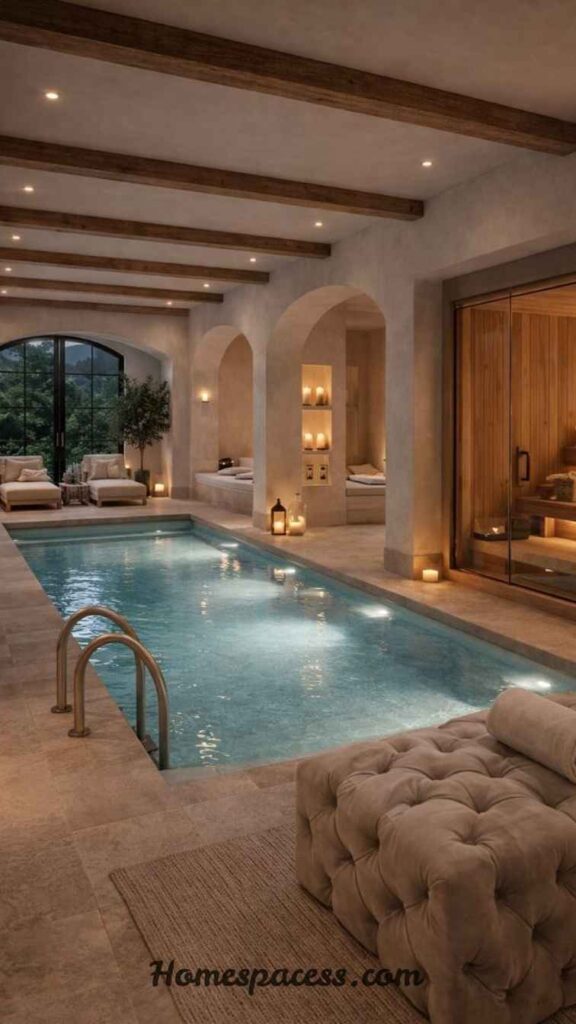
An indoor pool eliminates the seasonal limitation of outdoor swimming entirely, and when thoughtfully designed, it becomes the most-used room in the house. The key engineering challenge is humidity control without a proper natatorium dehumidification system (distinct from standard HVAC), the moisture produced by an indoor pool will cause progressive structural damage to walls, ceilings, insulation, and mechanical systems within just a few years.
Architecturally, indoor pools have evolved far beyond the institutional feel of hotel or gym natatoriums. Private indoor pool spaces now commonly feature vaulted timber ceilings, natural stone walls, floor-to-ceiling glazing that opens to exterior gardens, and curated lighting systems that simulate daylight conditions. The boundary between interior and exterior pool spaces is increasingly blurred through the use of large-format sliding or folding glass walls a design approach called an “inside-outside” pool that can convert from a fully enclosed indoor space to an open-air pavilion in minutes.
Key Insight
Indoor pool rooms should be designed with a slight positive air pressure relative to the rest of the house. This prevents humid natatorium air from migrating into adjacent living spaces and is a frequently overlooked detail in residential indoor pool builds.
Resort-Style Pool Designs:
Bringing the Hotel Home
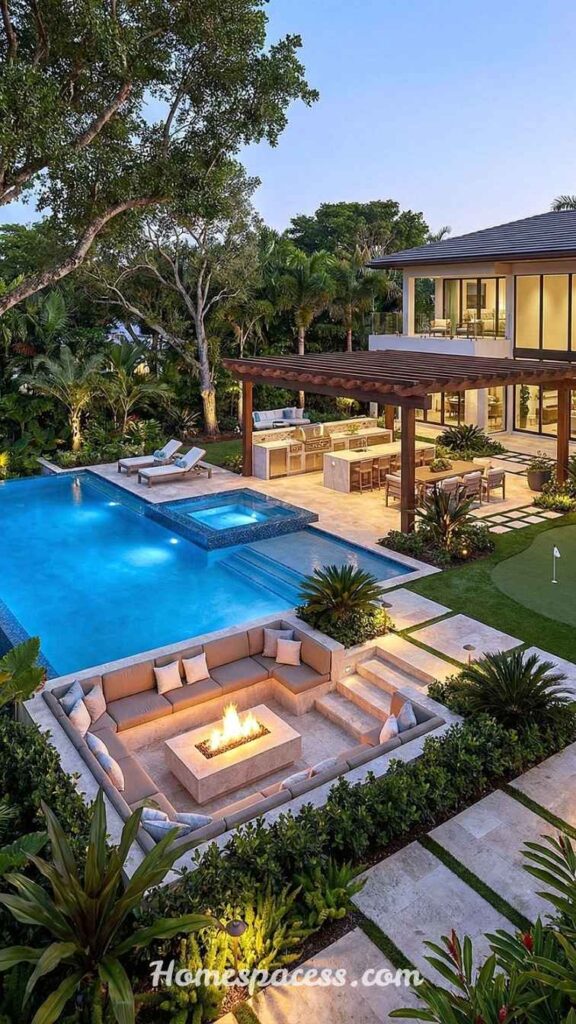
The resort-style pool is less a specific shape and more a philosophy: the pool as the centrepiece of a complete outdoor living environment. These designs typically incorporate multiple water features a main swimming pool, a separate elevated spa, grottos or caves, water slides, beach entry points, and waterfall elements all unified by a cohesive landscape design that includes cabanas, outdoor kitchens, fire features, and lush tropical or Mediterranean plantings.
What makes a resort-style pool feel genuinely resort-like versus merely complex is the sequencing and flow of the space. Well-designed resort pools guide you through a layered experience from a sun-drenched shallow beach entry, through the main swimming zone, toward a shaded grotto, and finally to a secluded hot tub. This narrative quality, borrowed from resort landscape architecture, transforms a swimming pool into a destination that family members and guests actively choose to spend time in.
For homeowners pursuing this style, the most commonly overlooked component is lighting design. Zoned, programmable LED systems with separate controls for the pool water, landscaping, fire features, and pavilion allow the space to transition from a family-friendly afternoon environment to an atmospheric evening entertainment setting with a single touch. Investing properly in lighting (typically 8–12% of total pool budget) delivers one of the highest perceived-value returns of any pool amenity.
Smart & Tech-Integrated Pool Designs:
The Intelligent Pool
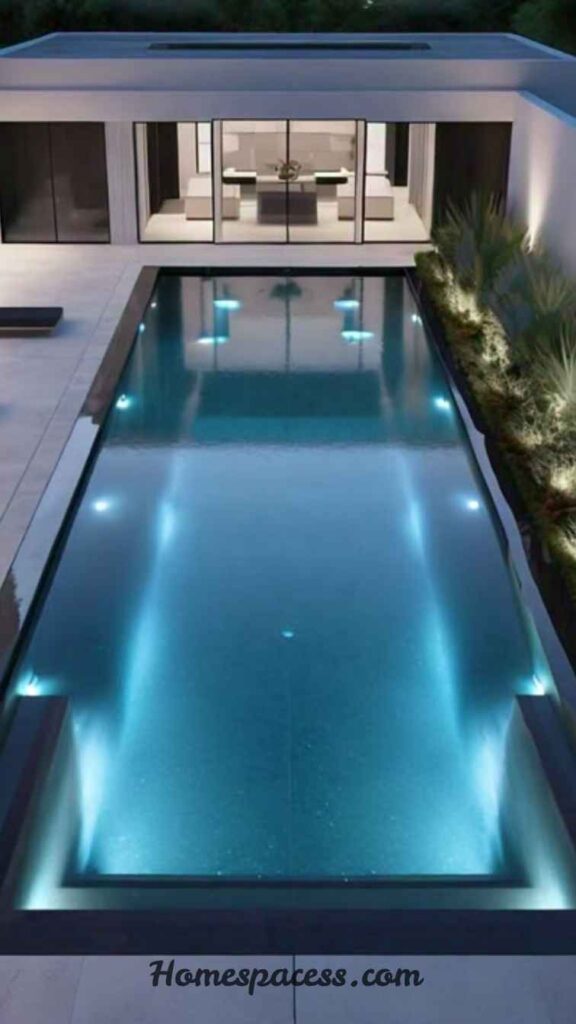
The smart pool isn’t a design style it’s a layer of intelligence that enhances any pool design. Modern pool automation systems allow homeowners to control water temperature, lighting, pump speed, chemical dosing, cover operation, and water features from a smartphone app, voice assistant, or centralized home automation hub. But in 2026, the technology has advanced well beyond convenience features.
AI-powered chemical management systems now continuously monitor pH, chlorine, alkalinity, and water temperature in real time, auto-dosing chemicals precisely as needed rather than relying on weekly manual testing. These systems reduce chemical usage by 20–35% compared to traditional methods, while maintaining consistently safer water quality. Similarly, variable-speed pumps now mandatory in most US states can reduce pool pump energy consumption by up to 90% compared to single-speed models, a significant operating cost reduction over a pool’s lifetime.
Looking specifically at design integration, technology components should be invisible. Well-designed smart pools conceal automation equipment in purpose-built equipment rooms, route wiring and conduit during construction (retrofitting is prohibitively expensive), and use flush-mounted or underwater sensors rather than external probes. The best smart pools feel completely analogue to the user effortlessly maintaining perfect conditions without any visible machinery.
Voice & App Control: What’s Actually Worth the Investment?
Of all the smart pool features available, water temperature scheduling and automatic safety cover operation provide the clearest, most consistent value. A pool that is pre-warmed to your preferred temperature before you arrive, and automatically covered after dark to retain heat and prevent debris, will be used significantly more often than one that requires manual operation and that usage frequency is the true measure of a pool’s value.
Colour-changing LED systems are frequently undervalued in ROI discussions. A pool lighting system that can shift between 250+ colours and pre-programmed lighting shows costs relatively little to install but adds enormous perceived value, both personally and at resale.
Conclusion:
The best swimming pool design is not the most expensive one, or the trendiest one it’s the one that fits how you actually live. A $35,000 plunge pool used daily all summer provides more real value than a $150,000 lagoon pool that sits unused because it’s too complex to maintain.
Start by being honest about three things: how you’ll use the pool (fitness, entertaining, relaxation, or all three), how much time you’re willing to invest in maintenance, and how long you plan to stay in your current home. These three answers will guide you to the right design category more reliably than any trend report.
Invest in good design, quality construction, and smart infrastructure from day one. A pool is one of very few home improvements that changes how you experience your property every single day. Done well, it’s one of the most rewarding investments a homeowner can make.
Trend Analysis
Swimming Pool Design Trends in 2026 And What’s Coming Next
The swimming pool industry is in one of its most dynamic periods since the post-war suburban boom of the 1950s. Three macro forces are reshaping what homeowners want and what designers are delivering: the wellness movement, environmental consciousness, and the maturation of smart-home technology. Understanding where trends are heading not just where they’ve been gives homeowners and designers a genuine competitive advantage when making long-term investment decisions.
In 2026, the clearest emerging trend is pool minimalism with maximum function. Homeowners are moving away from the “more features = more value” resort-style thinking of the early 2020s toward a more considered approach: fewer, better-integrated features, with exceptional finishes and embedded technology. A pool with matte black coping, a single high-performance fire line, and a sophisticated lighting system now signals more sophistication than one with a waterfall, slide, grotto, and beach entry.
Dark-finish pools
Charcoal, navy, and black plaster finishes dominating new builds for their mirror-like aesthetics
Wellness circuits
Cold plunge + sauna + hot tub clusters replacing single-use pool designs
Naturalised edges
Organic rock surrounds and native planting replacing traditional concrete decking
Solar-heated systems
Solar thermal panels reducing pool heating costs by 50–80% in sunbelt climates
Prefab pool panels
Modular fibreglass and steel panel pools cutting build time from months to weeks
Pool-to-landscape integration
Pools dissolving visually into gardens rather than dominating them
Looking ahead to 2027–2030, the most significant shift will be the normalization of saltwater biopools hybrid designs that combine the biological filtration of a natural pool with a low-concentration saltwater backup system for climate resilience. This hybrid approach solves the primary weakness of pure natural pools (vulnerability to algae during extreme heat events) while maintaining the chemical-free ethos that drives their appeal. Several European aquatic designers are already deploying these systems at scale.
Expert Insights
Practical Expert Tips That Most Pool Guides Won’t Tell You
After speaking with pool designers, structural engineers, and long-term pool owners, several insights consistently emerge that are underrepresented in mainstream pool design content. These aren’t aesthetic preferences they’re practical considerations that meaningfully affect both the quality of your experience and the lifetime cost of ownership.
Oversize Your Equipment Pad From Day One
The area designated for pool equipment pumps, heaters, filters, automation controllers is almost universally undersized in initial pool designs. Homeowners add features over time (salt systems, automation panels, supplemental heating), and without adequate space, retrofitting becomes extremely expensive. A well-designed equipment area should accommodate twice the initial equipment load, be fully enclosed for weather protection and noise reduction, and have a dedicated electrical subpanel with spare circuits from day one.
The True Cost of a “Cheaper” Pool Finish
Pool interior finishes plaster, quartz, pebble, tile vary enormously in longevity and long-term cost. Standard white plaster, while the most affordable, typically needs resurfacing every 7–10 years. Premium aggregate finishes (pebble, quartz, glass bead) last 15–25 years. Over a 20-year ownership period, the “cheaper” plaster finish often costs more in cumulative resurfacing than a premium finish would have cost initially. Calculate total cost of ownership, not just upfront cost.
Orientation Is More Important Than Shape
The direction your pool faces relative to the sun determines how much natural heat it retains, how much shade falls on the swimming area, and how often wind chop disrupts the water surface. In the northern hemisphere, a pool oriented so its long axis runs east-west, with the seating and sun shelf on the south side, maximizes afternoon sun exposure on the prime social areas while the swimming zone benefits from morning light. This orientation decision, made once during design, affects enjoyment every single day the pool is used.
Pro Insight
Always install conduit runs (empty pipes) to the pool from the house during construction even for features you don’t plan to add immediately. Running new conduit after concrete and landscaping is complete costs 5–10 times more than installing it during the build. Future-proof with conduit; it costs almost nothing at the time.
Sustainability & Long-Term Value
Sustainable Pool Design: Lower Costs, Lower Impact, Higher Value
The environmental profile of a swimming pool has improved dramatically over the past decade, driven by regulatory pressure (variable-speed pump mandates, water conservation standards) and genuine consumer demand for sustainability. But there’s a commercially underreported reality: sustainable pool design isn’t just better for the planet it’s significantly cheaper to operate, and it’s becoming a meaningful factor in real estate valuations in water-stressed markets like California, Arizona, and Australia.
Water conservation is the most significant environmental issue in pool ownership. A standard 25,000-gallon pool loses 25,000–50,000 gallons per year to evaporation, splash-out, and backwashing roughly equal to the pool’s total volume. An automatic safety cover is the single highest-impact intervention, reducing evaporation by up to 97%. Paired with a pool cover, salt or mineral sanitation (which eliminates the need to periodically “shock” the pool with large chlorine doses and dilute with fresh water) can cut annual water consumption by 60–70% compared to conventional pools.
From an energy perspective, the shift to variable-speed pumps, solar pool heating, and LED lighting has transformed the energy footprint of residential pools. A well-optimized modern pool in a sunny climate can operate its heating almost entirely on solar thermal energy from March through October, and run its circulation on as little as 150–300 watts during off-peak hours (compared to 1,500–3,000 watts for a legacy single-speed pump). These improvements don’t require sacrificing any aspect of the pool experience they require better initial specification and a marginally higher capital investment.
Long-Term Value
In Australian and Californian real estate markets, pools with documented low-water-use credentials (cover systems, salt sanitation, smart dosing) now command a measurable premium over conventional pools buyers increasingly factor operating cost into purchase decisions, not just capital value.
Future Innovations
The Future of Swimming Pool Design: What’s Coming by 2030
The next five years will see several emerging technologies move from experimental installations to mainstream availability. Understanding these developments now helps homeowners make design choices that won’t feel dated and allows early adopters to specify infrastructure (conduit, structural reinforcements, electrical capacity) that accommodates future upgrades without expensive retrofitting.
2026–2027
AI-Managed Water Chemistry
Continuous real-time monitoring with machine-learning dosing algorithms that predict chemical needs based on weather forecasts, usage patterns, and seasonal data reducing chemical consumption by 40% compared to even today’s automated systems.
2027–2028
Transparent Solar Pool Covers
Photovoltaic covers that simultaneously insulate, reduce evaporation, and generate electricity from sunlight. Early prototypes are generating 1–2 kWh per square metre per day enough to offset most of the pool’s pump and lighting energy in full sun.
2028–2029
Structural Graphene-Enhanced Concrete
Graphene-reinforced concrete mixes for pool shells are moving toward commercial availability. The material offers equivalent structural performance at 30% less thickness reducing material costs, construction time, and enabling design geometries impossible with conventional concrete.
2029–2030
Autonomous Cleaning & Safety AI
Computer-vision systems mounted at pool edges will monitor for safety events (unattended children, distress behaviour) while simultaneously managing robotic cleaning, skimmer operation, and chemical dosing the full autonomous pool management stack.
One innovation already arriving ahead of schedule is modular pool construction. Steel-panel and fibreglass-composite modular systems now allow pools to be assembled in as little as two weeks rather than the months required for traditional gunite construction. These systems are increasingly achieving premium finishes and geometric complexity that was previously impossible outside of poured concrete and they’re fully compatible with all smart pool technology. For markets with short building seasons (northern Europe, Canada, northern US states), the speed advantage is transformative.
Common Mistakes
7 Swimming Pool Design Mistakes That Are Painfully Common
The most costly pool design mistakes aren’t made during construction they’re made during the planning phase, before a single shovel hits the ground. These errors are common enough to be familiar to any experienced pool designer, yet they appear repeatedly in residential projects because homeowners are making major decisions without the context to evaluate them critically.
- Prioritizing Pool Size Over Pool Quality: A smaller pool with premium finishes, proper equipment, and thoughtful landscaping delivers more daily pleasure than a large pool built to a budget. Pool size affects resale value far less than pool quality and condition.
- Ignoring the Equipment Room in the Design: Equipment areas planned as afterthoughts create lifetime maintenance headaches. Tight, poorly ventilated equipment enclosures cause equipment failures, difficult servicing, and expensive retrofitting when upgrades are needed.
- Choosing a Design Style Before Solving the Site: Falling in love with a pool style before understanding sun angles, drainage patterns, utility locations, and access constraints leads to compromised designs. Let the site inform the design, not the other way around.
- Underbudgeting for Landscaping: A stunning pool surrounded by bare dirt and temporary fencing is a common and avoidable disappointment. Landscaping including coping, decking, planting, and lighting typically equals 30–50% of the pool construction cost. Budget for it from day one.
- Not Installing a Pool Cover System: Automatic safety covers pay back their cost within 3–5 years through energy savings, chemical savings, and dramatically reduced evaporation. They also represent the single most effective child safety intervention available for residential pools.
- Choosing Finishes for Photos, Not for Daily Life: Highly textured finishes, all-white pools, and exposed aggregate surfaces that photograph beautifully can be rough underfoot, difficult to keep clean, and visually unforgiving of water chemistry imbalances. Test finishes for tactile comfort and maintenance implications, not just aesthetics.
- Skipping the Structural Engineer for Elevated or Hillside Pools: Any pool on a slope, retaining wall, or elevated structure requires a structural engineer’s input not just a pool contractor’s assurance. The consequences of soil movement or structural failure in a pool containing 20,000+ gallons of water are catastrophic and irreversible.
Your Dream Pool Starts With the Right Questions
The best swimming pool designs don’t emerge from a catalogue they emerge from an honest conversation between your lifestyle needs, your site’s physical realities, your long-term budget, and a genuinely skilled designer. Whether you’re drawn to the drama of an infinity edge, the serenity of a natural biopool, or the precision of a smart geometric design, the foundation is always the same: understand the purpose first, then let the design follow. A pool that perfectly suits how you actually live will give you more pleasure on day 3,000 than the most photographically stunning design that was never quite right for your life.

Team Home Spacess shares simple, practical design ideas that work for real families. The team focuses on cozy décor, soft colors, and natural textures that make a space feel truly lived-in. From everyday decorating tips to creative home projects, Team Home Spacess is dedicated to helping readers create warm, comfortable, and inviting spaces with a fresh and personal touch.