
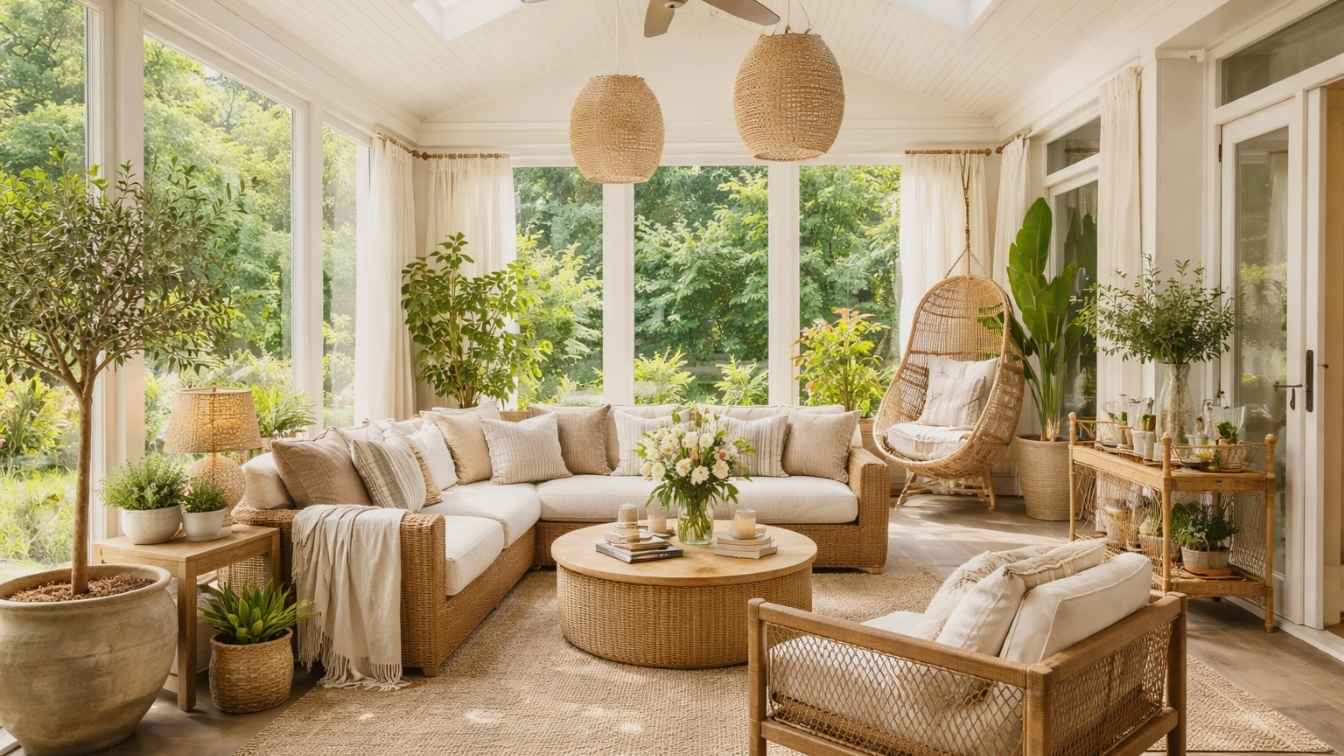
Sun Room Ideas That Turn Dead Space Into Your Home’s Best Room

A sunroom is not simply a glass box bolted onto the side of your house. Done right, it becomes the room your family gravitates toward every single day a transitional space that blurs the line between inside and outside, floods your home with natural light, and adds measurable resale value. Done wrong, it becomes a storage room you avoid from May through September.
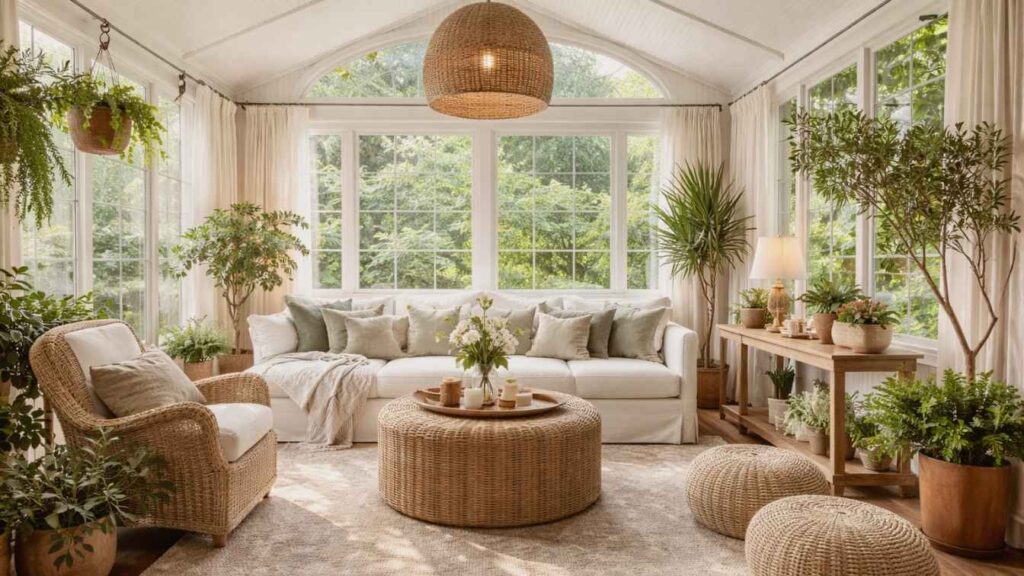
The difference between a thriving sunroom and an abandoned one almost always comes down to three decisions made early: orientation, glazing specification, and functional purpose. This guide addresses all three within each of the ten ideas below, so you can choose the design that fits your climate, lifestyle, and budget and actually enjoy it year-round.
Whether you’re planning a new addition, converting an existing porch, or reimagining a tired conservatory, these sun room ideas are grounded in practical design principles, current material science, and emerging trends reshaping how architects think about light-filled residential spaces in 2026.
7–15%
Average home value increase from a quality sunroom addition
3× more
Natural light compared to a standard living room with windows
40%
Of sunroom owners say it became their most-used room within 6 months
Year-Round Living
The Four-Season Glass Room Your Home’s Most Livable Addition
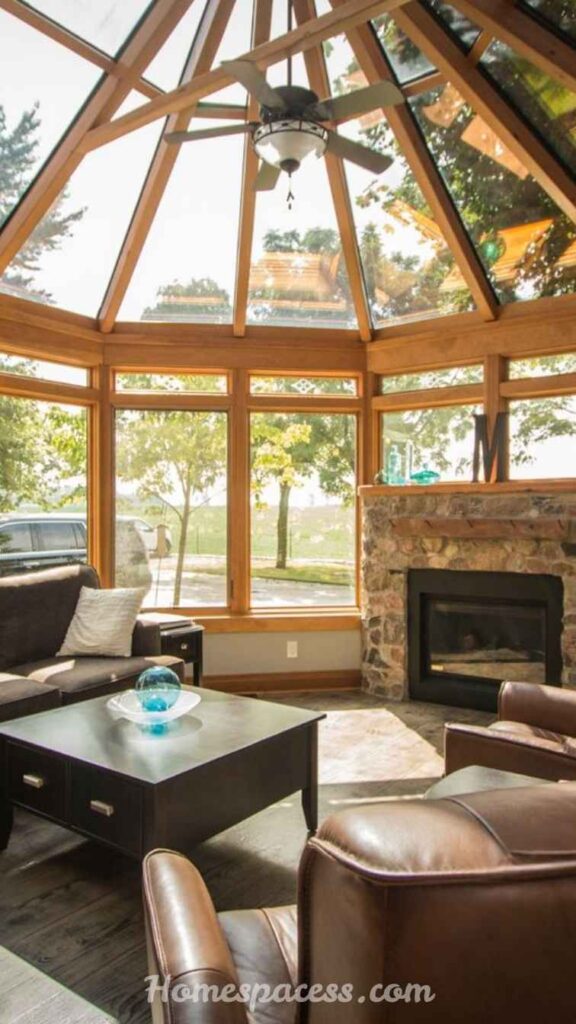
The four-season sunroom is the gold standard of sunroom ideas because it operates comfortably in every climate condition, from a snowy February afternoon to a humid July evening. Unlike a three-season porch which is essentially a screened enclosure a four-season room uses insulated glass units (IGUs), proper wall insulation, and a dedicated HVAC connection to function as true conditioned living space. This distinction is critical for both comfort and property valuation; real estate appraisers typically count four-season rooms in total square footage, while three-season porches are not.
The most effective four-season sun room designs position the main glazed wall facing south (in the Northern Hemisphere) to capture low winter sun while using roof overhangs calculated to block the higher summer sun angle. A well-designed overhang typically 60% of the window height can reduce summer solar gain by up to 60% without sacrificing winter warmth. Pair this with low-emissivity (low-e) triple glazing, which reflects heat back inward during winter and outward during summer, and the room becomes thermally self-regulating for much of the year.
For the interior, think of a four-season sunroom as a proper room, not a transitional space. Durable yet refined materials like porcelain tile flooring (with in-floor radiant heating below), natural linen upholstery, and solid wood built-ins create a room that feels permanent and intentional. Many homeowners make the mistake of furnishing their sunroom with outdoor-rated furniture this signals to the brain that the space is secondary. Interior-grade furniture transforms the room’s perceived status and encourages daily habitation.
Design Insight: The North-Facing Exception
In hot climates like the American Southwest or Mediterranean regions, a north-facing four-season sunroom can be a strategic choice you get soft, consistent daylight without aggressive solar gain, making the room comfortable even in peak summer without heavy cooling loads. Artists and photographers especially prize this orientation for its glare-free, diffused light quality.
MUST READ: Entryway Decor Ideas: Transform Your First Impression Into a Lasting Statement
Nature Integration
The Biophilic Garden Room Where Plants and People Thrive Together
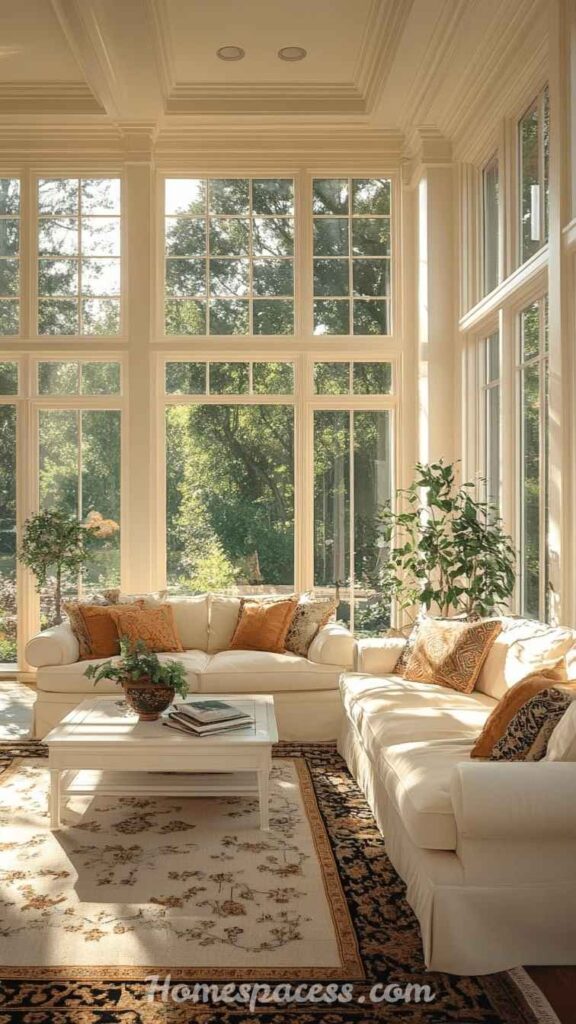
Biophilic design the intentional integration of natural elements into living spaces has moved from architectural journals into mainstream home design, and the sunroom is its ideal canvas. A biophilic garden room goes well beyond placing a few potted plants by a window. It treats the room as a living ecosystem: humidity levels between 50–65%, consistent indirect light, soil-based planters integrated into the architecture, and a material palette drawn entirely from natural sources stone, raw timber, woven grass textiles, and terracotta. The psychological benefits are well-documented: exposure to living plants reduces cortisol levels and measurably improves cognitive performance in tasks requiring sustained attention.
The critical design challenge in a biophilic sunroom is managing the moisture that plants require without damaging the building structure. A vapor barrier installed beneath any timber framing, combined with thermally broken aluminum glazing systems (which prevent condensation on the frame) and a continuous mechanical ventilation system with humidity sensing, will protect the structure indefinitely. Species selection matters enormously: for a sunroom that receives full afternoon sun, choose drought-tolerant Mediterranean herbs like rosemary, thyme, and bay laurel alongside architectural succulents. For a shadier room, tropical foliage plants like monstera deliciosa, philodendron, and peace lilies thrive with the diffused light levels.
An increasingly popular approach in 2026 is the integrated aquaponic or hydroponic planting wall a living wall system that circulates nutrient-rich water through modular growing pockets, producing fresh herbs and leafy greens while the plants themselves act as natural air purifiers and humidity regulators. Systems like this, once exclusive to commercial installations, are now available in domestic scales starting from around $800 and can support 40–60 plant pockets in a 2×2 meter panel. The result is a sunroom that genuinely performs biological functions cleaning air, softening acoustics, and connecting occupants to natural cycles of growth.
Don’t Miss: 20 Stunning Door Painting Ideas That Actually Transform your Home
Wellness & Mindfulness
The Reading & Meditation Retreat Designing Intentional Quietude
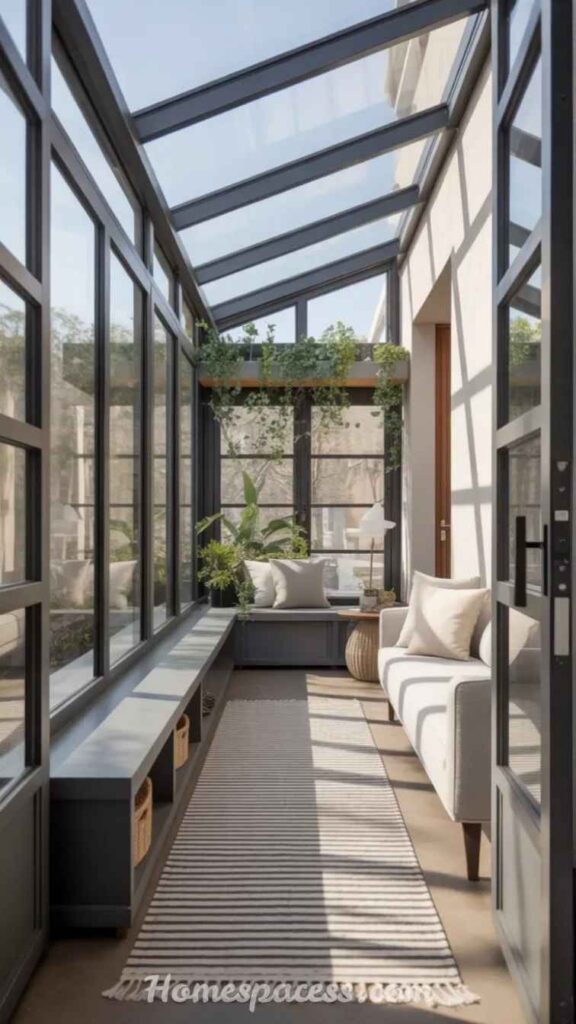
The desire for a dedicated quiet space within the home has accelerated significantly in the post-pandemic era, and the sunroom with its natural light, garden connection, and acoustic separation from main living areas is the natural choice. A reading and meditation sunroom differs from a general-purpose sunroom in one key design principle: it prioritizes sensory curation over versatility. Every element is chosen to reduce cognitive noise soft diffused light without glare, ambient acoustic insulation, natural scent from nearby plantings, and a spatial scale that feels intimate rather than expansive. Aim for a room of roughly 12–16 square meters; too large and it loses the sense of enclosure that makes quiet spaces feel secure.
Acoustics are frequently neglected in sunroom design because glass is perceived as acoustically transparent which is both true and manageable. A standard 6mm single glass pane offers negligible sound reduction, but a 6.4mm laminated inner pane within a double or triple IGU achieves a 40–50dB sound reduction coefficient, which is enough to bring a road-facing sunroom down to library-level quietness. This single specification change swapping standard float glass for laminated acoustic glass is one of the most impactful yet underutilized options in residential sunroom glazing.
For the furnishing of a meditation-focused sunroom, consider the Japanese principle of ma the conscious use of empty space as an active design element. A single deep-seated reading chair with a side table, a low cushioned floor area for seated meditation, and a minimal built-in shelf for a handful of books and a few meaningful objects. Nothing more. The restraint itself becomes a feature: walking into the room signals to the nervous system that this is a place for slowness, not productivity. Layer natural light with dimmable warm LED fixtures for evening use, and incorporate a ceiling fan set to its lowest speed to provide the gentle air movement that makes natural light sunrooms comfortable on still summer days.
Don’t Skip: 25 Home Decor Ideas That Actually Transform Your Space
Entertaining
The Indoor-Outdoor Dining Room Redefining the Meal Experience
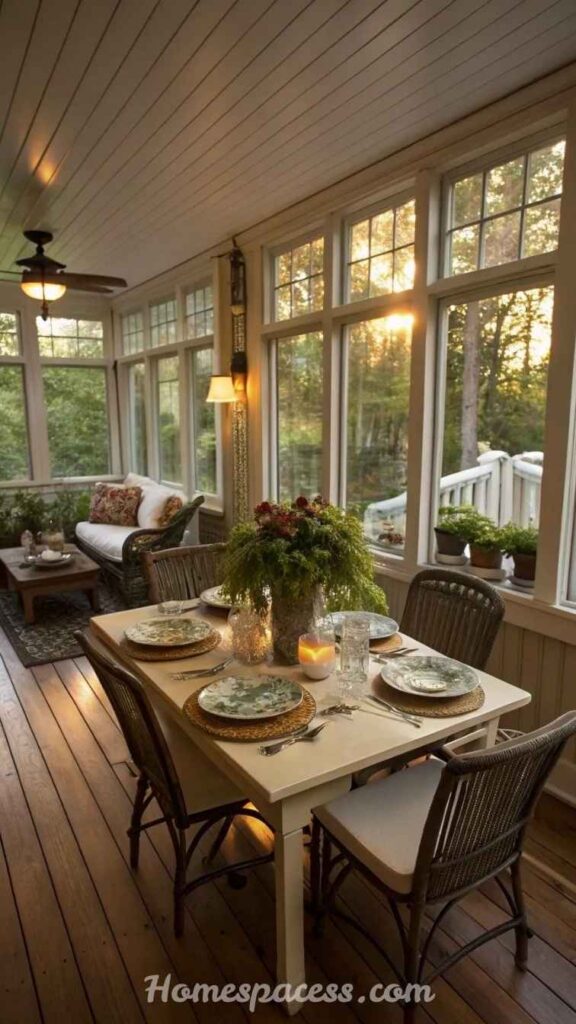
Dining in natural light is a fundamentally different experience from dining under artificial lighting food looks more appealing, conversations feel more open, and meals last longer. A sunroom configured as a dining room captures all of this while removing the unpredictability of outdoor dining: no wind, no insects, no weather anxiety, but full visual connection to the garden and sky. The most successful sunroom dining rooms use full-height sliding or bifold glazing on one or two walls, which can open fully in good weather to genuinely extend the dining experience outdoors, and close silently to create an enclosed room when conditions demand it.
For a dining sunroom, thermal comfort management during the meal is non-negotiable. Guests who are too hot or too cold disengage. The solution is layered: automated solar blinds or electrochromic glass (which transitions from clear to tinted at the touch of a button) manage incoming solar radiation during afternoon dining, while underfloor heating provides radiant warmth from below during cooler months the most efficient delivery point for heating since warm air rises from the floor upward through the occupant zone. Avoid ceiling-mounted radiant heaters in dining sunrooms; they create hot spots and are visually intrusive in what should be an elegant space.
Material choices for a dining sunroom should balance sophistication with practicality. Large-format porcelain tiles (900×900mm or larger) in a stone-effect finish are both beautiful and impervious to food spills and chair scrapes. A round or oval dining table positioned centrally under a statement pendant light creates a focal point that grounds the space. Many designers now position dining sunrooms as the home’s “hero shot” room visible from the garden and often photographed so invest in a table and lighting fixture that photograph beautifully in natural light.
Read More: 21 Kitchen Decor Ideas That Transform an Ordinary Kitchen Into a Space You Actually Love
Productivity
The Natural Light Home Office Scientifically Better for Focus
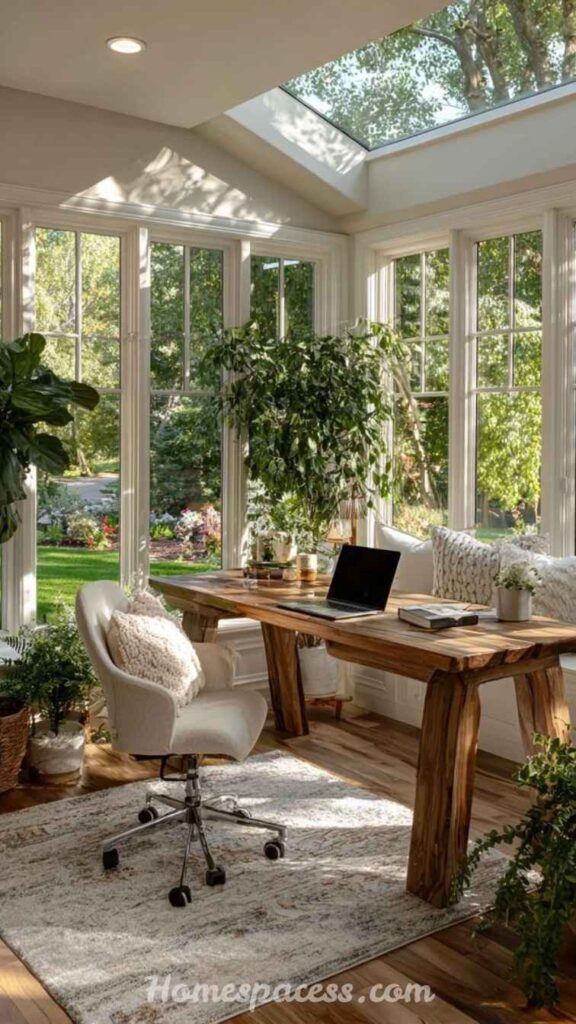
Research from the Cornell University Human Factors and Ergonomics Laboratory found that workers in offices with natural light reported 84% fewer headaches, 75% less eye strain, and significantly improved sleep quality compared to those working under artificial lighting alone. A sunroom home office translates this workplace research into a residential setting, creating a working environment that is measurably more productive than a windowless study. The key differentiation from a generic home office is the completeness of the light environment: rather than one window providing light from a single direction, a sunroom wraps the worker in diffused daylight from multiple angles, eliminating harsh shadows on the desk and reducing screen glare.
The most common failure in sunroom home offices is screen glare management. East-facing sunrooms create perfect morning working conditions but become unusable between 10am and noon as the sun angles directly into screens. West-facing rooms suffer the reverse problem in the afternoon. The solution is not to avoid these orientations but to specify appropriate glass. Selective low-e coatings with visible light transmittance (VLT) values of 40–55% reduce glare significantly while preserving daylight ambiance. Additionally, external automated roller blinds or louvres controlled by a sun-tracking sensor can deploy automatically when solar angles reach problematic levels without requiring the occupant to stand and adjust.
For the office layout itself, position the desk perpendicular to the main glazed wall rather than facing it directly. This orientation provides excellent ambient side-lighting without placing a bright glass surface directly in the line of sight behind the monitor. A standing desk with motorized adjustment adds ergonomic value, while acoustic panels or a dense bookshelf wall on the non-glazed sides manage sound reverberation a frequent problem in rooms with large glass surfaces that reflect rather than absorb sound waves.
Productivity Insight: Light Temperature Matters
Morning natural light is rich in blue wavelengths that stimulate alertness and cortisol regulation. If your sunroom office faces east or south, you’re receiving the most cognitively activating light during your prime working hours a genuine biological advantage over indoor office workers that compounds across a year of daily use.
Leisure & Wellness
The Pool or Hot Tub Enclosure Extending the Season by Months
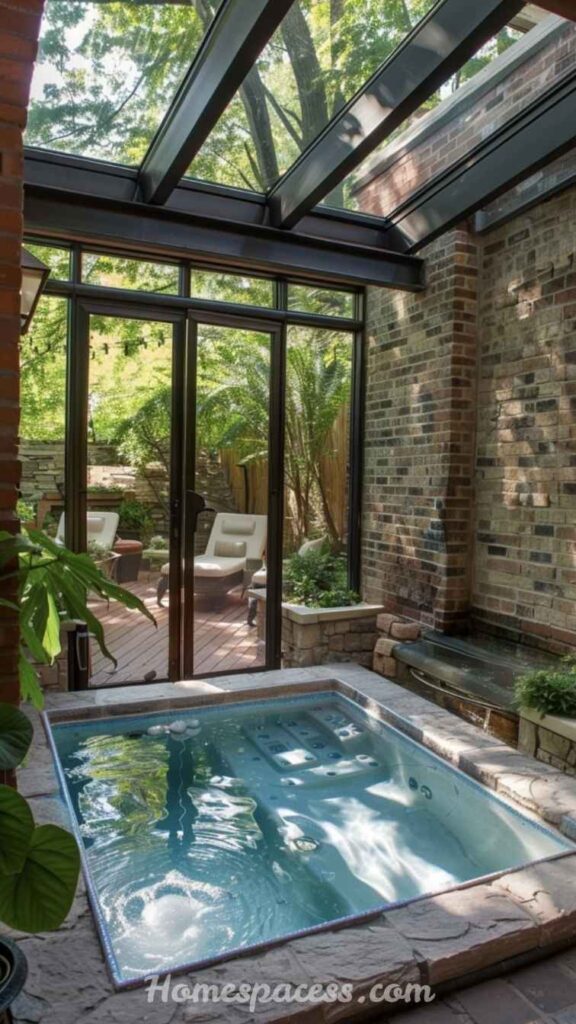
An enclosed pool or hot tub sunroom transforms a seasonal amenity into a year-round wellness feature, and it represents one of the highest-ROI sunroom configurations in colder climates. In the UK, Scandinavia, and northern US states, an unenclosed pool is typically usable for 4–5 months. Enclose it within a thermally efficient glass structure and that figure rises to 12 months a 140% increase in usability from a single architectural addition. The economics are compelling: heating an enclosed pool costs a fraction of heating an open-air pool because the glazed enclosure dramatically reduces evaporative heat loss, which accounts for up to 70% of a pool’s energy loss.
Pool enclosure sunrooms require specialized design considerations beyond standard glazing. Chlorine vapor and high humidity create a corrosive environment that will degrade standard aluminum glazing systems within a decade. Specify marine-grade aluminum alloys (6005-T5 or 6061-T6) or thermally broken stainless steel systems for the structural framework, and use toughened safety glass with a minimum 10mm pane thickness on all roof panels a regulatory requirement in most jurisdictions when glazing is positioned overhead. Ventilation must be mechanical and robust: a pool enclosure without adequate air exchange will suffer from condensation, mold, and deteriorating air quality within months.
The most sophisticated pool sunroom designs of 2026 integrate retractable roof panels either sliding on overhead tracks or using a folding cassette system that allow the enclosure to open fully to the sky in perfect weather, creating an outdoor pool experience without removing the protective structure. These retractable systems, while expensive (typically $25,000–$60,000 for a residential-scale roof), eliminate the most common complaint about pool enclosures: the feeling of being inside on a beautiful day.
Creative Space
The Artist & Craft Studio Chasing the Perfect Light
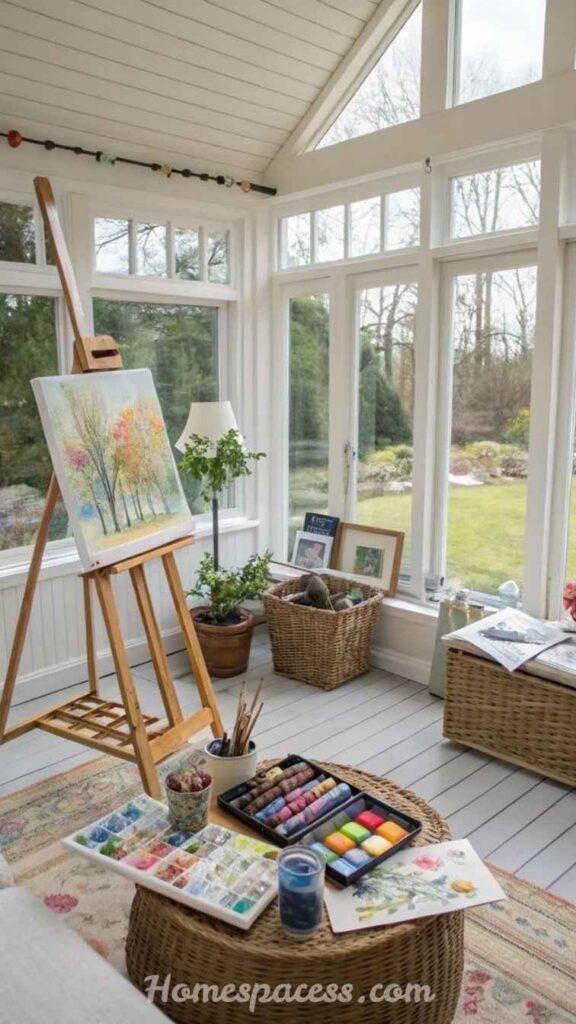
Artists have sought north-facing studios for centuries, and the reasoning is purely optical: north light in the Northern Hemisphere is indirect, consistent throughout the day, and free of the dramatic shadows and color-temperature shifts that accompany direct sunlight. For painters, illustrators, ceramicists, or any maker working with color-critical materials, a north-facing sunroom studio provides the most faithful rendering environment possible colors appear as they truly are, without the warm distortion of afternoon sun or the harsh contrast of direct eastern light. Architects designing artist studios often specify a high clerestory glazing band on the north face and opaque insulated panels on the south to achieve this pure north light effect even in rooms that aren’t perfectly north-oriented.
Beyond orientation, an artist studio sunroom demands practical infrastructure that standard sunrooms rarely include. A deep utility sink with cold and hot water, sealed concrete or epoxy-coated floors that withstand solvents and pigments, 20A electrical circuits for kilns or resin curing equipment, and adequate storage for materials (shelves, flat-file drawers, rod hooks for rolled canvases) all need to be planned into the structural design. Ceiling height is particularly important: a minimum of 2.7 meters for two-dimensional work, and 3.0+ meters for sculptors or ceramicists working at scale. Many homeowners retrofit an existing sunroom into a studio and discover too late that a 2.1-meter ceiling prevents working with large vertical canvases.
For hobbyist makers who also want the room to serve social functions hosting crafting evenings, art classes, or family creative sessions consider a hybrid studio sunroom with a large folding workbench system that collapses flat against one wall to reveal a social seating zone. Several European manufacturers (notably Hettich and Bulthaup) produce furniture systems specifically designed for this dual-use application, allowing the room to transition between studio and salon mode in under five minutes.
Classic Style
The Farmhouse Conservatory Victorian Heritage Meets Modern Performance
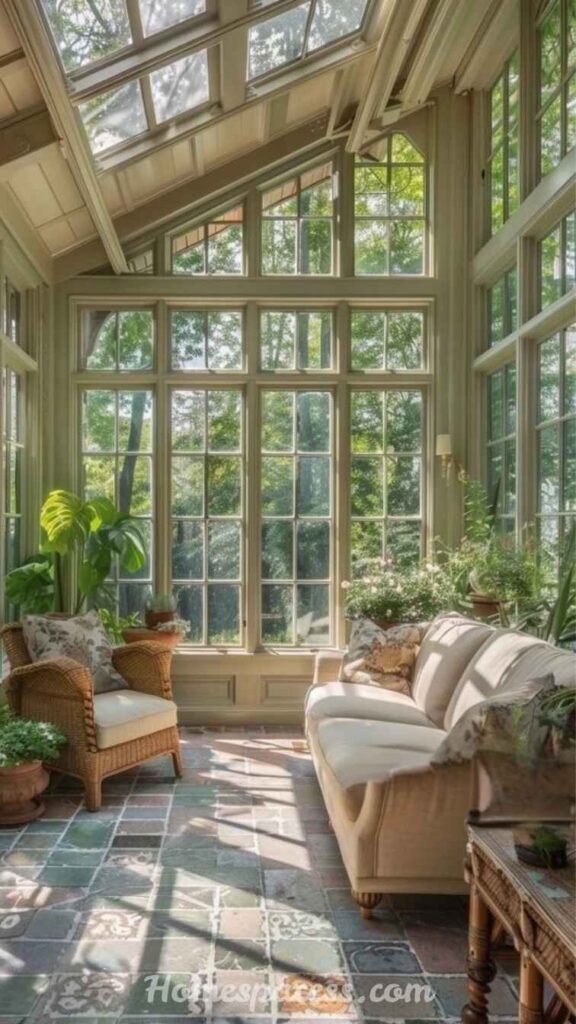
The Victorian conservatory that iconic glass-and-cast-iron structure found on the backs of British townhouses and rural farmhouses has experienced a remarkable revival in 2025–2026, but with a critical upgrade: contemporary thermal performance specifications hidden behind period-appropriate aesthetics. The demand for this style reflects a broader homeowner appetite for spaces with character and provenance rather than the sleek minimalism that dominated the 2010s. A well-executed farmhouse conservatory uses authentic design elements ogee roof ridges, cresting finials, Georgian-bar glazing patterns, and powder-coated Victorian green or racing green frames while delivering four-season thermal comfort through modern insulated glass and underfloor heating.
The most common mistake with period-style conservatories is treating them as decorative-only choices and neglecting the performance specification. A Victorian-style conservatory with thin polycarbonate roof panels and single-glazed walls will perform exactly as the original Victorian ones did beautifully in spring and autumn, miserably in winter and summer. Specify real glass throughout (polycarbonate yellows and discolors within 5–8 years), use self-cleaning glass on roof panels where manual cleaning is impractical, and ensure the ridge ventilator is mechanically operated with a thermostatic controller rather than the manually-cranked handle found on original structures.
Interior styling of a farmhouse conservatory rewards restraint in ornament and richness in natural material. Quarry tile or encaustic tile floors, cast-iron column radiators supplementing the underfloor system, potted citrus trees in terracotta pots, vintage wrought-iron furniture with botanical print cushions, and a carefully curated collection of antique botanical prints or taxidermy. Avoid the impulse to over-accessorize; the structure itself with its pleasing geometry and the play of shadow from Georgian glazing bars is the primary decorative element.
Contemporary Design
The Modern Minimalist Pavilion Where Architecture Becomes Art
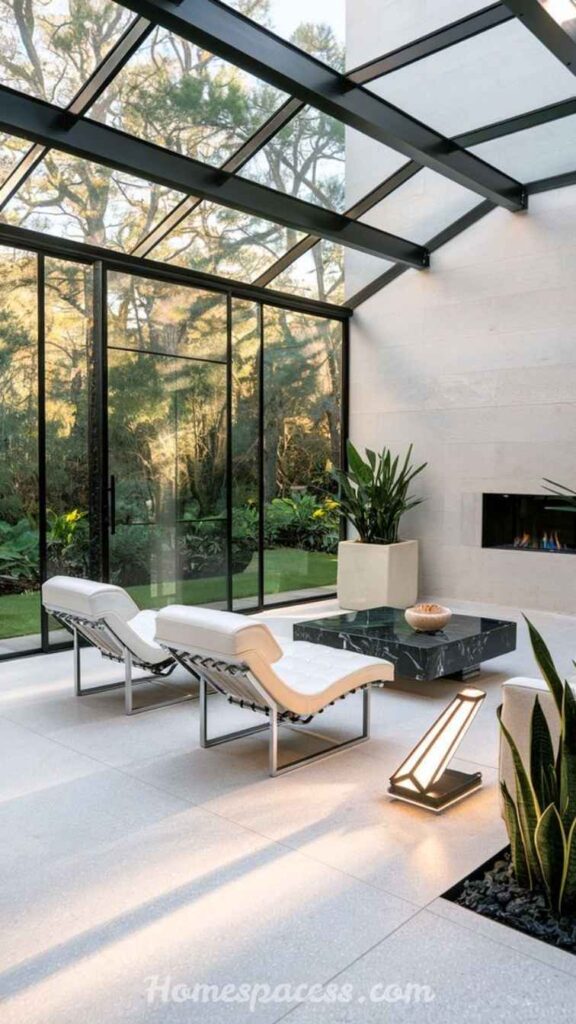
The modern minimalist sunroom pavilion represents the current apex of residential glass architecture a structure where the engineering precision itself becomes the aesthetic statement. Characterized by structural silicon glazing (SSG) systems with no visible external frames, ultra-slim roof elements in steel or timber, flush floor-to-ceiling glass walls, and a monochromatic material palette, this typology creates rooms where the boundary between structure and glazing essentially disappears. The visual effect standing inside a glass pavilion that appears to float against a garden backdrop is genuinely transformative in ways that photographs struggle to capture.
Executing this aesthetic at a residential scale requires engaging an architect or specialist glass contractor rather than a standard conservatory supplier. The structural silicon used to bond glass panels directly to the supporting frame (eliminating the need for a mechanical frame rebate) requires specific surface preparation and curing conditions that are outside the scope of most general builders. Similarly, the ultra-slim roof elements that make this aesthetic possible often steel I-beams spanning 4–6 meters with depths of only 80–100mm require structural engineering calculations to verify their deflection limits under snow and wind loads. This is not a project to value-engineer: the defining characteristic of a successful minimalist pavilion is the absence of visual compromise.
In terms of living quality, the modern pavilion sunroom excels at providing an unobstructed view of the garden from a fully sheltered position an experience particularly valued in beautifully landscaped gardens where the view itself is the primary asset. Furniture selection should reflect the room’s architectural ambition: a single iconic design piece (a Barcelona chair, a Womb Chair, or a piece of bespoke joinery) performs better than a curated collection. In rooms where the architecture speaks loudly, the furniture should listen.
The Right Sunroom Changes How You Live
Every one of these ten sun room ideas is capable of becoming the room you use more than any other in your home but only when the design is grounded in honest answers to three questions: How will you actually use this space? What is the thermal reality of your climate? And what level of investment makes sense relative to your home’s value and your length of tenure?
The common thread running through all successful sunroom projects is specificity of intent. Rooms designed for everything often deliver nothing particularly well. Rooms designed for a clear purpose reading, growing, entertaining, working, playing deliver that purpose magnificently, and then expand into secondary uses naturally.
Start with the idea that resonates most deeply, then work backward through the specification details. The light will take care of the rest.
Conclusion
Choosing the right sun room ideas can completely change how you enjoy your home. A sunroom brings natural light, warmth, and a peaceful connection to the outdoors all without leaving your house. Whether you want a quiet reading nook, a lively family space, or a beautiful dining area, there is a design that fits your life perfectly. Start with a clear purpose, and the rest will follow naturally.
The best sun room ideas are not about trends they are about how you actually live. Focus on good glass, smart orientation, and honest functionality. A well-built sunroom pays you back every single day through comfort, wellbeing, and long-term home value. Build it right, and you will wonder how you ever lived without it.
Trends Analysis
Sun Room Trends in 2026 and What’s Coming Next
The sunroom category has undergone the most significant design evolution in decades over the past two years, driven by three converging forces: the normalization of home working, increased consumer awareness of biophilic design benefits, and the dramatic improvement in thermal glazing performance at accessible price points. Understanding where the category is heading helps you make design decisions today that will feel current rather than dated in five years.
Structural Timber Glazing
Cross-laminated timber (CLT) and glulam structural systems are replacing aluminum frames in premium sunrooms, offering warmth and carbon credentials alongside structural performance.
Electrochromic Smart Glass
On-demand tinting glass that transitions from clear to deeply tinted via app or automation is entering the residential mainstream, replacing roller blinds in modern sunroom designs.
Integrated BIPV Glazing
Building-integrated photovoltaic glass roof panels that simultaneously provide shelter and generate electricity is moving from commercial into high-end residential sunroom roofs.
Acoustic-First Design
Following years of open-plan noise fatigue, buyers are specifically requesting laminated acoustic glass packages in sunroom specifications to create genuine quiet retreats.
Modular Kit Systems
High-quality flat-pack sunroom systems from Scandinavian manufacturers (e.g., NorDan, Rationel) are disrupting the bespoke market with precision-engineered components that install in days rather than weeks.
Dark Frame Aesthetics
Anthracite gray, black, and bronze powder-coated frames have overtaken white as the dominant frame color choice, complementing both contemporary and heritage architectural styles.
Looking beyond 2026, the most significant emerging development is the integration of sunrooms into whole-home passive energy strategies. Rather than treating the sunroom as an add-on, forward-thinking architects are designing it as a thermal buffer zone a semi-conditioned transitional space that pre-warms incoming ventilation air in winter, reducing whole-home heating loads. This “solar lobby” concept, common in commercial passive house design, is beginning to appear in residential projects as homeowners seek to reduce energy bills without sacrificing living quality. Within five years, energy-rated sunroom packages similar to the energy rating system applied to appliances are likely to become a standard part of the purchasing conversation.
Expert Insights
Expert Tips and Real-World Optimization Insights
The gap between a sunroom that functions beautifully and one that disappoints is almost always attributable to decisions made before the first piece of glass is ordered not during installation. Experienced sunroom designers consistently return to the same set of practical principles that rarely make it into glossy showroom brochures.
- Specify the glass before choosing the frame system: Most purchasers pick a frame style first and accept whatever glazing the supplier offers as standard. In reality, the glass specification drives thermal performance, acoustic performance, glare management, and long-term maintenance requirements. Lead with glass, then find a frame system that accommodates it.
- Overcapacitate the electrical from day one: The most common retrofit request in sunrooms is additional power circuits. Installing a 60A sub-panel and generous conduit runs during construction costs under $400 and prevents the £3,000+ disruption of retrofitting circuits through a finished floor and ceiling later.
- Thermal mass on the floor, not the walls: Stone or porcelain tile floors absorb solar heat during the day and release it slowly after sunset a genuine passive heating contribution. Thick rugs negate this effect entirely. If you want both warmth and softness underfoot, use smaller rugs that cover 40% or less of the floor area.
- Size the ventilation for summer, not winter: Most sunroom ventilation systems are undersized because they’re specified against winter heat-loss calculations. Size ridge ventilation and mechanical extraction for peak summer solar gain (calculate this using your latitude’s peak solar irradiance data) and you’ll never experience an overheated sunroom.
- Commission a pre-completion thermal camera survey: Before the builders leave, have a thermographer scan the completed structure with an infrared camera. Cold bridges, poorly installed insulation, and glazing seal failures are invisible to the naked eye but immediately apparent with thermal imaging and dramatically cheaper to fix before finishes are applied.
- Plan for ceiling fan positioning in the structural phase: A ceiling fan positioned centrally in a sunroom provides highly efficient temperature equalization (pushing warm air from ceiling to floor in winter, creating a cooling breeze in summer) at a running cost of pennies per hour. But retrofitting one requires structural blocking in the ceiling something that costs $30 at the frame stage and $300+ afterward.
One insight that competitors rarely discuss: the orientation of the main door into the sunroom from the house significantly affects how the room gets used. A door positioned in the corner of the sunroom room rather than centrally on the connecting wall allows furniture to be arranged without the awkward void that a centrally-placed door forces. Experienced designers place the internal door asymmetrically, preserving the full width of one wall for a sofa, bookcase, or dining setup, dramatically improving the room’s livability from the first day of use.
Sustainability, Long-Term Value
Sustainability, Long-Term Value, and the True Cost of Ownership
The sustainability conversation around sunrooms is more nuanced than simply specifying triple glazing and calling it green. A sunroom has an embodied carbon cost the carbon emitted during the manufacture, transport, and installation of materials that must be weighed against its operational carbon savings over its functional lifespan. Aluminum, which dominates the glazing frame market, is highly carbon-intensive in its primary production (approximately 15kg CO₂ per kg of aluminum) but is infinitely recyclable without degradation. A thermally broken aluminum frame will last 40–60 years in a residential application; over that lifespan, the embodied carbon is amortized to a reasonable per-year figure, particularly if the frame eventually returns to the recycling stream.
Timber-framed glazing systems offer a more favorable embodied carbon profile engineered timber actually sequesters carbon during its growing phase but require more maintenance than aluminum: repainting or re-oiling every 5–7 years, and careful detailing at junctions to prevent moisture ingress. In terms of long-term value, both aluminum and timber frames in excellent condition add meaningful resale value, while neglected timber frames actively reduce it. The honest sustainability choice depends on your maintenance commitment as much as the material specification.
From a property investment perspective, the return on a sunroom depends heavily on how well the design integrates with the existing house architecture. A sunroom that reads as an afterthought different brick, mismatched roof pitch, incongruous frame color adds less value than one that appears to have always been there. Survey evidence from UK and US real estate markets consistently shows that seamless extensions with matching materials achieve 12–18% higher value contributions than clearly distinguishable additions. The additional design investment required to achieve architectural integration matching existing brick or stone, mirroring roof pitch angles, selecting frame colors that complement the house’s external palette typically costs 10–15% more during construction but delivers 40–60% better returns on resale. This is one of the most asymmetric investment decisions available in home improvement.
Future Innovations
Future Innovations That Will Redefine the Sun Room by 2030
The next five years will see several emerging technologies move from prototype to residential availability, and each has the potential to fundamentally change what a sunroom can do. Understanding these innovations now positions you to design a sunroom infrastructure that can accommodate them avoiding the costly retrofits that early adopters of any technology typically face.
The most immediately impactful upcoming technology is dynamic electrochromic glass at residential price points. Currently available from manufacturers like Sage Glass and View Inc. at commercial price points ($80–$150/sq ft installed), electrochromic glazing that tints on demand is projected to reach $30–$50/sq ft in residential-scale applications by 2027–2028, driven by manufacturing scale-up and new competing entrants. This technology eliminates the need for any blind or curtain system the glass itself manages solar transmission from 3% (fully tinted, blocking 97% of solar heat gain) to 62% (fully clear). For a four-season sunroom in a climate with significant seasonal solar variation, this single technology solves the overheating problem permanently and elegantly.
Building-integrated photovoltaic (BIPV) roof glazing is the second transformational technology approaching residential accessibility. Rather than attaching solar panels to an existing roof, BIPV systems replace the roof glazing entirely with glass panels that incorporate thin-film photovoltaic cells within the glass laminate. The cells generate electricity without obstructing the view (transparency levels of 10–40% are achievable, depending on power output requirements) and add no additional weight or structural loading compared to standard roof glass. A 20-square-meter BIPV sunroom roof in a southern UK or mid-Atlantic US climate could generate 2,000–3,000 kWh annually enough to meaningfully offset the sunroom’s own heating and cooling energy consumption. Several manufacturers, including Onyx Solar and Tesla Energy, are actively developing residential-scale BIPV glazing products, with commercial availability anticipated between 2026 and 2028.
On the integration side, AI-driven home automation will increasingly manage sunroom environments autonomously monitoring weather forecasts, occupancy patterns, outdoor temperature, and user preferences to pre-condition the room before it’s needed, activate shading systems preemptively, and optimize ventilation timing to avoid peak-rate energy consumption. Sunrooms designed today should incorporate the wiring infrastructure (power, data, and control cabling) to support these systems, even if they’re not installed at the outset. A sunroom wired for a “dumb” environment that needs to be upgraded to a smart-integrated system in five years faces significant retrofitting costs that are almost entirely avoidable at the design stage.
Common Mistakes
Common Sunroom Mistakes (and the Overlooked Factors That Cause Them)
The most persistent sunroom failures share a common origin: decisions optimized for the showroom experience rather than the lived experience. Sales environments showcase sunrooms on overcast days, in climatically temperate regions, with professional styling that bears no resemblance to normal domestic use. Understanding these failure patterns allows you to avoid them at the specification stage rather than learning from expensive personal experience
- Choosing polycarbonate roof panels to save money: Polycarbonate is significantly cheaper than glass at installation but yellows within 5–10 years, degrades sound reduction, amplifies rain noise dramatically, and cannot be cleaned without scratching. The per-year cost difference between polycarbonate and glass narrows rapidly when replacement and cleaning costs are factored in. Specify glass throughout.
- Under-sizing the structural opening into the house: A narrow single door between the house and sunroom creates a bottleneck that prevents the space from feeling connected. The minimum effective opening is 1.8 meters wide enough for two people to pass simultaneously. Wider is better: many designers now specify 2.4m+ sliding or bifold openings that allow the sunroom to read as a continuous extension of the interior room.
- Ignoring planning and building regulations until late: In the UK, sunrooms exceeding 30m² or covering more than 50% of the original house footprint require full planning permission. In the US, local zoning setback rules frequently restrict where a sunroom addition can be placed. Discovering these constraints after design development begins forces expensive redesigns. Engage your local planning authority or a planning consultant before any design work commences.
- No defined purpose from the outset: Sunrooms designed as “flexible multi-purpose spaces” almost always become underused catch-all rooms. Without a defined primary purpose guiding the specification orientation, electrical, flooring, ventilation the room serves no single use well. Define a primary use, design for it, and the secondary uses will follow naturally.
- Treating the room as independent of the house’s thermal system: A sunroom that is not connected to the home’s central heating system relies on portable heaters or standalone electric radiators expensive, inefficient, and architecturally unsatisfying. Extending the home’s wet central heating system or ducted HVAC into the sunroom during construction is the correct approach, and far cheaper than retrofitting it post-completion when floors and ceilings are finished.
One frequently overlooked factor is the acoustic impact of a sunroom on adjacent internal rooms. A glazed structure transmits external noise traffic, wind, birdsong into itself and also transmits noise from within the house (kitchen sounds, television, conversations) into the sunroom space. Homeowners who plan to use the sunroom as a quiet retreat or home office are often disappointed to discover that the internal acoustic separation between the sunroom and the main house was never addressed during construction. Specifying acoustic-rated internal glazing between the house and sunroom (if the connection uses glass), and ensuring the connecting wall is properly insulated, resolves this issue at source.
FAQ’s About Sun Rooms
What is the best orientation for a sunroom?
South-facing is generally optimal for most Northern Hemisphere climates it captures low winter sun for passive warming while a correctly sized overhang blocks the higher summer sun. In hot climates, north-facing sunrooms provide consistent, glare-free light without solar overheating. East-facing works best for morning-use rooms like breakfast rooms; west-facing suits afternoon entertaining spaces.
How much does a sunroom cost to build in 2026?
Sunroom costs vary significantly by type and specification. A basic three-season prefab kit runs $15,000–$30,000 installed. A fully custom four-season room costs $50,000–$120,000. Premium architect-designed glass pavilions with high-specification glazing and structural systems range from $120,000 to $300,000+. Ongoing energy costs depend heavily on glazing specification and orientation.
Does a sunroom add value to a home?
Yes, when properly designed and constructed. A four-season sunroom that is counted in the home’s total square footage typically returns 50–80% of its construction cost in added home value. A three-season porch typically returns 30–50%. Architectural integration with the existing house (matching materials, complementary style) is the single biggest factor in maximizing value return.
What is the difference between a sunroom and a conservatory?
Terminology varies by region. In the UK, a conservatory traditionally refers to a structure with over 50% glazed roof area, while a sunroom or garden room typically has a solid insulated roof with standard windows. In the US, “sunroom” and “conservatory” are often used interchangeably. Four-season functionality depends on insulation and HVAC connection, not the name.
Can I use a sunroom all year round?
Yes, if it is designed and built as a four-season room with proper insulation, thermally broken glazing frames, double or triple insulated glass units, and a connection to the home’s heating and cooling system. A three-season sunroom with standard aluminum frames and single glazing is typically comfortable from April through October in most temperate climates, but is uncomfortably cold in winter without supplemental heating.
Aliza Noor founded Home Spacess to share simple, practical design ideas that work for real families. She focuses on cozy décor, soft colors, and natural textures that make a space feel truly lived-in. Based just outside Toronto, Aliza spends her days juggling family life, experimenting with home projects, tending to her plants, and occasionally moving things around just to create a fresh vibe.
