
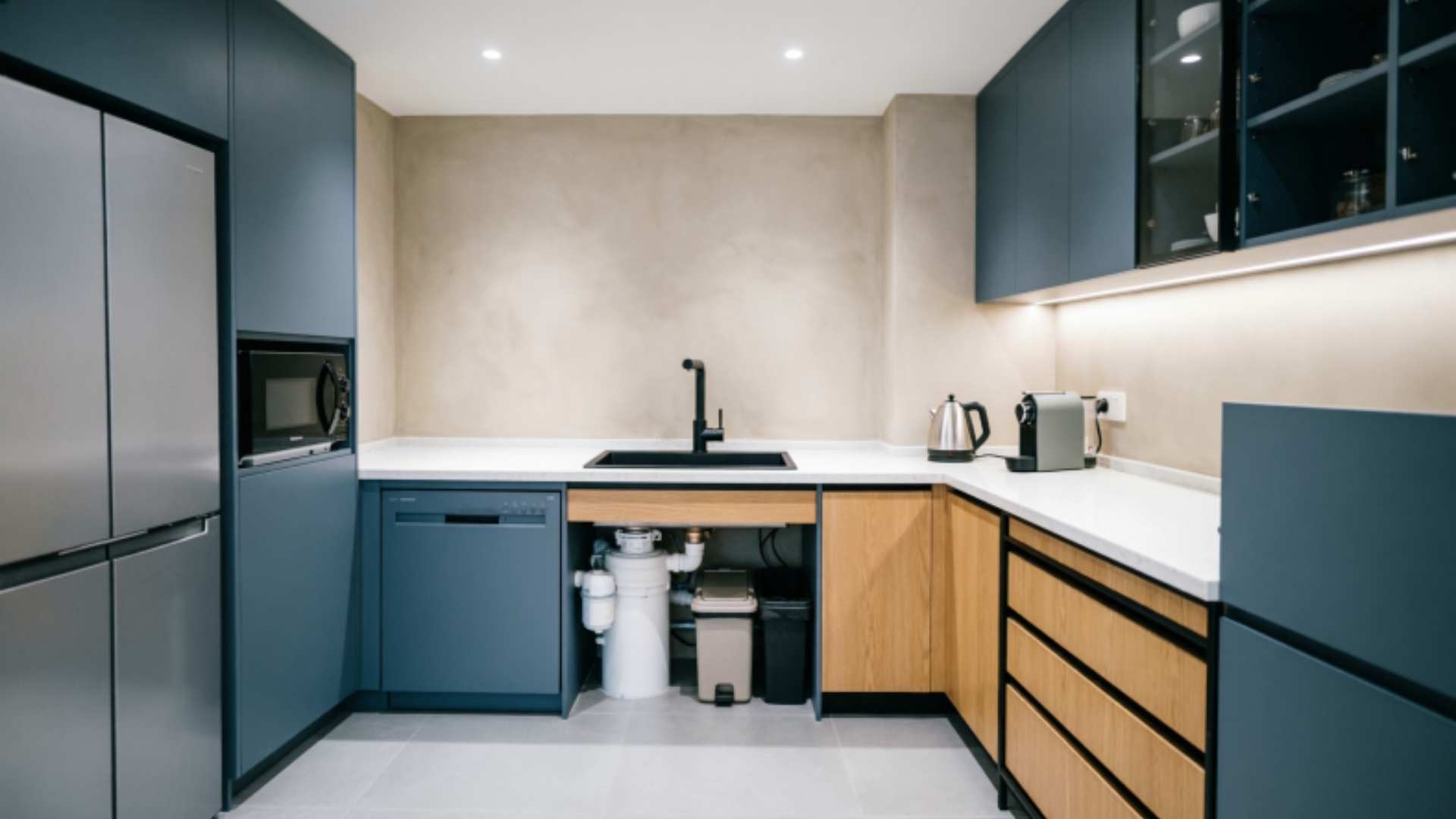
Small Kitchen Ideas: 18 Expert Transformations That Actually Work

The complete expert guide to maximizing every square inch from storage hacks to layout psychology, sustainable upgrades, and what’s coming next.
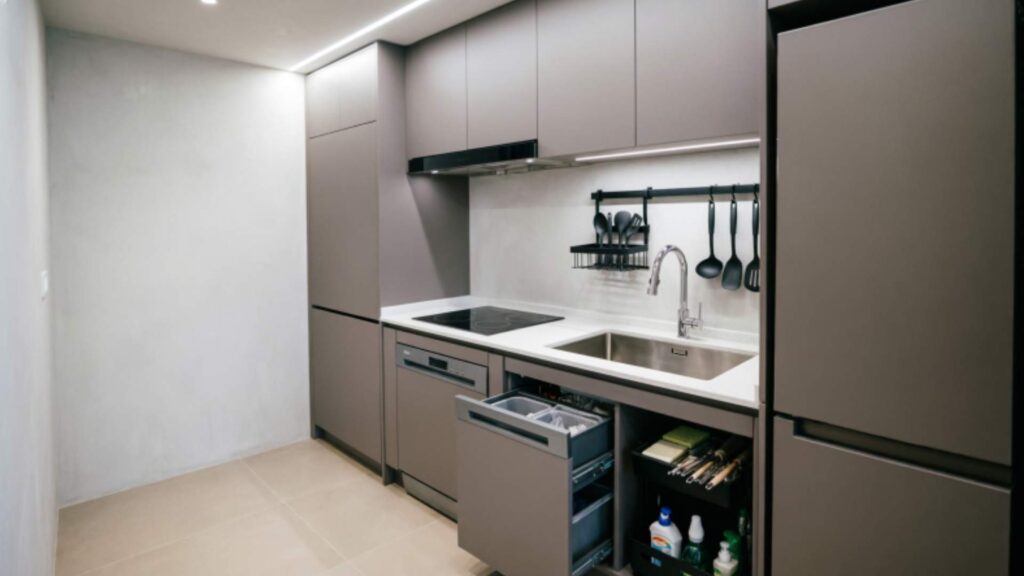
A small kitchen is not a limitation it is a design challenge waiting to reveal the most creative version of your home. Whether you’re working with a city apartment galley, a studio kitchen nook, or a compact suburban cooking space, the difference between a cramped kitchen and an efficient one often comes down to decisions made within just a few inches.
What most people overlook is that small kitchen design is fundamentally about spatial psychology and workflow logic, not just clever storage. The best kitchens under 100 square feet function better than many that are double the size and this guide will show you exactly why, and how to replicate that intelligence in your own space.
73%
of urban renters have kitchens under 100 square ft.
40%
more storage unlocked through vertical + hidden space
2×
resale value boost from a well-optimized small kitchen
Below, you’ll find 18 specific, actionable ideas each explained with design reasoning, real-world scenarios, and pro-level insights. These aren’t generic tips you’ve already read. These are the approaches that interior designers actually use when space is genuinely tight.
Vertical Space
Floor-to-Ceiling Vertical Storage Walls
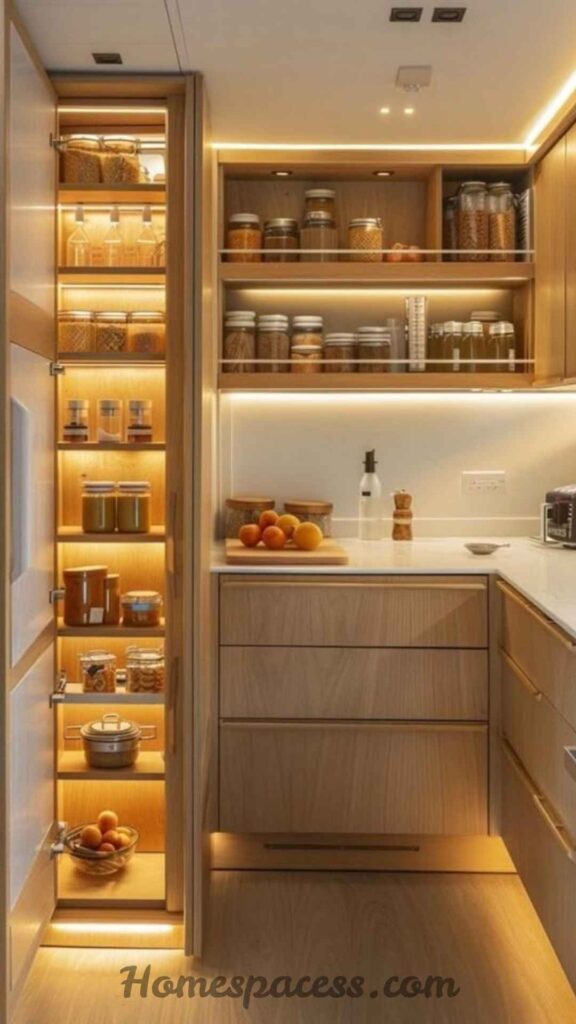
Most small kitchens stop storing things at eye level and leave 2–3 feet of wall space completely unused above the cabinets. This dead zone is one of the most underutilized spaces in residential design. Installing floor-to-ceiling cabinetry or even open shelving towers immediately adds functional storage without expanding your footprint by even a single square foot.
The psychology here matters too. Tall vertical lines actually make a room feel taller and more expansive. Interior designers refer to this as “vertical elongation” a trick used in boutique hotels and luxury apartments to create grandeur in small rooms. In a kitchen, it means your 8-foot ceiling becomes an asset rather than a ceiling pun. Use the highest shelves for seasonal or rarely used items: large pots, extra pantry staples, or appliances used only a few times a year.
Pro Tip:
Install a small rolling kitchen library ladder if you go truly ceiling-height. This adds character, solves access, and genuinely impresses guests transforming a practical solution into a design statement.
Must Read: Small Bathroom Ideas:25 Clever Ways to Make Every Inch Count
Cabinet Engineering
Pull-Out Cabinet Systems & Deep Drawer Organizers
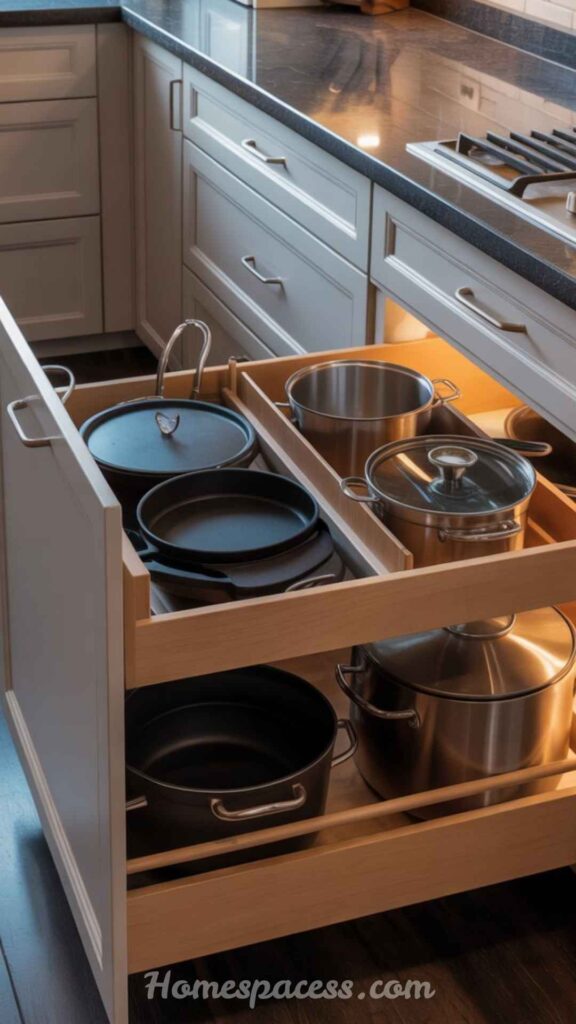
Standard cabinet doors are inefficient by design. When you open a door and reach into a deep cabinet, you immediately lose access to everythi
ng behind the first row of items. Pull-out systems soft-close drawers that replace cabinet shelves turn the full depth of a cabinet into accessible space. Brands like Rev-A-Shelf and Blum’s Tandem system have made this technology affordable for retrofits.
The deeper insight here is the concept of “dead depth elimination.” A standard base cabinet is 24 inches deep, but most people access only the first 10–12 inches. Pull-out systems double your effective storage by making the remaining depth visible and reachable. For pots and pans specifically, a two-tier pull-out drawer stores 4–6 pieces that would otherwise stack chaotically in a regular cabinet costing you 15 minutes every time you search for a lid.
Designer Insight:
When retrofitting existing cabinets, opt for full-extension, soft-close drawer slides rated for 100 lbs. The extra cost (roughly $30–60 per drawer) pays for itself in daily convenience and in resale value buyers consistently rank kitchen storage as a top purchase driver.
Must Read: 20 Home Office Ideas to Boost Productivity in 2026
Central Hub
Multi-Function Kitchen Islands That Replace Furniture
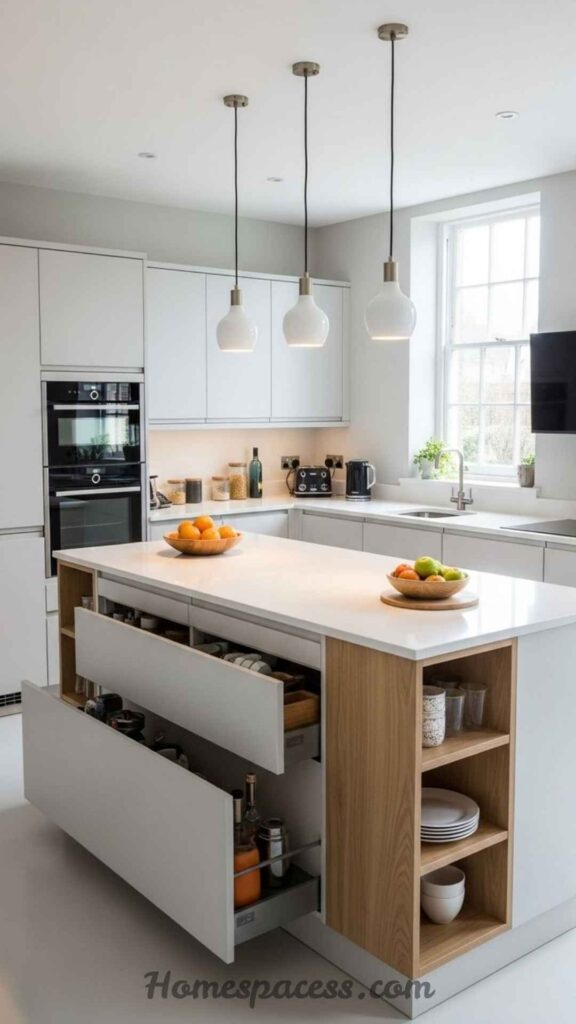
The common objection to kitchen islands in small spaces is purely dimensional “there’s no room.” But this thinking misunderstands the island’s true role. A well-chosen compact island (think: 24″×36″ on casters) doesn’t just add counter space, it replaces the need for a kitchen table, a pantry cart, and a breakfast bar all at once. The return on square footage is extraordinary when the island is designed correctly.
Look for islands with integrated features: a butcher block top for prep, enclosed shelving below for pantry overflow, one or two small drawer units, and a drop-leaf extension for dining. Some models even include built-in wine racks or small trash bins. The caster detail is often overlooked a moveable island transforms the kitchen from a fixed layout into a flexible workspace. Slide it to the side when cooking something elaborate that needs floor space; roll it to the dining area when serving a meal.
Space Math:
A 24″×36″ island leaves adequate workflow space in a 10-foot-wide kitchen (leaving a 48-inch aisle on one side). This meets the National Kitchen & Bath Association’s recommendation of 42-inch clear work aisles for single-cook kitchens.
Display & Function
Strategic Open Shelving Beauty With Purpose
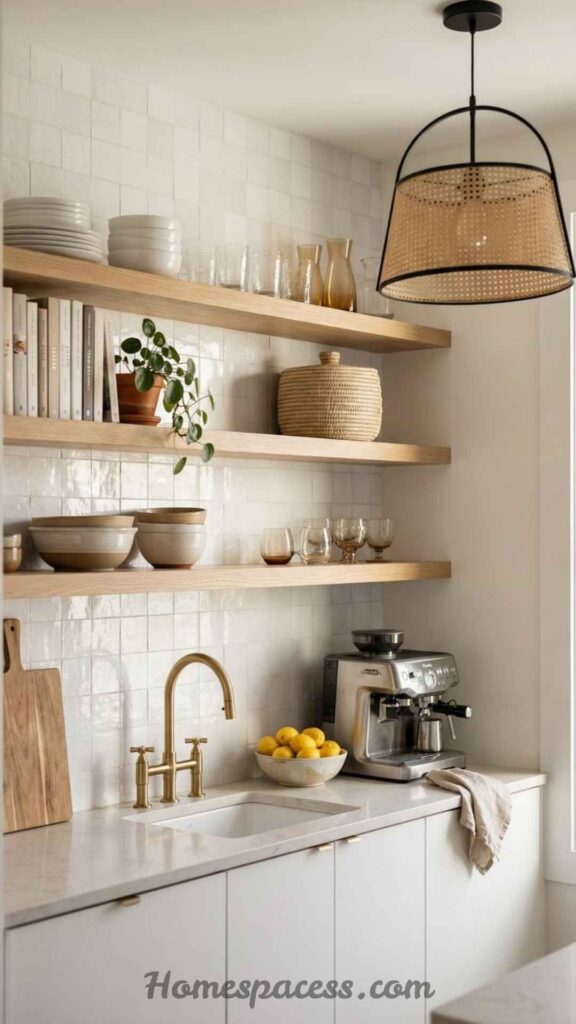
Open shelving is polarizing. Advocates love the airy, connected feeling it creates; critics point to the dust, visual clutter, and maintenance. The truth is that both sides are correct and the difference is in the strategy. Poorly executed open shelving (random mugs, mismatched containers, overcrowded rows) makes a small kitchen feel chaotic. Curated open shelving, where every item is intentionally placed, creates the illusion of a larger, more organized space.
The professional approach is to use the “rule of three” group items in odd numbers, vary heights slightly, and use consistent materials or colors within each grouping. White ceramic bowls, wooden cutting boards, and glass jars with uniform labels create a cohesive visual rhythm. Importantly, not everything needs to be on open shelves. Reserve closed storage for items you use daily (they’ll be in and out constantly anyway) and use open shelving for things used weekly or things genuinely worth displaying.
For structural support, floating shelves anchored to wall studs hold 40–50 lbs each when properly installed more than enough for dishware and pantry items. Bracket-free floating designs also create cleaner sightlines, reinforcing the visual openness small kitchens need most.
Hidden Space
Under-Sink Optimization: A Consistently Wasted Zone
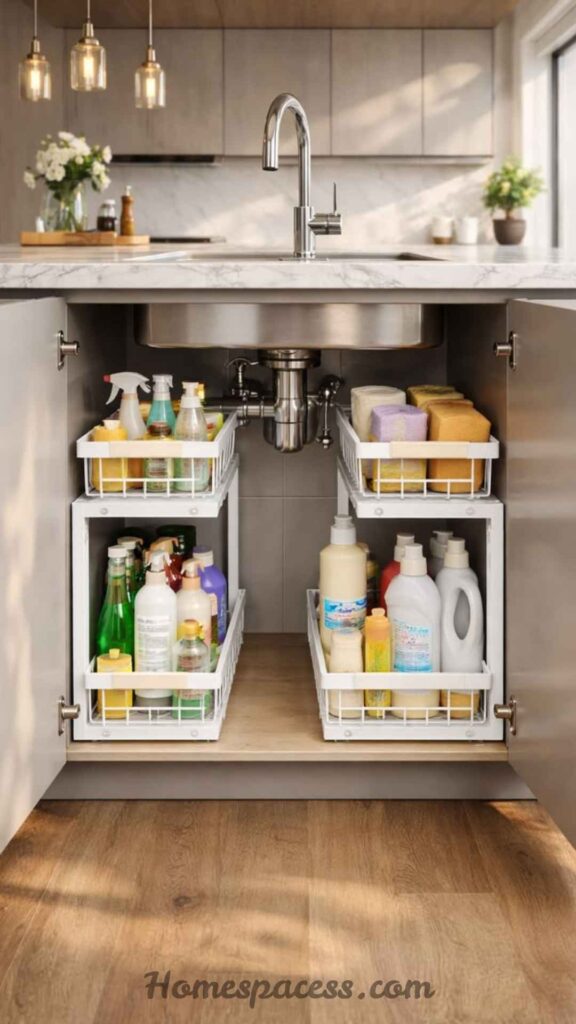
The area under the kitchen sink is typically occupied by cleaning supplies in a chaotic jumble around a drainpipe representing perhaps the worst-utilized storage in the entire kitchen. Yet this space, once properly organized, can store a surprisingly large volume of items when you account for the full depth and height available around the plumbing.
Tension rod systems stretched across the cabinet interior create a second “shelf” for hanging spray bottles freeing up base space for bins. Stackable pull-out drawers designed specifically for sink cabinets (with cutouts to clear the drain) maximize every inch. A turntable (lazy Susan) in the corner reaches items at the back without the usual archaeology. For renters, none of these require permanent installation they’re all tension, friction, or gravity-based solutions that leave no marks.
Specific Product Note:
The Rubbermaid Pull-Down Cabinet Organizer fits most under-sink depths and essentially doubles accessible storage by bringing back-of-cabinet items to the front with a single pull. It’s one of the highest-ROI storage purchases available under $50.
Right-Sized Appliances
Compact Appliance Swaps That Change Everything
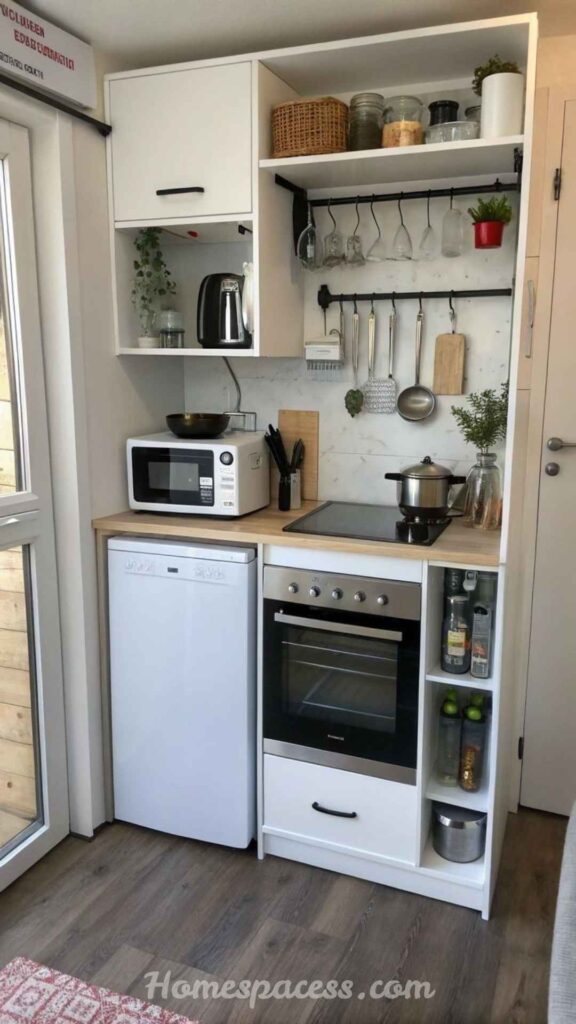
Most kitchens are fitted with appliances designed for families of four or more even when the occupant cooks for one or two. A full-size 30-inch range, a six-slice toaster oven, and a large-capacity refrigerator collectively consume counter and floor space that a small kitchen simply cannot spare. The swap to purpose-right appliances is one of the highest-impact changes you can make with no structural renovation required.
Induction cooktops (two or three-burner portable units) replace a full range and sit flush when not in use or can be stored in a cabinet. Countertop convection ovens have improved dramatically in the last three years and can handle everything from roasting a chicken to baking a cake. Drawer dishwashers (18-inch Fisher & Paykel models, for example) are one of the best-kept secrets in small kitchen design they use less water, less energy, and take up half the footprint of a standard dishwasher.
The Refrigerator Equation:
Counter-depth refrigerators (typically 24–27 inches deep vs. the standard 30–35 inches) align flush with your cabinets, visually expanding the room and improving workflow in narrow kitchens. The capacity difference (typically 10–15%) is rarely noticed in practice.
Spatial Psychology
Light & Mirror Illusions That Expand Space Visually
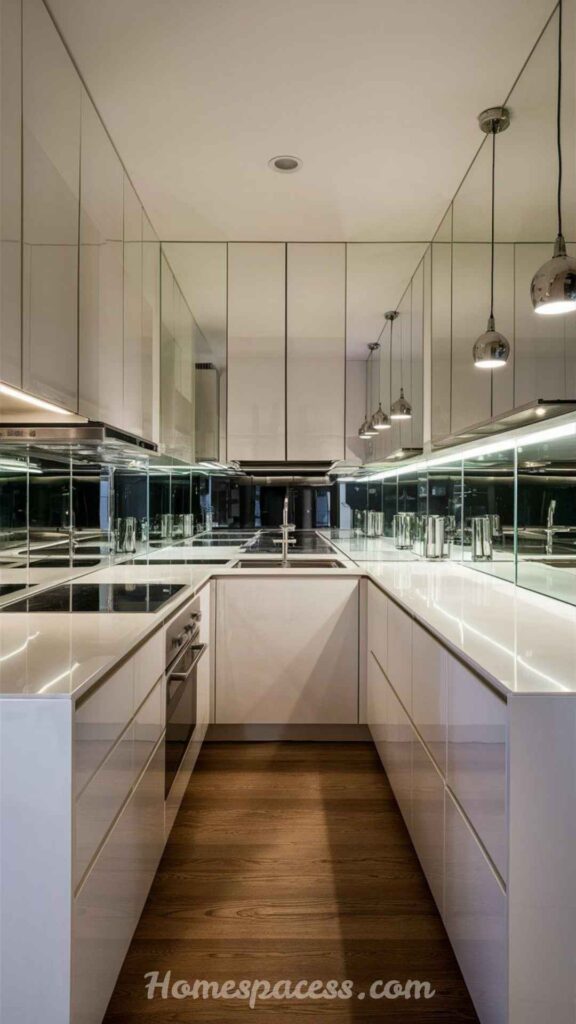
A kitchen doesn’t need to be physically larger to feel larger it needs to be perceived as larger. Light and reflection are the designer’s most powerful tools for achieving this. Glossy cabinet fronts, mirrored backsplash tiles, and highly reflective surfaces bounce light around the room, multiplying the apparent brightness and reducing the visual density that makes small rooms feel cramped.
Strategically placed mirrors deserve specific mention. A mirrored panel on a kitchen end wall where there’s no cabinetry creates an immediate visual doubling effect. In narrow galley kitchens especially, a floor-to-ceiling mirror at the far end creates the sensation of the kitchen extending beyond its actual boundary. Pair this with layered lighting: under-cabinet task lights, overhead fixtures for ambient light, and a small pendant over any island or dining corner. The combination eliminates the flat, dim quality that makes small spaces feel smaller.
Natural light maximization is equally important. If your kitchen window faces a good direction, keep the sill completely clear. Even a small plant or dish rack on the sill can reduce natural light penetration by 15–20%. Consider replacing heavy window treatments with simple cellular shades that disappear when raised, or remove treatments entirely if privacy allows.
Invisible Storage
Toe-Kick Drawers — The Most Overlooked Storage in Any Kitchen
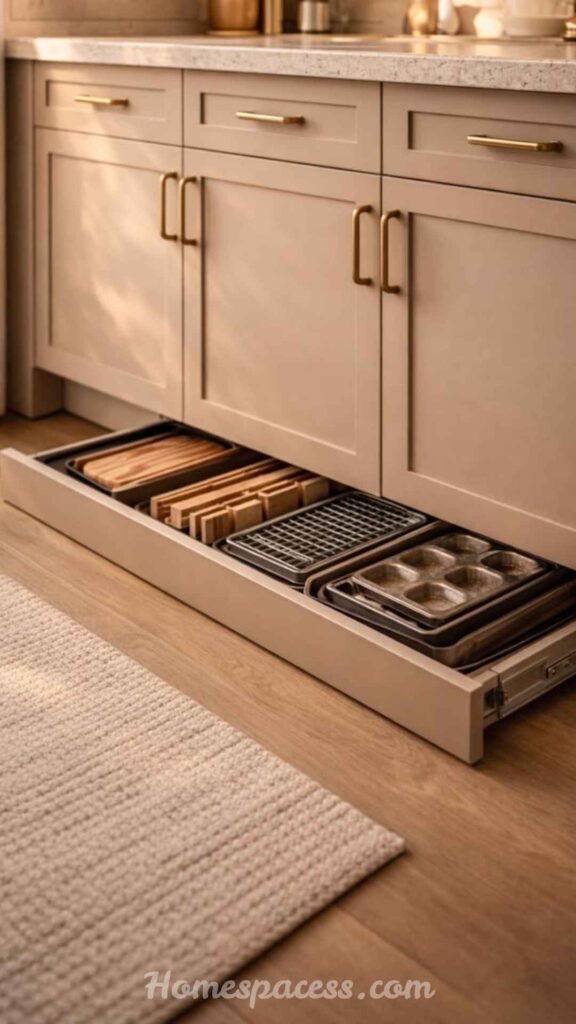
The toe-kick that 4-inch recessed strip at the base of your kitchen cabinets runs the entire length of your counter run and is almost universally empty. Converting this space into shallow drawers adds significant linear storage without touching a single visible cabinet. These drawers are ideal for flat items: baking sheets, cooling racks, cutting boards, pizza stones, and serving platters.
Installation requires only basic carpentry and can be done as a DIY project or by any general handyman. Push-to-open (no-handle) mechanisms keep them invisible until needed, maintaining the clean baseboard aesthetic while hiding an entirely new tier of storage below eye level. This is a solution that even interior designers frequently overlook when presenting kitchen renovation plans partly because toe-kick drawers don’t photograph as dramatically as open shelving or a statement island, but they deliver real, daily functional value.
Corner Efficiency
Corner Cabinet Solutions That Actually Work
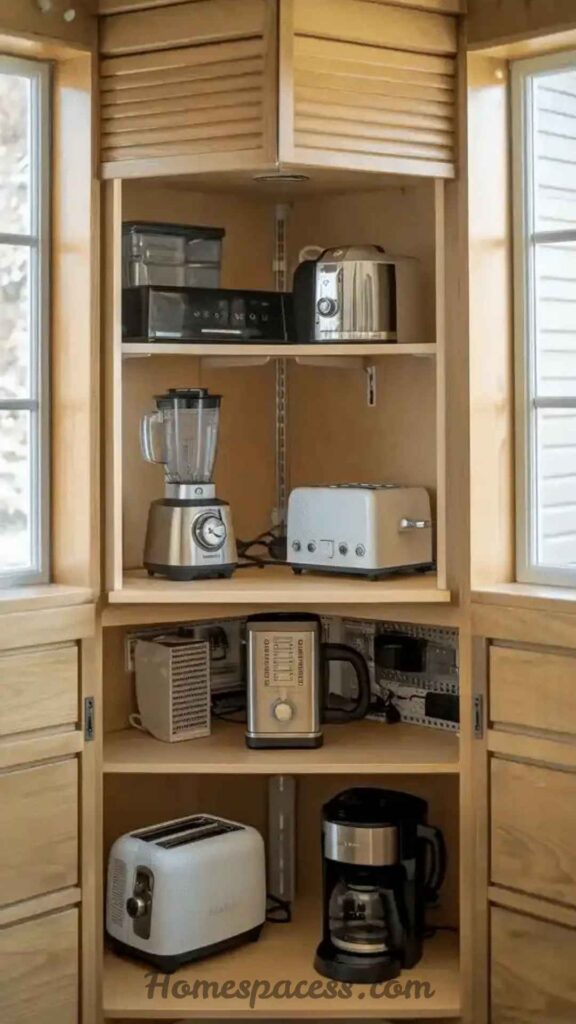
Corner cabinets are traditionally the most poorly utilized space in a kitchen. Standard lazy Susans help, but they waste significant volume in the area between the rotating shelves and the cabinet walls. The more effective modern solutions are pull-out drawer systems (sometimes called “lemans” corners or magic corners) that bring the entire corner volume forward on a hinged, sliding mechanism achieving close to 90% storage efficiency in a space that typically operates at 40%.
For smaller budgets, a diagonal shelf with a front-facing drawer is a simple retrofit that at least makes corner items visible. The deeper design principle is that corners are where kitchens accumulate unused space most rapidly so disproportionate attention to corner storage yields disproportionate gains in overall kitchen capacity. In a small kitchen, solving two corners well can add the equivalent of an entire additional cabinet’s worth of usable storage.
Wall Systems
Magnetic Wall Systems for Knives, Spices & Tools
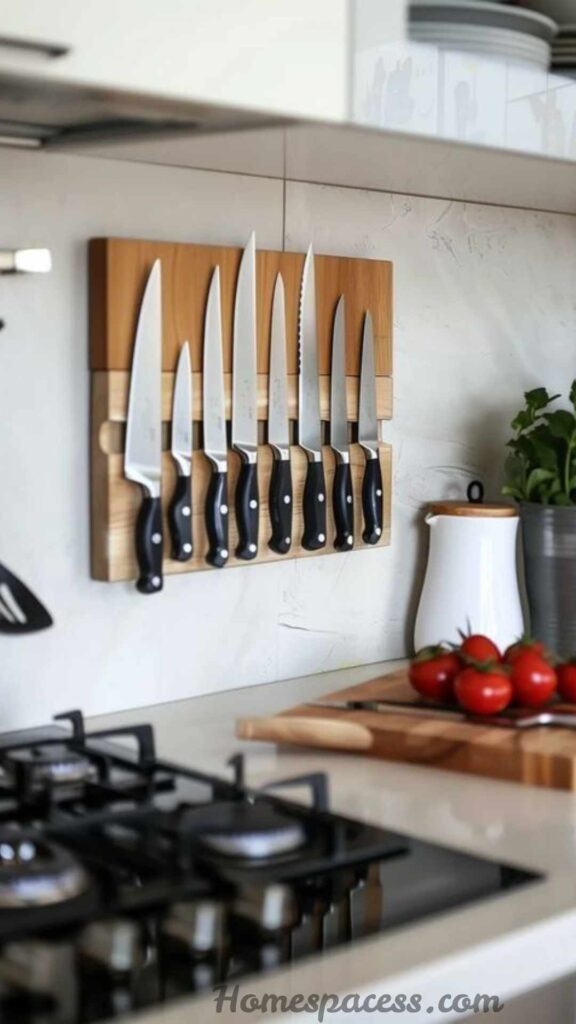
Magnetic wall-mounted storage systems have evolved far beyond the simple knife strip. Modern modular systems (such as those from Häfele or Yamazaki) use a magnetic or rail-based backbone to hold knife strips, spice jar holders, hook bars, paper towel holders, and even small shelving units all in a configurable, rearrangeable grid on a single wall section.
The real advantage is not just the storage but the counter liberation. Knives stored on a magnetic strip free a full knife block (roughly 4″×8″ of counter space). Spice jars in wall-mounted holders free up an entire shelf or drawer. Paper towel on the wall means one less counter accessory. In aggregate, moving these items off the counter can free up 20–30% of usable prep surface which in a small kitchen is transformational. A 36-inch magnetic rail over the stove wall is one of the single most cost-effective upgrades possible, often available for $25–60.
Flexible Furniture
Fold-Down Tables & Drop-Leaf Furniture for Dining
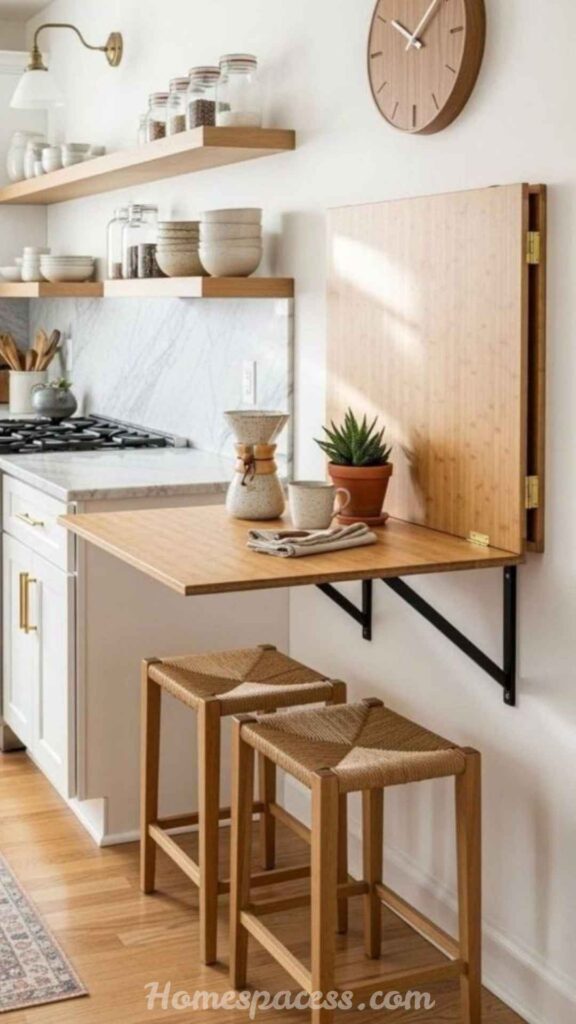
In a small kitchen, a permanent dining table is a luxury that often can’t be justified in square footage terms. Fold-down tables whether wall-mounted Murphy-style designs or drop-leaf tables attached to kitchen islands provide full dining capability when needed and disappear completely when not in use. This simple swap can recover 12–20 square feet of kitchen floor space, fundamentally changing how the room functions during cooking.
Scandinavian design traditions have perfected this concept, and the furniture quality available today is dramatically better than the wobbly fold-down tables of previous decades. Wall-mounted versions with folding legs support 100+ pounds when deployed and store flat at approximately 4 inches of wall projection. Some models incorporate hidden storage in the panel itself serving double duty as both a table and a wall cabinet. For breakfast bars, a counter-depth ledge with two bar stools pulls double duty as extra prep space and a two-person dining spot simultaneously.
Adaptable Wall Systems
Pegboard Panels: The Most Flexible Small Kitchen Wall
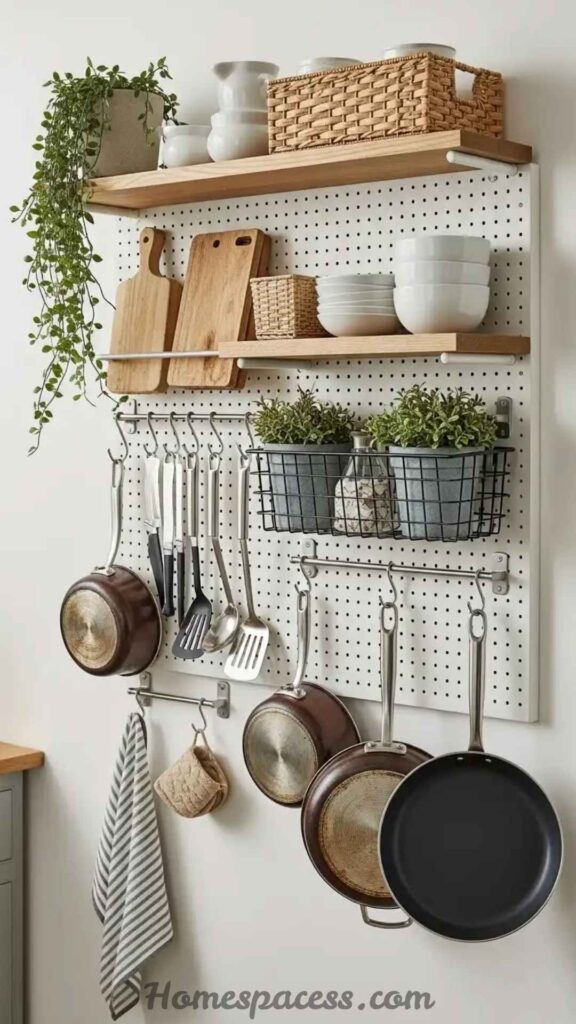
Pegboard has an image problem it conjures garages and workshop walls. But when finished in the right material (powder-coated steel, natural birch plywood, or painted hardboard) and fitted with design-forward accessories, a pegboard wall section becomes one of the most intelligent, adaptable storage systems a small kitchen can have. Unlike fixed cabinetry, a pegboard wall can be completely reconfigured in minutes as your cooking habits and tool collection change.
The key is using quality hooks and accessories designed specifically for kitchen use not garage hardware. Stainless steel hooks, small ledge shelves, and container clips allow a single 24″×48″ pegboard panel to store 15–20 items that would otherwise occupy two full cabinet shelves. Frame the board with a thin wood or metal border and finish the wall behind it in a contrasting color, and the result looks intentionally designed rather than improvised.
Color Science
Color Psychology: Choosing Shades That Make Kitchens Feel Bigger
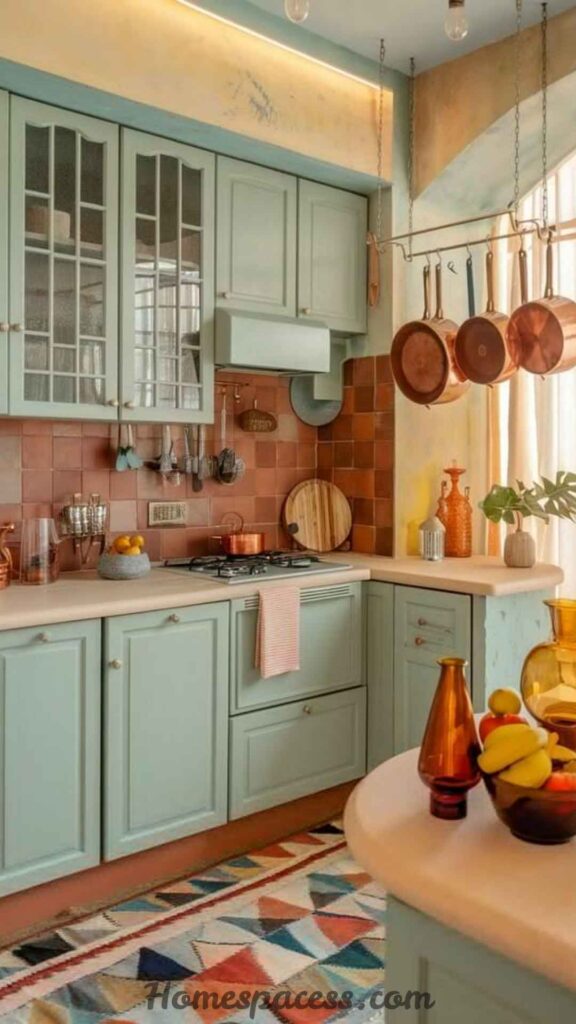
Color choice in a small kitchen operates on principles that are both psychological and physical. Light-reflective paint (with an LRV Light Reflectance Value above 70) bounces significantly more light than mid-toned colors, creating a brighter environment that reads as more spacious. But the common advice to “just paint everything white” is overly simplistic. The right white for a small kitchen depends on your light source: warm whites (creamy, slightly yellow undertones) suit south-facing kitchens with warm afternoon light; cooler whites or barely-there grays suit north-facing kitchens with cooler light.
Beyond the wall color, the cabinet color is the higher-stakes decision. Two-tone kitchens lighter upper cabinets, slightly darker (but still mid-toned) lower cabinets have been shown to create a visual grounding effect that makes ceilings feel higher. Sage green, warm greige, and dusty blue lower cabinets with white uppers are among the most effective combinations for small kitchen design in 2025–2026. Avoid very dark lower cabinets (navy, charcoal) in truly tiny kitchens, as these absorb light and visually compress the space.
The LRV Rule:
Choose wall paint with an LRV above 75 and cabinet paint above 60 for small kitchens. Most paint brand apps (Benjamin Moore, Sherwin-Williams) display LRV values — use them as your primary selection filter before considering aesthetics.
Backsplash Innovation
Backsplash Niches & Built-In Storage Behind the Stove
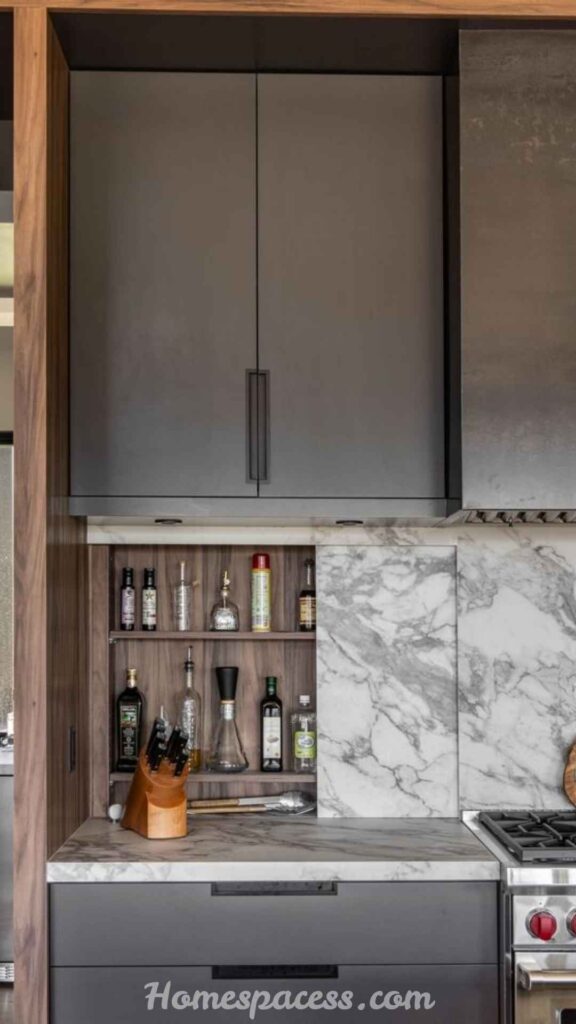
The space between your countertop and your upper cabinets the backsplash zone is typically treated as a purely decorative surface. But in renovation scenarios, this 18–24 inch vertical zone can incorporate recessed niches, built-in spice shelves, or integrated rail systems that add storage without projecting into the kitchen at all. A 3-inch-deep recessed niche between studs (standard walls are 3.5 inches deep) creates a perfect spice shelf flush with the wall surface.
Even without a full renovation, backsplash wall space can be fitted with slim magnetic panels, S-hook rails, or small shelf brackets that sit only 1–2 inches off the wall. The principle is using every vertical surface as a potential storage plane, rather than treating walls as backgrounds. In a small kitchen where every inch matters, the backsplash area represents a frequently missed opportunity roughly 10–15 square feet of wall surface that most kitchens use for nothing but tiles.
Ambient Lighting
Under-Cabinet Lighting: The Upgrade With the Best ROI
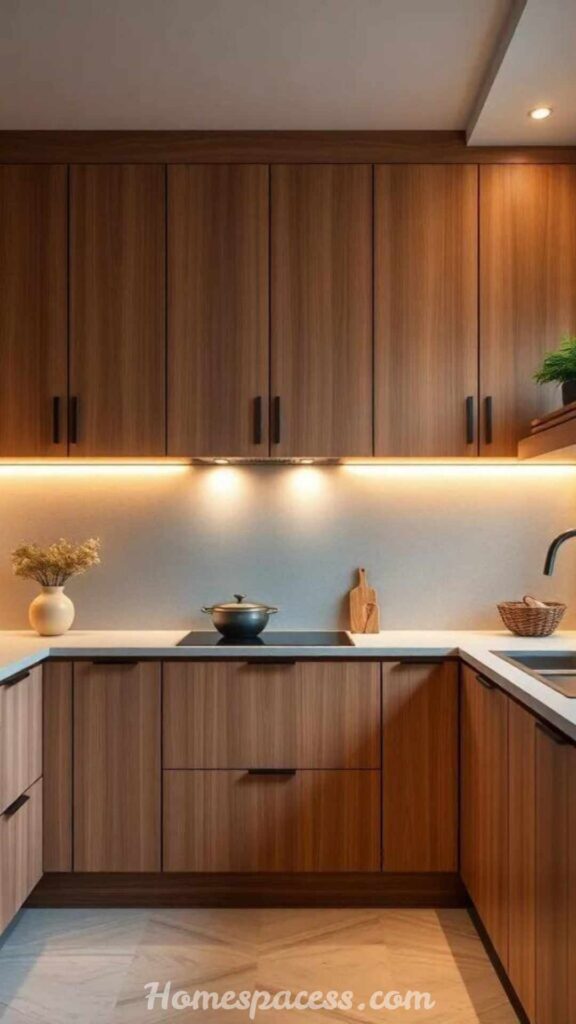
Under-cabinet lighting is consistently ranked by kitchen designers as the single highest-return upgrade for small kitchens in both livability and resale value. The reason is layered: it provides direct task lighting for prep work (reducing eye strain and improving cooking safety), it illuminates countertops that overhead lights shadow, and it adds ambient warmth that makes the kitchen feel more inviting at all hours.
Modern LED strip lights (specifically warm-white, 2700K–3000K) adhere with 3M tape and plug into standard outlets hidden behind upper cabinet overhangs no electrician required. Dimmable versions (paired with a smart plug) allow you to dial the kitchen from bright task-mode during cooking to soft ambiance mode during evening use. The total cost for a standard kitchen: $40–120 for LED strips, a Saturday morning installation, and an immediate, nightly improvement to how the space looks and functions.
Drawer Engineering
Drawer-Within-Drawer Systems for Layered Organization
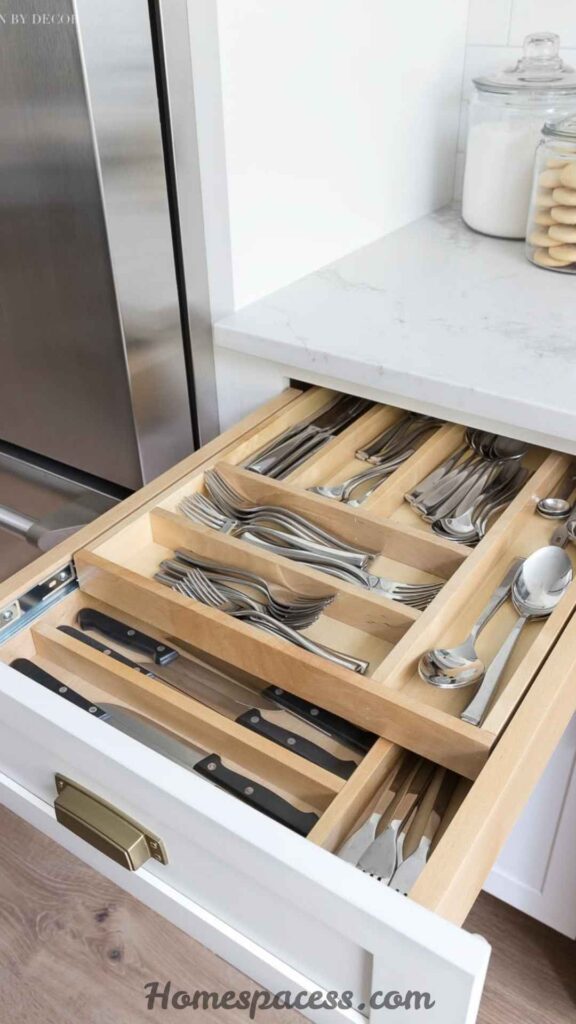
Standard drawers are a flat single layer open the drawer, see everything on one plane. Drawer-within-drawer systems (sometimes called “false bottom” or tiered drawer inserts) add a second, shallower tray inside the primary drawer, creating two distinct storage zones in the same vertical space. A knife drawer with a tiered insert holds knives in a top tray and kitchen scissors, peelers, and zesters in the lower layer all within a single 4-inch deep drawer.
This approach is especially valuable for utensil drawers, where the standard solution throwing everything into a single layer means rummaging through 30 items to find a spatula. Tiered inserts with divided compartments reduce search time and increase usable storage density by roughly 40–50% compared to a single-layer drawer with the same items. For spices specifically, a two-level tiered drawer insert (labels facing up) allows you to see and access every spice jar without moving others the so-called “top-down labeling” method popular in professional kitchen organization.
Overhead Utility
Ceiling-Mounted Pot Racks That Free Your Cabinets
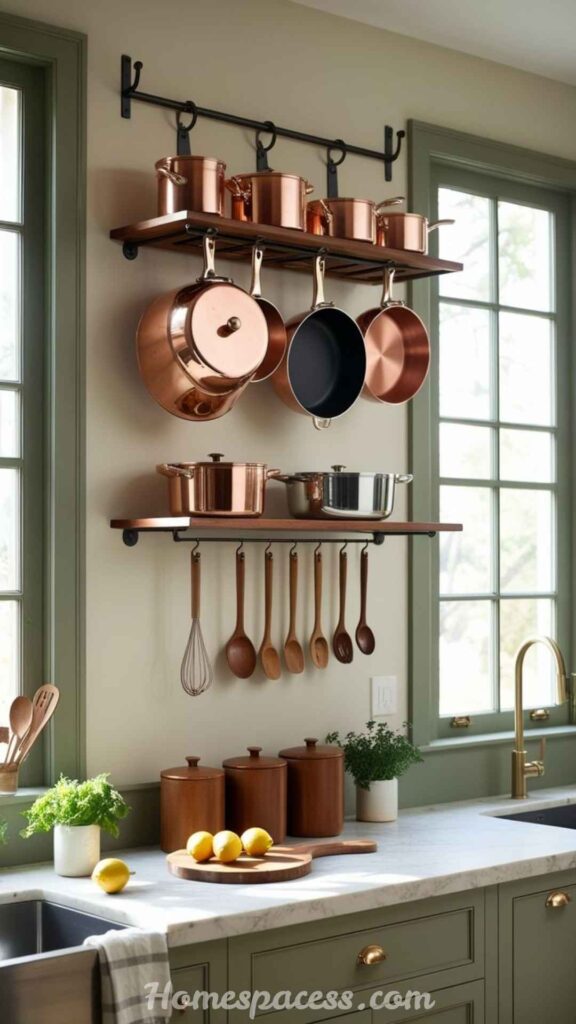
Pots and pans are among the most difficult kitchen items to store efficiently. They’re bulky, irregularly shaped, heavy, and used frequently a combination that makes traditional cabinet storage frustrating. A ceiling-mounted pot rack solves all of these problems simultaneously, removing the largest category of items from cabinet storage and placing them in overhead space that is otherwise completely unused.
The ceiling approach requires anchoring to ceiling joists (or using toggle anchors rated for the load), but this is a straightforward DIY project with a stud finder and appropriate hardware. The visual effect is an unexpected bonus: a well-arranged pot rack with copper, stainless, or cast iron pieces becomes a design feature the kind of detail that makes a small kitchen feel like a working chef’s space rather than a compromised apartment kitchen. For low ceilings (under 8 feet), opt for a wall-mounted rail version instead, placed high on a kitchen wall to achieve the same effect without reducing head clearance.
Layout Science
Zone-Based Layout Design: Work Smarter Than Your Footprint
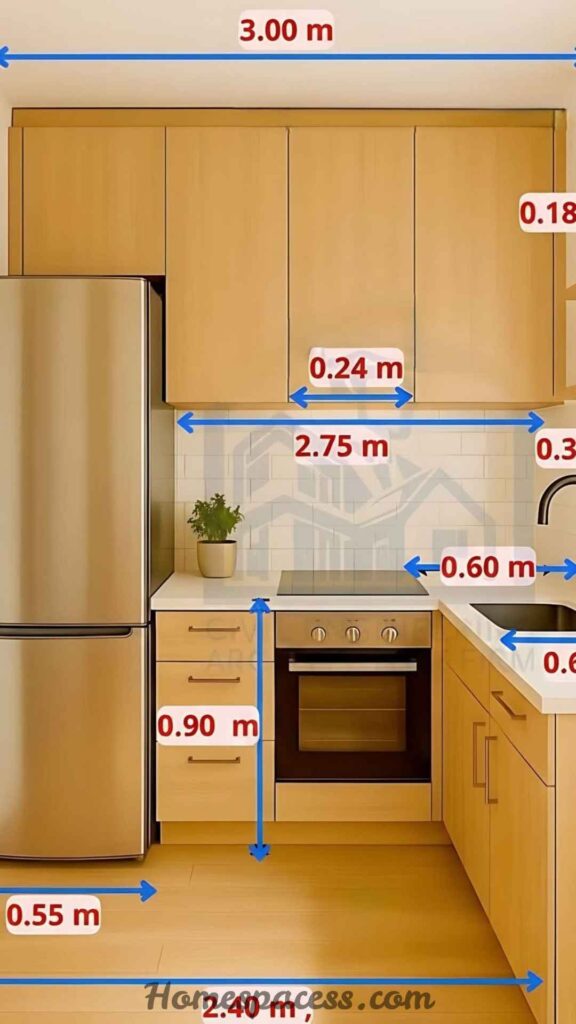
The most impactful “idea” in a small kitchen is not a product or a storage hack it’s a redesign of how the space is mentally and physically organized. Kitchen layout theory has evolved significantly beyond the classic “work triangle” (sink, stove, refrigerator). Modern kitchen design uses the concept of activity zones: a prep zone, a cooking zone, a cleaning zone, and a storage zone, each positioned to minimize unnecessary movement.
In a small kitchen, poor zone placement creates what designers call “conflicting traffic patterns” moments where two tasks (unloading the dishwasher and preparing dinner, for example) cannot happen simultaneously without physical interference. Analyzing your kitchen with zone logic often reveals simple rearrangements moving the knife block to the prep zone, repositioning the cutting board to a fixed prep station, consolidating spices near the cooking zone that require no renovation at all. Small changes in item placement can reduce the number of steps taken during meal prep by 30–40%, making the kitchen feel significantly more spacious simply because you’re moving through it more efficiently.
The Real Test:
Time yourself preparing a typical meal in your current kitchen layout. Note every trip you make between different areas. Then redesign item placement so your three most-used items in each zone are within arm’s reach. This single exercise, done thoughtfully, typically reveals 4–6 improvements that require zero spending.
Conclusion
Every idea in this guide shares a common thread: the best small kitchens are not ones that fight against their size, but ones that have been designed to work with it intelligently, intentionally, and efficiently. The kitchens that consistently rank highest in owner satisfaction are rarely the largest; they’re the ones where every decision, from cabinet height to countertop appliance selection, has been made with care.
Start with the changes that cost little or nothing: the zone audit, the cognitive load reduction, the counter-clearing discipline. Layer in targeted storage upgrades the magnetic rail, the pull-out drawers, the under-cabinet lights. And when you’re ready for a more significant investment, choose quality over quantity, sustainability over trend-chasing, and function over form. A small kitchen that works brilliantly is always more satisfying than a large kitchen that merely looks impressive.
The future of small kitchen design is bright literally and figuratively. The next five years will bring technology, materials, and modular systems that make today’s best practices look like a starting point. But the principles will remain constant: respect every inch, eliminate friction, and design for the way you actually live.
Advanced Analysis
Small Kitchen Design Trends: 2026 and the Decade Ahead
The small kitchen design landscape in 2026 is shaped by three powerful forces: the continued urbanization of housing stock, the post-pandemic normalization of working from home (which drives more cooking), and the mainstream adoption of smart home technology. Together, these forces are creating a new generation of small kitchen design that is simultaneously more compact, more functional, and more intelligent than any previous era.
Japandi design a fusion of Japanese wabi-sabi philosophy and Scandinavian functionality has become the dominant aesthetic for small kitchens in 2026. It prioritizes natural textures, neutral warmth, and purposeful objects. Every item visible in a Japandi kitchen is there because it belongs there a philosophy that is extraordinarily well-suited to small kitchen design. Clutter is not just discouraged; it is architecturally prevented by thoughtful storage integration.
Looking toward 2027–2030, the most significant shift will be the integration of ambient computing into kitchen infrastructure. Smart under-cabinet lighting systems that brighten automatically when you approach for prep work, ventilation that activates based on stove sensor data, and refrigerators that track inventory and suggest recipes based on what you have are all arriving at consumer price points. The small kitchen of 2030 will not be smaller than today’s it will simply be smarter, adapting to you rather than requiring you to adapt to it.
Expert Insights
Practical Optimization Lessons That Designers Rarely Publish
Interior designers who specialize in compact living spaces consistently report that the biggest gains in small kitchen functionality come not from expensive renovations but from behavioral changes enabled by better organization. One principle that rarely makes it into published guides: the “cognitive load” concept. A disorganized kitchen creates decision fatigue when you open a cabinet and face visual chaos, your brain must work harder to find what it needs, making cooking feel more difficult and time-consuming than it actually is. The physical act of organizing creates a measurable reduction in cooking-related stress.
Experienced kitchen designers also emphasize what they call “the 80/20 of kitchen storage” roughly 20% of your kitchen items are used 80% of the time. Identify those items first (typically: one frying pan, one saucepan, one knife, your most-used spices, a cutting board, and a colander) and optimize their storage and placement before addressing anything else. Once the frequently-used 20% is within arm’s reach and easily returned after use, the rest of the kitchen’s organization becomes significantly easier to maintain. Most people do this backwards they optimize rarely-used items first because they’re easier to organize definitively.
A final expert insight worth highlighting: the power of the “negative space audit.” Walk through your kitchen and identify every surface, drawer, or shelf where items have accumulated that don’t belong there. Kitchen counters especially accumulate non-kitchen objects mail, keys, chargers, medication. Each of these “settlers” has displaced kitchen functionality. Creating dedicated homes elsewhere in your home for these items, and protecting that kitchen real estate, often delivers more functional improvement than any storage product you could purchase.
Sustainability & Long-Term Value
The Green Small Kitchen: Sustainable Choices With Lasting ROI
A smaller kitchen has an inherent sustainability advantage: less space means less material use, less energy consumption, and less food waste (because everything is visible and accessible). But this advantage is only realized when the kitchen is designed with sustainability in mind. The choices you make in materials, appliances, and organization practices in a small kitchen have a disproportionate environmental impact because they are used so intensively.
Induction cooking (versus gas or standard electric) reduces kitchen energy consumption by 40–70% for the cooking function alone. Compact dishwashers use 3–4 gallons per cycle compared to 8–10 gallons for full-size models. Choosing solid wood or formaldehyde-free MDF for cabinetry avoids off-gassing that affects indoor air quality over years of daily kitchen use. And opting for LED lighting throughout (task, ambient, and accent layers) reduces kitchen lighting energy use by approximately 80% versus incandescent alternatives a saving that compounds meaningfully over a 10–15 year kitchen lifecycle.
From a long-term value perspective, sustainability investments in small kitchens have the highest payback rate of any room in the home. A well-designed small kitchen with quality, durable materials solid wood cabinetry, stone or quartz countertops, induction cooking will outlast three generations of trend-following, low-quality alternatives. Real estate data consistently shows that kitchen quality is the primary driver of home value; in urban markets especially, a thoughtfully designed small kitchen with high-quality finishes commands a premium that far exceeds its renovation cost.
Future Predictions
Upcoming Innovations That Will Reshape Small Kitchens by 2030
The most disruptive near-future innovation in small kitchen design is the convergence of modular cabinetry systems with smart actuator technology. Companies including IKEA (through its SPACE10 research arm) and several European kitchen manufacturers are developing cabinetry systems where shelves, drawers, and counters move on demand a small kitchen that literally reconfigures itself based on the task at hand. Prep mode might extend the counter and lower shelving for easy access; storage mode collapses surfaces and raises items out of the workflow. These systems are expected at mainstream consumer price points by 2028–2030.
Simultaneously, the “invisible kitchen” concept where all appliances are fully concealed behind unified panel fronts is moving from luxury custom builds into the mid-range market. Dishwashers, refrigerators, ovens, and microwaves will all be integrated behind matching cabinetry doors, making the kitchen visually indistinguishable from the living space when not in active use. This is particularly transformative for open-plan studio apartments, where the kitchen’s visual presence affects the entire living environment.
Vertical growing systems integrated into kitchen cabinetry (hydroponic herb and small-vegetable walls) are another innovation approaching mainstream accessibility. Currently available as premium installations ($800–2,000), these systems will reach commodity pricing within five years, allowing small kitchens to produce fresh herbs and greens year-round within their existing footprint. The food production, aesthetic, and air quality benefits make this one of the most multi-functional upgrades imaginable for a small kitchen.
Common Mistakes
The Small Kitchen Mistakes That Most Guides Never Mention
The most common and most costly mistake in small kitchen design is solving storage problems with more storage products before understanding the actual organizational problem. Bins, baskets, lazy Susans, and drawer organizers are tools; used without a clear system, they simply add new containers for the same clutter. Before purchasing any storage solution, the discipline is to first purge to remove items that don’t belong in the kitchen at all, and items that are rarely used enough to justify prime storage real estate.
- Mistake 01: Over-lighting with a single overhead fixture, creating harsh shadows on countertops and making the space feel clinically small. Layer light sources instead.
- Mistake 02: Choosing open shelving purely for aesthetics without a maintenance commitment. Open shelves require weekly attention without it, they become a visual liability within weeks.
- Mistake 03: Ignoring the island aisle clearance requirement. An island that leaves less than 36 inches of aisle space (42 inches preferred) creates more problems than it solves in daily use.
- Mistake 04: Matching cabinet color to wall color in an attempt to create “seamless” design. In small kitchens, this collapses depth and makes the room feel smaller, not larger.
- Mistake 05: Buying storage products before measuring. Cabinet organizers, pull-out systems, and drawer inserts require precise measurements a common $40 mistake that becomes a frustrating return trip.
- Mistake 06: Treating all countertop space as “available.” Permanent appliances (coffee maker, toaster) should be evaluated against the total prep surface required for your most complex typical meal.
One particularly overlooked mistake is the “renovation before organization” trap. Many homeowners invest $15,000 30,000 in a kitchen renovation and then fill the new space with the same organizational habits they had before. The result is a beautiful kitchen that is just as frustrating to use as the old one. The disciplined sequence is: first, purge; then, organize; then, upgrade storage solutions; and only then consider structural renovation if genuine limitations remain. Most small kitchens, when properly organized, function better than their owners expected reducing or eliminating the financial and logistical cost of renovation entirely.
Aliza Noor founded Home Spacess to share simple, practical design ideas that work for real families. She focuses on cozy décor, soft colors, and natural textures that make a space feel truly lived-in. Based just outside Toronto, Aliza spends her days juggling family life, experimenting with home projects, tending to her plants, and occasionally moving things around just to create a fresh vibe.
