
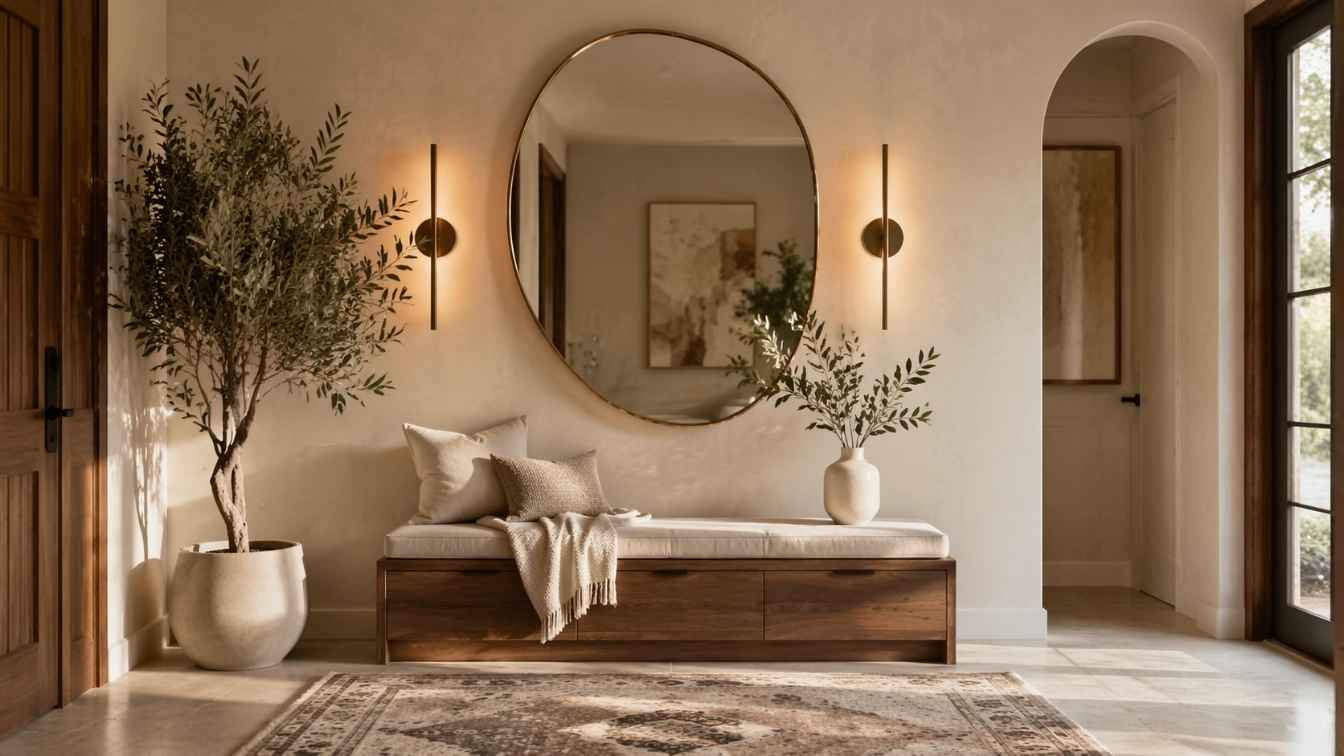
Entryway Decor Ideas: Transform Your First Impression Into a Lasting Statement

Your entryway is the first thing guests see and the last space you experience before leaving home. Most people treat it as an afterthought. These 18 expert-backed ideas will change that entirely.
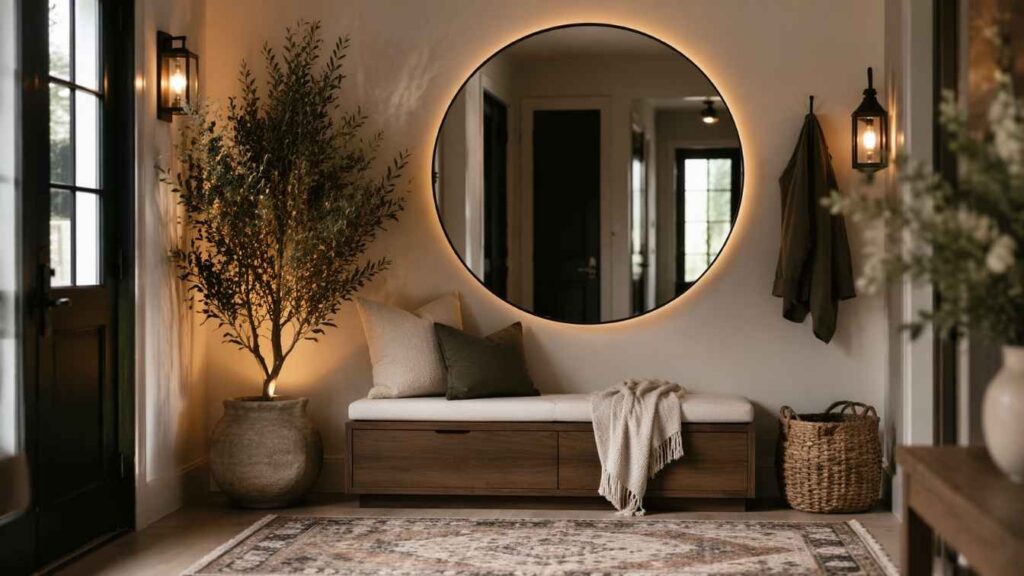
Imagine walking into a home where the entryway instantly tells you everything the homeowner’s taste, their sense of order, their warmth. That moment takes less than three seconds. Studies in environmental psychology confirm that first impressions of spaces are formed almost instantly and are incredibly hard to change. Yet most homeowners spend 80% of their decor budget on living rooms and bedrooms, while the entryway gets a coat hook and forgotten mail. This guide changes that equation with 18 practical, design-forward entryway decor ideas that work for tiny apartments and spacious foyers alike.
Hang a Statement Mirror to Expand Space Instantly
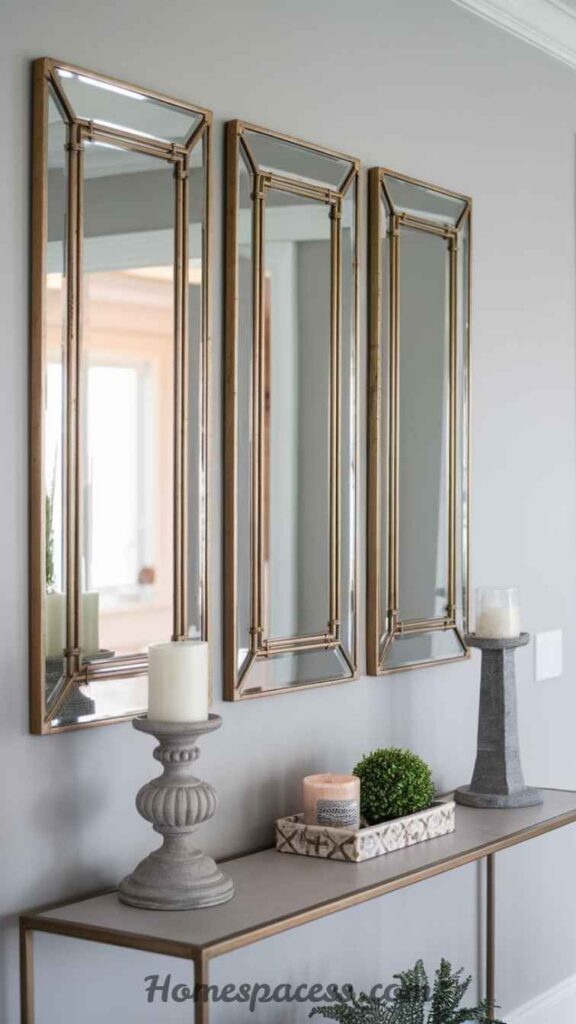
A large mirror in the entryway does three things at once: it makes the space feel twice as large, bounces natural or artificial light deep into the room, and gives you a final check before heading out. Interior designers consistently rank the statement mirror as the single highest-ROI piece in an entryway. For maximum impact, choose a frame that contrasts your wall color an aged gold frame against deep green, or a raw blackened steel frame against warm white.
The key detail most homeowners miss is mirror placement height. The center of your mirror should sit roughly at eye level for the average adult approximately 57 to 60 inches from the floor. Go higher and it loses its functional value; go lower and it feels cramped. For narrow entryways, lean a tall floor mirror against the wall at a slight angle rather than mounting it flat. The angled position adds a designer-intentional feel while visually elongating the space.
Pro Tip
The 75% Rule for Mirrors
Your mirror should span at least 75% of the width of the furniture it hangs above (console table, bench, etc.). A mirror that’s too small looks like an afterthought. When in doubt, go bigger you almost never regret a larger mirror in a foyer.
Must Read: 20 Stunning Door Painting Ideas That Actually Transform your Home
Layer Your Lighting for Depth and Warmth
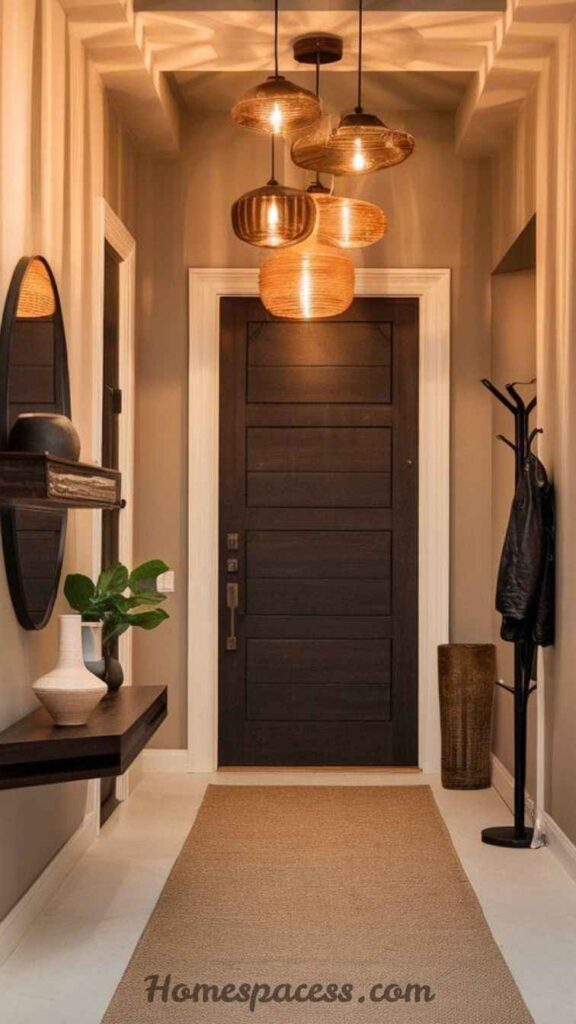
Overhead lighting alone creates a flat, institutional feel. The most inviting entryways use at least two light sources at different heights: a pendant or semi-flush ceiling fixture for general illumination, and a lower table lamp or wall sconce for warmth at human scale. This layering technique, borrowed from hospitality design, signals “welcome” rather than “utility room.”
Color temperature matters enormously in entryways. Bulbs between 2700K and 3000K produce a warm, amber-toned light that flatters skin tones and makes natural materials like wood and stone glow. Avoid anything above 3500K in an entryway it reads as clinical and cold. If your space gets natural daylight, add a dimmer to every entryway fixture so you can adjust the ambiance from afternoon to evening without changing a single piece of furniture.
💡Smart lighting upgrade:
Install a motion-activated light on a smart dimmer. It activates as you arrive, sets the mood automatically, and saves energy when the space is empty. Brands like Lutron Caséta integrate seamlessly with existing wiring.
Don’t Skip: 25 Home Decor Ideas That Actually Transform Your Space
Style a Console Table Like a Designer
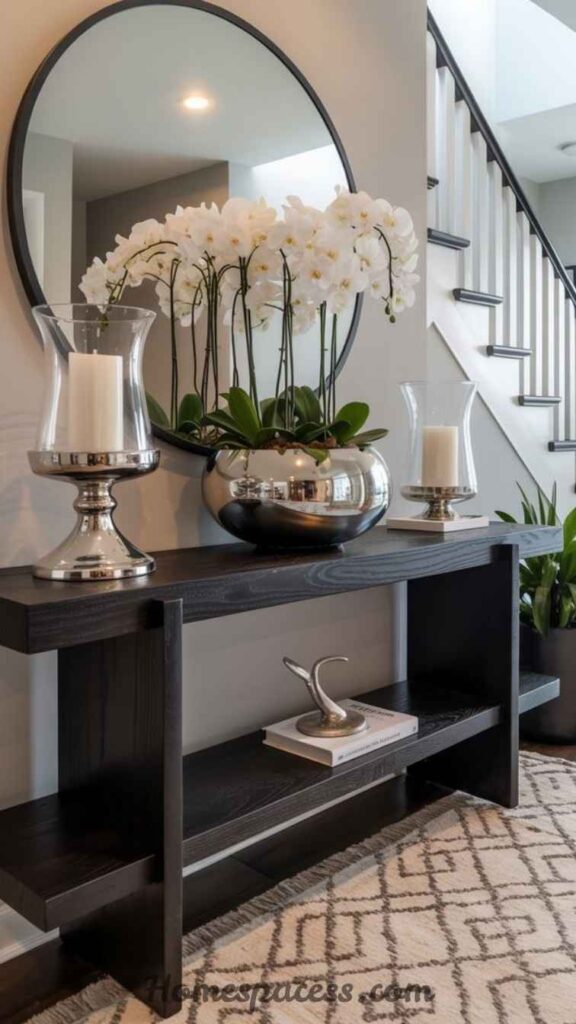
A console table transforms a blank wall into a curated moment. The design formula that works consistently is: tall object + medium object + low object, arranged in a rough triangle. For example a tall ceramic vase on one end, a medium framed photo or small painting in the center-back, and a low decorative bowl or stack of design books on the opposite end. This asymmetry creates visual tension that keeps the eye engaged without feeling chaotic.
The most overlooked element of console table styling is negative space. Leave at least 30% of the tabletop empty. Crowding a console with too many objects turns it from a focal point into clutter. Also consider what lives under the table: a large woven basket for umbrella storage, a small bench for shoe overflow, or even sculptural legs on the table itself can all contribute to the design story from floor to tabletop.
Read More: 21 Kitchen Decor Ideas That Transform an Ordinary Kitchen Into a Space You Actually Love
Add a Bench with Hidden Storage
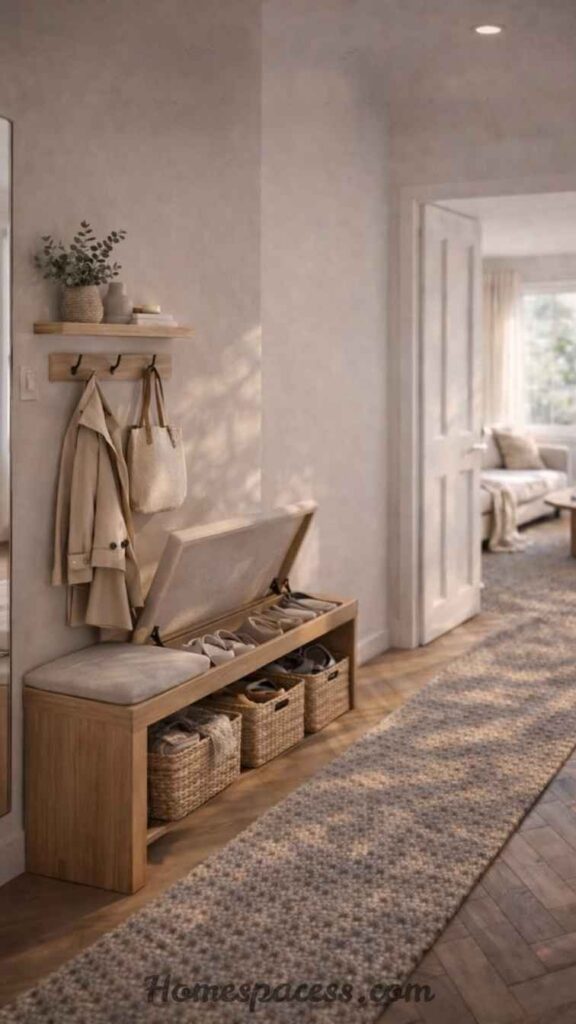
In a well-designed entryway, every piece must earn its place. A bench does this by serving three roles simultaneously: seating for putting on shoes, a visual grounding anchor for the space, and if chosen correctly a concealed storage unit for shoes, bags, or seasonal items. Upholstered benches with flip-top lids or slatted bases with visible baskets underneath are the most versatile options across different entryway sizes.
When selecting fabric for an entryway bench, durability must come first. Look for performance fabrics with a Martindale rub count of at least 30,000 these resist abrasion and are usually wipeable, which matters in a high-traffic area. Natural materials like boucle or velvet look luxurious but degrade quickly in entryways. Instead, opt for a velvet-look performance fabric that mimics the aesthetic while surviving real-world use.
Don’t Miss: 29 Bathroom Decor Ideas That Transform Any Space
Create a Gallery Wall That Tells Your Story
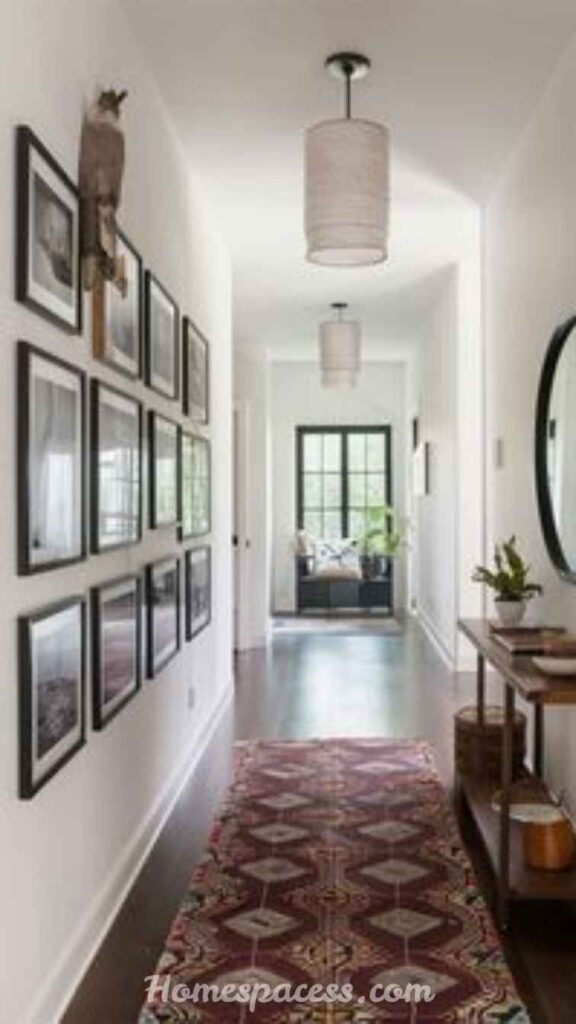
Gallery walls in entryways do something unique they act as a visual autobiography for guests walking in. Unlike a living room gallery that people observe at leisure, an entryway gallery is experienced in passing, which means the overall composition matters more than the individual pieces. Use a single consistent frame color or material (all black, all brass, all natural wood) to create cohesion across varied art styles and subjects.
Before hammering a single nail, lay your gallery arrangement on the floor and photograph it from above. This gives you a bird’s-eye view of the composition and lets you iterate without damage. The most successful entryway galleries have one clear anchor piece typically the largest or most visually striking and supporting pieces that orbit it. Avoid perfectly symmetrical grids; they read as corporate. Aim for balanced asymmetry instead.
Use Bold Paint or Wallpaper Without Fear
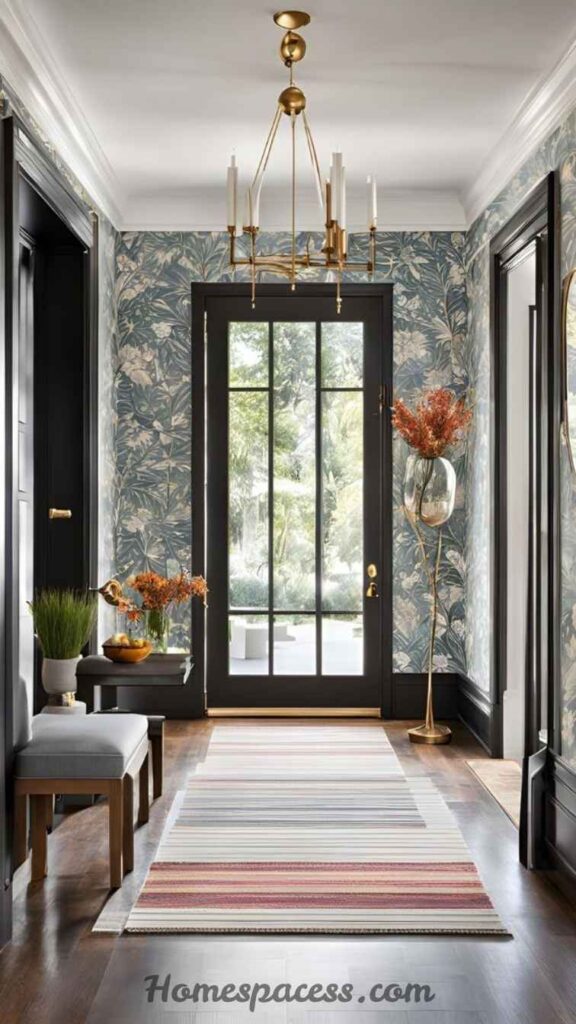
The entryway is the best room in your home to take a color risk. Because it’s a transitional space rather than a room where you spend hours at a time, bold choices feel exciting rather than overwhelming. Deep forest green, moody navy, saturated terracotta, or a dramatic floral wallpaper can all work beautifully in an entryway that might feel excessive in a bedroom or living room. The small square footage of most entryways means the cost of a mistake is low and the reward of a bold choice is high.
If you’re hesitant about commitment, consider a mural-style wallpaper on a single accent wall (typically the wall facing you as you enter). This gives maximum visual impact with minimum risk. Alternatively, paint only the ceiling in a rich color known as the “fifth wall” technique which adds depth and drama while leaving the walls neutral. This approach is particularly effective in entryways with ornate crown molding.
Designer Scenario
The “Jewel Box” Entryway
Interior designer Kelly Wearstler popularized the concept of the entryway as a “jewel box” a small, intensely decorated space that sets a tone of luxury and drama before revealing more restrained rooms beyond. Paint all four walls, the ceiling, and even the trim in the same saturated color for this effect. Deep plum, emerald, or lacquer red work particularly well.
Bring Nature Indoors with Living Elements
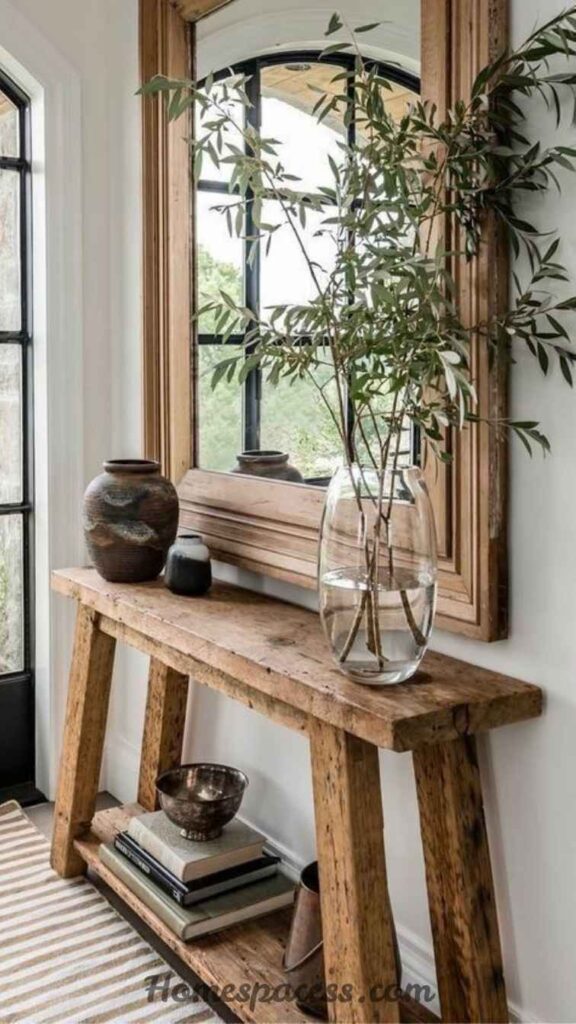
Plants in an entryway communicate that a home is alive and cared for which is precisely the impression you want to create. However, most entryways are low-light zones that struggle to support tropical houseplants. Choose species that genuinely thrive in low-light conditions: ZZ plants, cast iron plants, peace lilies, and pothos all excel in these environments without demanding constant attention.
For a more dramatic effect without a living plant, consider dried botanicals. Pampas grass, dried eucalyptus bunches, or tall dried palm leaves in an oversized vase create an organic, textural focal point that never wilts, requires no light, and lasts for years with minimal care. The dried botanical trend, which gained momentum through 2023 and 2024, has evolved into more sculptural arrangements that double as art objects rather than simple floral substitutes.
Install Smart Hooks and Organizers
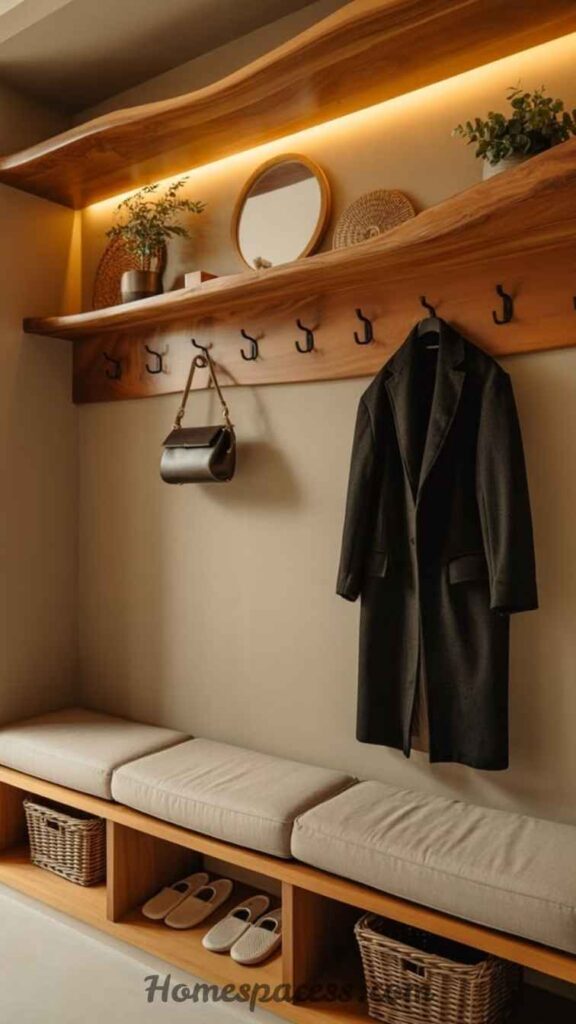
The most beautiful entryway decor ideas fail if the space can’t handle the reality of daily life coats landing on chairs, keys disappearing, bags piled on floors. A thoughtfully designed hook system solves all of this while contributing to the aesthetic rather than detracting from it. Shaker-style peg rails, architectural brass hooks, or custom built-in cubbies each offer a different aesthetic register while solving the same functional problem.
The emerging standard in high-end entryway design is the “command center” a dedicated wall or alcove that integrates hooks, a small mail sorter, a charging station, and sometimes a small chalkboard or whiteboard for household notes. When designed with consistent materials and finishes, a command center reads as intentional rather than utilitarian. Think of it as the entryway equivalent of a kitchen backsplash functional infrastructure elevated to a design feature.
Anchor the Space with an Area Rug
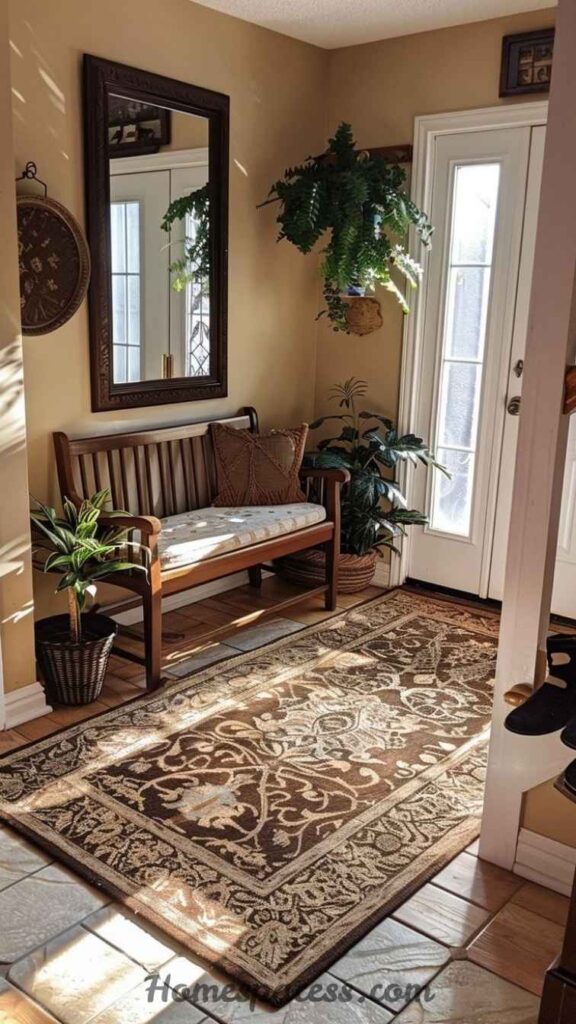
An area rug in the entryway serves dual purposes: it defines the zone as a distinct room (critical in open-plan homes where the entryway bleeds into a living space) and it provides the first tactile experience a guest has of your home. The texture underfoot whether plush wool, flat-woven sisal, or geometric cut-and-loop communicates something about your design sensibility before anyone has looked at a single wall.
For durability, choose a rug with a tightly woven construction and consider a pattern that helps disguise inevitable dirt. Geometric patterns, distressed vintage-style designs, and dark-ground rugs all handle heavy foot traffic more gracefully than light solid-colored options. Always use a rug pad underneath, even in small spaces it prevents slipping, extends the rug’s lifespan, and improves the way the rug lies flat over time.
📐Sizing rule:
In a standard entryway, a 3×5 or 4×6 rug is the minimum. For larger foyers, don’t be afraid of a 6×9. The rug should accommodate the width of the front door when open plus at least 12 inches on each side. Too-small rugs are one of the most common and most visually costly mistakes in entryway design.
Choose a Sculptural Coat Rack as an Art Object

The traditional coat rack has been reimagined entirely in contemporary design. Where once a simple freestanding rack was purely utilitarian, today’s best coat racks double as sculptural statements branching forms in bent steel, organically shaped wood pieces, or architecturally bold geometric structures that look compelling even when empty. This is particularly valuable in smaller entryways where space doesn’t allow for a full console table setup.
When the coat rack is unloaded (as guests arrive), it should read as intentional decor. When it’s loaded with coats and bags, it should be organized enough not to collapse visually. Look for designs with at least 8 to 10 hooks at varied heights, a weighted base that doesn’t tip when loaded, and a material that complements rather than clashes with your entryway’s primary finishes.
Install Floating Shelves for Vertical Storage
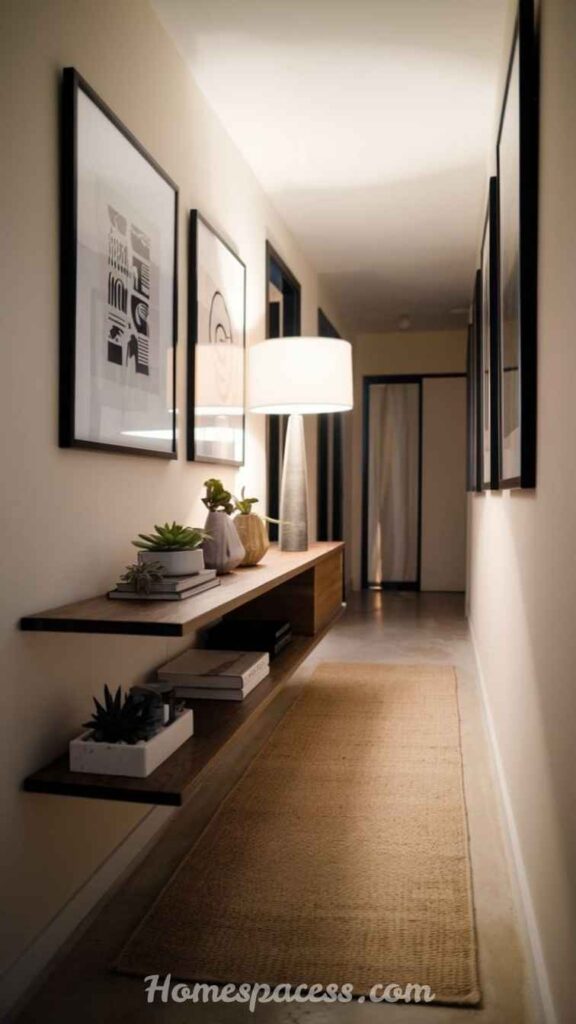
Vertical space in an entryway is massively underutilized. While furniture sits at floor level, the 5 to 8 feet of wall above it often goes completely empty. Floating shelves solve this by adding display and storage capacity without consuming precious floor space which is why they’re especially transformative in narrow or compact entryways where every square foot counts.
The most design-forward approach to entryway floating shelves is to treat them as a vertical gallery rather than simple storage ledges. Mix functional items (a small basket for sunglasses, a hook for keys) with purely decorative ones (a small sculpture, a single framed photo) and living elements (a trailing plant like string of pearls). This layered approach keeps the shelves looking curated rather than cluttered.
Design a Curated Entry Vignette
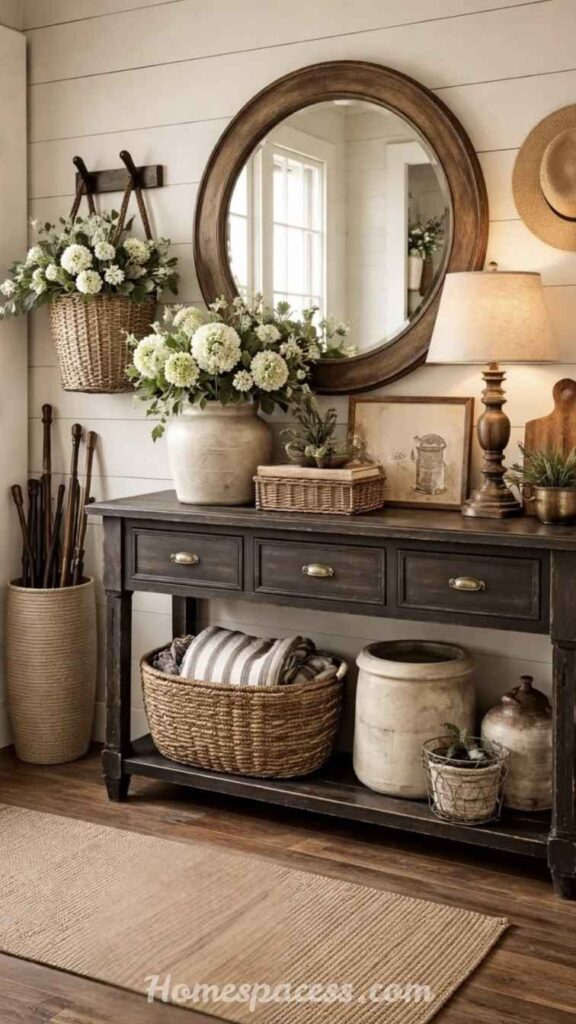
A vignette is a small, intentional grouping of objects that tells a visual story. In the entryway context, the most effective vignettes combine three to five objects with a shared color palette or material thread for instance, a ceramic vase in warm terracotta, a brass letter tray, a small stack of art books with terracotta-toned spines, and a single dried branch in a narrow glass vessel. The connecting thread (here, the earthy warm palette) unites disparate objects into a coherent moment.
The biggest mistake people make with vignettes is collecting objects with no connective logic. A successful vignette has intention: each object was selected for the group, not just added because it had nowhere else to live. Professional stylists often work with a “rule of odds” groupings of three, five, or seven objects feel more dynamic than even-numbered groupings, which can feel too symmetrical and static.
Commit to a Monochromatic Color Palette
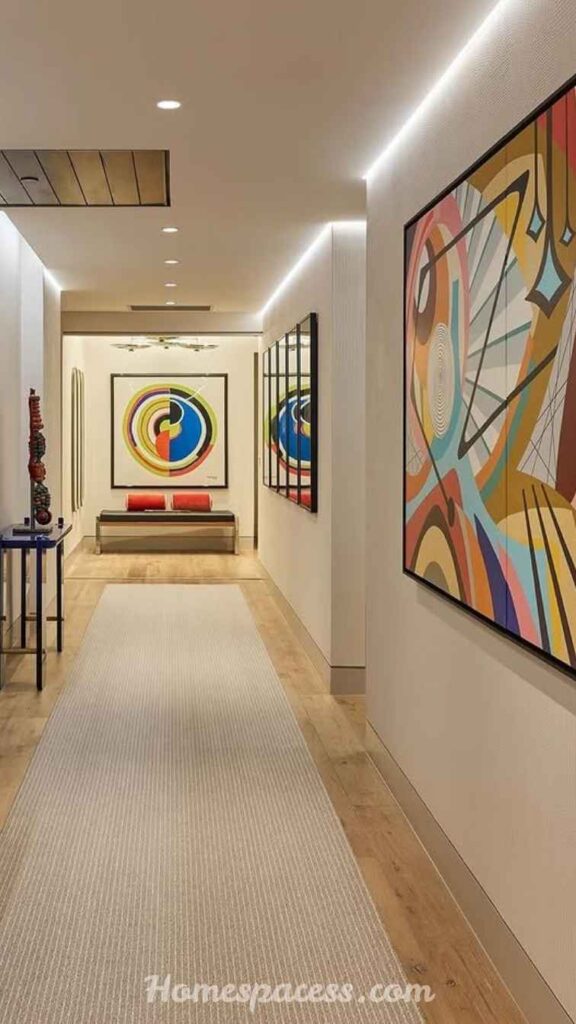
A monochromatic entryway one that uses varying tones, textures, and finishes within a single color family is one of the most sophisticated and timeless approaches in interior design. The technique works because it creates visual coherence without the risk of color clash, while allowing rich variation through material differences: matte plaster walls, glossy lacquered furniture, and soft linen textile accessories can all share the same beige-cream family while feeling anything but monotonous.
For 2026–2027, the most compelling monochromatic entryway palettes lean into warm neutrals with slight organic undertones: clay, sand, warm stone, and dusty sage. These palettes photograph beautifully, age gracefully, and translate across different architectural styles from modern to traditional. Introduce variation through finish rather than color pair a rough plaster wall texture against a smooth ceramic vase in the same tone.
Layer Textures to Add Tactile Richness
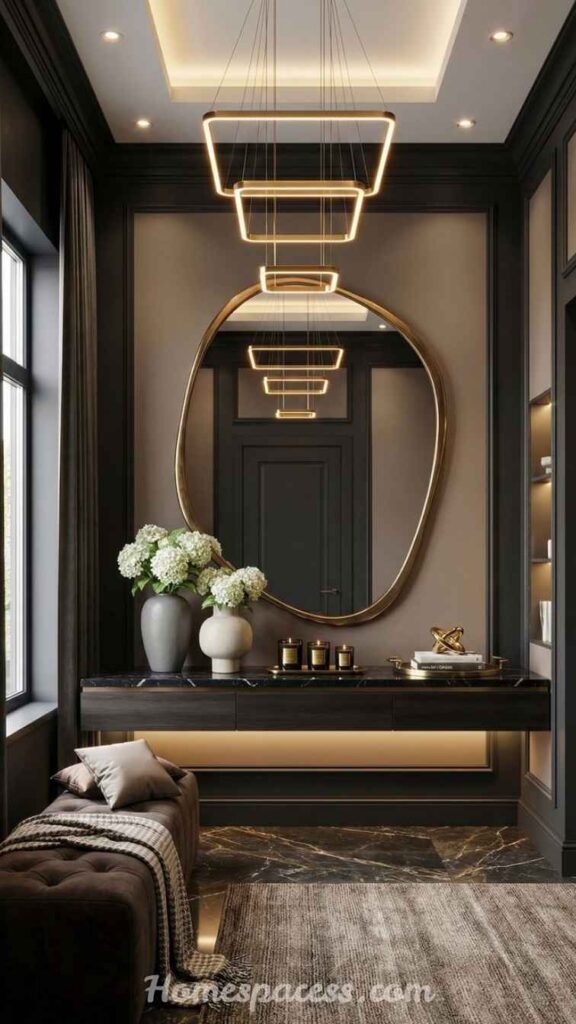
In an entryway that may not have room for many decorative objects, texture becomes your primary design tool. Layering different tactile qualities rough and smooth, hard and soft, matte and shiny creates visual depth that makes a space feel considered and rich rather than sparse. A concrete-look wall beside a warm wool rug beneath a polished brass mirror creates a textural conversation that keeps the eye engaged.
Think beyond surface materials to three-dimensional texture as well: a cane-fronted cabinet, a rope-wrapped pendant light, a woven seagrass basket, or bas-relief plaster panels all add dimension to walls and furniture that flat paint and standard materials cannot. In the post-pandemic design landscape, tactility has become increasingly important as a counter-movement to the hyper-digital environment people genuinely want to touch things in their homes.
Design the Scent Experience of Your Entry
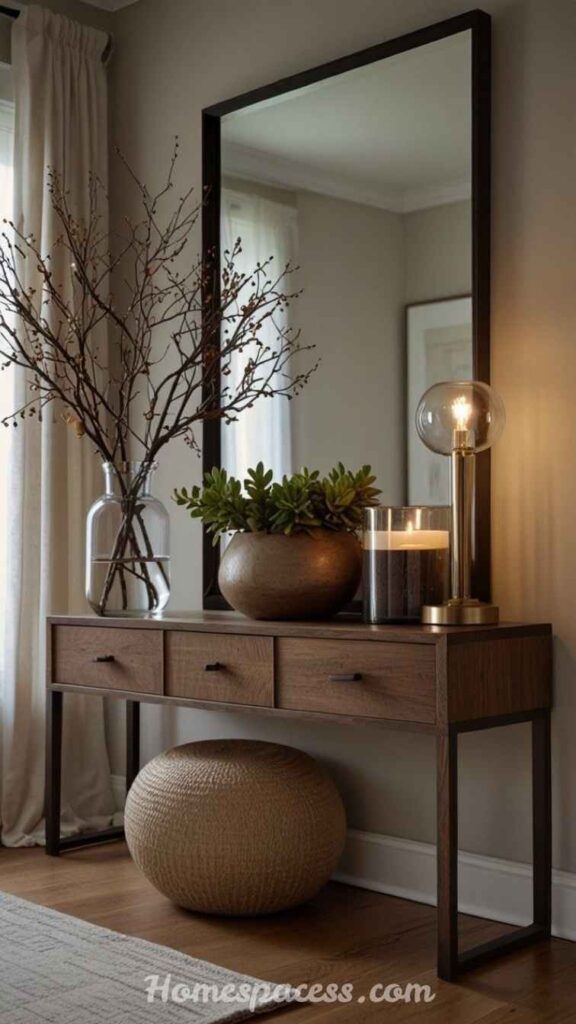
This is the entryway decor idea most commonly missed by competitors: scent. Before a guest processes what they see, they experience what they smell. A thoughtfully chosen entryway scent delivered via a reed diffuser, a subtly scented candle, or a large vase of seasonal flowers creates an immediate emotional response that colors every subsequent impression of your space. This is basic neuroscience: the olfactory system connects directly to the brain’s emotional and memory centers, bypassing rational processing entirely.
Choose a single, clean signature scent for your entryway and stick with it consistently. This builds what perfumers call an “olfactory identity” for your home guests will begin to associate that specific scent with the feeling of visiting you. Cedar and sandalwood create warmth and groundedness; eucalyptus and white tea feel fresh and clean; amber and vanilla read as cozy and inviting. Avoid synthetic air fresheners, which read as masking rather than welcoming.
Overlooked Strategy
The Entry Scent as Seasonal Ritual
Change your entryway scent with the seasons citrus in spring, marine notes in summer, spiced wood in autumn, evergreen in winter. This micro-ritual reinforces seasonal transitions and gives guests a sensory cue that your home is always fresh and intentional. It’s a detail that costs almost nothing and creates a surprisingly powerful impression.
Hang Transitional Art That Sets the Home’s Tone
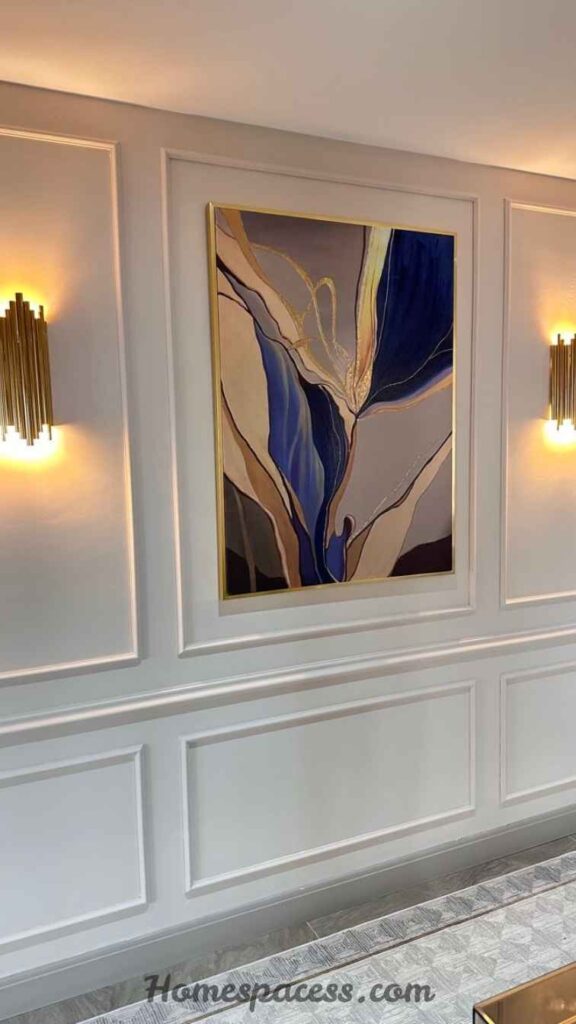
The artwork you choose for your entryway should function as a preview of your broader interior it’s a curatorial statement about what your home values aesthetically. A bold abstract canvas signals contemporary taste; a framed antique botanical print suggests appreciation for natural history and traditional craft; a large-scale black-and-white photograph communicates sophistication and perhaps a connection to travel or culture. None of these is objectively better they’re all intentional signals.
Where most homeowners go wrong is choosing entryway art that feels unrelated to the rest of the home. The guest who moves from a bold, graphic entryway piece into a room decorated entirely in traditional florals experiences a dissonance that’s hard to name but easy to feel. Instead, choose artwork that either matches or thoughtfully contrasts your interior style and can hold its own as a standalone object when the rest of the home isn’t visible.
Build a Minimalist Drop Zone for Daily Life
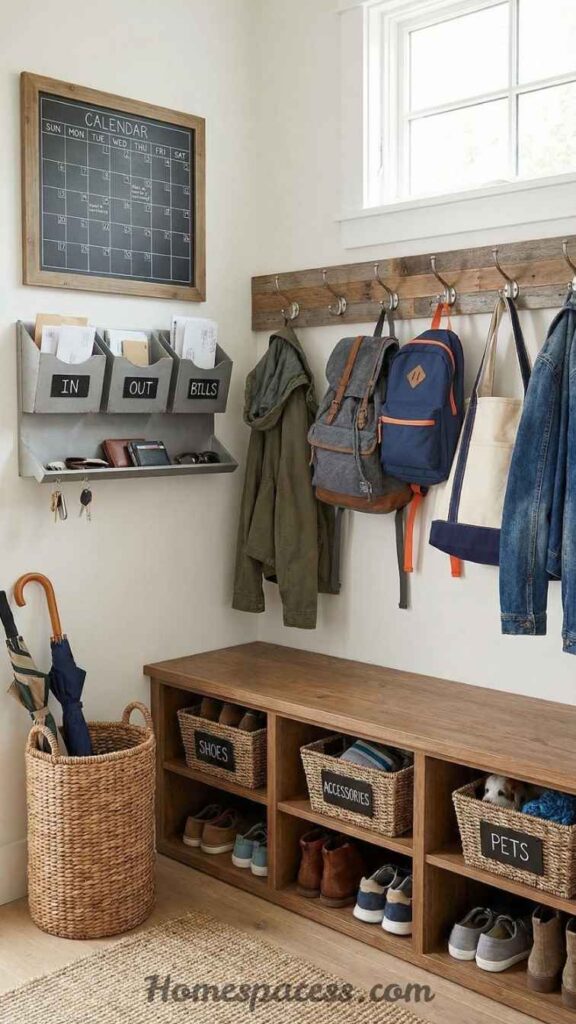
In high-functioning modern households, the entryway is the daily operations center: the place where keys land, bags rest, and the transition from “outside world” to “home” actually happens. Designing this drop zone with intentionality rather than letting it evolve organically into chaos is one of the most practical and underrated entryway decor moves available. The goal is a system so intuitive that it maintains itself with minimal effort.
The minimalist drop zone consists of three core elements: one dedicated surface (a small console, floating shelf, or even a mounted tray) for pocket items like keys and wallet; one hook or rack per person in the household for bags and coats; and one contained receptacle (basket, tray, or cubby) for shoes. When each of these elements is properly sized, attractively finished, and positioned correctly relative to the door, the system encourages good habits instead of fighting against them.
Add a Personalized Nameplate or House Number Display
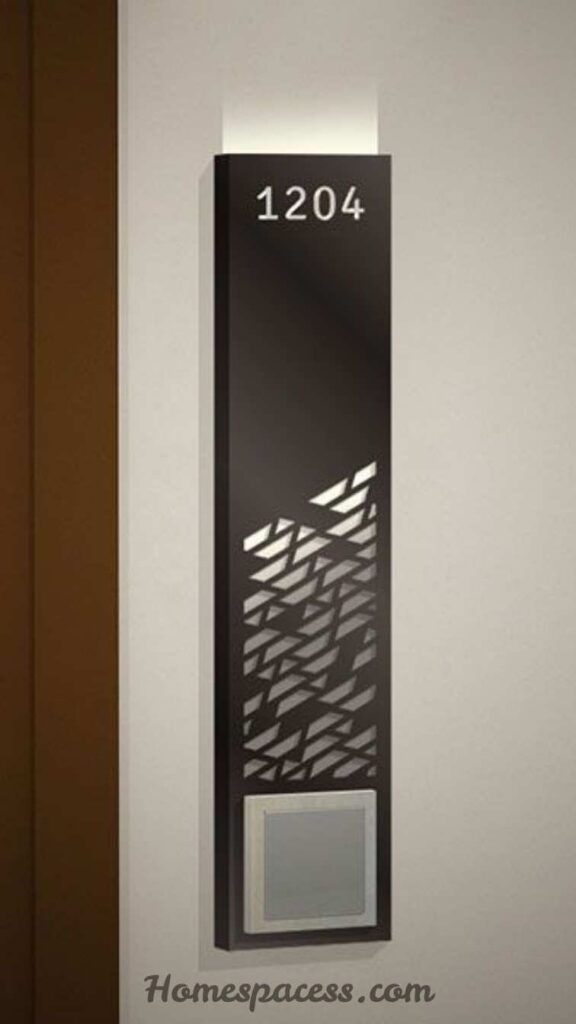
Exterior-facing entryway decor specifically, how your home addresses the street is the first impression before anyone even reaches your door. Custom house numbers in a typeface that reflects your interior style (sleek sans-serif for contemporary homes, serif for traditional, handcrafted ceramic tiles for bohemian aesthetics) signal care and intentionality from the moment someone pulls up. This detail is almost universally overlooked by homeowners who focus exclusively on the interior foyer.
On the interior side, personalized elements like a custom doormat with a meaningful phrase, a family initial monogram integrated into the entryway decor, or a custom sign with your home’s name (particularly resonant in historic homes or country properties) add a layer of authenticity that mass-produced decor cannot replicate. Personalization, paradoxically, makes your home feel more welcoming to guests because it signals genuine human presence rather than catalog-perfect staging.
Conclusion:
Your entryway is more than just a doorway it is the soul of your home. Every guest who walks in forms an opinion within seconds. These Entryway Decor Ideas show you that a thoughtful entryway is not a luxury. It is a necessity. A well-designed entry space tells your story before you even say a word.
You do not need to renovate everything at once. Start small. Hang a statement mirror. Add a warm light. Lay down a beautiful rug. Each step builds on the last. Small changes stack up into something truly impressive over time. The beauty of entryway design is that even one good decision transforms the entire feel of the space.
Trend Analysis:
2026–2027 Entryway Decor Trends: What’s Current and What’s Next
The entryway decor landscape is shifting faster than any other room in the home right now, driven by three converging forces: the continued influence of remote work on how we use transitional spaces, the growing sophistication of sustainable material options, and social media’s ability to accelerate micro-trends into mainstream awareness within months. Understanding these forces helps you make investments that will feel current for years rather than becoming dated within a single season.
The dominant aesthetic shift for 2026–2027 moves away from the stark minimalism that defined the previous decade toward what designers are calling “warm functionality” spaces that are highly organized and clutter-free but wrapped in organic materials, earthy tones, and natural textures. Think rammed earth plaster finishes, handcrafted ceramic hooks, live-edge wood shelving, and hand-woven textile accents. This is minimalism with warmth restored, and the entryway is where it manifests most directly.
Rising Fast
Limewash and Venetian plaster walls in terracotta and clay tones replacing the flat matte paint era.
At Peak
Arched niches and doorways as architectural features built into or simulated in entryway walls.
Emerging
AI-generated custom wallpaper designs unique prints created for individual homes, not commercially available.
Fading Out
Shiplap and farmhouse-style entryway elements oversaturation has diminished the aesthetic impact.
Future Forward
Biophilic built-ins shelving and storage units with integrated planters and living moss panels.
Technical Shift
Smart mirrors with embedded displays showing weather, calendar, and home status the functional mirror evolves.
Expert Insights:
What Interior Designers Know That Most Homeowners Don’t
Professional interior designers approach entryways with a fundamentally different framework than most homeowners. Where a homeowner sees a corridor that needs furniture, a designer sees a sensory sequence a series of carefully orchestrated impressions that begin at the property boundary and culminate when a guest settles into the main living space. Every decision in that sequence is deliberate, calibrated for both the moment of arrival and the daily lived experience of the household.
One insight that consistently surprises design clients is the importance of the ceiling in entryway design. Most entryway decor advice focuses exclusively on walls and floors, but the ceiling is the one surface that every single person looks at when entering a new space it’s an instinctive safety check, a holdover from our evolutionary history. A ceiling with visual interest (painted a rich color, fitted with decorative molding, hung with a statement pendant) creates a disproportionate impact relative to the investment required.
Another expert insight concerns proportion and scale. Residential entryways suffer more from undersized furniture than any other room in the home. Homeowners instinctively choose smaller-scale pieces for smaller spaces, but this creates a toy-like, unconvincing effect. Instead, professional designers recommend choosing one or two larger-scale anchor pieces an oversized mirror, a generously proportioned console, a substantial light fixture and letting negative space do the rest of the work. The larger pieces create a sense of grandeur; the negative space prevents overcrowding.
7s
Average time guests spend forming their first impression of your home
94%
Of homebuyers say entry presentation influenced their overall impression of a property
3×
Multiplier on perceived home value when entryways are professionally styled
62%
Of renovation budgets that interior designers allocate to entryways versus homeowner averages
Sustainable:
Sustainable Entryway Decor: Long-Term Value and Environmental Responsibility
The entryway by virtue of its high-traffic, high-visibility nature is subjected to more wear than almost any other space in the home. This makes material longevity not just an environmental consideration but a practical and economic one. Sustainable entryway decor choices tend to use materials that age gracefully and develop character over time: solid wood furniture that can be refinished, natural stone flooring that improves with a patina, high-quality brass hardware that transitions from polished to a beautiful aged finish without looking neglected.
The most significant sustainable decision you can make for your entryway is choosing materials with genuine longevity over trendy materials with short lifespans. Fast-furniture pieces MDF with a printed wood-grain finish, chrome hardware with thin plating, synthetically upholstered benches with cheap foam cores typically need replacement within three to five years. By contrast, a solid oak console, a marble-topped bench, or a hand-forged iron coat rack may outlast the house’s current ownership cycle. The initial cost is higher; the lifetime cost and environmental footprint are both substantially lower.
For flooring a major entryway sustainability decision reclaimed wood, recycled ceramic tile, and natural stone are all excellent choices that can be sourced with environmental certifications. Bamboo flooring, while technically renewable, has a complicated supply chain that sometimes negates its sustainability benefits. Cork flooring, however, is genuinely underrated in entryways: it’s harvested without harming the tree, naturally antimicrobial, comfortable underfoot, and surprisingly durable when properly sealed and maintained.
🌿Circular design principle:
Before buying any new entryway piece, ask: “If I tire of this in five years, can it be repurposed, resold, or recycled?” Solid wood benches become outdoor furniture. Quality mirrors find second lives in bathrooms. Ceramic tiles reappear in garden paths. Applying this filter naturally steers you toward higher-quality materials with genuine secondary value.
Future Innovations:
The Future of Entryway Design: Innovations on the Horizon
The entryway of 2030 will be meaningfully different from the entryway of today, and the trajectory is already visible in early-adopter homes and design exhibitions. The most significant incoming shift is the integration of ambient computing technology embedded so seamlessly into entryway surfaces and objects that it disappears into the design. Smart mirrors are already here; next will be pressure-sensing floor tiles that adjust lighting and scent based on who’s entering, and wall panels that display real-time environmental data or personalized art that changes throughout the day.
Biophilic design integration will deepen significantly. Beyond the current trend of placing houseplants near entryways, the next generation of entryway design will incorporate living walls with automated irrigation systems, mycological (mushroom-derived) material panels that are genuinely biodegradable and produce no VOCs, and water features small enough for a foyer but sophisticated enough to function as sound architecture shaping the acoustic environment as well as the visual one.
Personalization technology will reach entryway design through mass customization platforms. Rather than choosing from a catalog of standard console tables, homeowners will increasingly commission digitally fabricated pieces with fully customized dimensions, joinery details, and finish specifications at prices approaching (though not yet matching) mass-produced alternatives. This democratization of bespoke design will profoundly change what “personal expression” means in the home’s most public-facing interior space.
Common Mistakes:
Common Entryway Decor Mistakes (and How to Avoid Them)
Understanding what goes wrong in entryway design is as valuable as knowing what goes right. The following mistakes appear consistently across homes at every budget level from first apartments to high-end properties because they stem from instincts that seem logical but contradict fundamental design principles.
- Choosing furniture that’s too small: A console that’s too narrow, a mirror that’s too small, or a rug that barely fits the door swing all of these create a miniaturized effect that undermines the space.
- Ignoring the ceiling: The one surface everyone looks at when entering. A bare ceiling in an entryway is a missed opportunity, especially in spaces with low ceilings where color can create intimacy.
- Prioritizing aesthetics over function: A beautiful entryway that encourages clutter to accumulate on surfaces, floors, and chairs fails at its primary job managing the chaos of daily life at the home’s threshold.
- Using too many competing materials and finishes: Mixing chrome, brass, bronze, and matte black hardware in a small entryway creates visual noise. Choose one metal finish and repeat it across lighting, hooks, and hardware.
- Underestimating lighting: A single overhead fixture is almost never enough. Without layered lighting, even beautiful entryway decor can look flat and uninviting.
- Copying trends without considering architecture: Industrial-style exposed pipes and Edison bulbs look incongruous in a Georgian townhouse entry; ornate classical moldings feel strange in a concrete-and-glass loft. Always design for the bones of the space.
- Neglecting the transition to adjacent spaces: The entryway doesn’t exist in isolation. Its color palette, material choices, and aesthetic register should create a logical bridge to whatever room lies beyond the first doorway.
What to Do Instead
- Always buy the largest mirror and rug you can afford and fit scale is always underestimated in this space.
- Choose one statement piece and let everything else support it the entryway should have a clear visual protagonist.
- Design the functional system first (hooks, surfaces, storage) and then layer decoration around it, not the reverse.
- Limit your metal finishes to one primary and one secondary throughout the entire entryway.
- Visit your entryway at different times of day and in different light conditions before committing to any color decision.
FAQ’S About Entryway Decor
How do I decorate a small entryway with no space?
In a very small entryway, go vertical rather than horizontal. A tall, narrow mirror, wall-mounted hooks, and floating shelves all maximize the available wall space without claiming floor space. A light color palette and good lighting will make the space feel larger. Resist the urge to over-furnish in a tiny entryway, one or two well-chosen pieces work far better than several smaller ones competing for attention.
What is the best flooring for a high-traffic entryway?
Porcelain tile is the most durable and lowest-maintenance option for high-traffic entryways it resists moisture, dirt, and scratching better than almost any other material. Natural stone (particularly sealed slate or honed travertine) is a beautiful premium option. If you prefer a warmer look, engineered hardwood with a hardwearing finish performs significantly better than solid hardwood in wet, heavily trafficked conditions.
How do I make my entryway look more expensive on a budget?
Three high-impact, low-cost moves: paint the entryway a rich, deliberate color rather than leaving it white (a can of paint costs very little and transforms the space); find a large mirror secondhand and update the frame with spray paint; and add a statement light fixture even a modestly priced pendant dramatically upgrades the sense of design intentionality in a space. Consistency of finish across hardware and hooks also signals quality without significant cost.
Should an entryway be light or dark?
Both approaches work brilliantly when executed with confidence. Light entryways feel airy, spacious, and welcoming ideal for homes that receive strong natural light or have low ceilings. Dark entryways create drama, intimacy, and a powerful first impression particularly effective in homes where the subsequent rooms are lighter, creating a theatrical reveal effect. The worst choice is an accidental middle: a space that’s neither confidently dark nor properly bright, but simply underlit and unresolved.
Aliza Noor founded Home Spacess to share simple, practical design ideas that work for real families. She focuses on cozy décor, soft colors, and natural textures that make a space feel truly lived-in. Based just outside Toronto, Aliza spends her days juggling family life, experimenting with home projects, tending to her plants, and occasionally moving things around just to create a fresh vibe.


