
A complete expert guide to designing, building, and styling a media wall from budget-friendly DIY options to high-end built-in entertainment units.
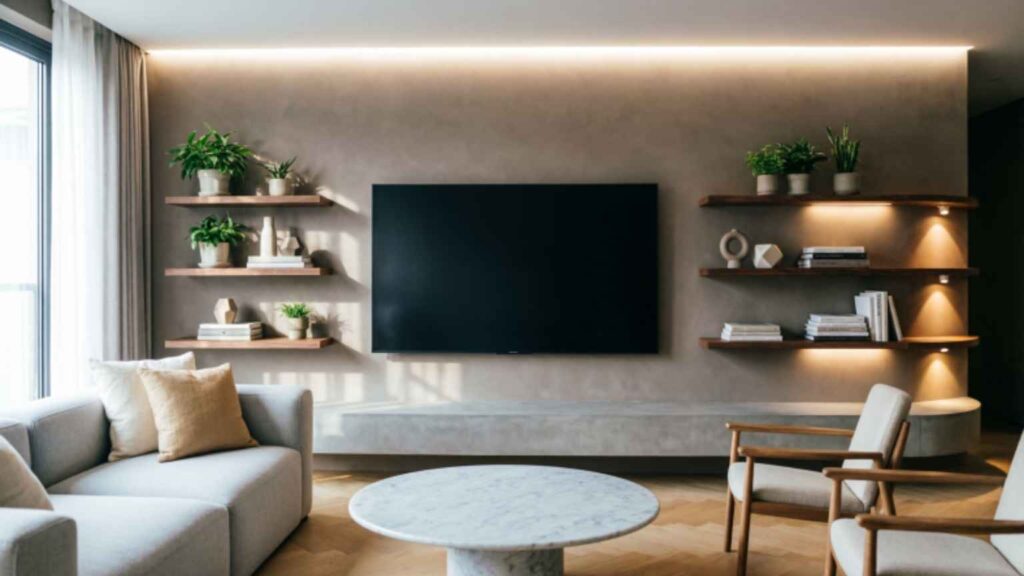
A media wall is no longer just a place to mount a TV. Today, it serves as the visual anchor of your entire living room a carefully designed feature wall that combines storage, lighting, technology, and style into one cohesive statement. Whether you’re renovating a small apartment or redesigning a large open-plan space, the right media wall idea can completely redefine how your room looks, feels, and functions.
In this guide, you’ll find 26 distinct media wall ideas, each with practical insights on materials, layout, costs, and real-world application. Beyond the ideas themselves, we’ve added advanced sections on 2026 design trends, expert tips, sustainability, and common mistakes to avoid giving you everything you need to make a confident, long-lasting design decision.
Full-Height Built-In Shelving Media Wall
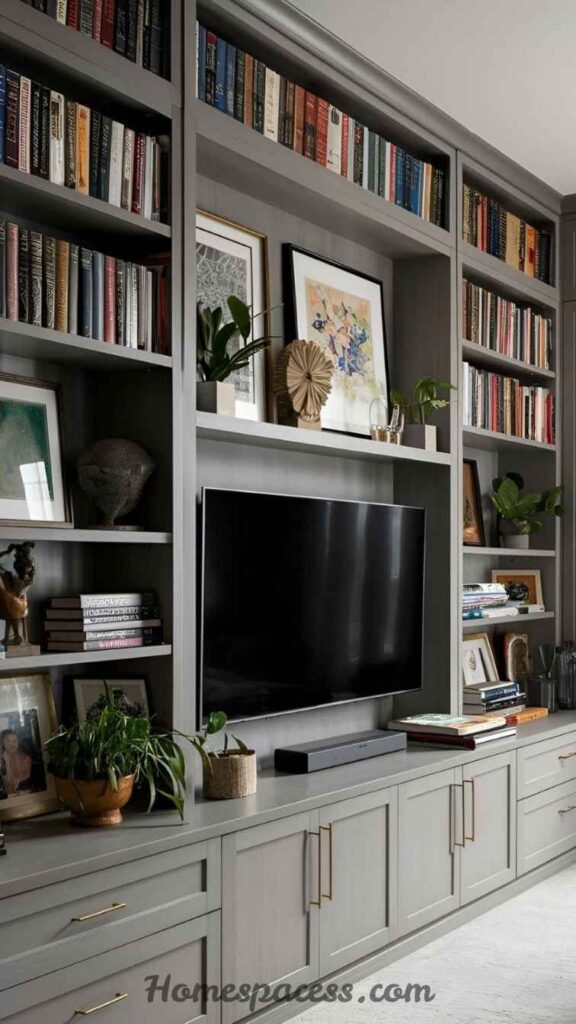
A full-height built-in shelving media wall is one of the most impactful interior design choices you can make. By extending cabinetry and shelving from floor to ceiling, you create a sense of grandeur and permanence that freestanding furniture simply cannot replicate. The TV sits flush within the unit, often framed by open shelves for books, plants, and decorative objects.
The key to making this work is proportionality. Designers typically recommend that the TV panel takes up about one-third of the total unit width, with symmetrical shelving on both sides. Avoid overcrowding the shelves negative space is just as important as what you display. This type of media wall works particularly well in rooms with high ceilings (2.7m or above), where it creates a dramatic architectural focal point without requiring structural changes.
💡 Pro Insight
Use a mix of closed cabinets at the base (for hiding cables, consoles, and routers) and open shelving above. This keeps the wall functional without looking cluttered.
Must Read: 22 Living Room Decor Ideas That Transform Any Space
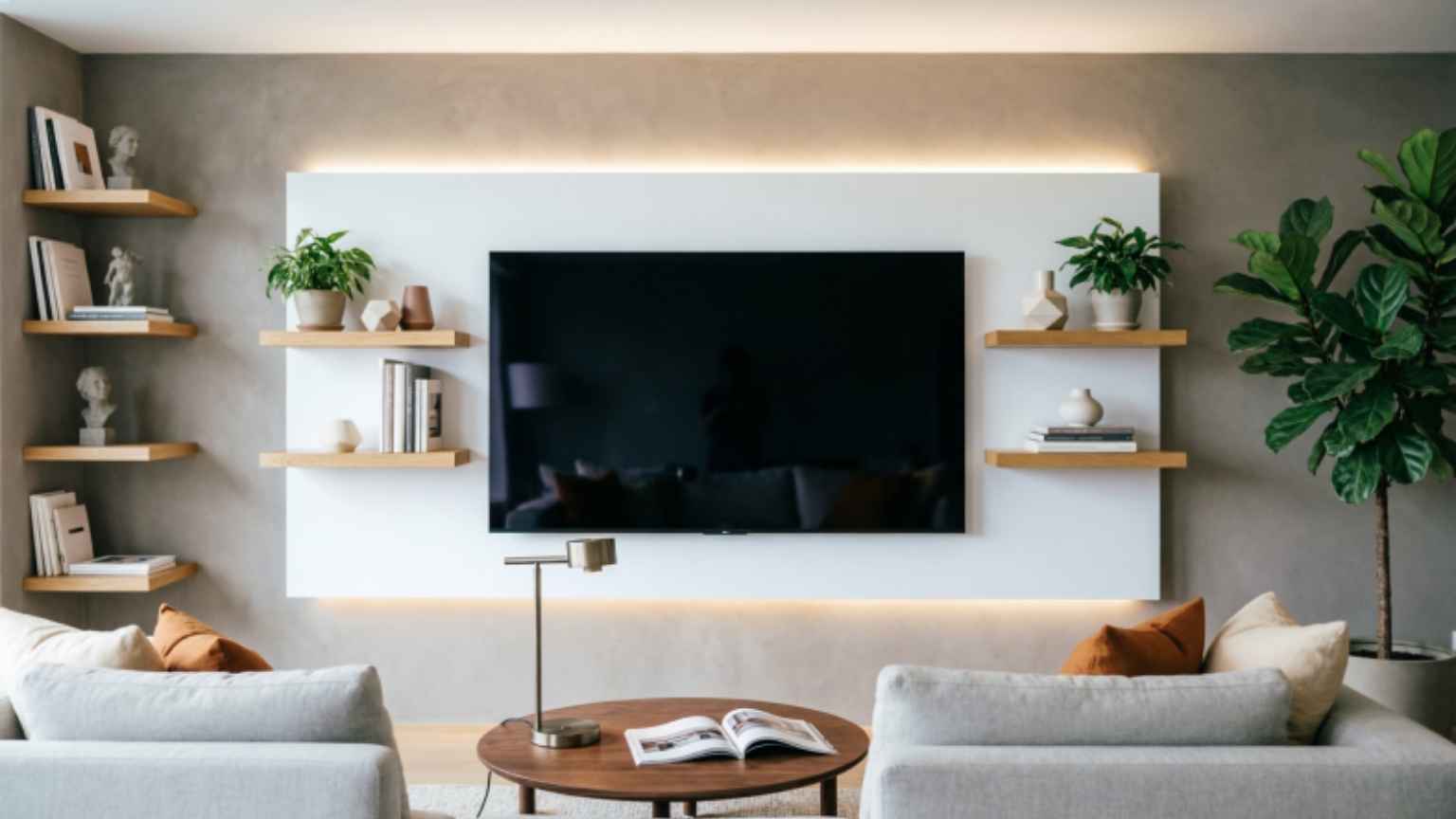
Floating TV Panel with LED Backlight
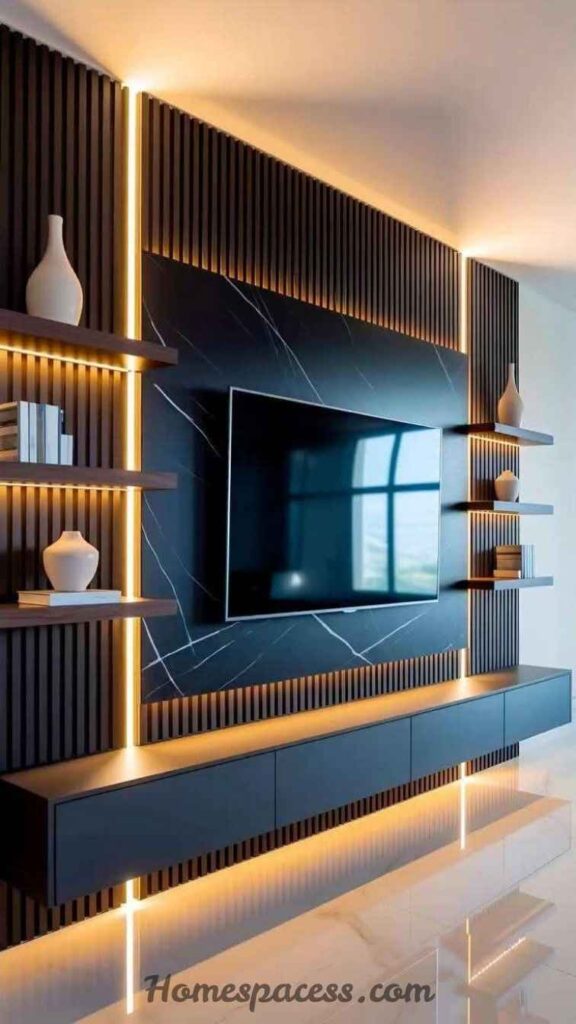
The floating TV panel a single, wall-mounted slab of timber, MDF, or marble-effect board has become one of the most searched media wall ideas in recent years. When paired with LED strip lighting behind the panel, it creates a stunning “floating” illusion where the TV appears to hover in mid-air against a glowing backdrop.
This design is especially powerful in modern and minimalist interiors. The LED backlighting serves a dual purpose: it reduces eye strain during evening viewing (a technique called bias lighting) and adds warm or cool ambient light that shifts the room’s mood at the touch of a button. RGB smart strips, controlled via an app or voice assistant, allow you to change colours for movie nights, parties, or relaxed evenings.
Don’t Skip: 15 Baby Nursery Ideas That Are Beautiful, Safe & Built to Grow With Your Child
Shiplap or Paneled Feature Wall
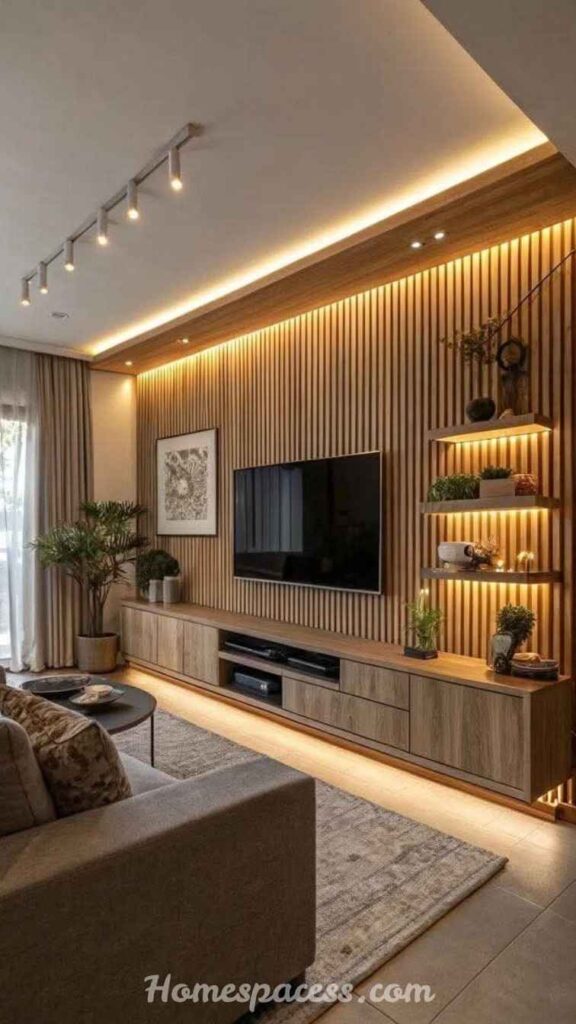
Shiplap paneling brings warmth, texture, and a distinctive character to any media wall. Originally a construction material, shiplap has been reimagined by interior designers as a decorative wall treatment that works equally well in coastal, farmhouse, and even contemporary homes when painted in the right colour. A TV mounted centrally on a painted shiplap wall looks effortlessly intentional as if the wall was always designed to be the room’s focal point.
The beauty of this idea lies in its versatility and relative affordability. Shiplap boards can be installed over existing drywall, painted in any colour from classic white to deep navy or sage green and completed in a single weekend. For a more refined look, consider MDF fluted panels or vertical slat panels, which offer a more polished, boutique-hotel aesthetic while using the same basic principle.
Read More: 24 Bedroom Interior Ideas That Actually Work in Real Homes
Stone or Brick Effect Media Wall
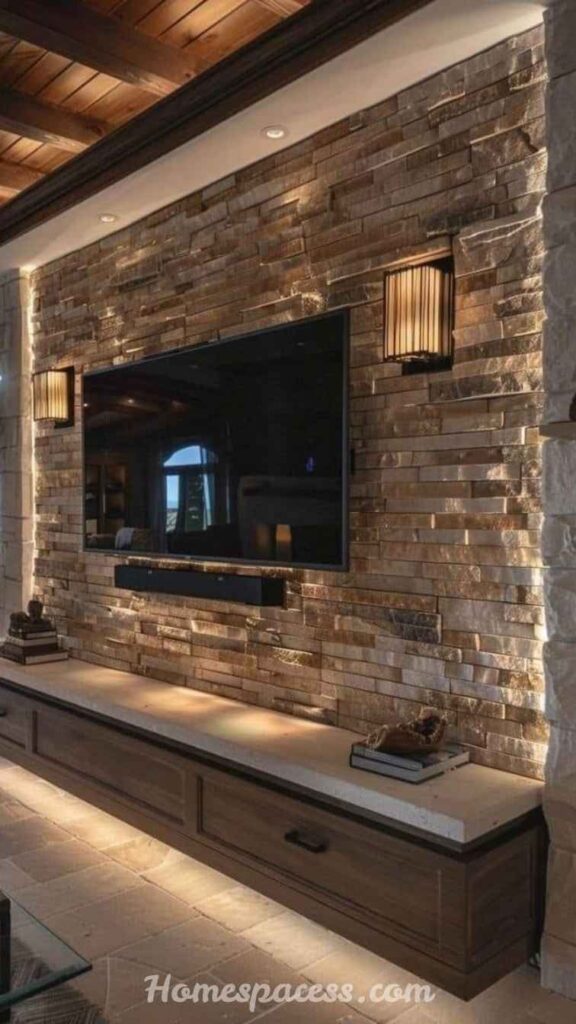
Natural stone cladding, exposed brick panels, or realistic stone-effect porcelain tiles create a dramatic, textural media wall that stands apart from timber-heavy alternatives. This type of media wall works brilliantly in industrial, rustic, or eclectic interiors. A large flat-screen TV mounted against dark slate, sandstone, or weathered brick creates a striking contrast that feels both rugged and curated.
Modern faux-stone panels made from lightweight polyurethane or thin porcelain have made this look far more accessible. They can be fitted without structural support, won’t crack like real stone, and are available in incredibly realistic finishes. For an authentic touch, consider sourcing reclaimed brick slips rather than manufactured panels. The irregular texture and natural colour variation of real brick is something no synthetic panel can fully replicate.
More Info: Small Kitchen Ideas: 18 Expert Transformations That Actually Work
Fireplace and TV Combination Wall
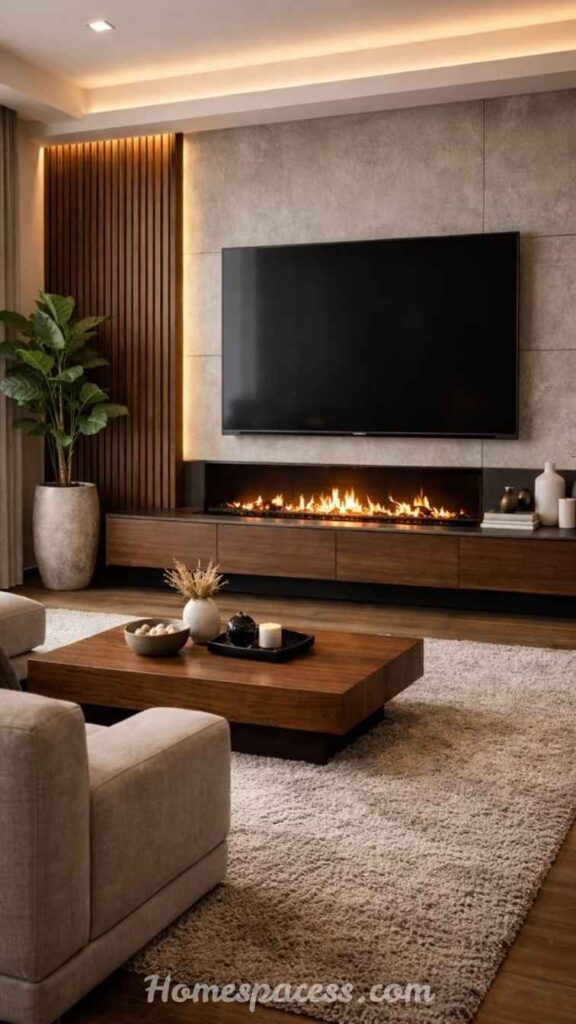
Combining a fireplace with a TV on the same media wall is one of the most asked-about design ideas in interior forums today. When executed well, it creates a true “hearth wall” a focal point that is both functional and emotionally resonant. The challenge is positioning: a TV placed directly above a roaring open fire is exposed to damaging heat, so the setup requires either an electric fireplace, a bioethanol fire, or a well-designed flue system that directs heat away from the screen.
Many designers recommend recessing the TV into an alcove above the fire, with a heat shield or cabinet door that can close when the fire is lit. Electric fireplaces, particularly those with realistic LED flame effects, are the most practical choice for this combination. They generate minimal heat, require no flue, and can be installed within a custom-built media unit at any height. Brands like Dimplex and Evonic have produced models specifically designed for wall-integration in 2025 and 2026.
📐 Design Rule
Maintain at least 30–40 cm between the top of any heat source and the bottom of your TV screen, even with an electric fireplace. This preserves both aesthetics and screen longevity.
Dark and Moody Painted Media Wall
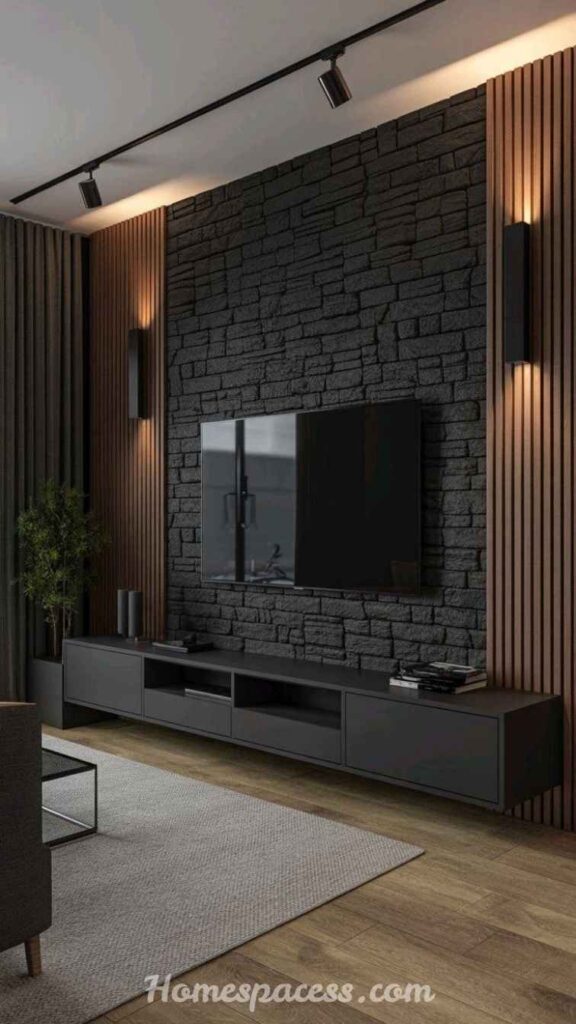
One of the simplest yet most transformative media wall ideas is painting a single wall in a deep, saturated colour. Charcoal, forest green, navy, terracotta, and plum are all popular choices for 2026. A dark accent wall behind the TV makes the screen visually recede during the day, reducing glare reflection and creating a more cinema-like environment for watching. When the TV is off, the rich painted surface becomes a dramatic backdrop for artwork, shelving, or decorative objects.
The misconception that dark walls make rooms feel smaller is largely outdated in a well-lit living room, a dark media wall creates depth and contrast that actually draws the eye into the space rather than closing it in. Choose a matte or eggshell finish to avoid paint sheen reflecting light from the TV or windows. Consider extending the colour 30–40 cm onto adjacent walls to create a “colour drenching” effect that feels considered rather than accidental.
Recessed TV Alcove Media Wall
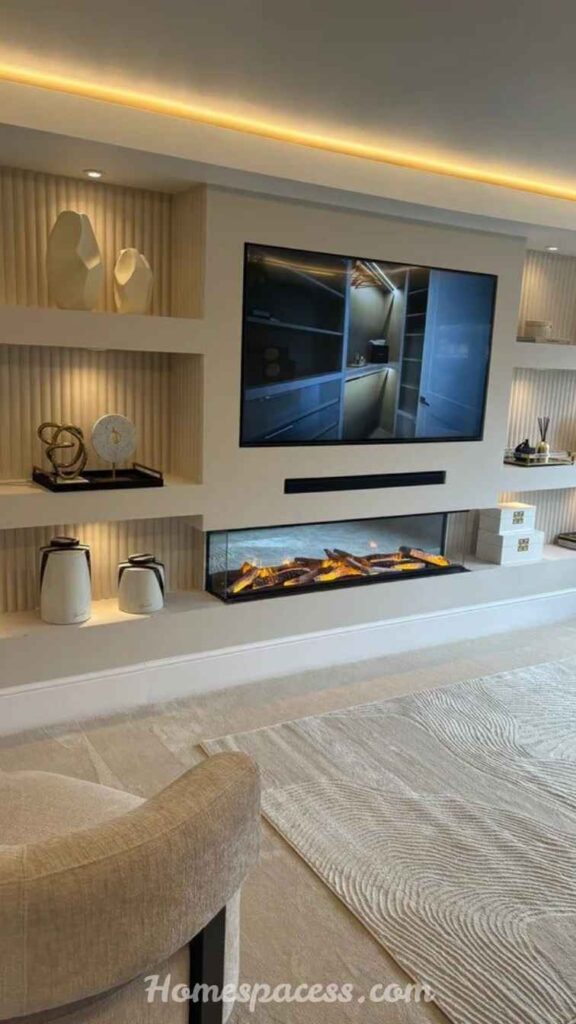
A recessed TV alcove pushes the screen back into the wall, creating a clean, seamless look where the TV appears to be part of the architecture itself rather than something mounted on it. This is a more involved project that typically requires creating a stud wall or building a timber framework, but the result is a genuinely high-end finish that looks custom-made and thoughtfully designed.
Beyond aesthetics, a recessed alcove has several practical advantages. Cables are completely hidden within the recess. The TV is protected from accidental knocks. The surrounding space can be used for integrated lighting, decorative niches, or speaker channels. This approach works particularly well in homes where the main living wall is adjacent to a lesser-used room, as the alcove can be built outward from the living room without losing space from an important area.
Industrial-Style Media Wall with Exposed Metal
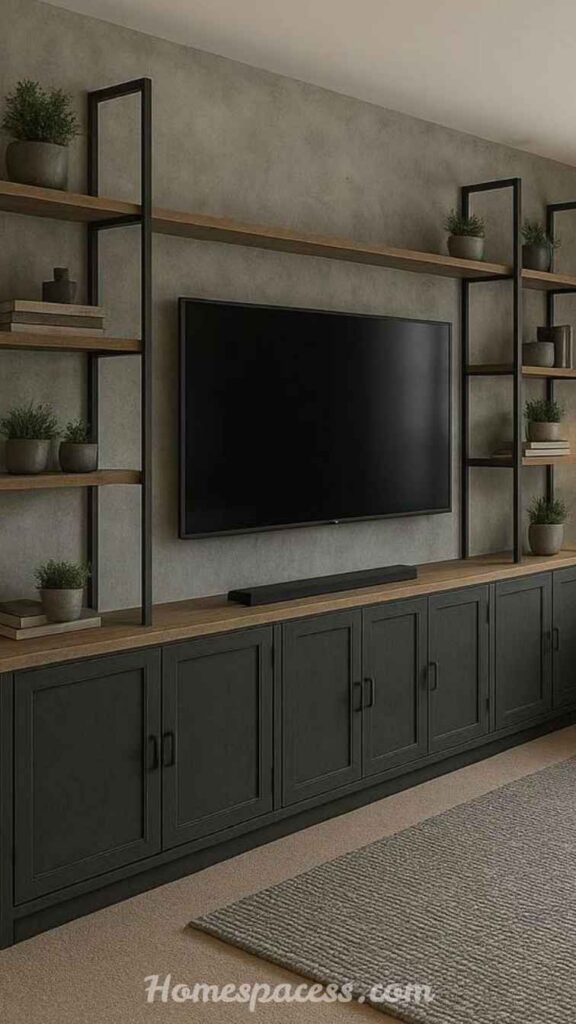
Industrial interior design continues to evolve beyond its raw-concrete-and-bare-bulb origins. The modern industrial media wall combines steel or black iron framing with warm timber shelving, creating a contrast of hard and soft materials that feels both structured and inviting. TV brackets with exposed metalwork, black steel shelf supports, and cable-managed conduit tracks all contribute to an aesthetic that feels honest about its construction.
This style suits urban apartments, converted lofts, and homes with polished concrete floors or exposed ceiling beams. The media wall doesn’t need to be elaborate even a simple arrangement of black-framed box shelves flanking a wall-mounted TV delivers a strong industrial statement. Pair with Edison-style filament bulbs in integrated shelf lighting for a cohesive look that plays into the style’s vintage-industrial roots.
Scandi-Minimalist Media Wall
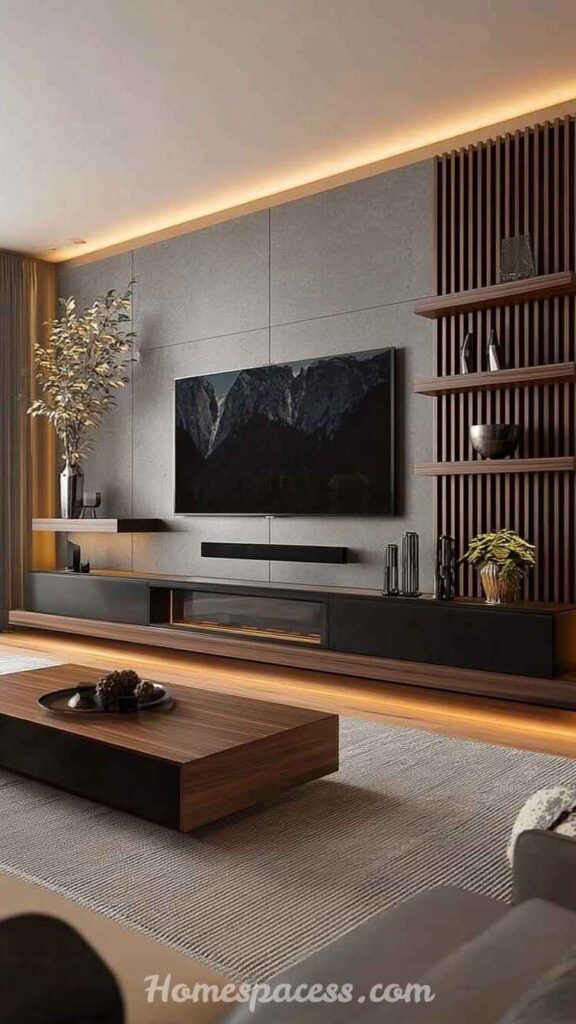
Scandinavian design principles clean lines, natural materials, functional beauty, and minimal ornamentation translate perfectly into media wall design. A Scandi-style media wall typically features a low-profile TV unit in light oak, white, or birch plywood, with a wall-mounted TV above and open shelving kept deliberately sparse. The colour palette stays neutral: white walls, warm wood, muted greens, and natural textures like wool and linen nearby.
What makes this approach distinctive is the discipline of restraint. Every item on the media wall should earn its place a single trailing plant, a well-chosen ceramic, a small stack of books. The TV is not hidden or disguised; it’s simply one of several considered objects in a curated composition. This is the media wall style most associated with mindful living, and it’s particularly effective in small apartments where visual calm is a genuine priority.
Colourful Kids’ Room Media Wall
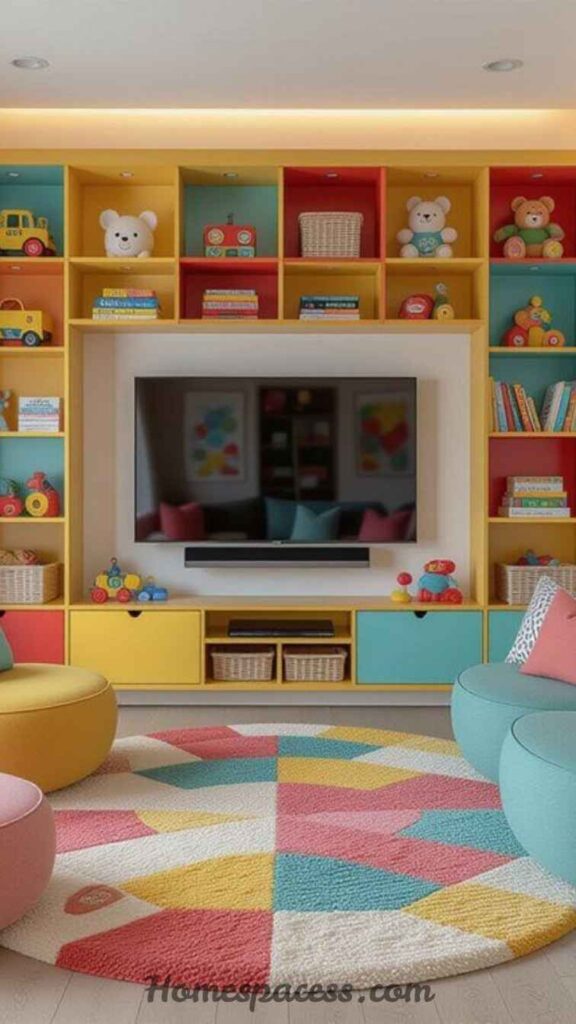
A media wall in a children’s playroom or bedroom requires a completely different design logic. Here, durability, safety, and joy take precedence over sophistication. Consider closed lower cabinets with child locks for consoles and cables, colourful painted panels or wallpaper behind the TV, and integrated storage for games, DVDs, and controllers. Round-edged MDF units reduce injury risk, and washable paint finishes accommodate inevitable scuffs and crayon experiments.
A smart approach in kids’ spaces is to design the media wall so it can grow with the child. Adjustable shelving, removable colour panels, and a TV bracket that changes height as children get older (and their viewing habits shift from sitting on the floor to lounging on a sofa) all extend the lifespan of the design. Consider a mounting height of around 70–80 cm from the floor when the room is used primarily by young children, rising to 90–100 cm as they grow.
Wallpapered Media Wall
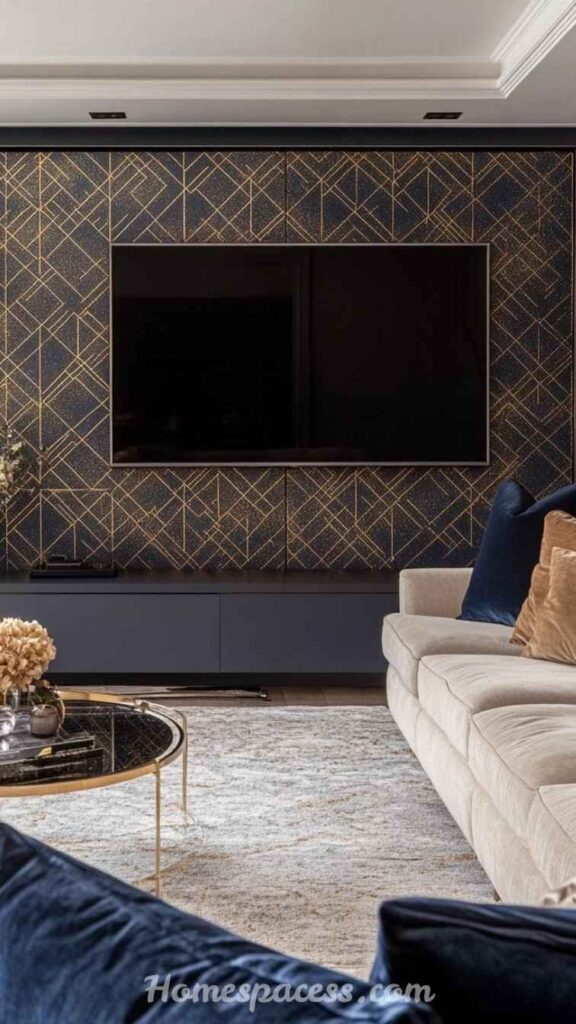
Feature wallpaper behind a TV creates instant personality without any structural work. This is one of the most accessible and reversible media wall ideas perfect for renters or anyone who likes to refresh their interior regularly. Geometric patterns, botanical prints, textured grasscloth wallpapers, and even photographic murals all work beautifully as the backdrop for a wall-mounted screen.
The design challenge is choosing a pattern that doesn’t compete visually with an active TV screen. When the TV is on, the eye is drawn to the moving image; when it’s off, the wallpaper becomes the star. Avoid very small, busy patterns that create visual noise. Instead, opt for large-scale botanicals, subtle geometrics, or textured plain wallpapers that add depth without distraction. Art-deco fan patterns and maximalist tropical prints are particularly popular media wall wallpaper choices heading into late 2026.
Smart Home Integrated Media Wall
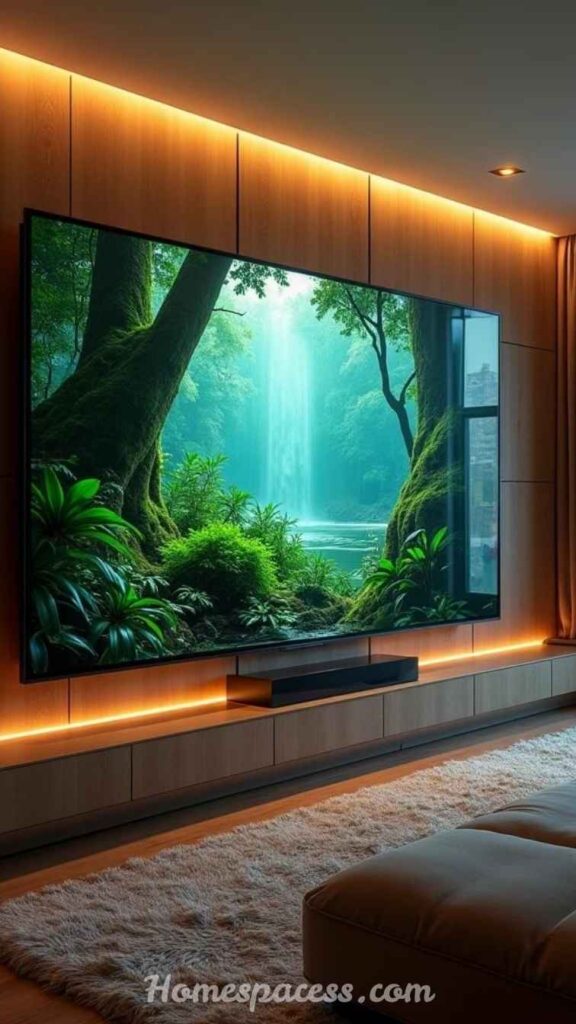
A smart home media wall goes beyond mounting a television it becomes the command centre for your entire connected home. Built-in smart speakers, integrated smart lighting controlled by panels flush-mounted into the unit, a hidden router shelf with ventilation, and even a built-in tablet dock for home automation control all contribute to a wall that is as intelligent as it is beautiful. The TV itself is part of a seamless ecosystem where a single voice command adjusts the lighting, dims the blinds, and starts playback.
The key to designing a smart-integrated media wall successfully is planning for future expansion. Technology changes rapidly, and a media wall designed rigidly for today’s devices may feel obsolete in three years. Design cable conduits large enough to accommodate future wiring, include spare power outlets, and use adjustable bracket systems that accommodate different TV sizes and mounting points. Working with an AV integrator during the design stage even just for a one-hour consultation is an investment that pays back in reduced frustration during installation.
🔋 Future-Proof Tip
Install a dedicated, ventilated media cabinet for your router, AV receiver, and streaming devices. Overheating is the number-one cause of smart device failures in built-in media walls.
Japandi-Style Media Wall
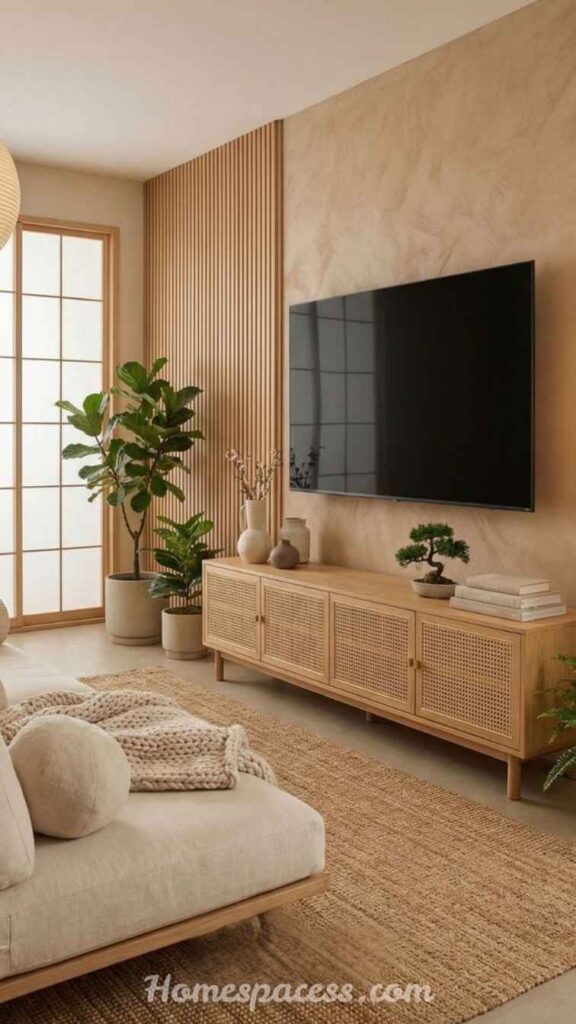
Japandi the hybrid of Japanese wabi-sabi sensibility and Scandinavian hygge philosophy is one of the most enduring interior design trends of the 2020s, and its principles create remarkable media walls. A Japandi media wall emphasises asymmetry, natural imperfection, and carefully chosen negative space. You might see a low-slung walnut cabinet offset to one side, with a single shelf at a different height on the other, and a wall of limewashed plaster or warm white behind the TV. Every element feels intentional yet effortless.
Colour plays a crucial role. Japandi palettes typically include warm stone, deep charcoal, muted sage, ash wood, and terracotta but never more than three or four tones in any one space. Avoid symmetry for its own sake. The slight visual imbalance of a Japandi media wall creates a tension that makes the space feel alive and human, as opposed to the polished perfection of showroom interiors. Add a single low-growing plant like a ZZ plant or snake plant at floor level to complete the look.
Art Gallery Media Wall
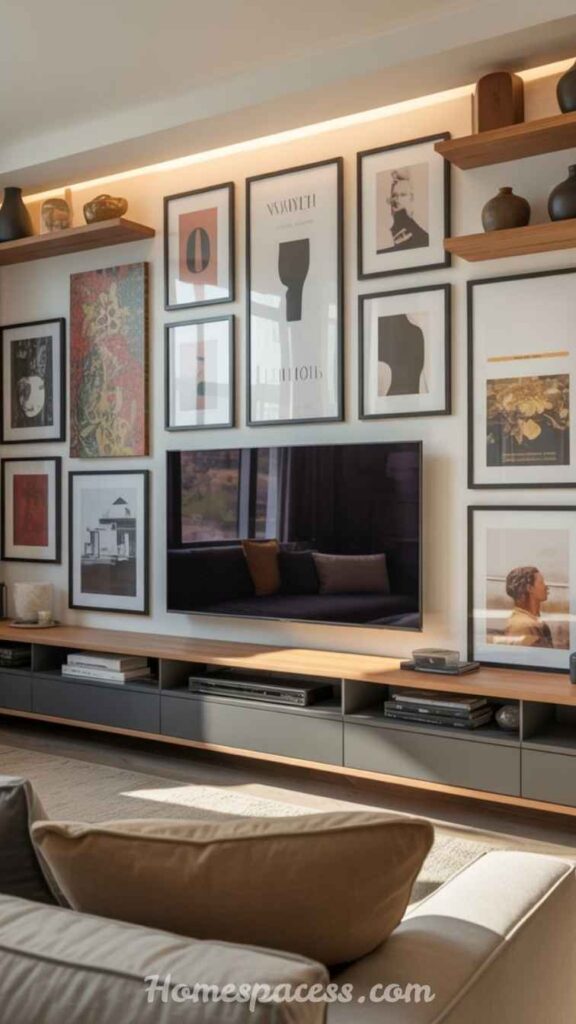
This approach reframes the TV as one artwork among many, integrating it into a gallery-style wall arrangement of framed prints, paintings, mirrors, and decorative objects. Samsung’s “The Frame” TV which displays digital artwork when not in use and mimics a picture frame in appearance has made this concept widely popular. But even without a specialist TV, a thoughtful gallery wall arrangement can make a standard screen look like a curated element rather than an awkward black rectangle.
The trick is scale and alignment. The TV should not be the smallest item on the wall, but it also doesn’t need to be the largest. Place it at the visual centre of the arrangement and work outward with framed art at varying heights, sizes, and distances. Use picture ledges at different levels rather than nailing everything directly to the wall this allows you to rearrange the composition easily and swap pieces in and out as your taste evolves. Warm, directional picture lighting above the artwork frames elevates the whole arrangement into a genuine gallery moment.
Bookcase-Style Media Wall
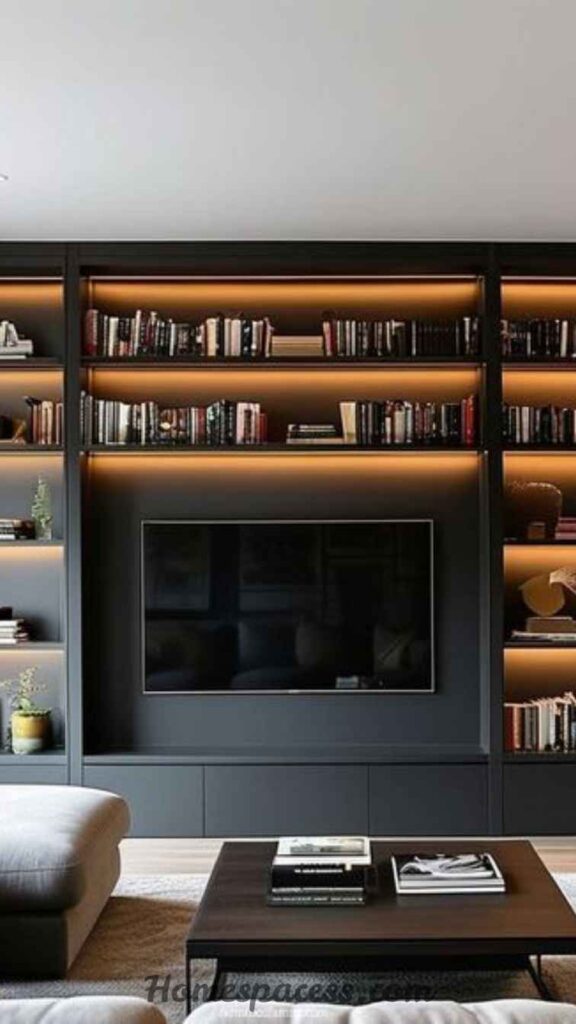
Few media wall ideas feel as timeless and intellectually rich as a bookcase wall. Floor-to-ceiling shelving filled with books, with the TV integrated into the middle section at eye level, creates an instantly characterful, lived-in interior that photograph well and function even better. Books are remarkable decorating tools their varied spines, colours, and sizes create organic texture that no styled object arrangement can replicate.
The practical challenge of a bookcase media wall is weight distribution. Full bookshelves are extremely heavy, and the shelving system must be adequately anchored into wall studs or solid masonry. A combination of fixed shelves for books (which need strong support) and adjustable shelves elsewhere gives you maximum flexibility. Consider colour-coding your book collection on the visible section of the wall arranging by spine colour creates a visually stunning gradient effect that has become something of a social media staple.
Fluted Panel Media Wall
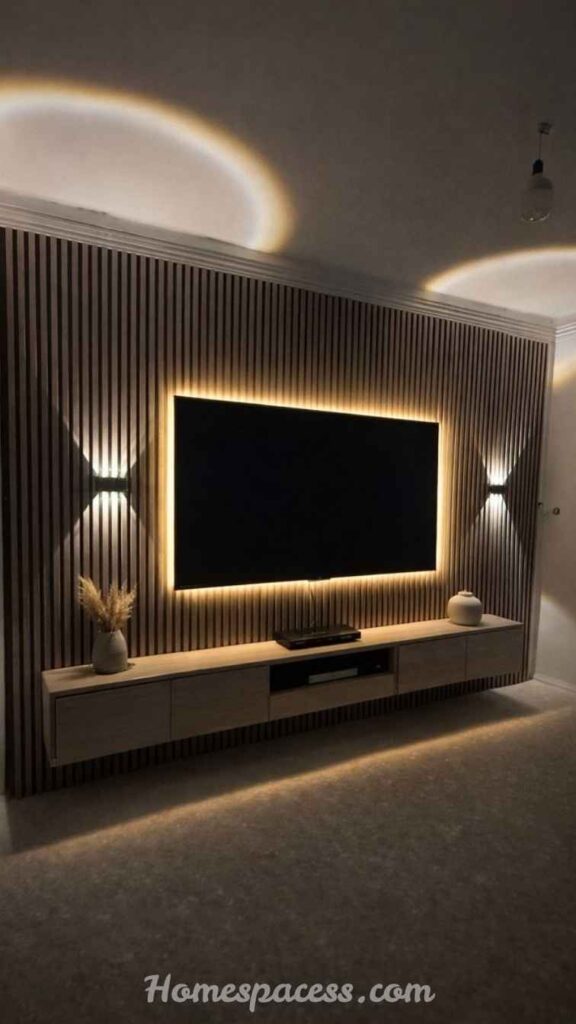
Fluted or reeded panels have become one of the most sought-after textural finishes in contemporary interior design. These vertical grooved panels available in timber veneer, MDF, bamboo, or even metal cast subtle shadows across their surface, creating a depth and rhythm that flat walls simply cannot achieve. A full panel of fluted material behind a wall-mounted TV makes an extraordinarily sophisticated statement with minimal effort.
The versatility of fluted panels is one of their key strengths. They can be painted to match the surrounding wall colour for a tone-on-tone effect, or left in a natural wood finish for warmth and contrast. In bathrooms and utility rooms, moisture-resistant fluted panels are available. On a media wall, fluted panels pair particularly well with a projecting TV shelf unit, brass or matte black hardware, and integrated downlighting that catches the panel’s ridges and amplifies the shadow play.
Concrete Effect Media Wall
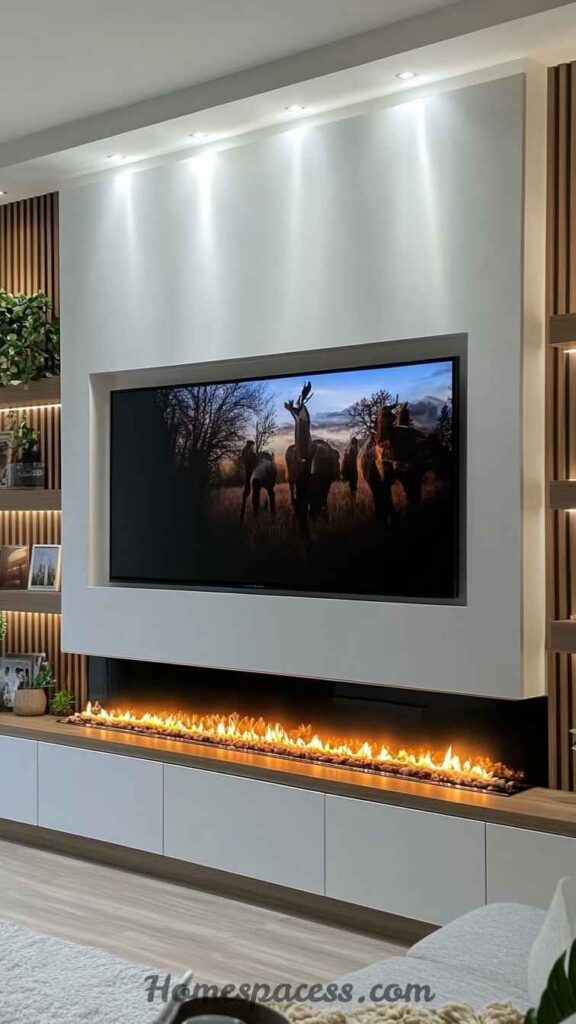
Concrete has been a prestige material in architecture for decades, and its translation into interior wall finishes has opened up extraordinary possibilities for media wall design. Genuine poured concrete walls are the domain of architects and structural engineers, but microcement, concrete-effect paints, and ultra-slim concrete wall panels make the aesthetic achievable in virtually any home. The result is a cool, urban, industrial surface that makes a mounted TV look surprisingly refined.
Microcement is particularly noteworthy because it can be applied over existing tiles, plaster, or painted walls no demolition required. It dries to a seamless, smooth surface that can be sealed and even made slightly reflective. For a media wall, a matte sealer is more appropriate, as reflective surfaces can cause glare on the TV screen. Pair a concrete-effect media wall with warm timber flooring and textured soft furnishings to prevent the room from feeling cold or clinical.
Open-Plan Media Wall Divider
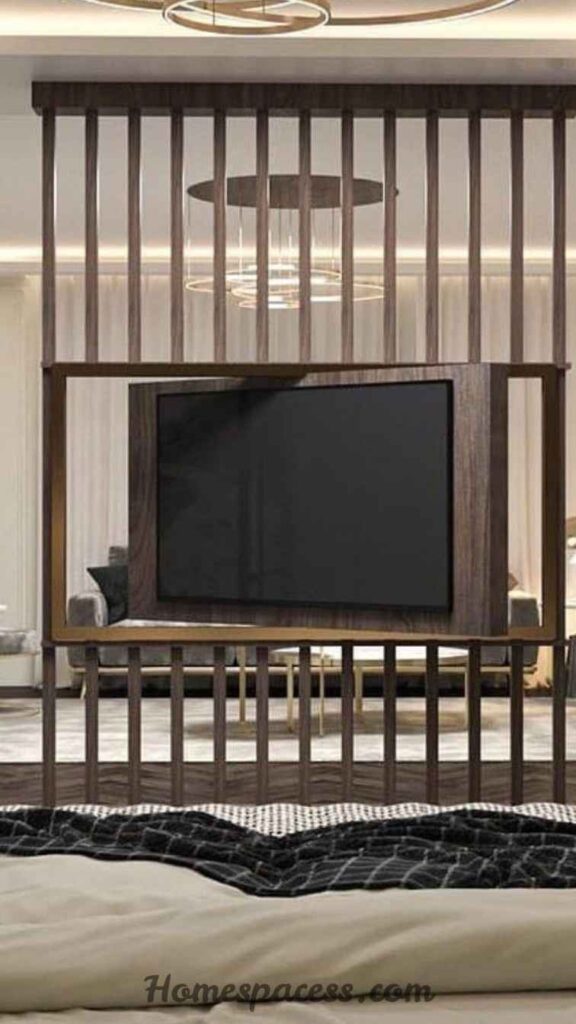
In open-plan homes where the living and kitchen or dining areas flow together, a media wall divider creates a purposeful boundary between zones without closing the space off entirely. A double-sided media unit with the TV facing the seating area on one side, and open shelving or a display cabinet on the other performs an architectural function while adding considerable storage. This is particularly valuable in new-build homes where open-plan layouts are standard but zone definition is often lacking.
The structural requirements of a freestanding media wall divider are more complex than a wall-mounted unit, as the piece must be self-supporting and safely anchored to the floor and ceiling. Working with a joinery specialist or structural engineer is advisable for large-scale dividers. For a lighter-touch approach, a tall bookcase unit with a TV bracket arm extended at the front replicates the concept with much lower structural demand and allows for repositioning as your layout needs evolve.
Bedroom Media Wall
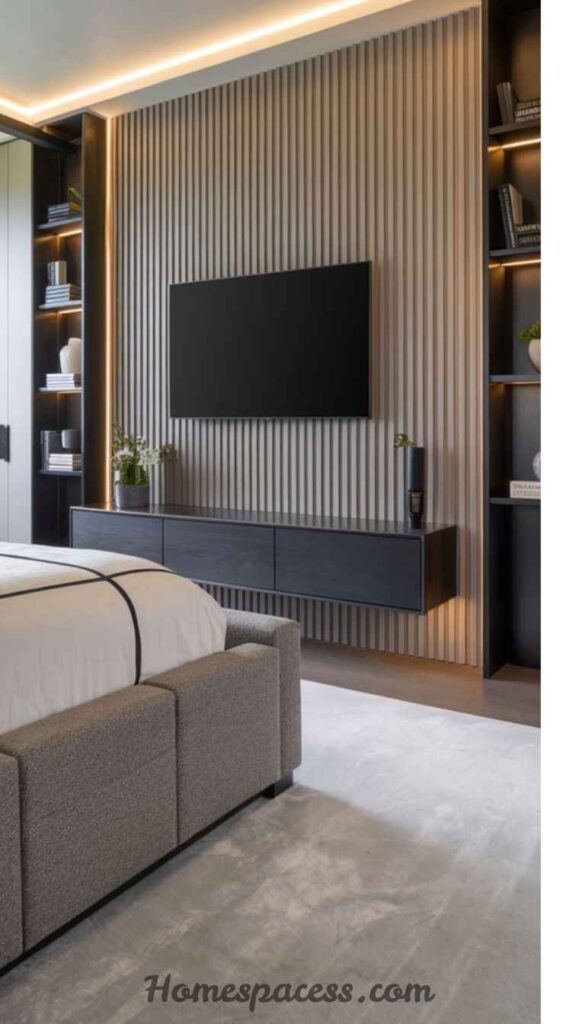
Moving the TV into the bedroom requires a different design approach than living room media walls. The priority here is ensuring the screen doesn’t dominate the space or disrupt sleep. A bedroom media wall should feel calm, low-profile, and carefully integrated into the overall scheme. Wall-mounted units with concealed cable management, soft ambient lighting rather than bright LEDs, and a TV that can be angled or rotated away from the bed when not in use are all practical considerations.
One increasingly popular approach is the “TV cabinet at the foot of the bed” a low unit with the screen at exactly the right height for comfortable viewing while lying down. This keeps the TV at a distance from the head of the bed, which sleep specialists recommend for both blue light management and mental association (you want the bedroom’s primary association to be rest, not entertainment). Use deep, warm tones for the media unit finish walnut, dark oak, or painted in muted greens and blues to reinforce the room’s restful character.
Outdoor Media Wall
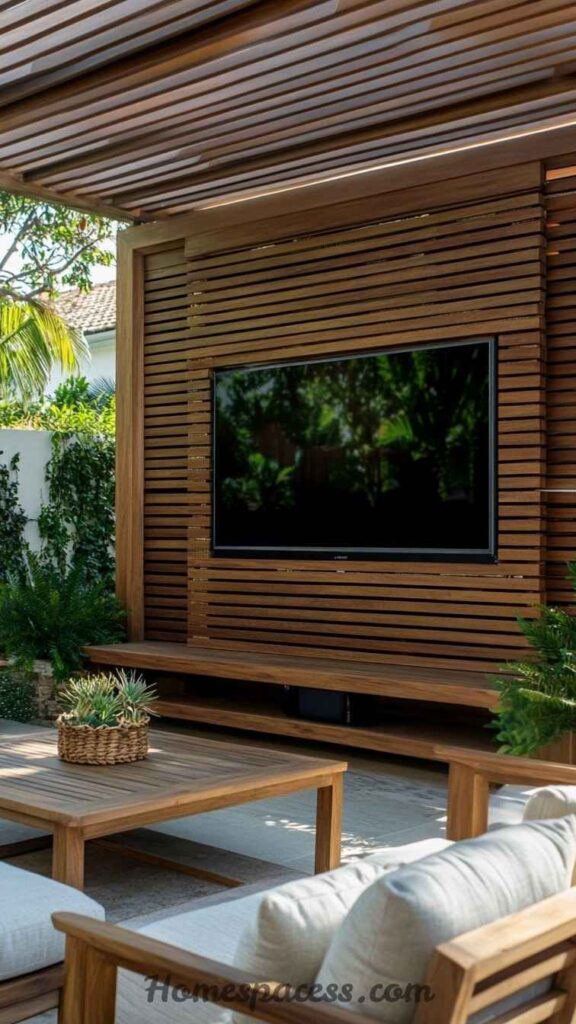
Outdoor media walls are a rapidly growing trend as homeowners invest in garden rooms, covered terraces, and alfresco entertainment spaces. A weatherproof TV paired with a purpose-built outdoor media unit extends the living space into the garden and makes outdoor entertaining significantly more versatile. The challenge, of course, is protection from moisture, UV light, and temperature extremes all of which degrade standard electronics rapidly.
Specialist outdoor TVs from brands such as Séura, Sun Brite, and Hisense are engineered with IP-rated enclosures, anti-glare screens, and wide operating temperature ranges. For the surrounding media unit, marine-grade plywood, teak, powder-coated aluminium, or composite decking materials all offer outdoor durability. Position the unit away from direct rain and consider a retractable cover or integrated shutter system that protects the TV when not in use. Adding outdoor-rated in-wall speakers at each side of the unit completes a genuinely impressive alfresco entertainment setup.
⚡ Safety Note
All outdoor media wall installations must use RCD-protected outdoor electrical circuits and IP-rated sockets. Never use indoor-rated electronics in uncovered outdoor areas.
Curved or Arched Media Wall
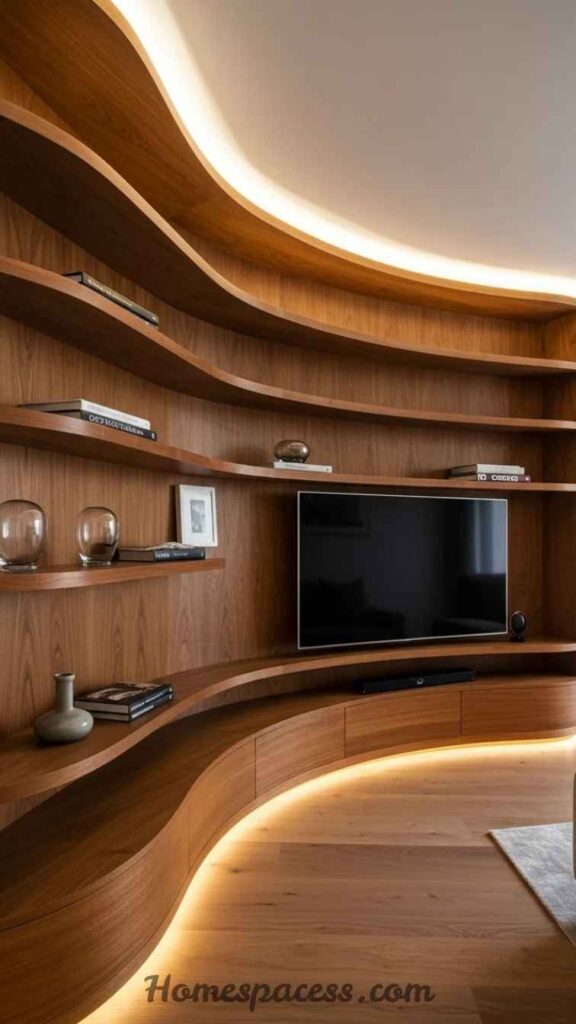
Curved architectural elements are having a significant moment in 2026 interior design, and media walls are no exception. An arched alcove framing the TV achieved with plasterboard formed over a curved timber framework creates an organic, almost sculptural quality that softens the hard lines of a screen and its surroundings. This works especially well in Mediterranean, Moroccan-influenced, and contemporary maximalist interiors.
The curve doesn’t need to be dramatic to be effective. Even a softly arched top to a recessed TV niche changes the entire character of the wall, moving it from utilitarian to expressive. Arch-shaped open shelves flanking the TV, painted in terracotta, warm white, or deep ochre, amplify the architectural detail further. This is a relatively achievable DIY project for those comfortable with plasterboard work, or a straightforward commission for a plasterer working from a clear brief.
Budget DIY Media Wall
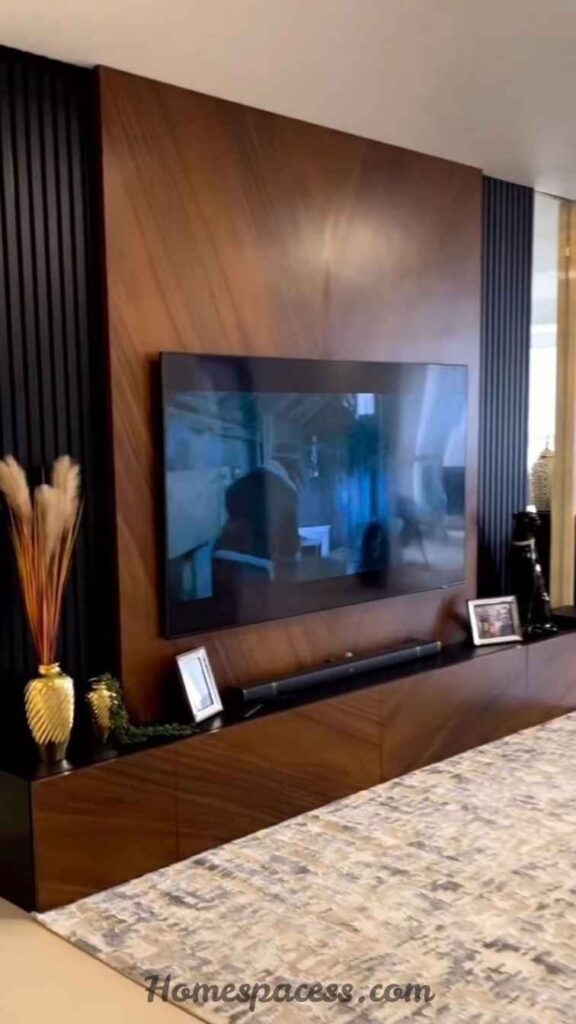
Not every media wall requires a significant budget or professional trades. A thoughtful DIY media wall using paint, a basic wall mount, and some carefully arranged shelving from affordable flat-pack ranges (IKEA’s KALLAX and Billy series are perennial favourites for this) can produce a genuinely impressive result for under £300–400. The keys are precision making sure everything is level and aligned and restraint in the number of items displayed.
A popular approach is the “IKEA hack” media wall: BILLY bookcases floor to ceiling on either side of the TV, with a plywood panel painted to match the wall colour connecting them at the top. Add simple LED strip lighting underneath the shelves and inside the upper bookcases, paint everything the same colour as the wall for a built-in effect, and the result looks far more expensive than its components suggest. Online tutorials for this specific project have generated millions of views testament to how achievable and satisfying the transformation can be.
Mid-Century Modern Media Wall
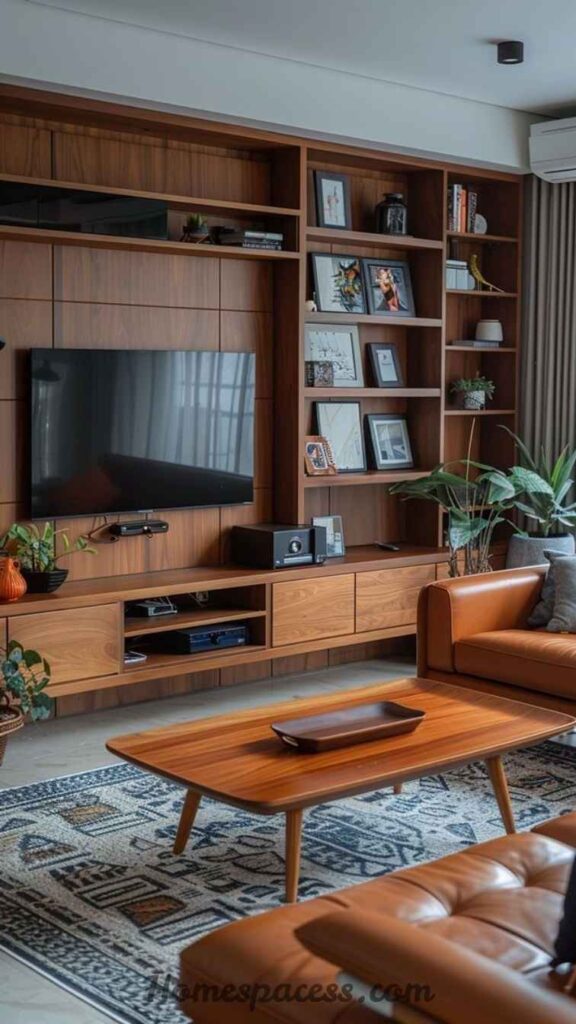
Mid-century modern design characterised by clean horizontal lines, tapered legs, warm wood tones, and a sense of joyful optimism produces some of the most enduringly beautiful media walls. A low-slung teak or walnut sideboard with splayed legs, paired with a TV mounted at precisely the right height above and a few restrained decorative objects, captures the era’s spirit perfectly. This look is experiencing a strong resurgence in 2026, driven by renewed interest in vintage furniture and natural materials.
The specific proportion of a mid-century media wall is important. The sideboard or media unit should be wide often the full width of the viewing wall and low, with the TV mounted so its center sits at approximately seated eye level (around 100–110 cm from the floor). Floating media units, which attach to the wall and appear to float above the floor, are particularly well-suited to this style and make cleaning underneath easy. Pair with a statement floor lamp, a low-maintenance tropical plant, and geometric artwork for an effortlessly period-appropriate result.
Neon or Statement Lighting Media Wall
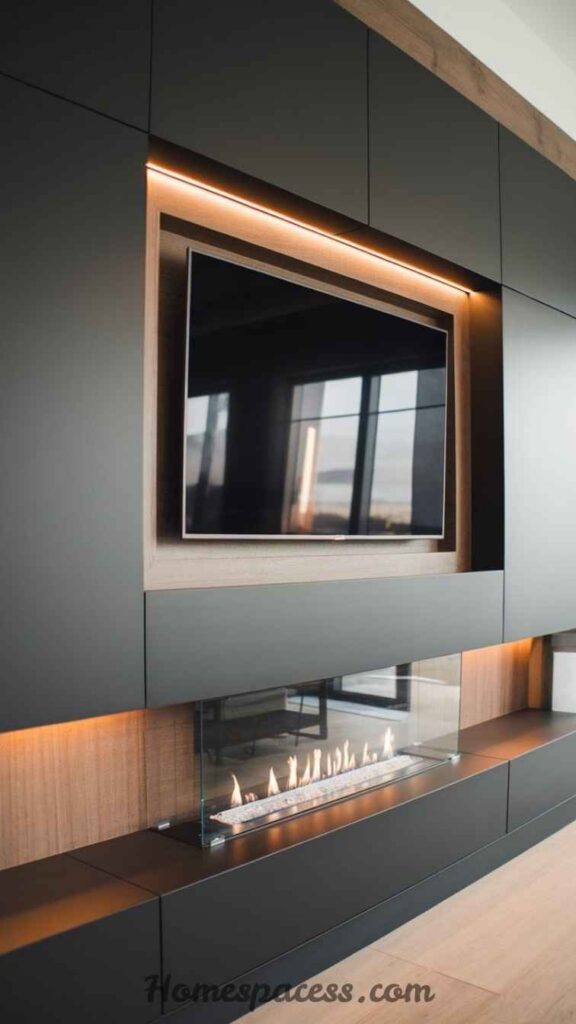
Neon signs and statement lighting elements have moved beyond student bedrooms and bars into genuinely sophisticated interior applications. A custom neon sign mounted beside or above the TV displaying a word, phrase, or graphic meaningful to the household creates a media wall with genuine personality. Coupled with smart LED backlighting that shifts colour with the content playing on screen, this approach creates an immersive entertainment environment that feels distinctly 2026.
LED neon flex (a safer, more energy-efficient alternative to traditional glass neon) is now available from hundreds of online suppliers and can be custom-shaped into virtually any design. For a more restrained take on statement lighting, consider Paulmann’s or Artemide’s architectural LED profiles recessed into the media unit itself casting directional light that illuminates shelves from within and creates a subtle glow visible from across the room. The combination of ambient, task, and accent lighting on a media wall is what separates truly designed spaces from simply furnished ones.
Projector-Ready Hidden Media Wall
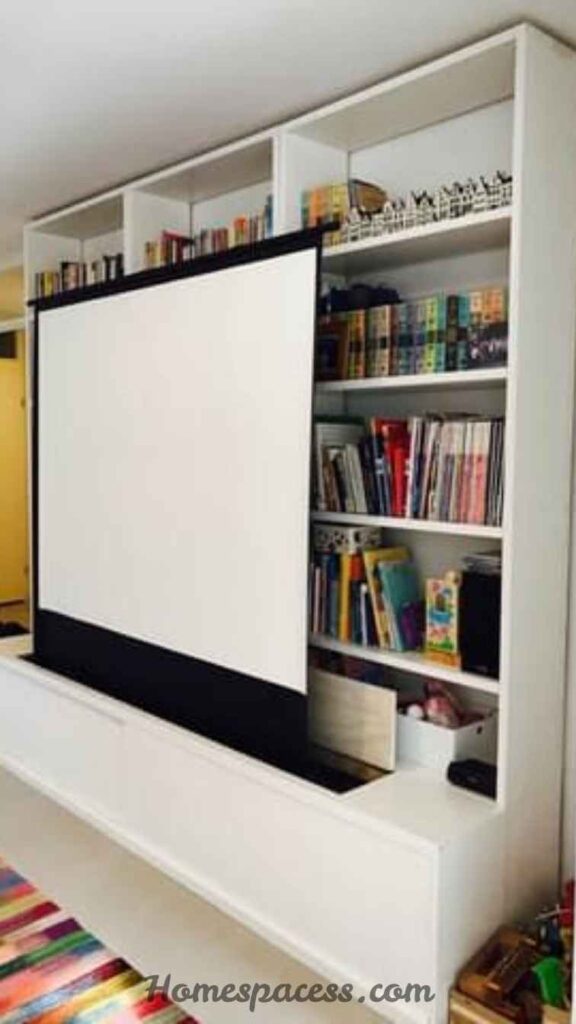
Rather than mounting a TV, some homeowners are choosing to design their media wall around a projector and retractable screen a setup that effectively eliminates the dark rectangle problem entirely. When not in use, the projector screen retracts into a ceiling-mounted cassette and the wall returns to being a clean, uninterrupted surface. The projector itself can be ceiling-mounted or recessed into a shelf within the media unit. The result is a living room that feels spacious and gallery-like during the day and transforms into a home cinema at night.
This approach has become significantly more accessible in 2025–2026 with the arrival of ultra-short throw (UST) projectors from LG, Samsung, and Epson that sit just centi meters from the wall and project 100-inch+ images without the traditional throw distance requirements. These devices can sit on a shelf within the media unit itself, pointing upward at a rolled-down ambient light-rejecting (ALR) screen. The media wall in this configuration becomes more of a framed architectural element housing speakers, streaming devices, and ambient lighting with the screen as the center piece.
Conclusion:
A great media wall is the result of three things working together: thoughtful design that suits the room’s architecture and your personal aesthetic, practical planning that accounts for cables, ventilation, viewing distance, and lighting, and material choices that balance beauty with longevity.
The 26 ideas in this guide cover the full spectrum from the simplest painted accent wall to fully integrated smart home command centers. The right choice is always the one that genuinely fits your space, your lifestyle, and your budget, rather than the one that photographs best or follows the most prominent trend. Start with the room, work outward to the wall, and let the technology follow not the other way around.
As display technology evolves toward transparent OLEDs, ambient AI-driven surfaces, and projector-based setups, the media walls designed with adaptability at their core will be the ones that age gracefully and serve their owners well for decades.
2026 Media Wall Trend Analysis & Future Outlook
The media wall design landscape is evolving faster in 2026 than at any point in the past decade, driven by simultaneous changes in display technology, materials availability, and how people use their living spaces. The single most significant shift is the move away from TV-centric design toward what designers are calling the “ambient living wall” a surface that serves multiple functions simultaneously and adapts to the activity happening in the room at any given moment. Samsung’s Ambient Mode (where the TV displays art, family photos, or a weather display when not in active use) was an early indicator of this direction; we’re now seeing the concept expand across entire wall systems.
Material trends are equally telling. The dominance of grey gloss MDF the defining finish of media walls in the 2010s has given way to a much richer palette of natural and textured finishes. Lime wash plaster, fluted oak, handmade ceramic tiles, and tactile hessian-backed wallpapers are all emerging as media wall backgrounds that feel irreplaceable by any flat digital surface. Interior psychologists argue this is a deliberate counterreaction to screen saturation people want their media wall to feel grounded in physical, imperfect materials precisely because the TV itself represents the endlessly smooth and perfect digital world. Expect this push toward texture, handcraft, and natural imperfection to intensify through 2027 and beyond.
Looking further ahead, the growing adoption of transparent OLED displays which appear as glass panels when switched off will fundamentally change how media walls are designed. Instead of accounting for a dark rectangle in the composition, designers will be able to treat the screen as a transparent architectural element. Furniture, artwork, and decorative objects placed “behind” the screen will remain visible when it is off, dissolving the traditional tension between TV presence and room aesthetics. LG’s transparent OLED screens are already commercially available in select markets; mainstream residential adoption is predicted within the next three to five years.
Expert Tips & Real-World Practical Insights
The most overlooked element in media wall planning is cable management and it is consistently the thing that separates a professional-looking installation from a DIY-looking one. Every cable visible on a finished media wall is a design failure. Before any shelving, panels, or TV brackets are installed, a qualified electrician should install an in-wall cable management kit: a hollow conduit through which all HDMI, power, and AV cables are routed between the TV and the media unit below. This typically costs between £80 and £150 in labour and materials and eliminates cable visibility entirely. It’s the single highest-return-on-investment addition you can make during the planning stage.
Lighting is the second most impactful and under utilised element of a media wall. Most homeowners stop at LED strip lighting behind the TV panel, which is a good start but only the beginning. Consider layering three distinct types: ambient lighting (a soft wash of light across the whole wall surface from recessed spotlights above), accent lighting (integrated LED profiles within shelves or niches that spotlight displayed objects), and bias lighting (LEDs directly behind the TV screen that reduce contrast between the bright screen and dark surrounding wall, dramatically reducing eye strain during long viewing sessions). Together, these three layers make a media wall look finished at any time of day or evening.
An expert insight that almost no general guide mentions: design your media wall for the room’s primary viewing distance, not for how it looks from the doorway. Interior photography typically captures media walls from the doorway or an oblique angle but you’ll be watching TV from the sofa. The optimal TV mounting height has the screen’s centre at your eye level when seated, which is usually 95–105 cm from the floor (not the 140 cm+ that many people instinctively mount their screens at). A TV that is too high causes neck strain over long viewing periods and is one of the most common media wall mistakes in practice. Before drilling a single hole, sit in your actual sofa position and measure your eye level with a tape measure.
- Always hire an electrician to run in-wall power before the media unit is installed retrofitting afterwards is costly and disruptive.
- Use a stud finder before mounting anything. Media walls fail structurally when anchored into plasterboard alone.
- Order media unit samples (paint chips, veneer swatches, tile samples) before committing finishes look radically different in photographs versus real space and light conditions.
- Leave 5–8 cm of ventilation space behind streaming devices and AV receivers within enclosed cabinets heat buildup is the leading cause of device failure in built-in media units.
- Choose a TV bracket with 15° tilt capability, even if you don’t think you need it now viewing angle requirements change as furniture arrangements evolve.
Sustainability, Long-Term Value & Strategic Design Thinking
A media wall is one of the most significant fixed investments you make in a home’s interior, and its environmental impact deserves serious consideration. The furniture industry is a major contributor to global deforestation and formaldehyde emissions (from standard MDF), and the electronics industry generates an enormous volume of e-waste. Designing a media wall with longevity, adaptability, and sustainable materials at its core isn’t just an ethical choice it’s a financially smart one. A well-built, sustainably sourced timber media unit can last 20–30 years; a trend-chasing fast-furniture equivalent might need replacing in five.
Material choices matter enormously. Look for FSC (Forest Stewardship Council) certified timber and plywood, low-VOC (volatile organic compound) paint finishes, and formaldehyde-free MDF alternatives such as Medite Ecologique or CARB2-compliant boards. For textiles used in integrated acoustic panels or cabinet interiors, recycled fabric options are now widely available. When specifying tiles, consider reclaimed stone or porcelain the manufacturing of new large-format porcelain slabs is energy-intensive, and the reclaimed market offers genuinely beautiful alternatives with a significantly lower footprint.
The most sustainable media wall strategy is also the most economically logical one: design for adaptability. A media wall that can be reconfigured as TV sizes change, as your family’s needs evolve, or as display technology transitions from wall-mounted TVs to transparent OLEDs and projector systems will avoid the skip entirely. Design for adjustable shelf heights, universal mounting brackets, and a wiring infrastructure that can accommodate future technologies. A media wall with embedded adaptability is not just an interior design decision it’s a hedge against technological obsolescence.
Future Innovations in Media Wall Design
The next five years will bring media wall technology changes that are difficult to overstate. Transparent OLED panels, already previewed by LG and Samsung at CES 2025 and 2026, will become residential products within this decade. These screens which are genuinely transparent when off, like glass will eliminate the fundamental tension that has defined media wall design since the first flat-screen TV: how to accommodate a large, dark, inert rectangle in a living space when it is not in use. Future media walls designed around transparent displays will be conceived as glass-and-light installations rather than furniture-and-screen compositions.
AI-integrated media walls are another horizon worth designing for. Smart home systems are already beginning to offer dynamic wall lighting that responds to the content playing on screen a sunset scene triggers warm amber tones across the room, a thriller shifts the bias lighting to cool blue-green. The next evolution will involve the wall surface itself responding: electro-chromic glass panels that change opacity, surfaces with embedded micro-LEDs that extend the screen’s image outward into the surrounding wall, and AI-curated art displays that shift based on the time of day, your mood data, or the music you’re listening to. These are not science fiction proof-of-concept installations exist in commercial spaces today.
Acoustics is a genuinely overlooked frontier in residential media wall design. Professional home cinema designers have long understood that room acoustics are as important as display quality but this expertise rarely filters into mainstream media wall planning. Fabric-wrapped acoustic panels integrated invisibly into a media wall design, combined with in-wall speaker systems that deliver spatial audio without visible speaker boxes, represent the next leap in living-room entertainment quality. Dolby Atmos and spatial audio formats now standard on Apple TV 4K and Amazon Fire TV Stick require multi-directional speaker placement that a well-designed media wall can accommodate structurally. Within three to five years, expect “acoustically designed media walls” to become a distinct and mainstream design category.
Common Media Wall Mistakes & Overlooked Factors
The most prevalent media wall mistake documented by interior designers and AV specialists alike is mounting the TV too high. It seems like common sense to raise the screen above furniture height for a clear view, but the result is a chronic neck-tilt that causes physical discomfort over time and a visual disconnect between the screen and the seating area that makes the room feel off-balance. The correct mounting height (screen centre at seated eye level, approximately 95–105 cm from the floor for most sofa heights) often feels uncomfortably low when standing in front of the wall, but is immediately correct from the viewing position. Trust the measurement, not the visual impression when standing.
A second overlooked factor is ambient light management. Many media walls are designed without any consideration of how daylight from windows on adjacent or opposite walls affects screen visibility and glare. A media wall that looks stunning in the evening becomes a frustrating mirror of reflections during afternoon use if the TV’s anti-glare properties are insufficient or the room’s soft furnishings don’t adequately diffuse incoming light. Matte-screen TVs (offered by most major brands as an option), layered curtain systems, and the positioning of the media wall on the wall that receives the least direct sunlight are all factors to address during planning rather than after installation.
- Mounting the TV too high always measure from seated eye level, not standing height.
- Ignoring cable management until after the unit is built retrofit cable management is always inferior and more costly.
- Overcrowding the shelves a cluttered media wall loses its impact within weeks of completion.
- Choosing a TV that is too large for the room the recommended viewing distance is 1.5–2.5x the screen’s diagonal measurement.
- Forgetting ventilation for AV equipment enclosed cabinets without airflow overheat devices and reduce their lifespan significantly.
- Skipping a structural check heavy built-in units must be anchored into wall studs or masonry, not plasterboard alone.
- Designing around today’s TV size only future screens will likely be larger; build in extra width and height to the mounting area.
Team Home Spacess shares simple, practical design ideas that work for real families. The team focuses on cozy décor, soft colors, and natural textures that make a space feel truly lived-in. From everyday decorating tips to creative home projects, Team Home Spacess is dedicated to helping readers create warm, comfortable, and inviting spaces with a fresh and personal touch.